








Executive Overview
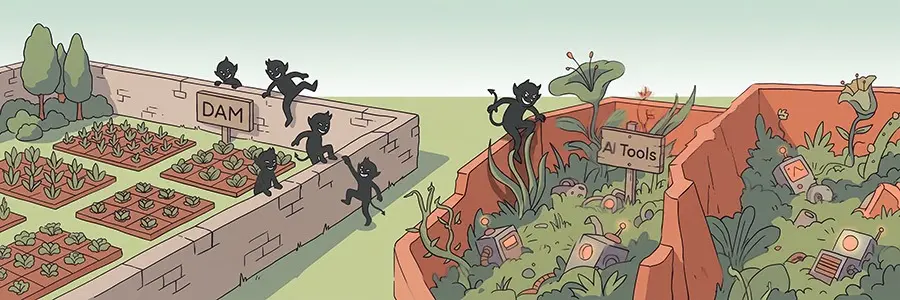
As the volume of enterprise data and digital assets continues to grow exponentially, organizations face unprecedented challenges in managing, securing, and deriving genuine value from their digital footprints. The modern Digital Asset Management (DAM) ecosystem is no longer merely a repository for creative files; it is a critical nexus intersecting knowledge management, semantic web architecture, cryptographic provenance, stringent European regulatory frameworks, and enterprise-grade asset hygiene.
Recent industry developments highlight a pivotal shift in how professionals approach these domains. From the educational offerings of the Practical DAM podcast series to Heather Hedden’s insights on taxonomies and knowledge management, the industry is increasingly focusing on structural rigor. Concurrently, technological and regulatory shifts—such as Apple’s novel approach to photographic authenticity via its Reference Image system, the strict enforcement mandates of the EU’s Digital Operational Resilience Act (DORA) for financial-sector DAM vendors, and Peter Scoins’ practical methodologies for eradicating asset duplication—demonstrate that digital custodianship has matured into a high-stakes corporate discipline.
This report provides an in-depth synthesis of these developments, exploring how semantic structures, cryptographic verification, rigorous compliance, and advanced deduplication techniques are reshaping the future of information and digital asset management.
Detailed Chronology & Industry Developments
The past few months have yielded a wave of thought leadership, technical whitepapers, and operational frameworks that redefine best practices across the information architecture and DAM landscapes. Tracing these milestones reveals a cohesive industry trajectory toward higher accountability, automated governance, and semantic integration.
The Practical DAM Series: Bridging Theory and Real-World Usability
In the audio and video space, the Practical DAM podcast has rolled out a trio of episodes designed to tackle foundational pain points in information governance.
- Episode 7 featured Meg Morrissey breaking down the elusive concept of "real-world usability" in DAM systems. Morrissey emphasized that software architecture must align with the daily operational realities of creative and marketing teams rather than theoretical idealisms.
- Episode 8 shifted the focus to search architecture and metadata strategy, featuring search consultant Clemency Wright. Wright unpacked the direct correlation between rigorous metadata design and findability, arguing that metadata is not a post-production afterthought but a core strategic driver of organizational efficiency.
- Episode 9 brought together hosts Lisa and Elizabeth alongside Fred Rascoe to explore how DAM and library professionals can move beyond vanity metrics. The panel discussed methods for developing meaningful metrics that demonstrate true organizational value, factoring in how custodianship, licensing models, discovery frameworks, long-term preservation, and controlled terminology influence both quantitative data collection and executive decision-making.
Taxonomies, Knowledge Management, and the Generative AI Horizon
Expanding on structural organization, prominent taxonomist and author Heather Hedden published an exhaustive examination of the expanding role of taxonomies and ontologies within modern knowledge management (KM) frameworks. Hedden argued that controlled vocabularies are indispensable tools that allow modern organizations to identify, structure, retrieve, and disseminate institutional knowledge across its entire lifecycle.
Crucially, Hedden highlighted the capacity of robust taxonomies to capture implicit and tacit organizational knowledge that often escapes structured databases. By explicitly connecting people, workflows, software technologies, unstructured information assets, and corporate culture, taxonomies serve as the backbone for semantic interoperability. Most notably, Hedden linked these traditional classification structures directly to cutting-edge technologies, including generative artificial intelligence, knowledge graphs, Retrieval-Augmented Generation (RAG), and Graph RAG architectures, proving that clean taxonomy is a prerequisite for reliable AI implementations.
Redefining Photographic Authenticity: Apple’s Reference Image System
In the realm of media authenticity, digital media expert Paul Melcher published a critical analysis of Apple’s proprietary Reference Image system. Designed to combat deepfakes and verify photographic provenance, Apple’s architecture departs from traditional metadata-embedding models. Instead of altering the primary file, the system generates a separately signed JPEG derived directly from raw sensor data processed through Apple’s Private Cloud Compute infrastructure.
By combining cryptographic signatures with automated AI-based authenticity checks, compatible downstream devices can verify image integrity locally. Melcher contrasted this model with the Coalition for Content Provenance and Authenticity (C2PA) standard, noting that while C2PA logs an image’s subsequent edit history, Apple’s Reference Image strictly verifies whether an image matches its original point of capture. However, Melcher also raised significant archival concerns, pointing out that the underlying secure digital negative—the closest digital equivalent to immutable, untouched evidence—is permanently purged from the cloud infrastructure after a strict thirty-day window.
DORA Compliance and the Regulatory Landscape for DAM Vendors
Regulatory compliance has become an existential concern for software vendors operating within European markets. French DAM provider Wedia released a comprehensive briefing detailing the implications of the European Union’s Digital Operational Resilience Act (DORA) for enterprise software vendors serving regulated financial institutions.
Wedia’s analysis moves past surface-level compliance, emphasizing that DORA places heavy demands on third-party digital asset management providers regarding rigorous vendor security, operational resilience, explicit audit rights, mandatory incident cooperation protocols, structured exit strategies, and continuous third-party oversight. The guidance underscores that true DORA readiness cannot be achieved through generic self-certifications; it requires verifiable documentation, hardened security posture, and binding contractual SLAs. Wedia highlighted its own institutional posture—comprising ISO 27001, TISAX, and GDPR credentials aligned with emerging DORA mandates—as a model for software vendors aiming to service risk-averse financial sectors.
Taming Digital Clutter: The War on Duplication
Addressing internal operational inefficiencies, UK-based DAM consultant Peter Scoins tackled the pervasive problem of asset duplication in a widely discussed case study. Scoins illustrated how inconsistent file naming conventions, fragmented departmental workflows, and unmanaged multi-format variants routinely drive up cloud storage costs, degrade search efficiency, introduce brand compliance risks, and contribute to unnecessary carbon footprints through bloated data storage.
Advancing past basic filename checks and checksum comparisons, Scoins advocated for advanced mitigation strategies such as perceptual hashing. He championed a "single master asset" operational philosophy, where dynamic system renditions are automatically generated on-the-fly as needed by end-users. Alongside his technical commentary, Scoins introduced an interactive educational tool dubbed the "Duplicate Hunt" game, designed to train administrators in identifying hidden architectural redundancies.
Supporting Context & Industry Metrics
To fully appreciate the weight of these developments, one must examine the broader quantitative and qualitative trends governing the digital asset management landscape:
- The Cost of Duplication: Industry estimates suggest that up to 25% of enterprise storage is consumed by redundant, obsolete, or trivial (ROT) data. In large-scale DAM environments containing millions of high-resolution media assets, storage bloat translates directly to hundreds of thousands of dollars in unnecessary cloud infrastructure expenses annually.
- The AI Taxonomy Bottleneck: According to recent enterprise architecture surveys, over 60% of generative AI and RAG implementation failures stem from poor data governance, unmanaged taxonomies, and missing metadata context rather than algorithmic deficiencies.
- Regulatory Pressures in Europe: With the full implementation of DORA and the EU AI Act, software vendors failing to meet stringent operational resilience and transparency standards risk losing access to the lucrative European banking, insurance, and investment sectors, which collectively account for a massive share of enterprise software procurement.
- The Authenticity Crisis: As generative AI tools make synthetic media indistinguishable from reality, cryptographic validation protocols (such as Apple’s Reference Image and C2PA standards) are transitioning from experimental features to mission-critical requirements for journalism, legal forensics, and corporate communications.
Official Insights & Expert Perspectives
The synthesis of these recent developments underscores a unified philosophy across diverse sectors of the information management industry:
"Controlled vocabularies are no longer just internal filing aids; they are the semantic bridges that connect human intent to machine reasoning, forming the absolute foundation for generative AI, knowledge graphs, and scalable enterprise search."
— Heather Hedden, Author and Taxonomist"When managing enterprise digital assets, treating every variant as a separate master file is a recipe for operational chaos. True digital hygiene relies on a single source of truth paired with dynamic, on-demand rendering."
— Peter Scoins, DAM Consultant
On the regulatory front, compliance experts emphasize that security and resilience must be baked into the software lifecycle rather than bolted on as an afterthought. As financial regulators enforce frameworks like DORA, enterprise buyers are increasingly evaluating DAM vendors not solely on creative UI features, but on their auditability, encryption standards, and incident response readiness.
Future Outlook
Looking ahead, the convergence of semantic technology, cryptographic media verification, and rigorous regulatory compliance will fundamentally alter what enterprises expect from their Digital Asset Management systems.
- Semantic AI Integration: As outlined by taxonomy experts, future DAM solutions will increasingly rely on automated, taxonomy-driven knowledge graphs to power context-aware search and generative AI tools. Systems that lack clean metadata schemas and structured vocabularies will struggle to integrate with modern enterprise intelligence stacks.
- Mandatory Asset Provenance: Driven by the proliferation of synthetic media, cryptographic verification systems modeled after Apple’s Reference Image and open standards like C2PA will likely become standard features in enterprise media workflows, ensuring absolute traceability from capture to publication.
- Automated Governance and Hygiene: To combat the environmental and financial toll of digital clutter, next-generation DAM platforms will incorporate advanced perceptual hashing and automated deduplication routines directly into their core ingestion pipelines, shifting the burden of asset hygiene from human administrators to intelligent software agents.
- Strict Compliance as a Competitive Differentiator: In heavily regulated industries, compliance frameworks such as DORA and ISO certifications will transition from baseline checklist items to primary competitive advantages, separating enterprise-grade software vendors from legacy providers.
Ultimately, the maturation of digital asset management from a tactical file-storage utility into an enterprise-wide strategic asset underscores a simple truth: in an age of infinite digital noise, structure, security, and governance are the ultimate competitive advantages.