







By Christopher Tozzi
Technology Analyst & Author
Executive Overview
For decades, the physical and electrical architecture of the enterprise data center was anchored by a comfortable, predictable baseline. A "typical" server rack drew roughly 10 kilowatts (kW) of sustained power—a standard that easily accommodated legacy virtualization platforms, enterprise databases, and standard web applications. Higher densities were occasionally encountered in specialized high-performance computing (HPC) clusters or niche render farms, but they were aberrations rather than the industry rule.
Today, that architectural baseline has fundamentally fractured. Driven by the relentless explosion of generative artificial intelligence (AI), machine learning (ML) training pipelines, and large language model (LLM) deployments, rack power densities are experiencing an unprecedented upward trajectory. Practical rack capacities that once seemed futuristic are rapidly becoming mainstream, with industry averages doubling in mere years—climbing from roughly 12 kW per rack in 2024 to an anticipated 26 kW in 2026.
More aggressively, forward-looking hyperscalers and specialized AI clouds are designing next-generation facilities capable of supporting an astonishing 1 megawatt (MW) per single rack. This paradigm shift is not merely a hardware upgrade; it is an existential re-engineering of the data center ecosystem. Accommodating these astronomical power draws requires deep transformations across electrical distribution, thermal management, structural engineering, and grid-level supply agreements.
As the industry hurtles toward this megawatt frontier, data center operators face a defining strategic question: How far can this density curve realistically climb, and what fundamental infrastructure changes must be implemented today to survive tomorrow’s compute demands?
Detailed Chronology: The Evolution of Rack Density
To understand the sudden, acute pressures facing modern data center facilities, it is necessary to examine how the industry arrived at this critical juncture. The acceleration of rack power density has not been a gradual, linear drift; rather, it represents a compressed timeline of rapid hardware intensification.
The Era of Predictability: Pre-2022
For most of the 2010s and early 2020s, data center capacity planning was relatively straightforward. Compute hardware was bound by the physical limits of traditional CPU architectures (such as standard x86 multi-core processors) and conservative power-scaling laws. While virtualization densities climbed via containers and hypervisors, physical server power consumption plateaued around 500W to 1,500W per chassis. Distributed across standard 42U or 48U server racks, this translated to a sustained draw of 8 kW to 12 kW. Cooling was dominated by raised-floor perimeter air handlers, and electrical infrastructure was safely provisioned using standard 208V or 415V distribution units.
The Acceleration Phase: 2023–2024
The mass commercialization of generative AI ruptured this equilibrium. The introduction of dense GPU accelerators—such as NVIDIA’s Hopper architecture and subsequent custom silicon initiatives from hyperscalers and hardware vendors—demanded unprecedented levels of electrical current within confined physical footprints. A single high-end AI server chassis could easily consume several kilowatts, and packing multiple nodes into a single rack pushed baseline densities past 12 kW almost overnight. Operators accustomed to legacy thermal thresholds suddenly found their traditional air-cooling methodologies inadequate for localized hot spots.
The Tipping Point: 2025–2026
By 2026, the industry average for rack power density crossed the 26 kW threshold, more than doubling the standard benchmarks of just two years prior. Concurrently, cutting-edge AI training clusters began breaking through the 100 kW, 300 kW, and even 500 kW barriers. The conversation shifted from managing localized high-density zones to architecting entire facilities capable of sustaining extreme multi-hundred-kilowatt—and eventually megawatt-scale—rack footprints. Hardware collaborations, such as the integration of custom AI accelerators from vendors like NVIDIA and MediaTek, further cemented the reality that silicon design and data center architecture are now inextricably linked.
Supporting Context & Metrics: The Forces Driving Higher Loads
The migration toward extreme rack power densities is not a voluntary design choice born of engineering hubris; it is an absolute operational necessity driven by the convergence of compute demand, physical constraints, and thermal realities.
[Legacy Era (Pre-2022)] ──> ~10 kW/rack  (Air cooled, standard CPUs)
[Transition Phase (2024)] ──> ~12 kW/rack  (Early GPU integration)
[Current State (2026)]    ──> ~26 kW/rack  (Mainstream AI workloads)
[The Frontier (Future)]   ──> Up to 1 MW  (Liquid-cooled hyper-clusters)
1. The AI and LLM Compute Explosion
Training and running inference on frontier AI models requires massive parallelism. Massive parallelism demands thousands of high-performance GPUs working in concert, communicating over ultra-low-latency fabrics. Because latency between accelerators is critical, these GPUs cannot be distributed arbitrarily across a sprawling facility floor; they must be densely packed into adjacent chassis within the same rack—or tightly coupled across adjacent racks—to minimize signal transit times. This spatial hyper-concentration creates localized power sinks of staggering proportions.
2. Real Estate and Space Constraints
In major data center hubs—such as Northern Virginia, Silicon Valley, Frankfurt, and Dublin—land acquisition costs, permitting delays, and zoning restrictions have made physical expansion increasingly difficult. Operators cannot simply build outward indefinitely. To scale compute capacity within fixed real-estate footprints, the only viable vector is vertical and volumetric intensification: packing vastly more processing power into the exact same physical floor space.
3. Maturation of Advanced Thermal Technologies
For years, the practical ceiling of rack density was governed by the laws of thermodynamics and the limitations of air cooling. Air has a relatively low specific heat capacity; moving enough air through a standard rack to dissipate 50 kW or 100 kW of heat requires turbine-like fan speeds, excessive acoustic output, and prohibitive fan-power overheads. However, the commercial maturation of direct-to-chip liquid cooling and immersion cooling technologies has effectively removed the air barrier, giving operators the thermal headroom needed to support extreme electrical loads.
Facility Impacts: Power, Cooling, and Structural Engineering
Accommodating higher per-rack power draws is far more complex than simply plugging high-density servers into an existing row. A dramatic increase in rack density sends shockwaves across every foundational pillar of data center infrastructure.
Electrical Distribution and Grid Integration
Delivering 50 kW, 100 kW, or eventually 1 MW to a single rack renders traditional low-voltage busways and standard power distribution units (PDUs) obsolete. Facilities are forced to transition to medium-voltage (MV) distribution deep into the data hall, stepping down voltage closer to the rack to minimize $I^2R$ copper resistive losses. Furthermore, securing local utility interconnects capable of supporting multi-megawatt buildings—let alone individual multi-megawatt rows—has become one of the primary bottlenecks in modern data center deployment.
Thermal Management Paradigms
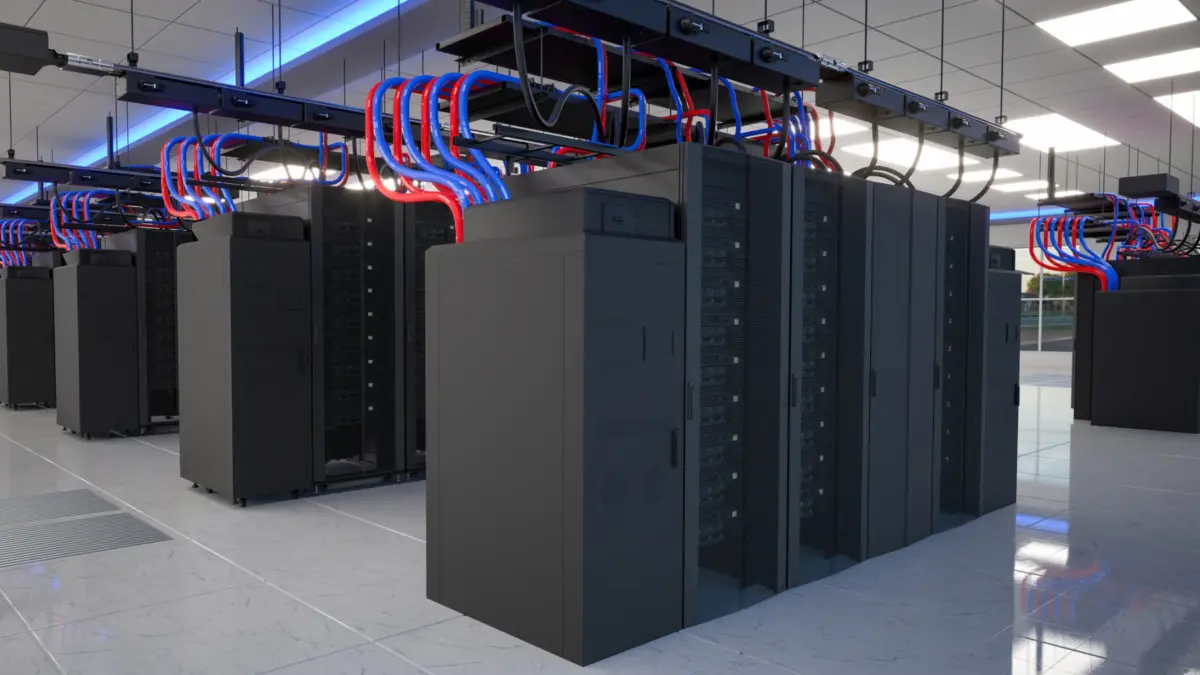
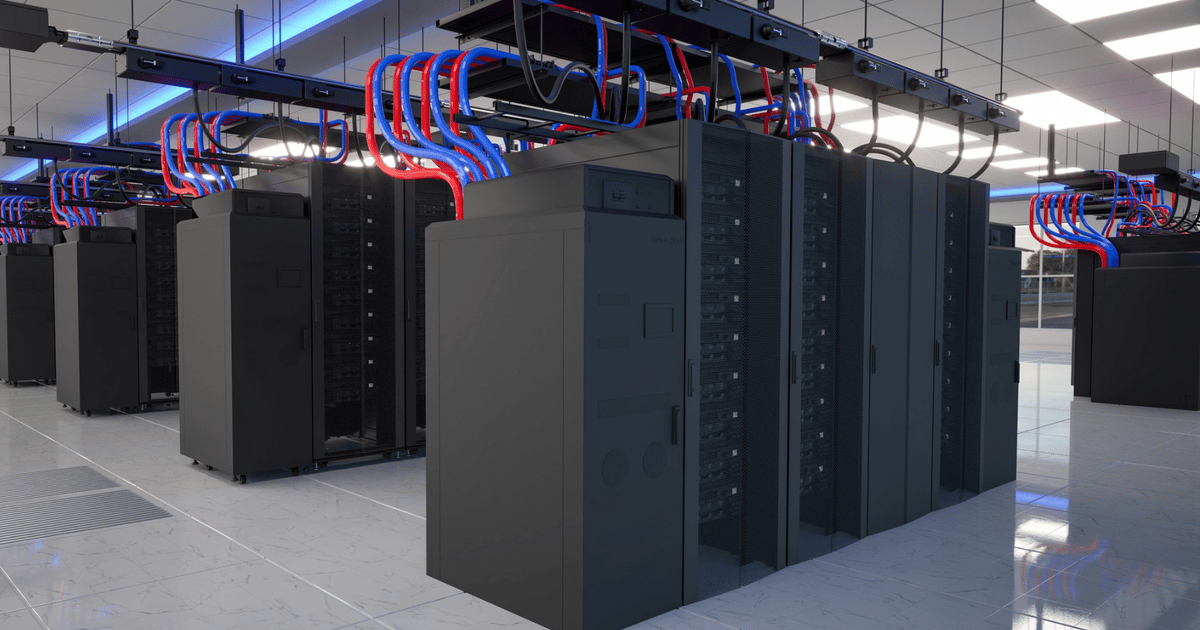
Air cooling is rapidly hitting a wall of diminishing returns for high-end deployments. While raised-floor containment and in-row air conditioners can manage the current 26 kW average, they struggle intensely as loads scale upward. Facilities targeting the upper echelons of density are universally adopting liquid-to-air heat exchangers, direct-to-chip cold plates with specialized dielectric coolants, and fully integrated rear-door heat exchangers. These systems require complex plumbing infrastructure routed directly to the server racks, introducing new variables regarding leak detection, fluid maintenance, and pump redundancy.
Structural Load-Bearing Realities
Physics dictates that denser hardware is heavier hardware. A fully populated rack bristling with heavy server chassis, dense GPU accelerators, copper and fiber cabling, and liquid cooling manifolds (including internal reservoirs and piping) exerts immense downward pressure on the raised floor or concrete slab. Modern data center engineering must account for hyper-concentrated static and dynamic loads, often requiring structural reinforcement, heavier floor tiles, or slab-on-grade construction to prevent structural degradation.
Official Industry Perspectives and Expert Analysis
As the industry navigates this transition, data center executives, hardware architects, and infrastructure strategists are re-evaluating long-held engineering tenets.
Industry consensus highlights that while 1 MW racks will likely remain specialized outliers reserved for extreme supercomputing and massive sovereign AI training clusters in the near term, the death of the 10 kW baseline is absolute. Operators who delay modernizing their facilities risk finding themselves locked out of the most lucrative segment of the cloud and enterprise market: high-performance AI deployment.
Hardware manufacturers are increasingly collaborating with facility designers to co-optimize silicon and infrastructure. Chipmakers recognize that designing a processor that draws exceptional power is useless if no commercial data center can reliably cool or power it. Consequently, standards set by bodies like the Open Compute Project (OCP) are shifting rapidly to accommodate standardized liquid-cooling interfaces and high-voltage direct current (HVDC) power delivery architectures.
Future Outlook: Will Rack Loads Keep Rising?
Looking toward the horizon, the trajectory of rack power density will be governed by a delicate interplay of macroeconomic demand, technological breakthroughs, and regulatory pressures.
- Demand-Side Pressures: As AI models grow larger and autonomous systems demand real-time edge inference, the appetite for high-density compute shows zero signs of abating. Enterprise adoption of generative AI is transitioning from proof-of-concept trials to core production workflows, ensuring sustained demand for high-density hardware.
- Supply-Side and Grid Constraints: The ultimate governor on rack density may not be engineering capability, but rather electrical grid capacity. In many Tier-1 markets, local utilities are running out of generation and transmission capacity. Operators may face regulatory caps on power consumption, forcing them to prioritize maximum compute efficiency over raw density scaling.
- Silicon Efficiency: Conversely, advances in semiconductor manufacturing—such as sub-nanometer nodes, photonic interconnects, and neuromorphic computing architectures—could eventually bend the power curve downward by delivering higher computational output per watt consumed.
What Operators Should Do Now
While racks drawing 1 MW will remain the exception rather than the rule for the foreseeable future, the era of the 10 kW standard is officially over. To remain competitive and future-proof their operations, data center facility managers and enterprise IT leaders must take decisive action today:
- Audit and Upgrade Power Distribution: Evaluate current electrical topologies to determine readiness for higher amperage and medium-voltage distribution. Implement robust sub-metering to track real-time power utilization at the rack level.
- Transition Thermal Strategies: Begin integrating liquid-cooling-ready pathways into new builds and major retrofits. Even if current deployments rely on advanced air cooling, designing facilities with facility water loops (CDUs) ensures seamless adaptability when high-density hardware arrives.
- Collaborate with Utilities Early: Given the massive power demands of modern AI clusters, engagement with power providers must happen years in advance of facility commissioning to secure adequate generation and substation capacity.
- Future-Proof Structural Integrity: When designing or remodeling data halls, engineer floor slabs and overhead support structures to handle hyper-concentrated static loads associated with heavy liquid-cooled hardware.
In short, higher rack loads are here, and they are steadily rising within AI-centric and high-performance computing environments. Facilities that proactively upgrade their power, cooling, and structural systems will be uniquely positioned to capture the next wave of transformative compute demand, while laggards risk being left behind in a low-density past.