







Executive Overview
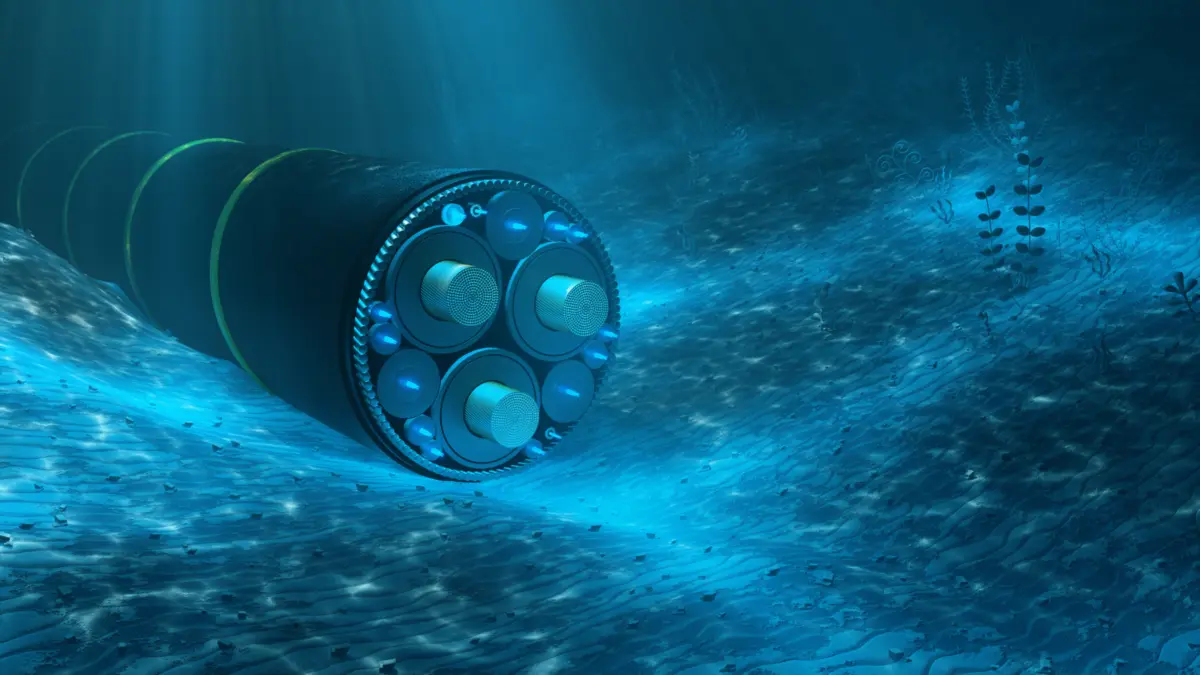
Global finance, international commerce, defense operations, and digital entertainment depend on a fragile, highly complex web of submarine and terrestrial fiber-optic networks. As humanity hurtles deeper into an era defined by artificial intelligence, cloud-native services, and big data, the physical underpinnings of the internet are facing an unprecedented stress test. Subsea fiber cables, which traverse vast oceanic expanses to seamlessly connect continents and island nations, are no longer just intercontinental transport pipes. Today, these critical links are extending directly into the hyperscale data centers that power modern AI and cloud infrastructures.
The sheer scale of this transformation is staggering. With global data center capacity hovering around 100 gigawatts (GW) and projected to double to 200 GW by 2030, the demand for intercontinental connectivity has entered a massive investment supercycle. Industry trackers report that more than 570 subsea cable systems currently span roughly 1.5 million kilometers of ocean floor. This includes a booming pipeline of over 40 new subsea cable systems scheduled to enter service in 2026 alone, with dozens more planned before the decade concludes.
This historic capacity expansion is forcing network operators, telecommunications providers, and hyperscale tech giants to rethink traditional network architectures. Cable landing stations (CLS), once static endpoints where submarine traffic was laboriously handed off to terrestrial networks, are undergoing a radical evolution. Driven by the need to support spatial division multiplexing (SDM) architectures—which scale fiber pairs from historical counts of four, six, or eight up to 24 or more—operators are adopting innovative hardware like 800G coherent pluggable optics, optical pass-through technologies, and expanded C+L wavelength division multiplexing (WDM) spectrums.
By treating subsea and terrestrial segments as a unified, end-to-end network rather than siloed domains, the telecommunications industry is racing to stay ahead of the AI-driven data explosion.
Detailed Chronology: The Evolution of Intercontinental Connectivity
To understand how modern subsea networks arrived at this architectural turning point, it is helpful to trace the chronological milestones that have shaped the telecommunications landscape over the past several decades.
The Era of Telecom Consortia (Pre-2010s)
For decades, subsea cable deployments were almost exclusively the domain of traditional telecommunications providers, wholesale carriers, and massive international consortia. These projects required multi-year planning cycles, massive capital investments, and complex regulatory approvals across multiple sovereign jurisdictions.
In this era, network architecture was rigid. Submarine line terminating equipment (SLTE) was housed strictly within the confines of a Cable Landing Station (CLS). The CLS served as a hard functional boundary: oceanic traffic terminated at the coast, where it was unpacked, managed, and handed off to domestic or regional terrestrial backhaul networks via back-to-back transponders. Capacity grew incrementally, typically limited to traditional WDM spectrums and modest fiber-pair counts.
The Hyperscale Disruption (2010s–2020)
As digital behemoths like Google, Meta, Microsoft, and Amazon Web Services (AWS) rose to prominence, the consumer demand for streaming media, social networking, and enterprise cloud storage exploded. Traditional telecom consortia could no longer keep pace with the hyper-growth requirements of content providers.
Hyperscalers began bypassing traditional carriers, directly funding private subsea cable systems or purchasing massive consortia shares to link their burgeoning global data center footprints directly across oceans. During this period, cable designs began shifting toward higher-fiber-count configurations, and the industry experienced its first major pressures at landing sites as traffic volumes began to dwarf historical baselines.
The AI Infrastructure Boom and the C+L Revolution (2021–Present)
The emergence of generative AI, large language models (LLMs), real-time machine learning inference, and distributed AI agents has fundamentally broken traditional traffic models. AI training workloads require massive, low-latency, high-bandwidth interconnects between geographically dispersed data centers.
Entering 2026, the industry is witnessing a record-breaking buildout. With more than 40 new subsea cable systems entering service this year alone, operators are abandoning outdated legacy practices. The deployment of 24-plus pair SDM cables has necessitated a total overhaul of the CLS. Technologies once reserved for short metro links—such as 800G coherent pluggable optics—are now being adapted for long-haul and subsea routes. Meanwhile, the integration of combined C and L bands ("C+L") across terrestrial backhauls has become the standard mechanism for doubling fiber capacity and taming skyrocketing lease costs.
Supporting Context & Metrics: The Numbers Driving the Supercycle
The convergence of AI workloads and cloud computing has triggered metrics that underscore the urgency of modernizing global fiber networks.
- 200 GW by 2030: Global data center capacity is undergoing an unprecedented expansion cycle, jumping from today’s roughly 100 GW footprint to an anticipated 200 GW by the end of the decade. Every new gigawatt of compute power requires exponentially scaled interconnectivity.
- 1.5 Million Kilometers of Subsea Infrastructure: Across the globe, an intricate web of more than 570 active subsea cables snakes across the ocean floor, spanning approximately 1.5 million kilometers.
- 40+ New Systems in 2026: Subsea activity is booming, with over 40 brand-new submarine cable systems slated to launch in 2026, driven primarily by hyperscale cloud and AI demands.
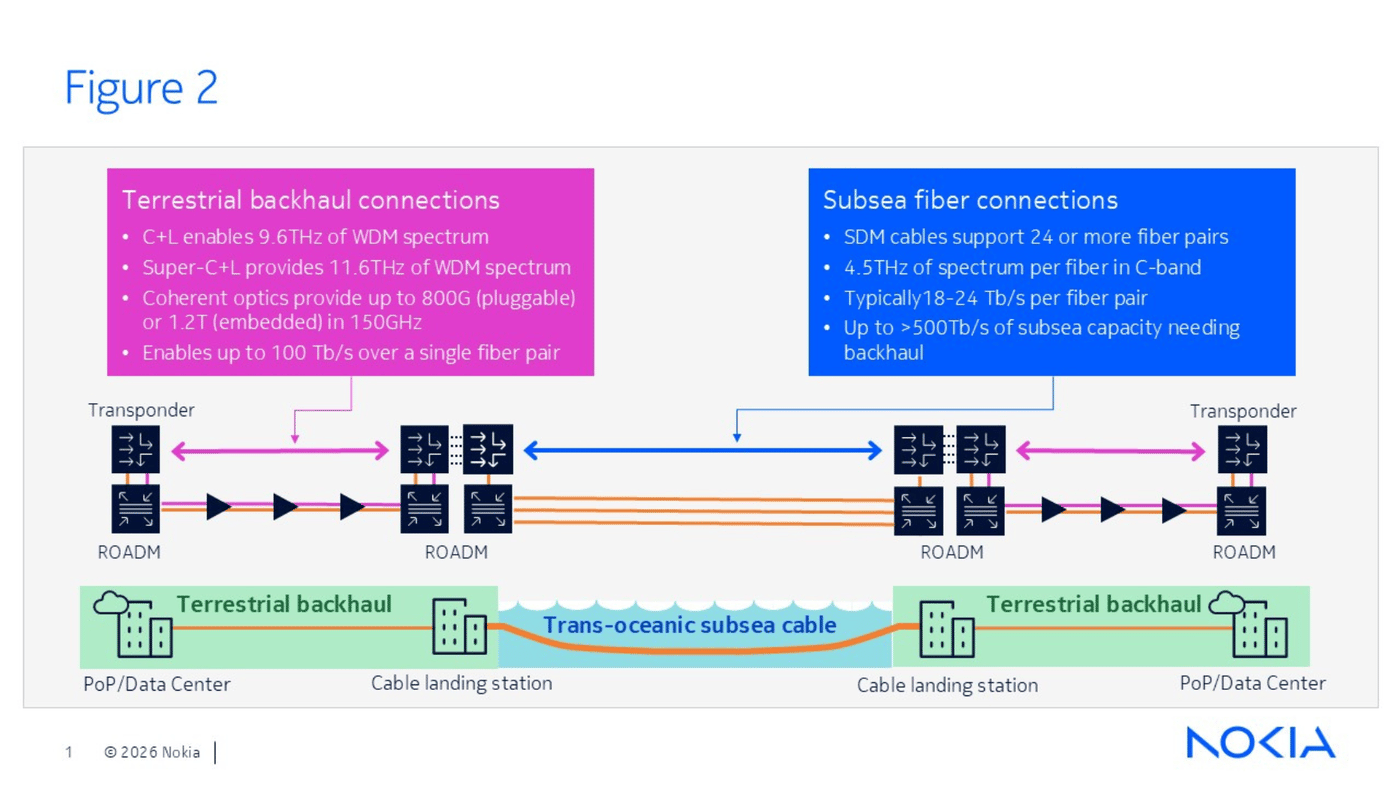
- Massive Capacity Multipliers (SDM): Cable systems that historically accommodated four, six, or eight fiber pairs are being replaced by spatial division multiplexing architectures featuring 24 or more pairs. A single modern CLS now handles at least four times the traffic capacity of its predecessors.
- Terrestrial vs. Subsea WDM Spectra: While typical subsea fibers remain constrained to roughly 4.5 THz of WDM spectrum, terrestrial fibers can comfortably support approximately 9.6 THz using C+L bands—and even more with extended Super-C and Super-L configurations. This spectral advantage allows operators to reduce required terrestrial backhaul fiber by 50% to 75%.
- Record-Breaking Field Trials: Recent high-profile field trials on subsea routes spanning from the United States to Puerto Rico demonstrated the viability of 800G coherent pluggables, successfully achieving 600G per wavelength over 2,841 kilometers and 400G per wavelength across an impressive 5,862 kilometers.
Official Perspectives: Industry Insights and Technical Breakthroughs
The architectural paradigm shift required to support modern AI data center fabrics is reflected in the strategies being deployed by top-tier networking and optical infrastructure providers.
Rethinking the Cable Landing Station
Historically, the CLS was treated as a mandatory tollbooth and traffic-conversion point. However, as hyperscale cloud and AI providers increasingly dictate cable deployments, the network topology is shifting. Today’s cables are engineered to connect specific data centers across oceans without treating the coastline as a terminus.
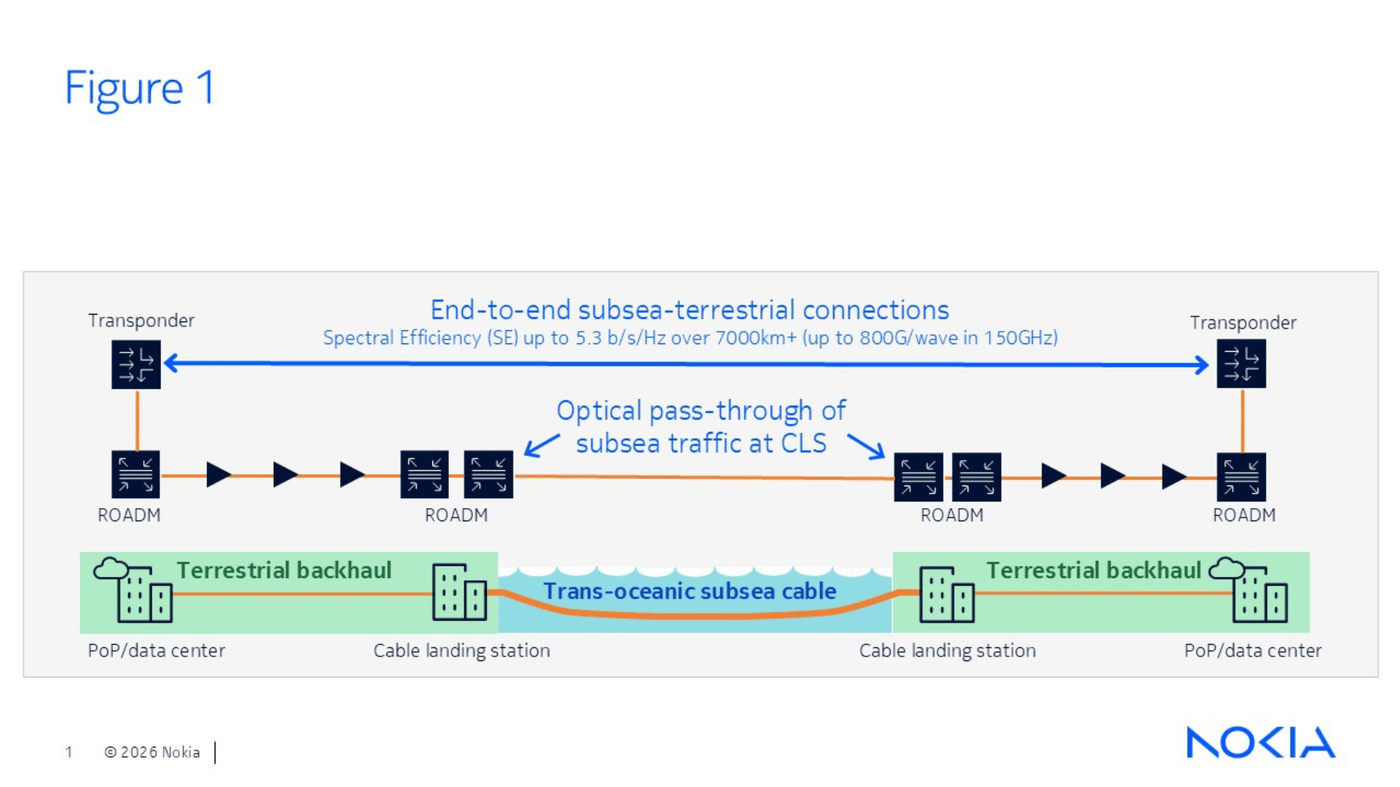
When a single operator controls both the subsea and terrestrial fiber segments, the installation of reconfigurable optical add/drop multiplexers (ROADMs) at the CLS enables optical pass-through. Rather than terminating at the coast, light wavelengths bypass the CLS entirely, continuing uninterrupted into the terrestrial backhaul and terminating deep within destination data centers.
Achieving seamless optical pass-through requires a sophisticated orchestration of hardware functions:
- Amplified Spontaneous Emission (ASE) Spectrum Power Insertion: Managing power levels across dynamic optical channels.
- Spectrum Sharing: Carving up bandwidth efficiently among multiple enterprise or hyperscale tenants.
- Optical Channel Monitoring: Providing real-time telemetry to ensure signal integrity.
- Constant-Power Operation: Stabilizing terrestrial inline amplifiers to prevent signal degradation over long distances.
By eliminating back-to-back transponders at the CLS, operators drastically reduce the space, cooling requirements, power consumption, and capital expenditures traditionally associated with landing site facilities.
The Rise of 800G Coherent Pluggables
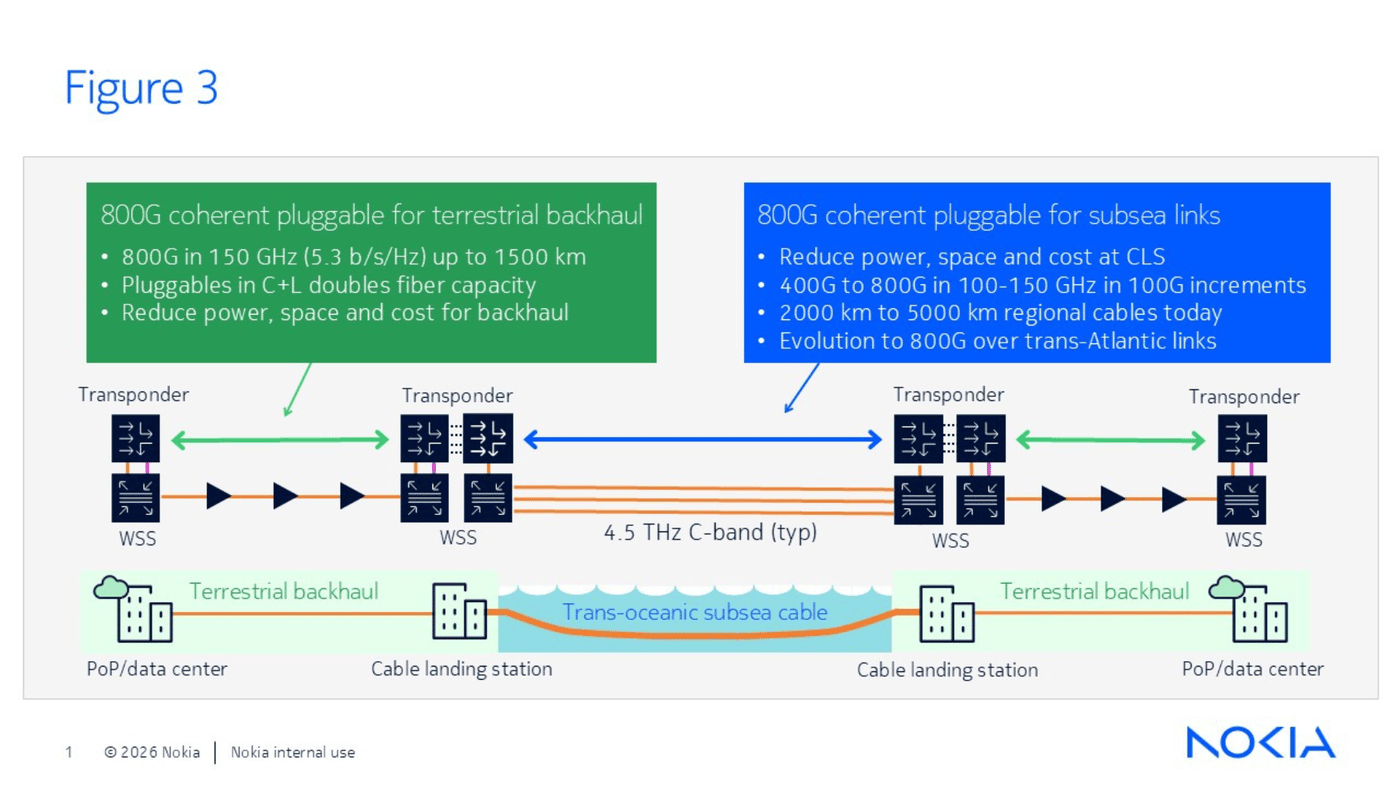
Another critical technological leap is the maturation of 800G coherent pluggable optics. Traditionally confined to metro data center interconnects, these compact optics are rapidly moving into regional and long-haul backhaul roles.
Deployed directly into routers (supporting IP-over-WDM architectures) or utilized in "thin" transponder configurations for service demarcation and lower-speed aggregation, coherent pluggables offer massive operational efficiencies. They drastically reduce physical footprints, slash power draw, and lower capital costs compared to traditional, performance-optimized coherent optics.
Furthermore, their ability to operate natively across combined C+L bands unlocks crucial fiber capacity. As field trials continue to push the distance and throughput boundaries of these pluggables—with upcoming iterations designed to achieve full transatlantic reach—the economic model of long-haul networking is being rewritten.
Future Outlook: The Road to 2030 and Beyond
As the industry looks toward the close of the decade, the integration of subsea and terrestrial networks will only deepen. The 200 GW data center milestone anticipated by 2030 will require network architectures that are not only faster and denser, but inherently more agile and automated.
Several key trends will define the future of global connectivity:
- End-to-End Network Convergence: The artificial dividing line between subsea and terrestrial domains will continue to dissolve. Network operators will increasingly manage global fiber assets through unified software-defined networking (SDN) control planes, dynamically provisioning wavelengths from a data center in Ashburn, Virginia, straight to a landing site in Europe or South America without manual intervention.
- Next-Generation Spectrum Extensions: As standard C+L band capacity reaches its limits under the weight of generative AI traffic, the adoption of Super-C and Super-L extended bands will accelerate. This will push terrestrial and subsea spectral efficiency to new heights, squeezing maximum throughput out of every strand of glass.
- Power and Sustainability Imperatives: With data center energy consumption under intense global scrutiny, connectivity hardware must become hyper-efficient. Technologies like 800G coherent pluggables and optical pass-through architectures will play a vital role in curbing power consumption at landing stations and backhaul nodes, helping operators meet corporate sustainability targets while scaling bandwidth.
- Enhanced Resilience and Security: Given the geopolitical and physical vulnerabilities associated with subsea cables—ranging from seismic events to accidental anchor strikes and intentional tampering—future network designs will prioritize multi-path redundancy and advanced AI-driven optical sensing. These sensing capabilities will allow operators to detect physical threats to cables in real time using the fiber itself as a seismic monitoring array.
Ultimately, AI performance starts long before data reaches the GPU. Without a resilient, high-capacity, and intelligently managed global fiber backbone, the AI revolution would grind to a halt. By embracing innovations in SDM architectures, coherent pluggables, and optical pass-through routing, the telecommunications industry is successfully building the digital superhighways required to power the next generation of human technological progress.