





Executive Overview
In the modern landscape of B2B sales and tech-centric enterprise marketing, traditional funnels are rapidly becoming obsolete. Long contact forms, randomized round-robin assignments, and the dreaded 24-hour response lag are remnants of an era when patience was expected from buyers. Today, particularly within the tech and AI-native sectors, buyers demand friction-free, instantaneous engagement.
A masterclass in modern revenue operations has recently emerged from the team behind SaaStr AI Annual. Over a 12-month period, their inbound artificial intelligence agent handled roughly 17,000 prospect conversations, successfully booking approximately 600 high-intent meetings for their flagship event. When paired with a newly deployed self-serve agent architecture, this automated inbound framework generated a staggering 60% increase in new business.
Most remarkably, this entire apparatus—managing massive volumes of inbound traffic, automated data enrichment, custom-built booking infrastructure, and lead routing—is operated by a lean team of just three humans.
This deep dive breaks down the step-by-step evolution of SaaStr’s AI revenue engine, exploring what they replaced, how their on-site and self-serve agents are engineered, the metrics that matter, and the strategic guardrails required to successfully implement autonomous sales workflows without sacrificing the human touch.
Detailed Chronology: From Static Forms to Autonomous Revenue
Thirteen months ago, the sponsorship acquisition process for SaaStr AI Annual was bogged down by legacy sales mechanics. A prospective sponsor navigating to the site’s sponsorship page would encounter a long, tedious contact form. Upon submission, the lead landed in an inbox managed by Amelia, who would manually round-robin the submission to herself or co-founder David.
Inevitably, a human would reply roughly 24 hours later with a generic message: "Hey [company], you look like a great fit for SaaStr, let’s book a time."
Labeling this interaction "the worst email on planet Earth," the team recognized that the bar for initial prospect engagement was remarkably low. When a potential buyer reaches out expressing high intent, a delayed, template-driven response effectively penalizes them for showing interest.
Phase 1: Deploying the On-Site Inbound Agent
Realizing the need for immediate engagement, the team initiated a phased rollout, focusing first on high-intent real estate rather than a site-wide deployment.
Step 1: Target High-Intent Pages First
Instead of embedding an AI agent on the generic homepage where casual browsers roam, SaaStr placed their avatar-driven agent—named Amelia AI and built on Qualified—directly on the SaaStr AI Annual sponsor page. This is where prospective buyers arrive when actively evaluating a significant financial commitment (roughly $90,000). For high-value transactions, providing instant answers where money is actively on the line yields the highest return on investment.
Step 2: Empower the Agent with Real Qualification Tasks
Rather than serving merely as a glorified FAQ bot, the AI agent was programmed to execute rigorous qualification workflows. By answering complex real-time questions while simultaneously vetting the prospect’s budget, use cases, and timeline, the agent gathered crucial data points that transformed subsequent human-led calls into strategic conversations rather than discovery sessions.
Step 3: Instantaneous Meeting Booking
By cutting out the human lag entirely, the agent was given the autonomy to book discovery and closing meetings directly into calendars on the spot. Eliminating the friction between submitting a form and receiving a scheduling link closed the largest leak in their legacy funnel.
Step 4: Seamless Context Handoff
When a human sales rep steps into a meeting booked by the AI, they do not waste the first ten minutes asking repetitive discovery questions. Armed with transcripts of what the prospect discussed with the agent, the rep opens the dialogue directly: "You said you were interested in coffee and newsletters. Coffee is sold out, but let me walk you through newsletters and our remaining packages." The prospect experiences zero repetition.
Phase 2: Building the Self-Serve Agent Architecture
While the on-site agent thrived, a distinct segment of buyers—those intimidated by conversational avatars or simply seeking pricing packages and prospectuses independently—hit a self-serve download barrier. For over a year, this path offered a static Google Slides prospectus linked behind a simple form, converting at a significantly lower rate.
Prompted by suggestions from their internal renewal AI agent, the team constructed a parallel self-serve agent architecture to capture and convert anonymous and passive traffic.

Step 1: Tokenized Dynamic Pages
They replaced the static PDF download with a tokenized, custom-built web page hosted on Replit. Upon form submission, the prospect receives a unique URL tailored specifically to their enterprise. Unlike static files that vanish into downloads folders, a hosted page offers continuous visibility and tracking.
Step 2: Behavioral Heat Mapping
Using Microsoft Clarity—selected autonomously by their AI VP of Revenue, 10K—the system maps user engagement. If a lead spends extensive time reviewing Gold and Super Gold sponsorship packages, the behavioral data confirms their stated form preferences, allowing the AI to construct highly tailored follow-ups.
Step 3: Strategic Engagement Delays
Understanding that self-serve visitors typically browse for 5 to 7 minutes before bouncing, the team programmed a mandatory 10-minute dwell timer. This ensures the user’s session is fully completed and heat-mapping data is comprehensively synthesized before the AI initiates automated workflows.
Step 4: First-Party Signal Enrichment
Before querying third-party data providers, the agent evaluates proprietary first-party signals. It analyzes internal historical data to uncover whether the prospect’s executive leadership has attended past events or if direct competitors have previously sponsored. For instance, on a test lead from Base44, the agent surfaced that the company’s CEO had previously attended SaaStr events—a crucial relationship detail previously unknown to the sales team.
Step 5: Multi-Channel Automated Routing
Upon lead ingestion, the agent instantly distributes data across internal communication channels, notifying teams on Slack, updating Salesforce CRM records, and triggering email drafting queues.
Step 6: AI-Drafted, Human-Approved Pitching
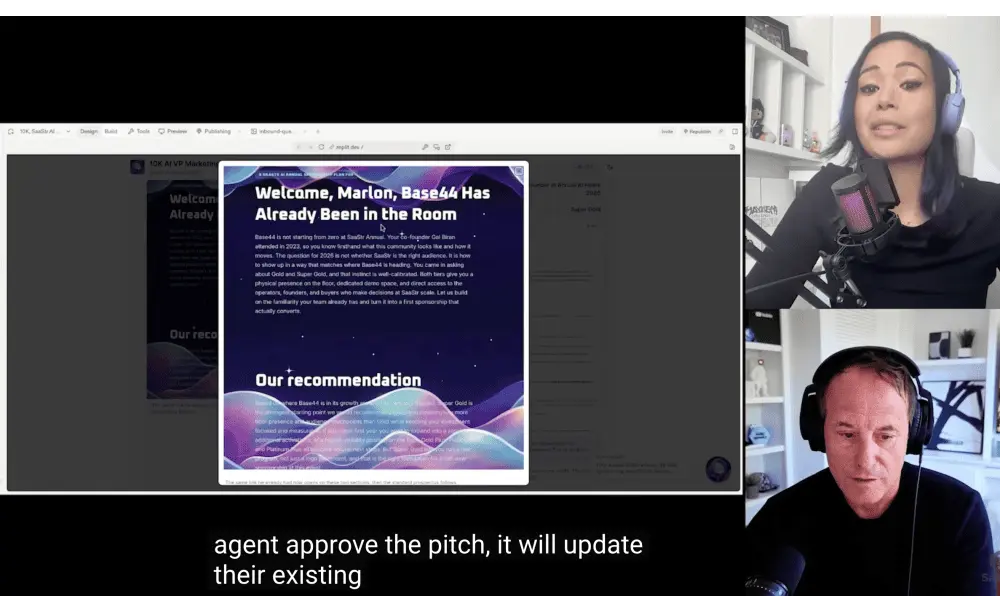
The agent synthesizes a custom narrative within 30 to 60 seconds, explaining why the prospect’s specific company should sponsor SaaStr, highlighting competitor participation, and recommending specific packages. Crucially, strict safety protocols ensure only public, anonymized data regarding other customers (such as Replit’s public top-sponsor status) is utilized. Amelia reviews the generated pitch, approves or tweaks it, and fires it off from her direct email address.
Step 7: In-Place URL Mutation
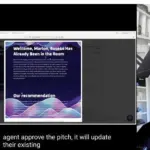
Rather than emailing a new document, the prospect’s original tokenized URL dynamically updates. When they return to the link, it transforms into a personalized proposal: "Marlin, here’s why Base44 should be at SaaStr," complete with custom package recommendations and competitor breakdowns. The link evolves into a living document for the duration of the sales cycle.
Step 8: Custom-Built Scheduling Infrastructure
Dissatisfied with standard calendar tools that failed to integrate seamlessly with their proprietary data layer, their internal AI agent (10K) designed and built a custom meeting booker in just 20 minutes. The resulting interface displays the prospect’s company name, directly references the viewed prospectus, tracks drop-offs, and automatically drafts re-engagement sequences if a prospect hesitates.
Supporting Context & Metrics: The Numbers Behind the Machine
A system of this magnitude must be judged not by vanity metrics like total chat volume, but by its deep-funnel impact. Over the past 12 months, the operational metrics speak for themselves:
- Total Inbound Conversations: ~17,000 interactions handled by the on-site AI agent.
- Meetings Booked: ~600 targeted sponsor meetings secured directly through automation.
- Business Growth: A 60% year-over-year increase in new business driven entirely by the combined inbound and self-serve AI architecture.
- Human Capital: Exactly three human operators oversee, review, and manage the entire ecosystem.
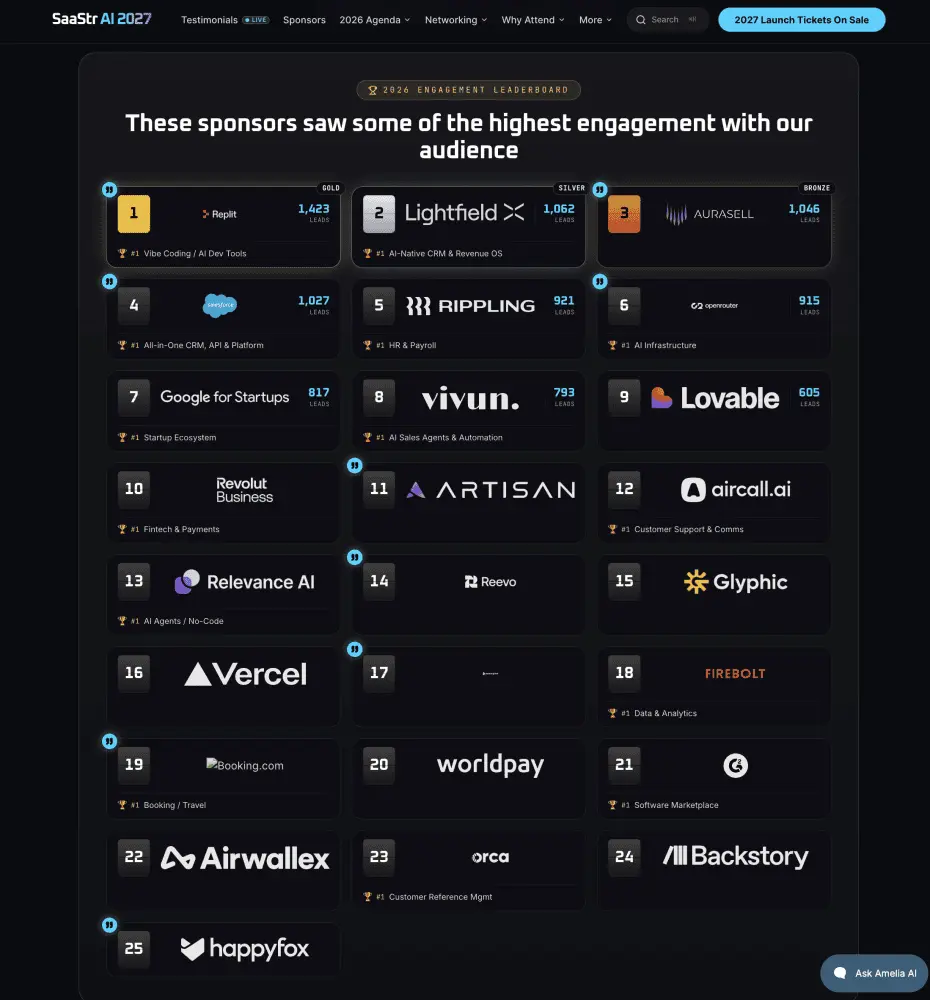
- Notable Enterprise Wins: High-profile tech logos, including OpenRouter, successfully closed through this automated inbound pipeline.
The Technology Stack
SaaStr’s revenue engine operates on a lean, modern stack optimized for speed, autonomy, and flexibility:
- Conversational AI / On-Site Avatar: Qualified (Amelia AI)
- Custom Backend & Tokenized Prospectuses: Replit
- Behavioral Heat Mapping & Analytics: Microsoft Clarity
- Core CRM & Data Architecture: Salesforce, integrated with custom AI agents (10K and internal orchestration models)
- Model Intelligence: Leveraging advanced frontier models (such as Fable 5.1) to optimize system architecture and decision-making logic.
Future Outlook: Scaling the Architecture and Avoiding Pitfalls
While the results are undeniably transformative, the SaaStr team is candid about the structural hurdles and failure points encountered during deployment. Organizations attempting to replicate this model must navigate four core warnings:
- Avoid the "Big Bang" Trap: Do not attempt to build a fully autonomous AI sales machine overnight. SaaStr ran their foundational on-site agent alone for an entire year before layering on self-serve analytics and custom bookers. Build in strict, manageable steps.
- Prevent Backend Bloat: At one stage, their internal AI agent 10K experienced performance degradation. Investigation revealed the backend app had become bloated with excessive APIs and data structures. Regular refactoring and modularization restored peak intelligence.
- Equip the Entire Team: While Amelia interfaces seamlessly with the AI backend, co-founder David maintains traditional workflows within Salesforce. Future iterations will focus on building customized AI assistants tailored specifically for individual sales representatives.
- Unify Inbound Portals: Currently, SaaStr operates two parallel inbound doors—the conversational avatar and the self-serve tokenized page. The ultimate long-term roadmap involves merging these streams so every buyer receives an identical, hyper-personalized experience regardless of their preferred point of entry.
The Recommended Build Order for Revenue Teams
For organizations looking to transition from legacy sales funnels to an AI-driven inbound engine, SaaStr recommends the following sequential build order:
- Deploy an intelligent conversational agent on your single highest-intent, highest-value page.
- Replace static PDFs and downloadable prospectuses with tokenized, dynamic web pages hosted on your own domain.
- Integrate behavioral analytics (such as heat mapping) to track prospect engagement in real time.
- Program first-party data enrichment and automated pitch generation requiring human-in-the-loop approval.
- Construct custom, lightweight scheduling and tracking infrastructure to close the loop on prospect conversion.
As buyer expectations continue to shift toward instant, AI-native interactions, organizations that cling to static forms and day-long response lags will find themselves left behind. By combining intelligent automation with rigorous data hygiene and human oversight, revenue teams can scale their operations exponentially without expanding headcounts—proving that the future of enterprise sales belongs to the lean, the automated, and the hyper-personalized.