







Executive Overview
The ongoing conflict in Ukraine has routinely served as a crucible for modern military technology, aggressively accelerating the timeline for autonomous combat integration by decades. From the ubiquitous presence of First-Person View (FPV) aerial quadcopters to ground-based robotic logistics and explosive delivery platforms, unmanned systems have fundamentally altered tactical paradigms across all domains. However, a watershed moment in naval warfare occurred on September 12, marking a historical milestone that military historians and defense analysts will study for generations.
In the world’s first recorded engagement of its kind, a Ukrainian uncrewed surface vessel (USV) successfully hunted down, engaged, and obliterated a hostile Russian explosive drone boat in the contested waters of the Black Sea. This landmark skirmish was not merely a localized tactical victory for Kyiv; it represents the definitive dawn of true robotic naval combat—a kinetic duel fought entirely by machine intelligence, remote satellite links, and automated stabilization systems, completely devoid of human sailors in the immediate line of fire.
The lopsided engagement unfolded when operatives from Ukraine’s Defense Intelligence (HUR) identified an incoming threat: a Russian explosive USV, later identified as an "Orcan" surface drone, navigating covertly toward critical maritime infrastructure. Rather than dispatching a traditional crewed patrol craft or exposing valuable aviation assets, Ukrainian command orchestrated an autonomous interception. They deployed a heavily armed Ukrainian Navy drone boat—a Sargan-3000 platform outfitted with a sophisticated, remote-controlled heavy machine gun turret.
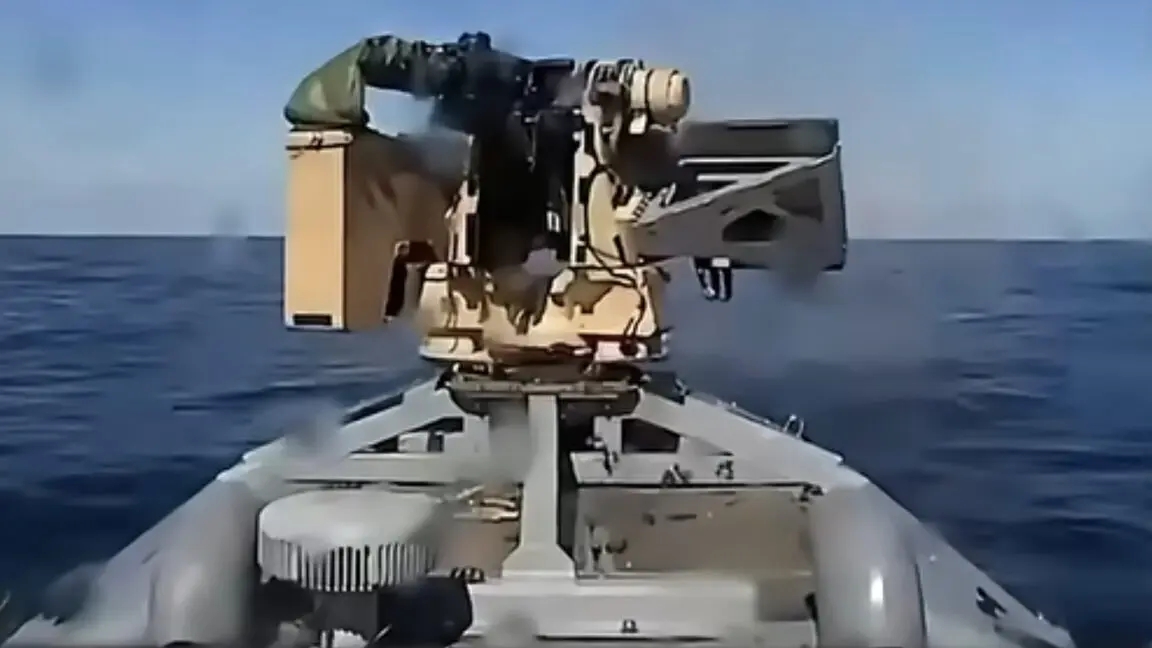
Utilizing a Kongsberg remote weapon station, the Ukrainian USV engaged its Russian counterpart at a distance of roughly one kilometer. The resulting firefight demonstrated brutal efficiency: precision automatic fire systematically disabled the enemy vessel’s communications array before riddling its hull and detonating its explosive payload. Released subsequently by the Ukrainian Navy and government media platforms, video footage of the engagement offers a chilling, crystal-clear glimpse into the future of naval warfare. As robotic systems proliferate across global oceans, the September 12 Black Sea duel stands as the grim proof-of-concept that unmanned naval warfare has officially graduated from asymmetric harbor raids to autonomous fleet-on-fleet defense.
Detailed Chronology of the Black Sea Engagement
To fully comprehend the magnitude of the September 12 engagement, one must trace the tactical sequence of events as they unfolded across the gray, choppy expanse of the Black Sea. The operation was a masterclass in modern, multi-domain intelligence-driven warfare, integrating aerial reconnaissance, electronic surveillance, and precise remote-control marksmanship.
Phase 1: Detection and Identification
The incident began in the early morning hours when Ukrainian Defense Intelligence assets—leveraging a combination of coastal radar, long-range maritime patrol drones, and overhead reconnaissance—spotted an unauthorized uncrewed surface vessel departing from a Russian-controlled staging area. The unidentified craft was maintaining a high-speed vector designed to evade traditional coastal defenses and slip past early warning lines.
As the target closed the distance, operators utilized high-resolution optical and thermal sensors to achieve a "positive identification." According to prominent naval analyst H.I. Sutton, writing for Naval News, the intercept target was confirmed to be a Russian Orcan-class surface drone. Characterized by its distinct jet-ski-type steerable water jet propulsion system, the Orcan is a specialized kamikaze platform engineered specifically for high-speed suicide runs against anchored ships, port infrastructure, and coastal installations. These vessels are packed with high explosives and designed to detonate upon impact, turning the drone itself into a precision-guided maritime missile.
Phase 2: The Intercept Vector
Recognizing the imminent threat posed by the Orcan drone, Ukrainian military leadership bypassed the need to scramble crewed fast-attack craft—which would have exposed human personnel to extreme risk from enemy loitering munitions and coastal artillery. Instead, command was routed to the operational control center of the Ukrainian Navy’s uncrewed fleet.
Tasked with the interception was a Ukrainian Sargan-3000 drone boat. Unlike its quarry, which was built solely as a disposable, one-way explosive projectile, the Sargan-3000 is a sophisticated, multi-mission naval combat platform. Crucially, this specific hull was configured with an offensive defensive capability: a 12.7 mm heavy machine gun mounted on an advanced, stabilized remote weapon station (RWS) manufactured by the Norwegian defense giant Kongsberg.
While the Russian Orcan drone relied on pre-programmed coordinates or rudimentary manual routing—frequently augmented by overhead aerial reconnaissance drones such as the Russian Geran—the Ukrainian Sargan-3000 was piloted in real-time via secure satellite and radio-frequency data links by highly trained operators safely stationed miles away on the mainland.
Phase 3: The Lethal Intersect and Destruction
The two autonomous vessels converged in open waters. The tactical advantage quickly shifted to the Ukrainian platform due to its superior sensor suite, stabilizing optics, and heavier firepower.
As captured on dramatic video footage released by the Ukrainian Navy and corroborated by government channels via United24, the Sargan-3000 closed to a standoff range of approximately one kilometer. At this distance, the operator engaged the Kongsberg remote weapon station, locking onto the maneuvering Russian target.
The engagement itself was remarkably brief and clinical. The Ukrainian drone fired a sustained burst of 12.7 mm armor-piercing rounds. The initial salvo targeted and successfully shattered the Orcan’s primary communications and antenna array, effectively blinding the Russian drone and severing any emergency telemetry overrides from its handlers. Deprived of guidance and unable to effectively maneuver, the Russian vessel was subsequently peppered with heavy machine gun fire. The cumulative damage breached the hull and detonated the internal explosive payload, causing the Orcan to erupt in a secondary explosion before rapidly sinking beneath the waves of the Black Sea.
Supporting Context & Metrics: The Evolution of Maritime Drones
The historic clash on September 12 did not occur in a vacuum; it is the natural evolutionary product of a conflict that has relentlessly forced military innovation. For over two years, the war in Ukraine has served as a live-fire laboratory for asymmetric naval warfare. Understanding how both sides arrived at a point of USV-on-USV combat requires examining the technical metrics, strategic trajectories, and operational doctrines governing modern uncrewed systems.
The Rise of the Asymmetric Naval Fleet
When the full-scale conflict erupted, Ukraine possessed virtually no traditional blue-water navy capable of challenging the dominant Russian Black Sea Fleet. Capitalizing on ingenuity, Western technological assistance, and domestic defense manufacturing, Kyiv pioneered an asymmetrical naval strategy built entirely around uncrewed surface vessels.
Platforms such as the Sea Baby and Magura V5 fundamentally neutralized the numerical and tonnage superiority of the Russian Navy. Operating on a fraction of the budget required to build a traditional corvette or frigate, these Ukrainian USVs successfully sank or heavily damaged numerous high-value Russian warships, landing ships, and submarines, effectively pushing the Russian fleet out of its historic hub in Sevastopol and forcing a strategic redeployment to Novorossiysk.
Russian Adaptation: The Orcan Platform
Recognizing the devastating effectiveness of Ukraine’s maritime drone tactics, Moscow rapidly pivoted to develop and deploy its own uncrewed surface fleets. The Orcan drone deployed in the September 12 incident represents Russia’s counter-asymmetrical doctrine.
Designed for speed and stealth, the Orcan utilizes a steerable water-jet propulsion system borrowed from recreational watercraft technology. This gives the hull an exceptionally low profile, making it notoriously difficult to detect via surface radar, particularly in sea states with moderate chop. However, unlike the Ukrainian multi-role platforms that can serve as minelayers, electronic warfare nodes, or gun-platforms, the Orcan is primarily optimized for a single destructive purpose: maritime kamikaze attacks.
The Technological Ecosystem: Swarms and Synergy
The September 12 duel also highlighted the growing complexity of multi-domain drone warfare. As naval analyst H.I. Sutton noted, these surface engagements rarely occur in isolation. Russian explosive USVs frequently operate in synchronized coordination with flying aerial assets, most notably Iranian-designed Geran loitering munitions (variants of the Shahed series).
In these networked tactical environments, high-flying aerial reconnaissance drones act as eyes in the sky. They scan the maritime horizon, locate Ukrainian port defenses or moving vessels, and relay targeting coordinates to the surface drones. Furthermore, these aerial platforms frequently serve as communication relays, extending the operational control range of the surface drones well beyond the line-of-sight limitations of standard coastal transmitters.
Conversely, the Ukrainian response—utilizing a heavy machine gun mounted on a stabilized Kongsberg RWS—demonstrates the rapid evolution of "anti-drone" technology moving from the land and air domains directly onto the water. Stabilized weapon stations, originally engineered to protect armored personnel carriers and main battle tanks from infantry ambushes, have now been successfully marinized to counteract the dynamic, rolling vectors of autonomous naval combat.
Official Statements and Expert Analysis
The implications of the world’s first naval drone duel quickly reverberated through international defense circles, drawing reactions from military officials, government agencies, and preeminent defense analysts.
Expert Perspectives: The Inevitability of Robot-on-Robot Warfare
In interviews with specialized defense outlets including New Scientist and Naval News, renowned naval analyst H.I. Sutton emphasized that this clash was not an anomaly, but an inevitability.
"It was inevitable that there would be USV-on-USV combat," Sutton stated bluntly to New Scientist. "We have seen the same in the air and on the ground."
Sutton’s observation draws a direct parallel to the broader trajectory of modern mechanized warfare. In the skies above the Donbas and Zaporizhzhia, operators of Ukrainian and Russian FPV drones routinely hunt enemy reconnaissance quadcopters out of the air in mid-flight aerial dogfights. Similarly, on the ground, unmanned ground vehicles (UGVs) tasked with clearing mines or delivering supplies are increasingly engaging in localized defensive actions against opposing robotic systems. The September 12 incident proves that the naval domain has now fully entered this evolutionary phase, transitioning from asymmetric attacks on static infrastructure to active, maneuvering frontline combat between opposing autonomous forces.
Ukrainian Government and Military Reactions
The official media platform of the Ukrainian government, United24, alongside the Ukrainian Navy, moved quickly to publicize the event, releasing authenticated video footage of the engagement. The video, which showcases the Sargan-3000 closing the distance and methodically destroying the Russian Orcan drone, serves a dual purpose: a tactical briefing for allied defense partners and a powerful psychological morale booster for the domestic populace.
Military spokespersons emphasized that the successful interception highlights the adaptability of Ukraine’s defense sector. By integrating modular weapon stations—such as the Kongsberg remote turrets—onto uncrewed hulls, Ukrainian forces have successfully created a multi-layered maritime defense network capable of intercepting incoming aerial and surface threats long before they can endanger critical ports, commercial grain corridors, or coastal cities.
While official statements from the Russian Ministry of Defense remained largely silent regarding the loss of the Orcan drone—consistent with Moscow’s historical reticence to acknowledge tactical setbacks involving uncrewed systems—independent defense observers inside Russia have increasingly voiced alarm over the rapid closing of the technological gap in maritime drone warfare.
Future Outlook: The Next Generation of Naval Warfare
The historic engagement in the Black Sea on September 12 will be remembered by military theorists as a foundational event—the equivalent of the first tank-on-tank battle at Villers-Bretonneux in World War I or the first dogfight between aircraft in World War I. It marks the permanent crossing of a threshold, signaling that the future of naval warfare will be defined not merely by crewed warships dodging drones, but by autonomous fleets actively hunting, outmaneuvering, and destroying one another in sustained robotic engagements.
The Acceleration of Autonomous Naval Doctrines
As navies around the globe—from the United States and Great Britain to regional powers in the Indo-Pacific—analyze the telemetry and tactical footage from the Black Sea, several key takeaways are already reshaping doctrine:
- The Necessity of Counter-USV Capabilities: Navies can no longer view uncrewed surface vessels merely as offensive novelties. Every surface combatant, from patrol boats to aircraft carriers, will require dedicated, rapid-response close-in weapon systems (CIWS) and remote-controlled turrets specifically calibrated to track and neutralize fast-moving, low-radar-cross-section surface drones.
- Artificial Intelligence and Edge Computing: The reliance on human operators sitting miles away via satellite links introduces vulnerabilities, including electronic warfare jamming and signal latency. The natural evolution of the Black Sea skirmish will be the integration of fully autonomous artificial intelligence (AI) targeting systems. Future USVs will not require a human to pull the trigger via an RWS link; onboard computer vision will independently identify, track, and engage hostile robotic craft at machine speed.
- The Proliferation of Multi-Role USVs: The success of the Sargan-3000 proves that uncrewed vessels cannot be pigeonholed into single-use categories. Platforms that possess modular capability—the ability to switch between reconnaissance, electronic warfare, mine-laying, and kinetic anti-drone combat—will dominate future maritime theaters.
Conclusion
The Black Sea skirmish of September 12 is a grim harbinger of 21st-century warfare. As machines increasingly replace human sailors at the sharpest edge of naval conflict, the distinction between defensive patrolling and offensive hunting is blurring into a continuous, automated loop. Ukraine’s successful interception is a tactical triumph, but on a global scale, it serves as a stark warning to military planners everywhere: the era of autonomous naval warfare has officially arrived, and the oceans will never be the same again.