







Executive Overview
In the hyper-accelerated landscape of modern tech, a new and unconventional career archetype has emerged for seasoned B2B executives. While the industry spotlight remains fixated on hyper-growth AI-native startups multiplying their Annual Recurring Revenue (ARR) 300% year-over-year, a significant exodus of veteran talent is quietly flowing in the opposite direction. They are choosing to join companies experiencing 0% to 10% growth.
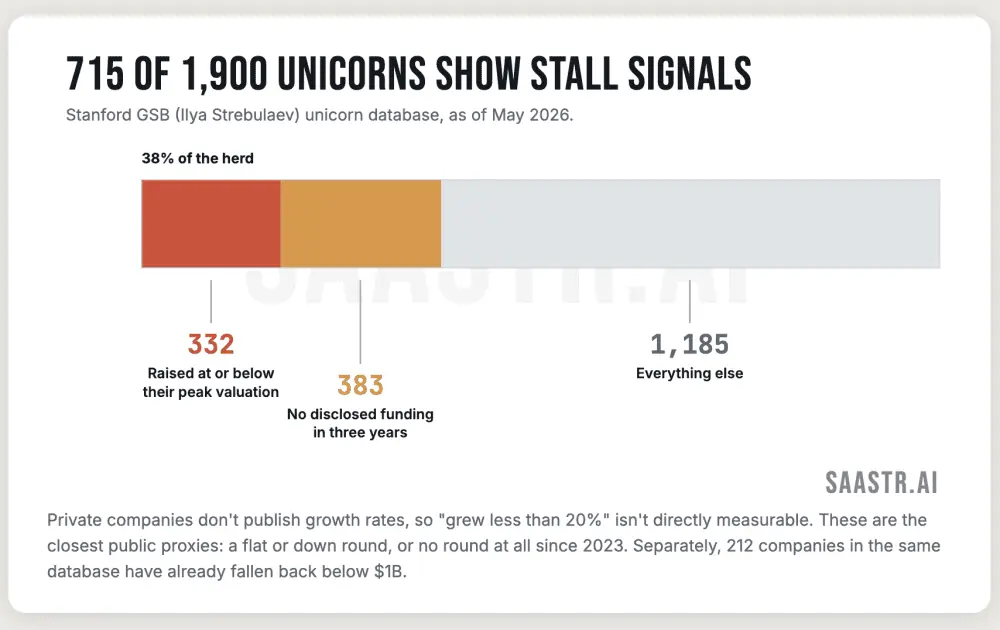
To the uninitiated, accepting a leadership role at a stagnant company sounds counterintuitive—if not career suicide. Yet, this phenomenon reflects a broader maturation of the software ecosystem. Industry indexes such as Hurun’s 2026 index place the global unicorn count between 1,400 and 1,700, with other tracking firms like CB Insights and Eqvista estimating similarly. A vast percentage of these private tech giants were minted during the capital-flooded market of 2021 and 2022. Today, many of those former high-flyers have plateaued. They are not shrinking, but they are no longer expanding at breakneck speeds.
At a scale of $50M, $100M, or $200M+ in ARR, organizations rarely hover effortlessly. Maintaining a flat trajectory requires deploying robust commercial infrastructure, managing complex enterprise sales motions, and handling millions in natural churn. For Chief Revenue Officers (CROs), Chief Marketing Officers (CMOs), and Heads of Product, managing a $150M ARR company growing at 0% is not a retirement job; it is a high-stakes, highly tactical deployment of traditional executive playbooks. This article explores why joining a flat unicorn has become a rational, lucrative, and increasingly sought-after strategic choice for top-tier enterprise leaders.
Detailed Chronology and Market Evolution: From 2021 Exuberance to the Plateaued Normal
The Minting of a Generation: 2021–2022
To understand the current crop of flat unicorns, one must look back to the zero-interest-rate policy era of 2021 and 2022. During this window, venture capital flooded the B2B SaaS ecosystem. Valuations decoupled from fundamental unit economics, and companies were rewarded almost exclusively for top-line growth at any cost. Burn rates soared, headcount tripled, and future expectations were baked into sky-high private market valuations.
The Correction and the Great Stabilization: 2023–2025
As macroeconomic conditions tightened, the music stopped. Capital preservation replaced aggressive expansion. Over the subsequent years, thousands of venture-backed firms underwent painful rightsizings, budget cuts, and structural reorganizations. Companies that had scaled past $50M or $100M in ARR found themselves trapped between inflated expectations and the gravity of market saturation.
By 2026, the dust had largely settled. Market metrics reveal a bifurcated ecosystem: a small, volatile cohort of AI-native startups chasing 4x growth, and a massive, stable middle-class of mature B2B companies generating substantial cash flow but posting single-digit or flat year-over-year growth. Rather than entering a death spiral, these companies stabilized. They retained their core enterprise customers, balanced their ledgers, and established a steady-state equilibrium—clearing the path for a new breed of executive leadership focused on operational resilience rather than blitzscaling.
Supporting Context & Metrics: The Mechanics of Growing 0%
The phrase "growing 0%" is a masterclass in enterprise misdirection. In the complex theater of B2B software, staying completely flat requires immense kinetic energy from an entire commercial apparatus.
The Math Behind Flat Growth
Consider a mid-market B2B software company operating at $150M in ARR with an 88% gross revenue retention (GRR) rate—a standard, healthy benchmark for businesses of that scale. Under this model, approximately $18M of ARR naturally walks out the door every single year due to customer churn, down-sells, seat contractions, client acquisitions, and the departure of internal executive champions.
To achieve a net-zero growth rate (0%), that company’s commercial engine must generate a full $18M in new and expansion ARR annually, in perpetuity.
[ $150M Existing ARR ]
       │
       ▼
   (-$18M Churn/Contraction) + (+$18M New/Expansion ARR) = $150M Flat Growth
The Human and Operational Infrastructure Required
Achieving this target is no trivial task. Assuming an average enterprise deal size of $150,000, the organization must:

- Close roughly 120 new logos every year.
- Maintain a dedicated sales organization comprising 30 to 50 quota-carrying account executives.
- Run a multi-tiered marketing funnel, a specialized systems engineering (SE) unit, and a customer success (CS) team aggressively fighting for every renewal.
- Continuously ship product updates robust enough to prevent renewal conversations from deteriorating.
If leadership sits idle for four consecutive quarters, the company does not simply maintain its position; it drops to $123M ARR, triggering an immediate board-level intervention. Operating a full commercial machine at maximum effort just to land precisely where it started demands elite execution.
Official Industry Perspectives and Strategic Rationales
Why are seasoned executives willingly walking away from hyper-growth narratives to lead these flat-line giants? Industry veterans and strategic advisors point to three primary drivers: the validity of the pre-AI toolkit, cash stability over speculative equity, and lifestyle sustainability.
1. The Pre-AI Toolkit Remains Valid
At an AI-native startup scaling at 300%, every foundational principle established between 2012 and 2022 faces daily interrogation. Executives must constantly question compensation models, the viability of traditional SDR teams, pricing metrics, and whether human-led demos are obsolete.
Conversely, at a $150M ARR company growing at 3%, the path forward is clear: run the proven playbook. Executives apply established methodologies—such as rigorous territory design, realistic pipeline coverage ratios, disciplined win/loss analysis, strategic enablement functions, and pricing refinements that capture marginal expansion. An executive with a decade and a half of enterprise experience can execute these tasks on day one without retraining from scratch.
2. Superior Cash Compensation
Early-stage, high-growth AI companies often offer compressed base salaries offset by highly speculative equity packages tied to aggressive, high-risk valuations.
Mature, flat companies often tell a different financial story. Having restructured and trimmed operations over preceding years, many of these $150M ARR companies operate at or near cash flow breakeven. They possess reliable revenue streams, allowing them to offer substantial, guaranteed cash compensation. Furthermore, they feature genuine operational budgets, established customer reference lists, and brand equity that eliminates the need to spend months explaining the value proposition to the market.
3. Navigating the Equity Reality
Executives exploring flat unicorns must approach equity with analytical detachment. A company that secured a $1.5B valuation in 2021 and remains flat at $150M ARR is rarely worth $1.5B in the current climate; realistic valuations may hover between $450M and $750M. Complicated preference stacks, participating preferences, and ratchets often sit atop common stock. Consequently, astute leaders price these offers primarily on cash compensation—base salary, bonuses, and negotiable cash incentives—treating equity as an unpromised lottery ticket unless a recent recapitalization or private equity restructuring has introduced a clean strike price.
Future Outlook: Risk, Reward, and the Rational Choice
As the B2B landscape matures further, the polarization between ultra-rapid, experimental tech startups and stable, cash-generating enterprises will only intensify.
Flat growth, however, carries inherent risks. A company that remains flat is perpetually one disastrous quarter away from entering a "down" cycle. A downward trajectory invites severe restructuring, private equity takeovers, halved teams, and executive quarters spent poring over data rooms rather than engaging with customers. Therefore, rigorous due diligence is paramount. Leaders must thoroughly vet the company’s balance sheet, net retention metrics, and capitalization structure before signing an offer letter.
For the veteran executive balancing career longevity, family commitments, and a desire to practice their craft without enduring the burnout of the 24/7 startup grind, the flat unicorn represents a rational and rewarding frontier. It offers a rare intersection: a mandate where proven operational expertise matters, compensation is delivered in reliable cash, and the business environment relies on sound business fundamentals rather than speculative hype.