The intersection of artificial intelligence, government regulation, and digital commerce has reached a critical flashpoint. Under the landmark European Union Regulation (EU) 2024/1689—widely known as the EU AI Act—creators, enterprises, and tech giants are facing sweeping mandates designed to inject absolute transparency into digital ecosystems. At its core, the regulation demands that synthetic content, including text generated by Large Language Models (LLMs), be machine-detectable.
While ostensibly framed as a consumer protection measure against disinformation and deepfakes, this mandate has triggered a profound shift in infrastructure. Major AI laboratories are moving rapidly to comply. Anthropic recently announced that all future iterations of its industry-leading Claude models will natively embed identifiable, text-based cryptographic watermarks. Other foundation model providers are expected to follow suit immediately.
For digital marketers, ecommerce brands, and content creators, this development is more than a technical footnote. It represents an existential pivot. By creating a frictionless, programmatic infrastructure for identifying AI-generated material, the EU AI Act inadvertently opens the door to systemic segregation and platform-level censorship. Rather than judging content by its editorial quality, relevance, or factual accuracy, platforms can now programmatically filter digital assets based solely on their provenance.
As search engines, social networks, and email inbox providers race to adopt machine-readable detection frameworks, the foundational efficiency of generative AI—the very engine driving modern agile marketing teams—faces severe headwinds. This investigation explores the mechanics of text watermarking, the regulatory pressures driving it, and the high-stakes implications for the global digital economy.
Detailed Chronology: From Legislative Intent to Technical Implementation
To understand how a Brussels regulatory decree transformed into invisible code embedded inside AI-generated prose, it is necessary to examine the timeline of events shaping the modern digital landscape.
1. The Legislative Genesis: The EU AI Act Takes Shape
April 2024: The European Parliament votes overwhelmingly to adopt the harmonized rules on artificial intelligence, establishing a risk-based framework for deployment across the European Union.
June–July 2024: Regulation (EU) 2024/1689 is formally published in the Official Journal of the European Union, setting strict compliance deadlines for general-purpose AI (GPAI) model providers. Among its core stipulations is the absolute requirement that providers of generative AI systems ensure that their outputs are marked in a machine-readable format and detectable as artificially generated or manipulated.
Late 2024 to 2025: Tech conglomerates and frontier AI labs scramble to interpret compliance metrics. Simple heuristics—such as relying on distinctive punctuation patterns, em dashes, or lexical choices—are quickly dismissed as unreliable and easily bypassed by prompt engineering. The industry requires a cryptographic, mathematical solution.
2. The Rise of Cryptographic Watermarking
The Technical Breakthrough: Recognizing the inadequacy of post-hoc AI detectors, researchers—notably at Google DeepMind—pioneered structural watermarking techniques that operate natively during the text generation phase.
Adoption by Frontier Labs: Google implements SynthID across its Gemini ecosystem. As compliance deadlines loom closer, competitors like Anthropic announce systemic integration of text-watermarking protocols directly into their Claude architecture.
The Present Day: Watermarking is no longer an experimental academic exercise. It is hardening into the default industrial standard for LLM deployment globally, ensuring that any enterprise utilizing frontier models for commercial content generation leaves a permanent, invisible statistical signature.
Supporting Context & Metrics: Decoding SynthID and the Mechanics of "Tokens"
To grasp how text can be tracked without breaking its flow or readability, one must understand how large language models process language and how statistical watermarking systems manipulate that process.
Understanding the Token
In the architecture of generative AI, raw data is broken down into bite-sized fragments known as tokens. A token is not necessarily a full word; it can be a sub-word component, a punctuation mark, a numeral, or a space.
When an AI model is prompted to write a product description, draft an email marketing campaign, or generate an extensive blog post, it operates on a predictive continuum. It looks at the existing sequence of tokens and calculates the statistical probability of what the next token should be.
For example, consider the sentence fragment:
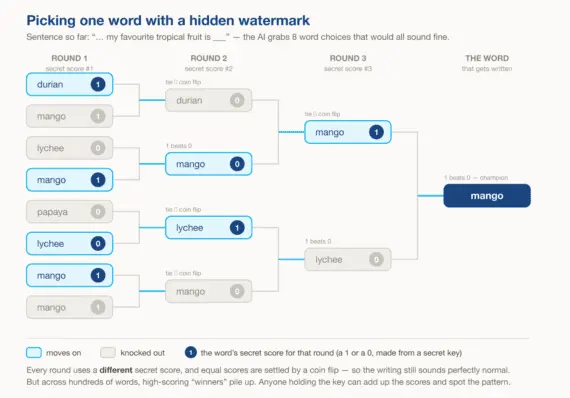
"My favorite tropical fruit is…"
A standard LLM evaluates a multitude of plausible continuations: mango, papaya, pineapple, banana, lychee, durian. While the model relies on probability matrices to choose the most contextually appropriate word, it rarely chooses the exact same word every single time unless constrained by strict temperature settings. It is precisely within these probabilities that advanced watermarking tools—such as Google’s SynthID-Text—perform their work.
The Mechanism of Tournaments and Seed-Influenced Scoring
Rather than altering text after it is written (which often degrades grammar or tone), SynthID embeds a hidden watermark during the generation phase using a process akin to a sports tournament for words.
Candidate Generation: When determining the next token in a sequence, the model surfaces multiple valid candidate words.
The Bracket System: The watermarking algorithm runs a secret, randomized scoring "tournament" among these candidates, utilizing a cryptographic pseudo-random number generator (seeded by a secret key).
The Winning Selection: A candidate token is selected not purely based on raw linguistic probability, but weighted slightly by the tournament’s internal seed.
Statistical Accumulation: One tournament proves nothing. A single winning token could easily occur by chance in human-written text. However, over the course of a multi-paragraph article containing hundreds of individual token tournaments, the resulting text exhibits a subtle, mathematically distinct bias toward seed-influenced choices.
This statistical pattern is the watermark.
Detection and Verification
A detector algorithm possessing the secret key can ingest a passage of text, reverse-engineer the underlying tokens, recalculate the tournament scores, and evaluate whether the frequency of seed-influenced choices crosses a pre-determined statistical threshold.
Length Matters: Longer passages provide robust evidence. A 500-word blog post offers hundreds of token decisions, making the statistical signature unmistakable. Conversely, a brief one-sentence tweet provides too little data for reliable detection.
Contextual Constraints: Highly factual passages, technical documentation, or heavily edited text leave less room for alternative token choices, naturally dampening the watermarking signal.
The False Positive Risk: Because detection is fundamentally probabilistic rather than deterministic, aggressive detection thresholds inevitably generate false positives, flagging fully human-written content that happens to share statistical similarities with the watermarked distribution.
Official Statements and Industry Reactions
The rollout of mandatory watermarking has ignited fierce debates among legal scholars, privacy advocates, open-source developers, and marketing leaders.
"While transparency is a noble regulatory goal, encoding systemic machine-detectability into the foundational layers of language models creates a turnkey infrastructure for automated censorship. Governments and platform gatekeepers no longer need to read text to judge it; they can simply read the math."
— Digital Rights Policy Analyst (Brussels)
Industry associations representing digital marketers have expressed deep anxiety regarding how downstream platforms will weaponize these watermarks. In statements released following Anthropic’s announcement, trade groups emphasized that small and medium-sized businesses (SMBs) rely heavily on generative AI to level the playing field against enterprise budgets.
"If search engines and email clients treat an AI watermark as an automatic proxy for low quality or spam, they are effectively dismantling the economic productivity gains that small businesses have fought to achieve over the last three years," notes an executive from a prominent digital commerce coalition.
Tech providers, meanwhile, defend the technology as a necessary compliance bridge. Representatives from AI labs emphasize that cryptographic watermarking protects intellectual property, maintains ecosystem trust, and fulfills statutory obligations without sacrificing the stylistic fluency of the generated prose.
Future Outlook: The Implications for Digital Marketing and Ecommerce
As the enforcement mechanisms of the EU AI Act mature, the digital marketing landscape faces a profound structural reckoning. Watermarking will fundamentally alter how content is distributed, valued, and monetized across every major digital channel.
1. The Death of Algorithmic Neutrality in Search
Search engines have historically claimed to rank content based on user intent, authority, and informational utility rather than production methodology. However, the operationalization of text watermarks provides search algorithms with a convenient, low-cost heuristic to discount or down-rank AI-aided pages. If Google, Bing, or regional European search engines choose to treat a positive SynthID detection as a negative ranking signal, organic visibility for AI-assisted ecommerce content will plummet.
2. Social Media Segregation and Distribution Penalties
Platforms are already moving to isolate synthetic media. Pinterest has actively adjusted its algorithms to limit the reach of heavily automated or AI-generated visual assets. As text watermarking standards take hold, social networks are expected to follow suit—routing unwatermarked human prose to primary feeds while segregating, throttling, or labeling AI-assisted copywriting in restricted discovery tiers.
3. Inbox Discrimination: The "AI Folder"
Email marketing remains one of the highest-ROI channels for ecommerce brands. However, inbox service providers (ISPs) and corporate email gateways constantly search for new ways to combat automated noise. With machine-readable watermarks embedded directly into marketing copy, enterprise email clients (such as Microsoft Outlook and Google Workspace) could easily deploy rules that automatically route watermarked promotional emails into dedicated "AI-generated" tabs or outright spam filters.
4. The Counter-Movement: Human-in-the-Loop Obfuscation
To survive this regulatory and algorithmic squeeze, the digital marketing industry will evolve rapidly. We are likely to witness the rise of specialized "de-watermarking" or human-editing software layers—tools designed to aggressively rewrite, re-contextualize, and structurally scramble AI outputs to break the statistical signature of underlying token tournaments before publication. Furthermore, brands may shift toward hyper-personalized, ultra-niche prompts and localized data sets that resist standard watermarking frameworks.
Conclusion
The EU AI Act’s push for absolute transparency was designed to bring order to the wild west of generative intelligence. Yet, by locking in text-detectability standards, regulators and tech giants have inadvertently built a digital caste system. For ecommerce marketers, the coming years will require a delicate balancing act: leveraging the unprecedented efficiency of generative AI while navigating an increasingly hostile ecosystem designed to hunt down, isolate, and penalize the invisible fingerprints of machine intelligence.