







Executive Overview
In a landmark legal decision that reverberates across both the artificial intelligence and open-source software communities, a federal appeals court has delivered a major victory to tech giants GitHub, Microsoft, and OpenAI. The United States Court of Appeals for the Ninth Circuit ruled in Doe v. GitHub that the generation of AI-authored code lacking copyright management information (CMI) does not automatically violate Section 1202 of the Digital Millennium Copyright Act (DMCA).
The case sits at the volatile intersection of generative AI and intellectual property law. For months, open-source advocates, developers, and legal experts have scrutinized how multi-billion-dollar large language models (LLMs) ingest, parse, and output code derived from public codebases. Plaintiffs—represented as a group of anonymous open-source software developers—argued that tools like GitHub Copilot and OpenAI Codex were built on a foundation of public repositories, generating snippets and applications stripped of original author attributions, copyright notices, and essential licensing mandates.
However, the Ninth Circuit’s September 16 decision introduces a narrow, highly technical, yet profoundly consequential distinction. Writing for the court, Judge Eric Miller asserted that creating a new work that fails to include CMI is fundamentally distinct from unlawfully stripping, altering, or removing existing CMI from a protected work under the DMCA.
While the ruling shields AI developers from specific metadata-removal liability, legal experts urge caution against overinterpretation. The decision explicitly leaves broader questions of direct copyright infringement, model-training legality, and open-source license compliance entirely unresolved. As the legal battles continue to unfold in lower district courts, the tech industry is forced to reckon with an evolving legal landscape where the boundaries of software provenance are increasingly blurred.
Detailed Chronology and Legal Mechanics of Doe v. GitHub
The Genesis of the Litigation
The legal confrontation began as a class-action lawsuit filed against GitHub, its parent company Microsoft, and OpenAI. The anonymous plaintiffs asserted that GitHub Copilot—an AI pair-programming assistant powered by OpenAI models—was trained on vast quantities of source code hosted in public GitHub repositories.
Crucially, many of these repositories operated under well-established open-source licenses, such as the MIT license, the Apache License, and the GNU General Public License (GPL). These licenses share a common core requirement: whoever uses, modifies, or distributes the software must preserve the original copyright notices and author attributions.
According to the plaintiffs, GitHub Copilot bypassed these obligations by outputting functional code snippets that reproduced original logic without carrying forward the necessary legal provenance or metadata. Consequently, the plaintiffs alleged that the tech companies had violated Section 1202 of the DMCA, which prohibits the intentional removal or alteration of CMI.
The Ninth Circuit’s Core Reasoning
The heart of the Ninth Circuit’s decision rests on statutory interpretation of the DMCA. Section 1202 targets individuals or entities that intentionally "remove or alter any copyright management information."
Judge Miller’s opinion dismantled the plaintiffs’ attempt to apply this statute to generative AI outputs. The court reasoned that when an artificial intelligence model generates a brand-new block of code based on patterns learned during training, it is engaging in a generative synthesis rather than an act of physical redaction or metadata stripping.
"One who creates a new work and fails to include CMI cannot be said to have ‘removed’ or ‘altered’ anything," the court wrote, emphasizing that the judiciary will not allow plaintiffs to transform run-of-the-mill copyright infringement claims into broad DMCA metadata violations.
By drawing a sharp line between generating uncredited content and deleting existing metadata, the court effectively closed off a particularly potent statutory avenue for open-source plaintiffs, significantly reducing immediate litigation exposure for providers of generative AI coding assistants.
Supporting Context & Metrics: The Open-Source Dilemma
The Provenance Chain Problem
To understand the gravity of the Doe v. GitHub ruling, one must examine the foundational architecture of open-source software (FOSS). For decades, the open-source movement has operated on a social and legal contract known as copyleft and permissive licensing. Whether a developer chooses a permissive license like BSD or a reciprocal license like the GPL, the underlying premise remains constant: the code’s license travels with it.
- Permissive Licenses (MIT, Apache, BSD): Require downstream users to retain copyright notices and disclaimers of warranty when redistributing code.
- Reciprocal Licenses (GPL, AGPL): Mandate that any derivative work incorporating the licensed code must also be released under the same open-source terms.
When a human developer reuses code, they explicitly inherit these obligations. However, large language models ingest billions of lines of code, distilling them into statistical probabilities and weights. When an AI coding assistant generates a complex algorithmic loop, a proprietary API integration, or a specialized sorting routine, the provenance chain is broken. The developer utilizing the tool receives functional code devoid of its historical lineage, creating systemic compliance risks for corporate engineering teams.
The Scale of AI Code Adoption
The commercial integration of AI coding assistants has accelerated dramatically. According to industry surveys, tools like GitHub Copilot now account for significant percentages of code written within major enterprise environments.
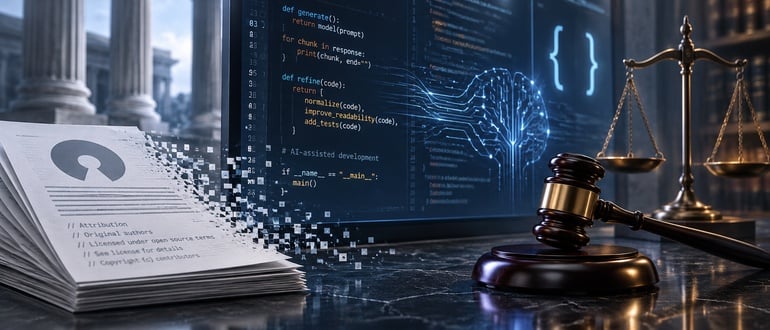
- Productivity Gains: Studies suggest that developers utilizing AI assistants complete coding tasks up to 55% faster.
- Adoption Rates: Over 40% of Fortune 100 companies have integrated AI-driven development tools into their standard workflows.
- Legal Exposure: Despite these productivity metrics, enterprises face latent liability if generated code inadvertently mirrors proprietary or heavily restricted open-source modules without proper attribution.
Official Statements and Expert Perspectives
The legal community and open-source leadership have responded to the Ninth Circuit’s ruling with a mix of pragmatism, analytical caution, and deep-seated concern.
Duane O’Brien, Executive Director of the Open Source Initiative (OSI)
Weighing in on the narrow scope of the verdict, Duane O’Brien emphasized that the ruling sidesteps the core ethical and contractual grievances of the open-source community:
"The Ninth Circuit answered a narrow question about one provision of the DMCA. It did not decide whether the developers’ open-source licenses were honored, and that claim is still before the district court. Nearly every open-source license, from MIT to the GPL, is unambiguous about the obligation to keep the copyright notice and attribution intact. Developers offered their work to the world on those terms, and anyone who builds on that work, including companies building AI tools, should honor them."
Karen Sadler, Attorney and Executive Director of the Software Freedom Conservancy (SFC)
Karen Sadler warned against panic, noting that the dismissal was heavily anchored in procedural shortcomings rather than a wholesale endorsement of AI training practices:
"It’s very easy to overread this decision. Most of the claims—such as whether Microsoft removed copyright information before using the code for training—were dismissed on procedural grounds. The plaintiffs hinted at the theory but didn’t actually assert it, so the court did not rule on it, instead stating that it considered them forfeited. The complaint is not about training. It just isn’t."
Sadler further pointed out that the court explicitly acknowledged that the generation of code could still constitute traditional copyright infringement under different legal theories, leaving the door open for future litigation built on more robust pleadings.
Bruce Perens, Co-Founder of Open Source
Offering a more philosophical and apocalyptic view of software copyright, open-source co-founder Bruce Perens expressed profound concern over the long-term viability of intellectual property protections in an AI-dominated world:
"We are indeed facing the issue that this is effectively the end of copyright for both proprietary and Open Source software and many other products. In explaining this to Richard Stallman recently, I noted that Copyleft was a casualty, but the copyright-free world he once dreamed of—the actual motivation behind Free Software—was being achieved, with various unforeseen circumstances."
Future Outlook: What Lies Ahead for AI and Copyright Law
While Doe v. GitHub provides temporary relief for Microsoft, GitHub, and OpenAI, it is far from the final word on generative AI and intellectual property. The legal battleground is shifting toward several unresolved questions that will shape the future of software development:
1. The Legality of AI Model Training
The Ninth Circuit made it abundantly clear that the plaintiffs’ complaint was not about the training phase of LLMs. Whether copying publicly available, open-source repositories to train commercial AI models constitutes copyright infringement—or whether it is protected under the doctrine of fair use—remains one of the most significant open questions in American jurisprudence. District courts handling parallel lawsuits will ultimately have to confront this issue head-on.
2. Substantial Similarity and Direct Infringement
The ruling does not shield AI vendors or users from traditional copyright infringement claims. If an AI model outputs code that demonstrates "substantial similarity" to a protected, copyrighted source repository, standard infringement rules apply. The practical risk will remain highly fact-dependent:
- Trivial Code: Standard loops, basic API calls, and routine formatting functions are generally uncopyrightable.
- Distinctive Code Blocks: Substantial, highly specific, and unique blocks of code pulled from proprietary or copyleft repositories remain high-risk liability items for enterprise users.
3. Enterprise Risk and Compliance
For corporate users of AI coding assistants, the ruling changes little regarding operational risk. Enterprises cannot rely on the absence of a DMCA violation as a guarantee of compliance. Legal counsels advise organizations to implement rigorous automated code-scanning tools (such as dependency and provenance checkers) to ensure that AI-generated code does not inadvertently import copyleft obligations that could compromise proprietary codebases.
Conclusion
The Ninth Circuit’s decision in Doe v. GitHub is a tactical win for Big Tech within the narrow confines of the Digital Millennium Copyright Act. However, it leaves the broader ideological and legal war over open-source provenance, fair use, and AI training entirely undecided. As software development enters an era increasingly dominated by autonomous coding agents and large language models, developers, legal scholars, and corporations alike must prepare for a prolonged series of judicial reckonings.