





Executive Overview
For years, the quiet backbone of the modern digital enterprise has operated in a state of data-driven ambiguity. Digital Asset Management (DAM) professionals—those tasked with preventing corporate metadata schemas from collapsing under their own weight, securing rights clearances, and ensuring brand assets remain globally accessible—frequently whisper about compensation at conferences, but rarely surface hard numbers in the open.
Enter the 2026 DAM Salary Survey.
Now officially open for global participation, this landmark initiative marks the fifth installment of a longitudinal study first launched in 2012. Designed to capture a comprehensive, unbiased snapshot of compensation, demographic trends, and working conditions within the DAM sector, the survey has become the gold-standard benchmark for the industry.
At its core, the survey addresses a fundamental question: How much are organizations actually paying to keep their digital ecosystems running smoothly?
Curated by a dedicated committee of industry veterans—Elizabeth Keathley, Lisa Grimm, Deb Fanslow, and Jennifer Tyner—the 2026 survey relies entirely on community participation to generate its insights. Unlike proprietary reports sold back to corporations at exorbitant enterprise rates, the findings of this survey are published freely for the benefit of the entire profession. As the industry faces new pressures from generative AI integration, remote work permanence, and escalating enterprise data volumes, the 2026 survey promises to deliver crucial clarity for professionals navigating salary negotiations and career growth.
Detailed Chronology: A Decade of Tracking DAM Compensation
To understand the significance of the 2026 DAM Salary Survey, one must trace its evolution over the past fourteen years. The survey’s journey reflects the maturation of Digital Asset Management from a niche operational task into a critical enterprise discipline.
2012–2014: The Formative Years
The salary survey initiative began in 2012 under the umbrella of the now-defunct DAM Foundation. During this period, Digital Asset Management was heavily concentrated in media, publishing, and heritage institutions. Professionals entering the field often possessed specialized library or information science degrees, and the role was frequently viewed through a tactical, rather than strategic, lens. The 2014 follow-up survey attempted to capture shifts in this landscape, though data collection was fragmented, and the industry lacked standardized job titles.
2017: A Community-Led Revival
Following the closure of the DAM Foundation, the survey faced an uncertain future. Recognizing the critical need for transparent compensation data, Ralph Windsor—founder of Digital Asset Management News—stepped in alongside Elizabeth Keathley, Lisa Grimm, and Deb Fanslow to revive the project in 2017.
The 2017 survey gathered responses from over 100 professionals, painting a fascinating picture of the workforce at the time. It revealed a high prevalence of traditional information management backgrounds, while simultaneously hinting at emerging gender and regional pay gaps that the dataset was not yet robust enough to fully isolate. Crucially, the 2017 revival institutionalized the survey as an independent, community-driven resource.
2024: Pandemic Shifts and Global Normalization
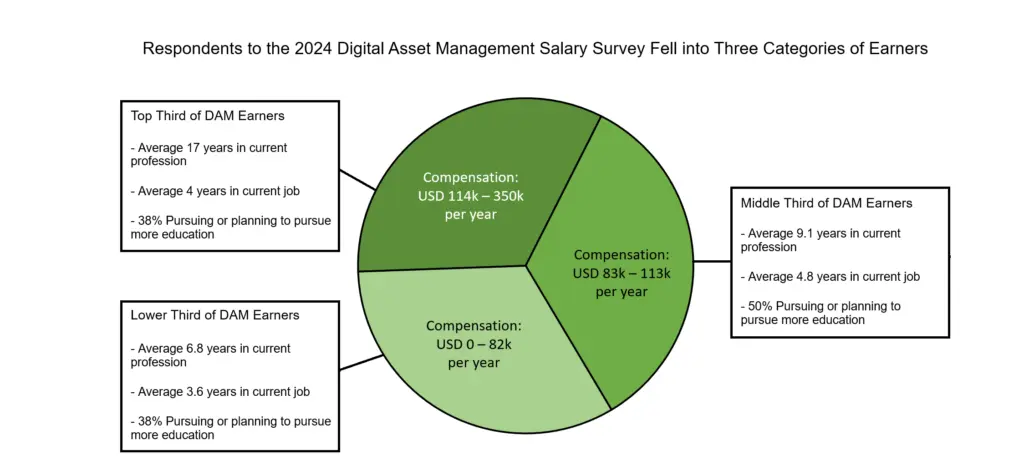
After a hiatus that spanned several years, the survey returned in 2024, steered by an expanded authorial committee. The 2024 results captured a radically altered professional environment shaped by the post-pandemic corporate landscape.
Key takeaways from the 2024 report included:
- A median full-time salary of $99,000.
- A mean full-time salary of $109,645.
- The decoupling of geography from compensation: historical premiums commanded by major metropolitan hubs like London, New York, and Los Angeles had largely flattened.
- The normalization of remote work, with nearly 50% of respondents operating on a fully remote basis.
2026: The Next Chapter
Now, in 2026, the survey enters its fifth iteration. With Jennifer Tyner joining Keathley, Grimm, and Fanslow on the committee, the 2026 survey aims to build upon historical datasets while capturing new workplace dynamics, such as the impact of generative AI workflows on asset management responsibilities.
Supporting Context & Metrics: Analyzing the Data Landscape
To appreciate why the 2026 survey matters, one must examine the metrics established by its predecessors. Data from the 2024 survey provides a vital baseline for understanding how experience, location, and specialization influence earning potential in the DAM ecosystem.
Experience as the Primary Salary Driver
One of the most robust findings from the 2024 dataset was the direct correlation between professional tenure and compensation. While education and certifications play supporting roles in hiring decisions, hands-on experience in orchestrating complex enterprise migrations, taxonomy overhauls, and cross-departmental user adoption programs remains the single most reliable predictor of higher pay.
In an industry where formal university degrees explicitly dedicated to "Digital Asset Management" have historically been rare, practical competence has always outweighed academic credentials. The 2024 survey showed clear salary stair-steps moving from junior asset coordinators (typically managing tactical ingest and tagging) up to enterprise DAM directors (overseeing multi-system integrations and global governance strategies).

The Geographical Shift: Death of the Metro Premium
Perhaps the most disruptive trend captured in recent survey cycles is the erosion of geographic pay localization. Historically, DAM professionals working out of corporate HQs in high-cost-of-living metropolitan centers—such as New York, London, and Los Angeles—commanded substantial salary premiums.
The widespread adoption of remote work infrastructure dismantled this model. With nearly half of respondents working fully remotely in 2024, employers increasingly benchmarked salaries against national or regional talent pools rather than local real estate markets. While this democratized access to high-paying roles for professionals living outside major tech and media hubs, it also introduced new complexities regarding localized cost-of-living adjustments and international contracting.
Comparing Past and Present Demographics
A side-by-side comparison of the 2017 and 2024 datasets highlights how the profession has broadened. In 2017, the workforce was heavily anchored by traditional librarians, archivists, and information scientists. By 2024, the talent pool had diversified significantly, drawing professionals from marketing operations, IT, creative production, and data engineering backgrounds.
This diversification has enriched the discipline, bringing technical prowess and marketing alignment into balance with traditional metadata science. However, it has also fragmented job titles—ranging from "DAM Specialist" and "Metadata Librarian" to "Global Content Operations Manager"—making standardized benchmarking more difficult than ever. This is precisely why comprehensive surveys like the 2026 edition are indispensable.
Official Perspectives: The Committee Behind the Survey
The persistence and credibility of the DAM Salary Survey are largely attributable to the dedication of its steering committee. Comprising Elizabeth Keathley, Lisa Grimm, Deb Fanslow, and Jennifer Tyner, the leadership team brings decades of combined expertise in information architecture, library science, and enterprise digital asset management.
The Philosophy of Open Benchmarking
Speaking on the importance of the survey, the committee has consistently emphasized that compensation data should not be locked behind corporate paywalls or restricted to expensive executive search firms. By keeping the survey open, anonymous, and freely accessible, the authors ensure that individual practitioners—ranging from entry-level coordinators to seasoned enterprise architects—are empowered during salary negotiations, performance reviews, and career planning.
"The data is only as good as the sample, and the sample only grows if people take ten minutes out of their day to contribute," notes the organizing committee. They acknowledge the universal fatigue surrounding online forms, noting that professionals would "literally rather be doing anything else on a Thursday afternoon" than filling out spreadsheets. Nevertheless, the community’s consistent willingness to participate has turned this grassroots effort into the definitive authority on DAM compensation.
Future Outlook: Why Your Response Shapes the Future of the Profession
As enterprises grapple with unprecedented volumes of unstructured data, synthetic media generated by artificial intelligence, and increasingly complex multi-channel distribution pipelines, the strategic value of Digital Asset Management has never been higher. Yet, a persistent disconnect remains between the business-critical nature of DAM and the compensation packages offered to those who manage it.
Combating the Recruiter’s Guess
Too often, human resources departments and external recruiters rely on generalized IT or marketing salary brackets when hiring DAM talent, failing to grasp the specialized blend of technical taxonomy, rights management, and change management required for the role.
When a DAM manager sits down to negotiate a salary or pitch a headcount expansion to leadership, pointing to a recruiter’s vague estimate is rarely effective. Armed with empirical, peer-reviewed data from the 2026 DAM Salary Survey, professionals can anchor their compensation discussions in hard facts.
How to Participate
The 2026 survey is entirely anonymous and designed to take approximately ten minutes to complete. It captures critical variables including:
- Current compensation and bonus structures.
- Years of experience in the DAM field.
- Geographical location and remote work arrangements.
- Organizational size, industry sector, and primary responsibilities.
Whether you administer an enterprise DAM system, wrangle complex metadata taxonomies, manage legal rights clearances, or ensure that your organization’s digital asset lights stay on, your voice matters.
The survey is live now, and participation is open to all practitioners globally. To make sure the next salary conversation you have is grounded in reliable data rather than guesswork, fill out the survey and share the link with your industry peers.
Participate in the 2026 DAM Salary Survey here:
https://docs.google.com/forms/d/e/1FAIpQLSd6Qq5fMIBM8Y8jPf2auM785N6jEzzwXGttGXDRHqtHNNTPGg/viewform