







Executive Overview
In the high-stakes arena of vertical Software-as-a-Service (SaaS), few names have commanded the respect and valuation multiples of ServiceTitan. Often hailed as the undisputed leader of "Vertical SaaS for the Trades," the company powers the operational backbones of millions of contractors, plumbers, and HVAC technicians. On paper, ServiceTitan’s fiscal second-quarter earnings report for 2027—released on September 8, covering the quarter ending July 31, 2026—was an undeniable triumph. The company posted revenue of $292.8 million, marking a robust 21% year-over-year increase that easily surpassed its own 18% guidance and beat Wall Street consensus estimates. Non-GAAP earnings per share (EPS) hit $0.40, outperforming the expected $0.36. Operating margins expanded by a healthy 310 basis points, free cash flow hit record levels, Net Dollar Retention (NDR) remained steadfastly above 110%, and management even modestly raised its full-year revenue forecast.
Yet, despite a metric sheet that would make most Chief Financial Officers beam with pride, the market’s verdict was swift and brutal.
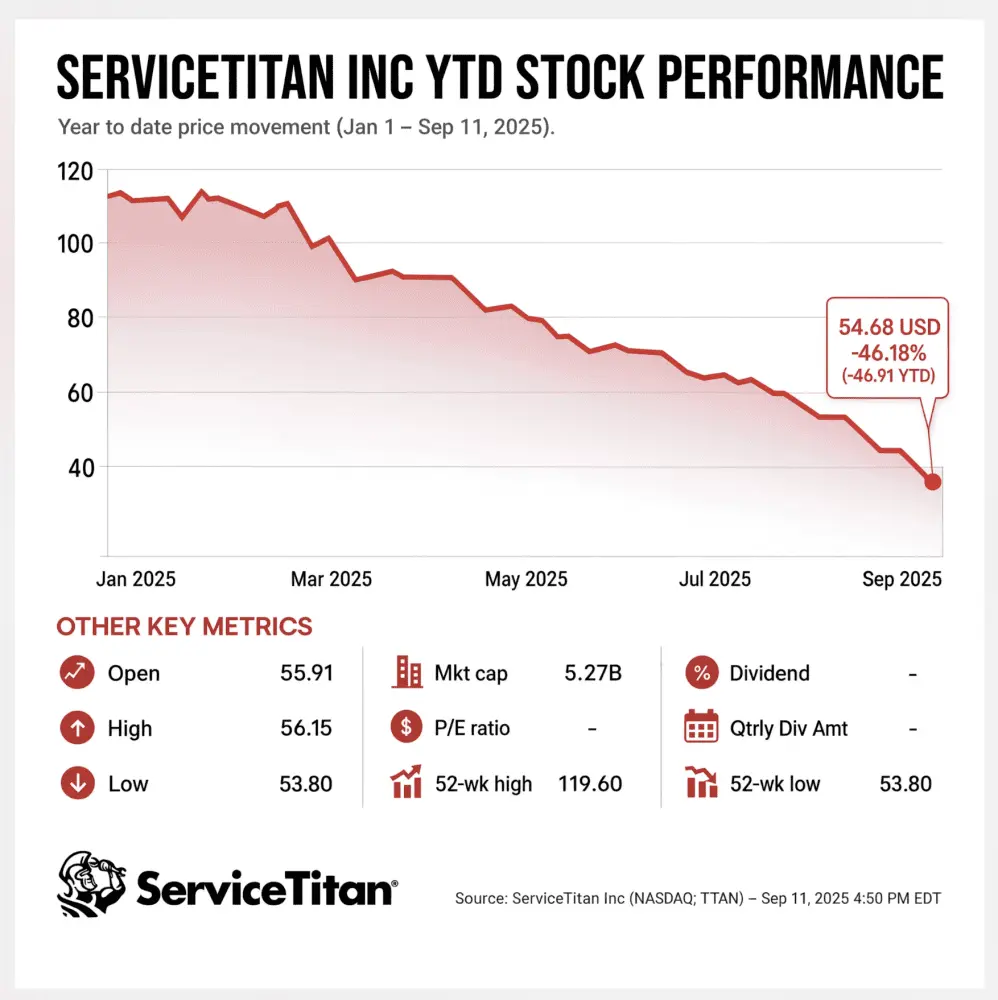
The next trading session, ServiceTitan’s stock cratered by 30%, evaporating more than $2 billion of market capitalization in a single day. By the end of the week, the equity had plunged to a new 52-week low of $54.16, marking a staggering 52% decline over the trailing twelve months. Within 24 hours of the report, seven major Wall Street firms slashed their price targets by 20% to 30%—even as most maintained their "Buy" ratings.
The underlying message from Wall Street was clear: the market is no longer rewarding past operational excellence or minor earnings beats. Instead, it is aggressively repricing the future. ServiceTitan’s dramatic fall was not caused by a flawed quarter, but by a chilling forward-looking guidance. Management signaled that the back half of the fiscal year would see revenue growth decelerate sharply to roughly 15%, down from 25% a year prior. Furthermore, Q3 revenue was projected to decline sequentially in absolute dollars compared to Q2.
In the hyper-punitive valuation climate of 2026, the old startup mantra—"Grow or Die"—has taken on a ruthless new meaning. Ten points of growth deceleration wiped out an earnings beat, expanding margins, record cash generation, and a raised full-year guide. This comprehensive deep-dive explores the anatomy of ServiceTitan’s historic sell-off, analyzing the intersection of macroeconomic headwinds, artificial intelligence monetization strategies, and the unforgiving math of modern SaaS valuations.
Detailed Chronology: The Earnings Release and the Great Stock Repricing
The Disconnect Between the P&L and the Stock Price
To understand the panic that seized Wall Street on September 8, one must first examine the stark divergence between backward-looking operational health and forward-looking market sentiment.
For the quarter ending July 31, 2026, ServiceTitan out-executed expectations across nearly every traditional financial metric:
- Revenue: Reached $292.8 million, representing 21% year-over-year growth and beating internal guidance by approximately $8 million.
- Profitability: Non-GAAP EPS reached $0.40, topping the consensus estimate of $0.36 by four cents. Operating margins widened significantly, backed by a 310-basis-point improvement.
- Cash Generation: Free cash flow nearly doubled off its historical base, establishing new company records.
- Retention: Net Dollar Retention held firm above 110%, demonstrating that existing customers continue to expand their footprint on the platform.
- Guidance Raise: Management raised its full-year revenue outlook by $4 million.
Yet, when the opening bell rang the following morning, the stock plummeted $24.46 per share, closing down 30%. The immediate aftermath triggered a wave of desperate recalibrations from institutional analysts. Major financial institutions rushed to lower their price expectations:
- TD Cowen: Cut its price target from $125 to $100.
- Wells Fargo: Lowered its target to $105.
- Piper Sandler & KeyBanc: Both reduced their targets to $110.
- BMO Capital Markets: Cut its target from $103 to $90.
- Canaccord Genuity: Adjusted its target from $105 to $90.
Significantly, these firms did not downgrade the fundamental quality of ServiceTitan’s business model. They kept their "Buy" ratings intact, recognizing that the underlying platform remains a category-defining titan. Instead, they were forced to reprice the forward growth trajectory. The linchpin of the entire report—the expected growth rate for the coming quarters—dropped from a historical 21%-25% bracket down to a sluggish mid-teens baseline.
The Slowdown in the Back Half of FY27
The catalyst for the sell-off lay squarely in the math of the back-half guidance. While the first half of the fiscal year posted a commendable 22.7% growth rate, management’s guidance for the third and fourth quarters pointed to a deceleration to roughly 15%.
Even more alarming to institutional investors was the absolute sequential trajectory. ServiceTitan’s Q3 revenue guidance was pegged at $286 million—a noticeable decline from the $292.8 million reported in Q2. For a high-growth software company operating at an annualized run rate of $1.17 billion to tell the market that its upcoming quarter will generate fewer absolute dollars than its previous one is a bitter pill to swallow.
Compounding the top-line deceleration, operating margins were also projected to step down in tandem. Non-GAAP operating income for Q3 was guided to a range of $29 million to $30 million on $286 million in revenue, representing an operating margin of roughly 10.3%, down sharply from 15.2% in Q2. When evaluating the Rule of 40—a vital metric combining growth rate and profit margin—ServiceTitan’s performance in the back half slumped to approximately 27, compared to 36 in the reported quarter and 37 in the same period a year prior.
While management proudly highlighted a $4 million raise to the full-year revenue guide, the market largely dismissed the metric as noise. ServiceTitan’s full-year guidance had been established at $1.11 billion to $1.12 billion back in March, and despite being raised incrementally throughout the year to its current $1.139 billion to $1.144 billion range, the stock had steadily bled value. Investors were trading the slope of the curve, not the absolute destination.
Supporting Context & Metrics: Gross Transaction Volume and Macro Pressures
The Vulnerability of Volume-Based Pricing
ServiceTitan’s business model is intimately tied to the economic health and transactional volume of its end-users. Rather than relying solely on traditional per-seat licensing fees, a significant portion of ServiceTitan’s revenue is derived from Gross Transaction Volume (GTV)—the total dollar value of invoices processed by contractors through its software ecosystem.
During the quarter, GTV reached $26.8 billion, representing a 17% year-over-year increase. ServiceTitan monetizes this volume at an effective take rate of roughly 1.09% (up slightly from 1.06% a year ago), effectively extracting about a penny for every dollar billed by its contractors.

While this model serves as a powerful engine during economic expansions—allowing the company to automatically capture upside as contractors raise prices or complete more jobs—it creates acute vulnerability when end markets experience friction.
- In Q1, GTV growth stood at a healthy 23%.
- By Q2, GTV growth decelerated sharply to 17%.
Management offered a detailed and transparent breakdown of this softening during the earnings call. Lead and job volumes experienced a noticeable contraction across the home services industry during May and June, with the weakness heavily concentrated in the HVAC sector. Crucially, contractors were unable to offset lower job volumes with larger average ticket sizes. Furthermore, an unusually early cooling season likely pulled peak demand forward into Q1, while the timing of the July 3 holiday weekend disrupted operational momentum.
Although lead volumes showed signs of stabilization by July, management refused to declare the sector-wide slowdown finished.
Because of its volume-sensitive monetization model, this six-point drop in GTV growth instantly impacted the profit and loss statement. While usage revenue still outpaced GTV growth by expanding 24%—proving that monetization efforts were working—the underlying macro cooling in HVAC transactions directly dragged overall revenue growth down from historical norms of 25% to 21%. Had ServiceTitan relied strictly on traditional seat-based contracts, this sudden industry-wide softness might have been masked until future annual renewals; instead, it hit the P&L in real time.
Official Statements & Strategic Shifts: The True Cost of the AI Pivot
The AI Max Transition: A Near-Term Revenue Headwind
At the heart of ServiceTitan’s long-term strategy is "Max," its proprietary agentic artificial intelligence operating system designed to automate administrative workflows and optimize field operations. Adoption metrics for Max have accelerated dramatically: after securing just over 100 enrolled locations at the close of Q1, the company doubled that figure in Q2 and now projects eclipsing 700 locations by the end of the fiscal year.
However, the rapid commercialization of Max is currently acting as a significant financial headwind. Management disclosed two distinct structural drags on near-term revenue resulting from the AI transition:
- Deferred Billing Structures: To reduce friction during the change-management process and convince traditional contractors to adopt an advanced AI operating system, ServiceTitan waives billing for the first quarter of the contract.
- Pricing Model Shifts: Moving clients toward outcome-based and usage-priced AI tiers temporarily alters the timing of cash recognition.
Together, these factors created an estimated $4 million to $5 million revenue headwind during the quarter. Paradoxically, the faster Max sells, the more it suppresses reported revenue in the immediate term.
Long-term, the strategic rationale is sound. Early adopters of Max report operational gains that drastically improve efficiency, including technician-to-admin ratios shifting from 2:1 to 3:1 and revenue growth exceeding 45% for participating businesses. Yet, in the market climate of 2026, transitioning business models to AI introduces a painful four-to-six-quarter trough in reported growth. In the freewheeling funding environment of 2021, Wall Street eagerly financed such transitional gaps; in today’s unforgiving market, it costs a company 30% of its valuation overnight.
Sacrificing Expansion Trades to Fund the AI Bet
To marshal the resources necessary to fuel Max and accelerate internal product development, ServiceTitan made a deliberate strategic pivot: it chose to defer its planned expansion into new commercial and residential exterior trades.
A review of the company’s expense lines highlights this tactical reallocation:
- Research and Development (R&D) investments were prioritized to scale the "software factory" behind Max.
- Sales and Marketing (S&M) expenditures were pivoted away from acquiring brand-new verticals and redirected toward deepening penetration within the existing customer base.
This reallocation is entirely defensible from an operational standpoint. Deepening engagement within an existing base boasting an NDR above 110% is significantly more capital-efficient than breaking into entirely new, untried trade verticals. However, it effectively removed two major growth vectors from the forward guidance model precisely at the moment core growth was decelerating.
Adding to the tumultuous messaging, ServiceTitan announced the appointment of a new Chief Revenue Officer, Rikus Pretorius, on the exact same day it issued its decelerated guidance. Presenting the market with a leadership shakeup alongside a 10-point drop in forward growth expectations proved to be an overwhelming combination of negative signals.
Future Outlook: Lessons for the Broader SaaS Ecosystem
ServiceTitan remains an elite operator within the vertical SaaS landscape. Delivering 21% growth at a $1.17 billion run rate, maintaining a Net Dollar Retention rate above 110%, preserving 81% platform gross margins, and sitting on $479.5 million in cash with growing free cash flow are achievements that the vast majority of B2B software companies would envy.
Yet, the harrowing events of September 2026 offer crucial, hard-earned lessons for every private and public SaaS enterprise navigating the modern technological transition:
- Model the Financial Friction of AI Transitions: Companies rushing to package artificial intelligence into usage-based, outcome-based, or deferred-billing models must accurately price the resulting revenue trough. Deferring revenue to incentivize adoption is a valid strategy, but management must prepare the market for the optics of decelerating top-line growth before making the leap.
- Weigh the Cost of Deferred Expansion: Reallocating capital away from new market expansions to fund internal AI initiatives alters the external growth narrative. When a company pulls back on geographic or vertical expansion vectors simultaneously as core demand softens, the resulting growth vacuum can trigger violent repricing from public markets.
- Growth Remains King: In the current economic cycle, the market overwhelmingly trades on the slope of growth. ServiceTitan outperformed expectations, expanded margins, generated record cash, and raised its annual guide—yet none of it mattered in the face of a projected 15% growth rate.
ServiceTitan’s trial by fire serves as a stark reminder to the software industry: when executing a massive technological evolution, protecting the narrative around forward momentum is just as important as building the product itself. In modern markets, failing to manage the growth trajectory can cost billions in a single afternoon.