Meta is officially preparing to introduce a paid tier for its standalone video-editing application, tentatively titled Edits Plus. Recent internal disclosures and official rollout roadmaps indicate that the tech giant is moving forward with a subscription model designed to monetize its rapidly growing video production ecosystem.
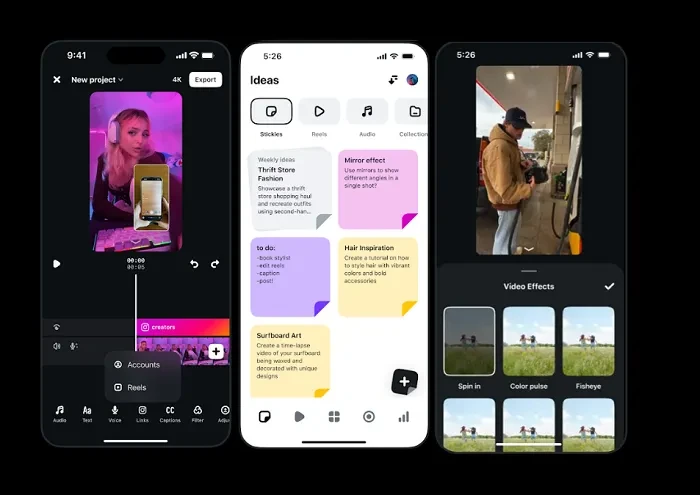
Originally positioned as a lightweight tool for creators to cut, style, and polish short-form video content—particularly for platforms like Instagram and Facebook—Edits has evolved through aggressive feature updates. It is now positioned as a direct, aggressive rival to ByteDance’s dominant editing powerhouse, CapCut. However, as Meta continues to integrate advanced generative artificial intelligence capabilities and high-capacity cloud features into the app, the mounting operational overhead has forced the company to reevaluate its free-to-use business model.
According to promotional slides and corporate announcements tied to the broader rollout of Meta One Business packages, the upcoming Edits Plus subscription will be available as both an independent standalone add-on and an integrated feature within comprehensive business bundles. This strategic shift marks a critical turning point for Meta’s monetization strategy, reflecting a broader industry-wide reckoning with the staggering cost of running large-scale artificial intelligence models. While casual users will likely retain access to a baseline tier of basic editing tools, power users, brands, and professional creators who rely on heavy AI workflows and extended cloud storage will soon face a paywall.
As Meta works to finalize the pricing structures, feature thresholds, and precise launch dates, the digital creator economy watches with bated breath. This article provides an exhaustive, multi-dimensional analysis of the Edits Plus announcement, exploring the technological drivers behind the subscription, Meta’s strategic positioning against CapCut, executive rationale, and the long-term implications for digital creators and businesses worldwide.
Detailed Chronology: From Concept to Monetization
To understand how Meta arrived at the threshold of monetizing Edits, it is essential to retrace the application’s rapid developmental timeline. The journey from a conceptual competitor to CapCut into a subscription-ready ecosystem has been marked by lightning-fast iterations, structural shifts in product architecture, and clear, calculated warnings from company leadership.
Phase 1: The Genesis and Early Warnings
The blueprint for Meta’s standalone video editor began taking shape amid the explosive global popularity of short-form video formats, spearheaded globally by TikTok and ByteDance’s CapCut. Recognizing that many creators were leaving Instagram and Facebook ecosystems to edit footage on third-party applications before re-uploading, Meta sought to capture the entire workflow natively.
When Meta first teased and subsequently launched the free Edits app, industry analysts immediately noted its polished interface and integration capabilities. Crucially, however, Meta’s product teams included subtle yet unmistakable disclaimers from day one: advanced capabilities, particularly those driven by resource-intensive machine learning algorithms, would eventually require a fee. Meta was transparent about the fact that the free iteration of the app was designed for consumer acquisition, while heavier, professional workloads would eventually necessitate a sustainable monetization engine.
Phase 2: Rapid Feature Iteration and the CapCut Rivalry
Throughout its lifecycle, Edits has received updates at a blistering pace—frequently introducing new tools every other week. These updates included sophisticated project management utilities, multi-track audio editing, advanced color grading presets, and early-stage AI automation tools designed to rival the capabilities found in standalone editing suites.
By aggressively shipping features, Meta aimed to stem the flow of creators migrating to ByteDance’s CapCut. CapCut had long held a massive advantage due to its seamless integration with TikTok and its robust suite of free AI-driven effects, auto-captions, and background removal tools. Meta’s strategy for Edits was clear: match feature-for-feature, build deep hooks into the Instagram and Facebook distribution algorithms, and position the app as the definitive ecosystem choice for modern content creators.
Phase 3: The Reality of Infrastructure Costs and the July Q&A
The turning point from speculation to reality arrived during a public Instagram Stories Q&A session hosted by Instagram Chief Adam Mosseri in July. When pressed by users regarding limitations on AI features, Mosseri offered a rare, candid glimpse behind the curtain of modern tech infrastructure:
"Basically, these AI models are very expensive to run, and so we try to just offer them for free, but we have a cap on how many times you can use them per day. Eventually, you’re going to be able to subscribe to be able to get access to more, we’re working on that right now."
Mosseri’s statement validated months of speculation. The sheer computational power required to run generative AI models—ranging from automated text-to-speech synthesis and intelligent scene reframing to generative visual effects—demands immense server capacity and specialized hardware (such as high-end GPUs). Providing these capabilities to billions of users completely free of charge is economically unsustainable, even for a company of Meta’s immense financial scale.
Phase 4: The Meta One Integration and ‘Edits Plus’ Confirmation
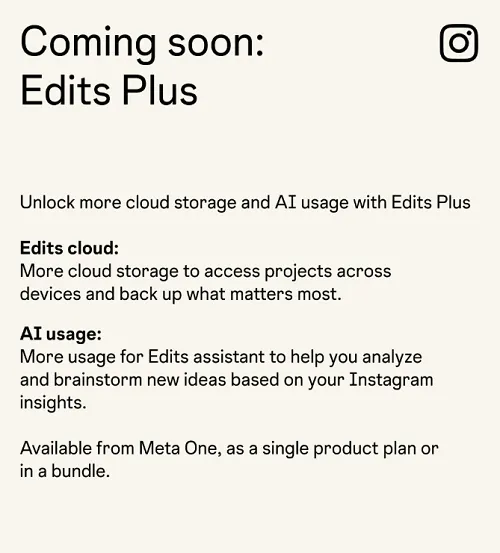
The culmination of these factors materialized in recent corporate roadmap documents. Slides outlining Meta’s newly launched Meta One for Business add-on packages explicitly revealed the development of the Edits Plus subscription tier.
Rather than serving merely as a standalone consumer app subscription, Edits Plus is being architected as a modular component that can slot seamlessly into business-oriented tiers or be purchased à la carte. This dual-track availability signals Meta’s intent to capture both individual professional creators who need extra horsepower and corporate marketing teams managing complex, multi-channel video assets.
Supporting Context & Metrics: The Economics of Generative AI
The decision to gate Edits behind a paid subscription model highlights a broader economic reality facing the technology sector: the staggering operational expenditure (OpEx) of artificial intelligence. To fully grasp why Meta is introducing Edits Plus, one must examine the metrics, infrastructure demands, and competitive pressures shaping the market.
The Computational Burden of Creative AI
Generative AI tools are fundamentally different from traditional software utilities. Traditional video filters rely on deterministic code—pre-written algorithms that apply mathematical transformations to pixel data locally on a user’s device. While computationally demanding, these tasks scale linearly with user device hardware.
Conversely, modern generative AI features—such as smart object removal, neural style transfer, automated script generation, advanced voice cloning, and AI-driven b-roll matching—often require inference computations running on massive cloud-based server farms. Every time a creator hits "Generate" on an AI-assisted video effect, Meta incurs direct costs in electricity, server maintenance, bandwidth, and specialized silicon wear-and-tear.
With millions of active creators processing hours of video daily, these fractional costs accumulate into billions of dollars annually. By implementing usage caps on the free tier and launching Edits Plus, Meta is establishing a cost-recovery mechanism that shifts the financial burden of heavy AI usage away from the corporation and onto the power users who derive direct commercial value from the tools.
What Edits Plus Will Offer: Storage and Scale
While Meta has not yet disclosed definitive pricing tiers or exact usage thresholds, corporate slides indicate two primary pillars for the Edits Plus subscription:
Expanded Cloud Storage: Professional video editing requires massive file transfers, raw footage archiving, and multi-device project synchronization. Edits Plus will offer substantially increased storage allocations, allowing heavy users to maintain complex video projects in the cloud without local hardware constraints.
Uncapped AI Access: Subscribers will bypass the daily usage limits imposed on the free tier, unlocking continuous, friction-free access to Meta’s suite of generative AI tools, automated captioning engines, and smart editing assistants.
The Competitive Landscape: Meta vs. ByteDance
The timing of Edits Plus cannot be separated from the geopolitical and competitive pressures surrounding ByteDance’s CapCut. For years, CapCut has enjoyed explosive growth in Western markets, serving as the default editing engine for the short-form video boom.
However, regulatory scrutiny facing ByteDance globally—including potential bans, divestiture demands, and data privacy investigations—has created a strategic opening for domestic tech giants like Meta and Google to capture market share. By building a world-class editing app and systematically rolling out a sustainable subscription model, Meta is attempting to out-innovate and out-capitalize its rivals.
While CapCut has largely relied on a freemium model supported by broader corporate subsidies, Meta’s pivot toward structured business packages (Meta One) and professional add-ons (Edits Plus) establishes a mature, enterprise-grade monetization framework that appeals directly to professional marketing agencies and professional content creators.
Official Statements and Leadership Vision
Meta’s leadership has been remarkably deliberate in framing this transition not as a restriction of user access, but as a necessary evolution to support advanced technology.
Adam Mosseri on the Economics of Innovation
During his illuminating July Q&A session, Instagram Chief Adam Mosseri addressed the core philosophical challenge facing modern social media platforms: how to balance universal accessibility with the crushing costs of frontier technology.
Mosseri emphasized that Meta’s primary goal remains democratic access—allowing casual users to experience the joy of modern video creation without financial barriers. However, he drew a firm line between casual utility and heavy professional demand. By utilizing a freemium architecture—offering a generous free tier with daily caps—Meta ensures that hobbyists and everyday users are never priced out of basic self-expression. Simultaneously, the upcoming Edits Plus tier provides an avenue for professionals who treat video creation as a business to pay for the elevated computational resources they consume.
Enterprise Integration via Meta One
The inclusion of Edits Plus within the broader Meta One for Business ecosystem reflects a strategic alignment across Meta’s product divisions. Business users—ranging from small local storefronts to multinational brands—increasingly rely on agile, mobile-first video production to drive customer acquisition through Reels and Stories.
By bundling Edits Plus into comprehensive business subscription packages, Meta is positioning the app not merely as a consumer toy, but as an indispensable enterprise productivity tool. Official corporate disclosures stress that businesses require reliability, advanced asset management, and priority processing power—all of which are core value propositions of the upcoming subscription tier.
Future Outlook: What Edits Plus Means for the Creator Economy
As Meta prepares to officially launch Edits Plus, the broader digital creator economy stands at a critical juncture. The shift from entirely free creative tools to segmented, subscription-based ecosystems is reshaping how creators budget their operations, select their software stacks, and monetize their output.
1. The Professionalization of Mobile Editing
For years, mobile video editing apps occupied a middle ground between amateur hobbyist software and professional desktop suites like Adobe Premiere Pro or DaVinci Resolve. With the arrival of Edits Plus, Meta is signaling that mobile-first editing has matured into an enterprise-grade discipline. Creators who rely on high-volume publishing schedules will increasingly view subscription fees for tools like Edits Plus and CapCut Pro as standard business operating expenses, much like hosting fees, cloud storage, or domain names.
2. The Battle for the Creator’s Wallet
As multiple platforms—including TikTok, Adobe, Canva, and now Meta—roll out competing subscription packages for creative tools, creators will face "subscription fatigue." To succeed, Edits Plus must prove that its integration with Instagram and Facebook’s distribution algorithms provides a tangible return on investment that justifies the monthly fee. If a subscription to Edits Plus directly translates to higher algorithmic reach, smoother workflows, and time saved through superior AI automation, creators will readily adopt it. If, however, the pricing is misaligned with market expectations, adoption may stall among independent creators, limiting the tier primarily to enterprise business accounts.
3. Pricing Transparency and Thresholds on the Horizon
As of press time, Meta has yet to announce specific pricing models, regional rollouts, or exact numerical thresholds for free-tier AI usage caps. Industry watchers anticipate that Meta will conduct phased beta testing in select markets before rolling out Edits Plus globally. The success of this rollout will depend heavily on price sensitivity and how aggressively Meta caps free-tier usage. If the daily limits on the free version are set too restrictively, casual users may experience friction that drives them back to competing platforms. Conversely, if the free tier remains overly generous, the incentive to upgrade to Edits Plus may weaken.
Conclusion
Meta’s impending launch of Edits Plus represents a watershed moment in the evolution of social media infrastructure and content creation tools. By transforming its standalone video editor into a monetizable ecosystem backed by business bundles and professional subscriptions, Meta is confronting the financial realities of running resource-intensive generative artificial intelligence at a global scale.
While casual creators will continue to enjoy a baseline of free features, the era of unlimited, free access to heavy cloud-based AI editing tools is coming to a close. As Meta finalizes its pricing strategies and usage thresholds over the coming months, the digital landscape will closely monitor how creators, businesses, and competitors adapt to this new economic paradigm. One thing is certain: the battle for the future of digital video creation is entering a more mature, highly competitive, and economically disciplined phase.