








Executive Overview
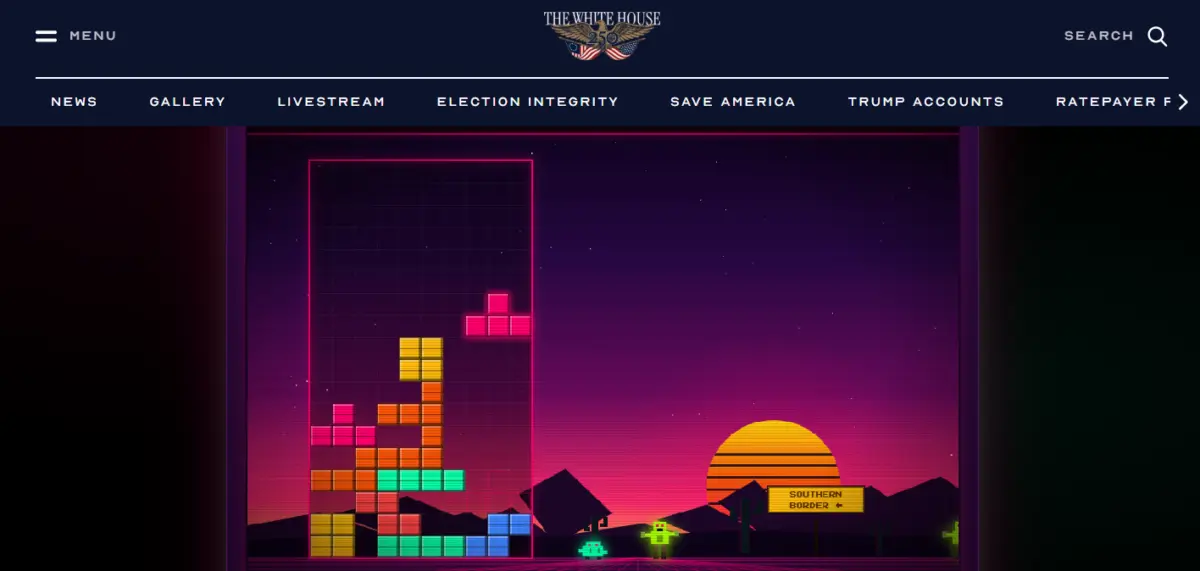
In an abrupt pivot that underscores the delicate intersection of digital politics, intellectual property law, and online cultural branding, the White House has removed the controversial arcade-style game "Build the Wall" from its official website. The title, which critics and gaming enthusiasts immediately recognized as a blatant Tetris clone, was quietly scrubbed from arcade.gov—a recently launched web portal featuring a curated collection of political, MAGA-themed mini-games.
The removal comes on the heels of mounting legal pressure from the intellectual property holders of Tetris, who publicly signaled that they take copyright violations "very seriously." The game, officially subtitled "Zombie Border Siege," tasked players with stacking falling structural blocks to fortify the southern United States border against advancing caricatures of migrants, employing classic Tetris mechanics to achieve a politically charged objective.
While the sudden disappearance of "Build the Wall" represents a swift victory for copyright holders navigating the labyrinthine waters of government-sponsored media, the broader digital arcade remains active. Other titles featuring politically and culturally loaded themes—including an anti-immigration Snake variant and a Flappy Bird parody—remain operational as of this writing. This incident not only highlights the vulnerabilities of leveraging popular pop-culture intellectual property for state-backed political messaging, but it also shines a harsh spotlight on the increasing weaponization of gamification within modern political discourse.
Detailed Chronology: From Launch to Legal Pushback
September 3: The Rollout of Arcade.gov
The controversy began when the Trump administration’s digital media team launched arcade.gov, an initiative designed to engage younger demographics and political supporters through interactive web browser games. The platform debuted with an initial lineup of five distinct, politically themed titles:
- "Build the Wall" (Subtitled "Zombie Border Siege")
- "Rio Run"
- "Flappy Bill"
- "Trump Savings Tycoon"
- "Supply Line"
Among these, "Build the Wall" immediately drew the most intense scrutiny from both political commentators and the independent gaming community. The gameplay mechanic was an unmasked replica of Alexey Pajitnov’s legendary 1984 puzzle game, Tetris. Players manipulated falling blocks to construct a barrier across the bottom of the screen. As digital adversaries from the Mexican side of the border bounced off the constructed wall and disintegrated, players were forced to manage space efficiently. If the blocks were stacked haphazardly and reached the upper bounds of the playfield, the game terminated abruptly with the ominous, all-caps message: "BORDER BREACHED."
The Gaming Community Blowback
Within hours of its launch, gaming journalists and online sleuths began dissecting the platform. Prominent gaming culture site Kotaku was among the first to formally document the striking similarities between the White House title and the globally protected Tetris intellectual property. The blatant appropriation of one of the most recognizable video game mechanics in history without licensing, attribution, or permission immediately raised red flags across the digital legal landscape.
The IP Holder Response
As public awareness grew, Tetris Holding LLC—the worldwide rights owner of the Tetris franchise—alongside its exclusive licensee, The Tetris Company, began evaluating the infringement.
On Friday, following days of internal review and widespread public discourse, The Tetris Company issued a strongly worded public statement via social media:
"At Tetris we believe in the power of connection and bringing people together, not dividing them. To our fans everywhere: we love you, we see you, and we’re grateful to have you in our community."
Crucially, the company explicitly distanced itself from the administration’s project, noting that it "was not involved in the creation of ‘Build the Wall.’" When pressed by reporters regarding potential legal action, corporate representatives initially maintained a guarded stance, stating that the firm was actively "reviewing the matter."
The Sudden Removal
The pressure—whether driven by impending legal liability, public relations exposure, or internal administration audits—yielded visible results by Tuesday. First spotted by gaming monitors, the "Build the Wall" game tile was silently removed from arcade.gov. Clicking the original direct URLs for the game now redirects users or results in dead links, effectively erasing the title from the government’s digital showcase. Representatives for both the White House and The Tetris Company have since declined to comment on the exact mechanics of the takedown or whether out-of-court communications transpired.
The Broader Arcade Catalog: What Remains on Arcade.gov?
While "Build the Wall" has been relegated to the digital graveyard, the White House gaming portal is far from empty. A comprehensive examination of the site reveals a suite of other mini-games that continue to leverage classic gaming tropes to advance political narratives and administration policy themes.
"Rio Run"
Remaining active as of Wednesday afternoon, "Rio Run" is an aggressive political adaptation of the classic Snake video game genre. In this title, users are instructed to "patrol the line" along the Rio Grande. As players navigate the playfield, they collect a growing chain of digital figures representing illegal immigrants behind a white border enforcement officer, effectively bundling them together to expel them from the United States. The adaptation turns the classic maze-chase mechanics of Snake into a continuous border-enforcement exercise.
"Flappy Bill"
Modeled heavily on Dong Nguyen’s viral 2013 sensation Flappy Bird, "Flappy Bill" replaces the frantic pixelated bird with a soaring bald eagle. Players navigate the patriotic raptor through a series of obstacles down the historic expanse of the National Mall, combining casual tap-to-fly mechanics with overt nationalist iconography.
"Trump Savings Tycoon"
Shifting from arcade action to economic messaging, "Trump Savings Tycoon" tasks players with utilizing an interactive net to catch falling bags of cash and various economic prizes. The stated in-game objective is to accumulate wealth to "Fill your kids’ Trump accounts," translating complex fiscal and savings policy debates into a fast-paced catching mechanic reminiscent of classic carnival games.
"Supply Line"
Addressing domestic health and administrative supply chains, "Supply Line" mechanics require players to sort incoming food items on a high-speed school-lunch conveyor belt. Successful sorting drives the overarching political slogan to "Make America Healthy Again," framing regulatory and nutritional initiatives as an interactive sorting puzzle.
Official Statements and Industry Implications
The abrupt removal of the Tetris knockoff highlights a broader, ongoing tension between modern political communication strategies and traditional intellectual property law. Government entities, political campaigns, and state-backed digital architects have increasingly turned to gamification as a tool to capture diminishing public attention spans. However, doing so while ignoring established copyright law creates significant institutional liabilities.
The Legal Framework of Video Game Copyrights
Under United States copyright law (Title 17 of the U.S. Code), raw gameplay mechanics—such as the concept of stacking falling blocks—have historically occupied a complex legal gray area, often defended under the doctrine that ideas cannot be copyrighted, only their specific expressions. However, the precise visual layout, asset design, audio cues, title styling, and direct code replication of a globally recognized trademarked property like Tetris cross firmly into actionable infringement territory.
The Tetris Company has historically maintained a notoriously aggressive legal posture regarding unauthorized clones, having spent decades purging app stores and web platforms of derivative works that threaten the brand’s distinct commercial identity. By aligning their proprietary gameplay structure with a politically explosive, highly polarizing national debate, the creators of arcade.gov inadvertently invited maximum corporate scrutiny.
Public Relations and Corporate Neutrality
For corporate entities like The Tetris Company, maintaining political neutrality is paramount to preserving a universal consumer base. The firm’s public statement—emphasizing that Tetris is designed for "bringing people together, not dividing them"—served a dual purpose: it distanced the corporate brand from a divisive partisan project while signaling to legal counsel and the public that the company was prepared to defend its cultural legacy from being co-opted.
Future Outlook: The Intersection of Politics and Interactive Media
As digital campaigns evolve beyond traditional banner ads, social media posts, and televised broadcasts, interactive web portals like arcade.gov are likely to become more common. Political strategists on both sides of the aisle recognize that younger voters consume media through interactive, gamified formats.
However, the "Build the Wall" debacle serves as a cautionary tale for any political digital team seeking to appropriate popular culture without proper authorization.
- Heightened Legal Scrutiny: Major intellectual property holders are now hyper-vigilant regarding how their brands, engines, and mechanics are utilized in partisan political spaces. Unauthorized parodies or clones can expect swift cease-and-desist mandates.
- Platform Vulnerabilities: Relying on proprietary third-party clones exposes government and campaign portals to immediate operational disruptions when intellectual property holders push back legally or publicly.
- The Pivot to Original Assets: Moving forward, political web developers looking to gamify policy messaging will likely be forced to invest in entirely bespoke, original code and asset creation rather than relying on recognizable nostalgic knockoffs that invite immediate copyright challenges.
For now, arcade.gov remains online with its remaining four titles active, but the silent disappearance of "Build the Wall" stands as a definitive reminder that even the White House is not immune to the unyielding reach of copyright law.