The rapid, unyielding expansion of artificial intelligence (AI) and high-density computing is running head-on into a physical bottleneck that threatens to cap the digital economy’s growth: electricity. According to the Energy Institute’s 2026 Statistical Review of World Energy, US data centers consumed an estimated 312.6 terawatt-hours (TWh) of electricity in 2025. This represents a staggering 25.5% year-over-year increase—a growth rate nearly eight times that of overall US electricity generation, which rose just 3.2% to 4,772 TWh over the same period.
On a global scale, the trajectory is equally monumental. Worldwide data center energy consumption reached 787.8 TWh in 2025, surging 19.7% in a single year and nearly doubling from 410.8 TWh in 2020. The United States alone accounts for 39.7% of this global footprint.
This widening chasm between surging digital demand and constrained electrical supply has fundamentally disrupted how data centers are conceived, financed, and built. Historically, site selection began with real estate preferences—evaluating labor markets, tax incentives, fiber proximity, and water availability before ever engaging a utility. Today, that hierarchy has been completely inverted. Power is no longer a utility service to be secured after finding land; it is the absolute filter governing where development can occur.
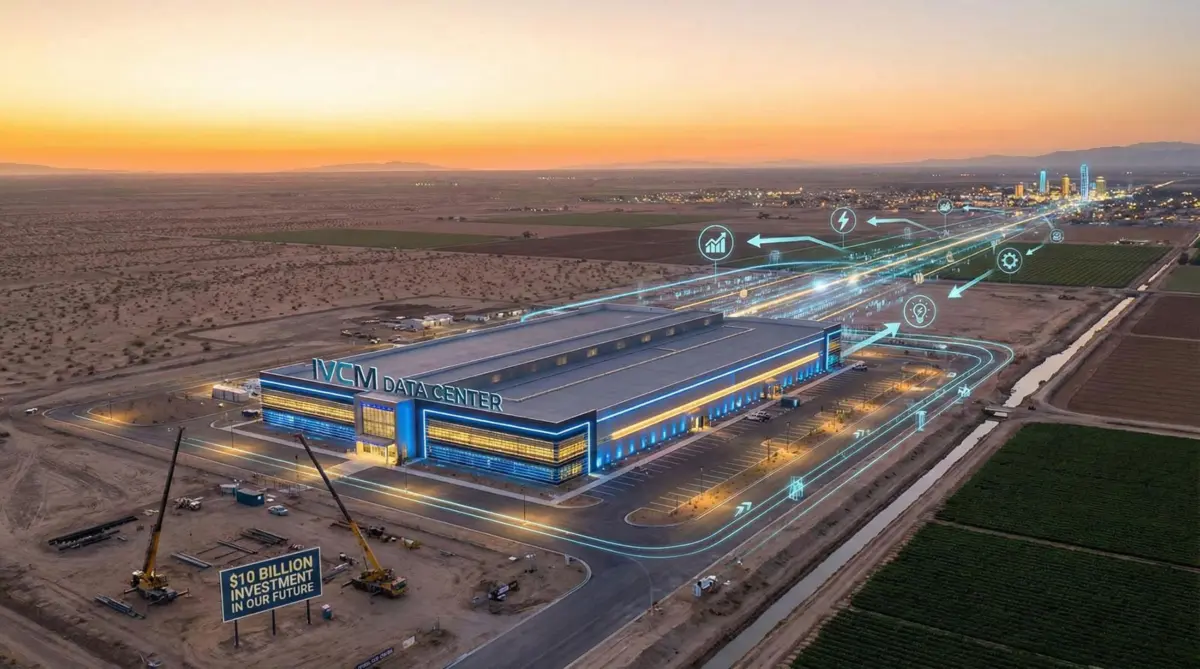
Proximity to electrical generation no longer guarantees access to hundreds of megawatts of capacity. With traditional hubs like Northern Virginia, Dallas, and Phoenix facing severe transmission congestion and long interconnection queues, data center developers are shifting from asking, "Where do we want to build?" to "Where can we actually secure and deliver the power?"
Detailed Chronology of the Power Bottleneck
To understand how the data center industry reached this inflection point, it is necessary to examine how the relationship between digital infrastructure and the electrical grid has evolved over the past half-decade:
2020 (The Baseline Baseline): Global data center power consumption stood at a relatively modest 410.8 TWh. While cloud computing was growing rapidly, server racks operated at standard thermal densities, and regional utilities could easily accommodate standard interconnection requests within 12 to 18 months.
2021–2022 (The Generative AI Spark): The public rollout of advanced generative AI models triggered an unprecedented pivot in corporate computing. Hyperscalers began aggressively acquiring GPUs and redesigning infrastructure for high-density AI clusters, instantly driving single-rack power requirements from 5–10 kW to 40 kW, 100 kW, and beyond.
2023–2024 (The Interconnection Queue Crisis): As demand scaled exponentially, regional transmission organizations (RTOs) and independent system operators (ISOs) were inundated with connection requests. Wait times for grid interconnection studies ballooned to several years. Traditional data center hubs began running out of substations, forcing developers to look past tier-one markets.
2025 (The Tipping Point): US data center consumption hit 312.6 TWh, driven by a 25.5% annual spike. Grid constraints became so severe that time-to-revenue surpassed capital expenditure as the primary metric for success. Behind-the-meter generation officially transitioned from a fringe contingency plan to a mainstream strategy, with operators actively pairing campuses with natural gas turbines, advanced storage, and direct energy partnerships.
Supporting Context & Metrics: The Anatomy of a Crisis
The numbers underlying the current data center power crunch reveal a systemic misalignment between digital infrastructure deployment speeds and utility planning cycles.
The Scale of Consumption
US vs. Global Share: The United States consumes nearly 40% of the world’s data center electricity, illustrating the concentration of major hyperscalers, large language model (LLM) training facilities, and enterprise cloud infrastructure within American borders.
The Velocity Gap: While overall US power generation grew at a modest 3.2% in 2025 to reach 4,772 TWh, data center demand skyrocketed by 25.5%. This means data center expansion is soaking up an outsized portion of new generation capacity, creating friction with residential and industrial ratepayers who face rising electricity costs and grid reliability concerns.
Shifting Site Selection Dynamics
In constrained markets, the traditional site-selection checklist has been upended. Developers can no longer assume that buying a plot of land near a high-voltage transmission line equates to usable capacity.
"The key shift is from asking, ‘Where do we want to build?’ to ‘Where can we actually secure and deliver the power?’"
— Siddharth Muzumdar, Senior Vice President of Research, DC Byte
Furthermore, pairing massive power blocks with secondary and tertiary markets introduces secondary infrastructure challenges. Emerging markets often lack the dense fiber-optic network infrastructure found in established hubs like Silicon Valley or Northern Virginia.
As Bill Major, CEO of FiberLight, points out: "It could take years to construct a new AI data center, and just as long to build the fiber networks needed to connect it. Planning for both needs to happen in parallel." Operators are now forced to engage utility companies and dark-fiber providers simultaneously, auditing whether quoted electrical capacity is truly "firm and funded" or merely speculative.
Official Statements and Industry Insights
Industry leaders across real estate, research, and infrastructure development agree that the market has crossed a permanent threshold. The constraints are no longer temporary supply chain hiccups; they are structural realities of the energy transition.
Prioritizing Time to Revenue Over Cost: Sean Farney, Vice President of Data Center Strategy at JLL, emphasizes that financial models have fundamentally changed. "There’s more of a focus on time to revenue than cost," Farney explains. In a high-stakes AI race where first-mover advantage dictates market share, waiting three years for a subsidized utility rate is far more financially punishing than paying a premium for immediate, reliable power. "What’s not as easy to fix is time-to-revenue pressure or constraints."
The Reality of Multi-Phase Campuses: Siddharth Muzumdar notes that initial capacity metrics are often misleading. A facility designed for an initial 100-megawatt (MW) deployment frequently balloons into a multi-phase campus requiring several hundred megawatts as successive generations of AI chips and cooling architectures roll online. Consequently, site operators must stress-test their energy pipelines against 12-, 24-, and 36-month delay scenarios.
The End of Blind Faith in Grid Interconnections: The days of submitting a grid interconnection request and waiting passively for the utility to deliver are over. Bill Major issues a blunt warning to developers relying exclusively on traditional grid access: "If their only plan is to interconnect with the grid, their data center may never break ground."
The Acceptance of Behind-the-Meter Power: Once viewed with skepticism due to environmental and operational complexities, decentralized power generation has become a cornerstone of modern campus design. "For large-scale development, [behind-the-meter power] is here," Farney states. "It has gone from resistance three or four years ago to being openly accepted right now."
Future Outlook: Navigating the New Energy Paradigm
As the industry looks toward the latter half of the decade, the survival of data center developers and operators will depend entirely on their ability to master energy strategy as a core competency. Several key trends will define the future landscape:
1. Mainstreaming Behind-the-Meter (BTM) Solutions
Because waiting for legacy transmission upgrades can take half a decade, operators are increasingly embracing "bring-your-own-power" (BYOP) architectures. Natural gas turbines, high-efficiency reciprocating engines, and emerging solid-state transformer technologies are becoming permanent fixtures on data center campuses. While renewables and battery energy storage systems (BESS) help diversify portfolios and meet corporate sustainability mandates, dispatchable thermal generation is frequently deployed to guarantee the continuous baseload power required by high-density AI clusters. However, operators deploying BTM strategies must carefully navigate complex webs of air permits, fuel pipeline access, emissions regulations, and ongoing maintenance overhead.
2. Total Cost of Ownership (TCO) Beyond the Utility Rate
Evaluating a site strictly based on its baseline $/kWh utility rate is an obsolete practice. Forward-thinking developers now calculate the all-in delivered cost of electricity. This includes factoring in interconnection construction charges, peak demand fees, auxiliary site infrastructure, backup generation, and projected rate escalations over a 15-to-20-year asset lifecycle. As Muzumdar observes: "The most attractive market is not necessarily the one with the cheapest electricity. It is the one that can provide competitively priced power reliably and at the scale the operator needs."
3. Institutional Demand for Proof Over Promises
The financial ecosystem backing these multi-billion-dollar developments—comprising private equity firms, infrastructure funds, and institutional lenders—has grown increasingly rigorous. Vague assurances from regional utilities are no longer sufficient to secure construction financing. Lenders demand firm, legally backed delivery timelines supported by tangible capital expenditure commitments and proven engineering expertise.
Conclusion
The explosive growth of artificial intelligence has exposed the fragility of traditional electrical infrastructure, transforming power from a background utility into the defining currency of the digital age. For data center developers, the mandate is clear: power can no longer be treated as an afterthought in the site-selection process. It must be woven into the fabric of planning from Day One. Those who adapt to this reality by securing firm, scalable, and diversified energy solutions will thrive; those who wait on the traditional grid will find themselves permanently offline.