









Executive Overview
For over a decade, the DevOps movement has been universally championed as an engine of pure acceleration. Across virtually every technology sector, software delivery has been measured by raw velocity: shorter release cycles, massive automation, instantaneous feedback loops, and unfettered developer autonomy. Speed has long been synonymous with modernization.
However, when applied to the high-stakes, heavily regulated ecosystem of financial services—encompassing global banking networks, complex payment processors, and critical wealth management infrastructures—speed in isolation represents only a fraction of the enterprise equation. In these critical environments, a deployment that reaches production in mere minutes, yet lacks adequate auditability, transparent traceability, immutable resilience, and airtight access control, is not an engineering triumph; it is an unmitigated operational risk.
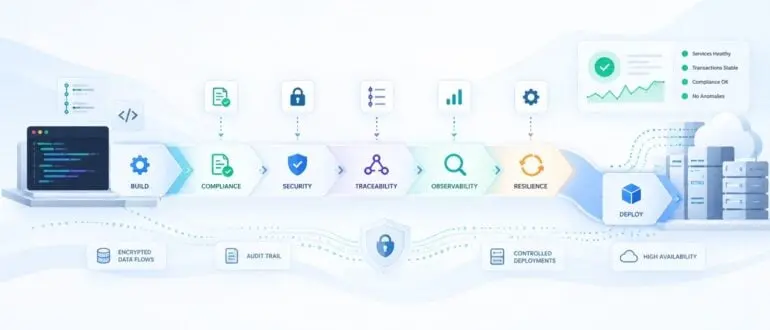
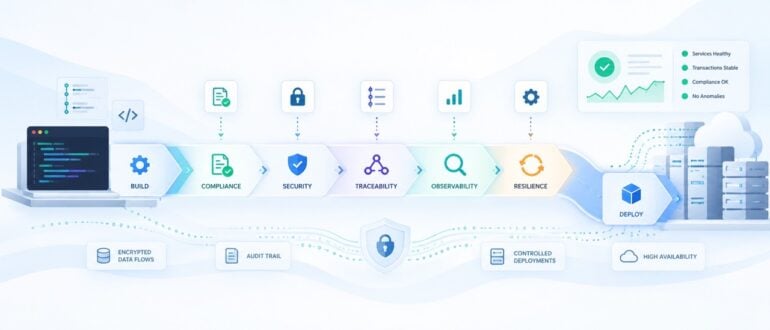
This fundamental reality is forcing a profound architectural reckoning across the financial sector. The traditional dichotomy that forces organizations to choose between the relentless speed of continuous delivery and the ironclad safety of regulatory compliance is a false choice. The modern mandate for financial institutions is far more sophisticated: to design end-to-end delivery systems where compliance and governance controls are not external roadblocks, but native, automated components of the core engineering workflow.
By embedding security policies directly into pipelines, shifting toward unified platform engineering, elevating traceability to a primary requirement, and merging infrastructure telemetry with deep business context, financial technology leaders are proving that regulatory rigor and high-velocity engineering are not mutually exclusive. Instead, they are mutually dependent.
Detailed Chronology: The Evolution of Compliance-Driven Delivery
To understand how financial institutions arrived at this modern convergence of DevOps and regulatory compliance, it is helpful to trace the chronological evolution of software deployment paradigms within the banking sector over the past twenty years.
Phase One: The Siloed Waterfall Era (Pre-2010s)
Historically, software delivery in financial institutions was dominated by rigid, highly segregated waterfall methodologies. Development teams wrote code in complete isolation from operations. Once a release candidate was finalized, it was thrown over the wall to a separate release management or infrastructure team.
Compliance and security were strictly terminal events. Weeks or months before a planned quarterly or semi-annual production release, auditors, risk officers, and security committees would manually review thousands of lines of documentation, configuration files, and change tickets. The process was notoriously slow, prone to human error, and generated immense friction between business goals and risk management.
Phase Two: The Rogue DevOps Experimentation (2010–2016)
As the digital revolution accelerated and fintech startups began eroding traditional market share, executive leadership in legacy banks demanded agility. Organizations rushed to adopt early DevOps toolchains—embracing continuous integration servers, configuration management scripts, and cloud infrastructure.
However, this initial wave of adoption was often decentralized and poorly aligned with regulatory mandates. Individual development squads spun up their own deployment pipelines, utilized disparate artifact repositories, and managed secrets according to their own ad-hoc preferences. While deployment frequencies skyrocketed, so too did operational inconsistencies, configuration drifts, and audit vulnerabilities. Regulators took notice, leading to severe reprimands, costly audit delays, and, in some cases, catastrophic production outages.
Phase Three: The External Gate Friction Model (2016–2020)
Realizing the dangers of unmanaged velocity, risk-averse financial institutions attempted to reconcile DevOps with compliance by introducing automated pipelines that culminated in massive manual checkpoints. Developers could build and test code rapidly within a staging environment, but the final push to production required multi-layered approvals, manual CAB (Change Advisory Board) sign-offs, and disjointed security scans executed just moments before deployment.
Rather than solving the problem, this model exacerbated it. Developers felt stifled by bureaucratic red tape, while compliance teams found themselves overwhelmed by a tsunami of last-minute change requests they lacked the automated tools to properly evaluate.
Phase Four: The Modern Platform Engineering Paradigm (2020–Present)
Today, the financial sector is embracing a mature, platform-driven model. Rather than treating compliance as an external hurdle or a manual gate, leading financial institutions are baking governance directly into automated delivery pipelines. Through advanced platform engineering, centralized teams build standardized "paved paths"—pre-approved, highly secure, and fully auditable templates that allow developers to move with startup-like speed while effortlessly satisfying stringent regulatory frameworks like Basel III, DORA, and SOX.
Supporting Context & Metrics: The Cost of Disconnected Governance
The transition from manual compliance gates to integrated platform engineering is not merely a philosophical preference; it is an economic and operational necessity dictated by the unique risk profile of the financial services industry.
The True Cost of Deployment Failures
In standard web applications, a failed deployment might result in a brief user-facing glitch that can be rolled back within minutes. In financial services, the stakes are exponentially higher. According to enterprise risk analyses across the banking sector, the average cost of a critical core-banking outage or compliance breach involves not only direct revenue loss and remediation expenses, but also severe regulatory fines, mandatory external audits, and catastrophic reputational damage.
| Dimension | Traditional Manual Approach | Modern Platform-Engineered Approach |
|---|---|---|
| Release Frequency | Quarterly / Bi-annual (High risk per release) | Multiple times daily (Low risk, incremental changes) |
| Compliance Verification | Manual audits post-release (High friction) | Automated policy-as-code during build (Continuous) |
| Incident Investigation | Hours/Days of manual log reconstruction | Minutes via immutable, version-controlled audit trails |
| Developer Experience | High frustration, ticket-heavy workflows | High autonomy via self-service "paved paths" |
| Resilience Strategy | Reactive high availability focus | Proactive, tested automated recovery disciplines |
The Mechanics of Policy-as-Code
Financial institutions operating at scale face immense architectural fragmentation if left unchecked. A medium-sized bank might house dozens of independent product teams. Without robust platform engineering, ten different teams will naturally produce ten distinct interpretations of how to manage cryptographic secrets, provision cloud infrastructure, configure audit logging, and execute rollbacks.
To eliminate this operational drift, mature institutions are codifying regulatory mandates into automated policy evaluation engines. When an infrastructure change is proposed via pull request, automated validation tools instantly scan the code against regulatory frameworks and internal security baselines. If a resource is configured without proper encryption-at-rest or if access control lists are overly permissive, the pipeline fails instantly, providing immediate, actionable feedback to the engineer long before the code ever touches a pre-production environment.
Official Statements & Industry Perspectives
Industry leaders across financial technology, regulatory compliance, and systems architecture increasingly agree that the future of banking infrastructure relies on harmonizing speed with control.
Elena Vance, Chief Information Security Officer at a Tier-1 Global Investment Bank:
"For years, compliance in banking was viewed as a speed bump designed to slow down reckless engineers. That model is entirely broken. In an era where cyber threats evolve daily and regulatory frameworks like the Digital Operational Resilience Act (DORA) demand absolute accountability, security cannot be an afterthought applied at the finish line. We must engineer compliance directly into the DNA of our software delivery pipelines. When governance becomes code, security is no longer a bottleneck; it is an accelerator."
Marcus Thorne, Principal Platform Architect and DevOps Strategist:
"The hallmark of a mature financial engineering organization is not how many deployments they push per day, but how predictably and safely they can recover when assumptions inevitably fail. If an engineer follows our standardized platform path, compliance is already satisfied by design. Traceability, immutability, and observability are baked in. This gives our developers the psychological and technical freedom to innovate rapidly, knowing the guardrails will protect the firm from systemic failure."
Dr. Aris Thorne, Regulatory Tech Analyst and Advisor:
"Regulators are no longer satisfied with static policy documents or verbal assurances. They want cryptographic proof, verifiable deployment chains, and instantaneous evidence of operational control. Financial institutions that cling to manual change approval boards will find themselves completely outpaced by competitors who have successfully automated their compliance workflows."
Future Outlook: The Next Frontier of Regulated DevOps
As financial institutions look toward the horizon, several emerging technological and operational trends will continue to redefine the intersection of DevOps, security, and compliance.
1. AI-Driven Compliance and Automated Remediation
The integration of Artificial Intelligence and Machine Learning into enterprise deployment pipelines is set to revolutionize risk management. Future platforms will not only detect policy violations before deployment but will utilize generative AI to automatically rewrite misconfigured infrastructure code to comply with evolving regulatory standards. Furthermore, advanced AI-driven observability systems will correlate infrastructure anomalies with business-level transaction failures in real-time, autonomously triggering pre-tested recovery playbooks before human operators are even alerted.
2. Zero-Trust Software Supply Chains
With software supply chain attacks increasing in sophistication, financial institutions are moving toward zero-trust delivery models. Every artifact, dependency, and container image will require cryptographic attestation (such as SLSA frameworks) ensuring that software has not been tampered with from its initial commit to its final production runtime. Traceability will extend deep into open-source dependencies, providing instantaneous impact analysis when a vulnerability is discovered globally.
3. Cultural Shift Toward Unified Operational Ownership
Ultimately, the future of DevOps in financial services relies on dissolving the historical barriers between development, security, operations, and compliance. By fostering a culture where every discipline shares a unified language of platform engineering, banks can finally eradicate the false dichotomy between speed and control.
Conclusion
The ultimate challenge of DevOps in financial services is not learning how to move slowly because the industry is heavily regulated. Rather, it is the sophisticated art of engineering so much confidence, resilience, and automated governance into the delivery system that financial institutions can move with absolute speed—without ever losing control.