






Executive Overview
For the better part of the last two years, the broader B2B software sector has endured a protracted period of existential dread, colloquially dubbed the "SaaSpocalypse." Wall Street grew deeply skeptical of legacy cloud models, questioning whether generative artificial intelligence would cannibalize seat-based software licences, compress margins, and render enterprise SaaS obsolete.
Then came August 26, 2026.
When Salesforce reported its Q2 fiscal year 2027 earnings, the market response was nothing short of electric. The company’s stock skyrocketed a stunning 23% in a single trading session, instantly dragging almost every other major B2B and SaaS stock upward in a monumental relief rally. Panic selling that had plagued the sector earlier in the year abruptly evaporated, replaced by a wave of optimistic re-evaluations.
At first glance, the numbers read like a historic blowout: $11.3 billion in revenue (up 11% year-over-year), a non-GAAP EPS spike of 103% to $5.90, and a raised full-year guidance bracket of $46.1 billion to $46.4 billion. CEO Marc Benioff boldly declared it the "No. 1 Q2 in Salesforce history."
However, beneath the headline-grabbing metrics and the market euphoria lies a more nuanced reality. A rigorous dissection of the financial statements reveals that Salesforce’s earnings explosion was heavily supercharged by strategic investment mark-ups—specifically its stake in AI pioneer Anthropic—and a massive $25 billion share buyback program, rather than pure, unadulterated organic operational hyper-growth.
Nevertheless, forward-looking indicators genuinely re-accelerated, and critical drivers like Agentforce and Data 360 proved that enterprise adoption of artificial intelligence is moving past the pilot phase. This article provides an exhaustive, deep-dive investigative analysis into Salesforce’s landmark quarter, dissecting the metrics behind the hype, the realities of organic growth versus inorganic padding, and what this pivotal report signals for the future of the enterprise software ecosystem.
Detailed Chronology & Financial Breakdown
The Setup and the Catalyst
The week leading up to Salesforce’s Q2 FY27 earnings call was characterized by muted expectations across enterprise software. Investors had grown accustomed to decelerating net-new annual recurring revenue (ARR), elongated sales cycles, and persistent macro-economic headwinds.
When the earnings release hit the wire after market close on August 26, 2026, the immediate reaction focused on top-line beats and explosive forward indicators. The stock’s subsequent 23% single-day surge signaled a dramatic psychological shift on Wall Street: investors were once again willing to pay a premium for enterprise software leaders that could successfully pivot toward an AI-native product suite.
Crucially, Salesforce’s forward-looking book genuinely accelerated. While recognized revenue reflects multi-year deals signed 12 to 24 months ago, forward-looking indicators demonstrated that enterprise demand had sharply rebounded over the preceding 90 days.
Supporting Context & Metrics: Five Critical Takeaways
To truly understand what happened during Q2 FY27, one must strip away the marketing gloss and examine five fundamental financial and operational pillars.
1. cRPO Accelerated to 14% While Revenue Grew 11%
Current Remaining Performance Obligation (cRPO)—the gold standard metric for contracted-but-unrecognized near-term revenue—hit $33.5 billion, climbing 14% year-over-year in constant currency.

- The Significance: cRPO growing three points faster than headline revenue is the most vital signal in the entire report. At a multi-billion-dollar scale like Salesforce, recognized revenue is a lagging indicator. cRPO, however, captures what was signed in the last quarter.
- Management’s Focus: Executive leadership noted that the entire company’s compensation structure had been realigned this year to prioritize net-new annual order value (AOV) growth over total AOV growth. This structural pivot served as the mechanical precondition for organic revenue reacceleration heading into the second half of the fiscal year.
- The Industry Context: To put this into perspective, enterprise peer Atlassian recently enjoyed a 35% single-day stock move on the back of 44% RPO growth. Salesforce’s 14% RPO expansion commanded a 23% move, proving that the modern market is ruthlessly pricing the order book above all else.
2. Strip Out Informatica, and Organic Revenue Growth Slips to 6.4%
While reported headline revenue growth stood at a healthy 11%, inorganic contributions must be accounted for to evaluate core business health.
- The Math: Informatica contributed $456 million during the quarter. Stripping this acquisition out reveals that Salesforce’s organic business grew at approximately 6.4% ($10.889 billion versus $10.236 billion a year prior). Subscription and support growth similarly drops from a reported 12% down to roughly 7%.
- Segment Dynamics: Salesforce now reports two primary revenue buckets: Agentforce Apps and Data/Platform/Other. Informatica sits entirely within the second bucket. Taking out Informatica’s $440 million in subscription revenue shows that the Data/Platform segment—widely heralded as the company’s primary AI growth engine—grew organically at just 5.7%, trailing core applications.
- MuleSoft, Tableau, and Slack: Management noted that growth in Data 360 and Headless infrastructure was "partially offset by license revenue headwinds and volatility in integration and analytics" (referring to MuleSoft and Tableau). Meanwhile, Marketing showed "early signs of recovery," though executives cautioned it was too soon to declare a sustainable trend. The reported apps growth figure of +7.6% also included Slack, which posted its best net-new AOV quarter since its acquisition, implying that core Sales and Service ex-Slack is expanding at a rate slower than 7.6%.
3. Non-GAAP Net Income (Excluding Investment Gains) Contracted
One of the most eye-catching figures in the earnings report was a staggering 103% increase in Non-GAAP Earnings Per Share (EPS). However, operating income tells a drastically different story: operating income came in at $2,331 million, compared to $2,332 million in the same period last year—essentially flat despite an 11% increase in revenue.
- The Investment Gain Bridge: The massive earnings beat came almost entirely from strategic investment mark-ups—specifically Salesforce’s booming stake in Anthropic—and an aggressive share buyback program. The strategic investment portfolio swelled from $7.6 billion to $11.3 billion over a six-month window. Marc Benioff highlighted this dynamic on the earnings call: "Take the value of Slack. Then take the value of our Anthropic stock. That has been like half our value."
- The Cost of Buybacks: To execute a massive $25 billion buyback program (repurchasing roughly 14% of shares at an average price of $176 while the stock traded higher), Salesforce took on significant debt. Interest expenses surged from $67 million to $473 million in a single year, non-current debt climbed from $10.4 billion to $39.3 billion, and total stockholders’ equity dropped from $59.1 billion to $38.4 billion.
- The Bottom Line: While buying back shares and holding Anthropic equity proved to be masterclass capital allocation decisions, the core operating business produced virtually identical dollar operating income on $11.3 billion of revenue as it did on $10.2 billion a year prior.
4. AI and Data Hit ~$3.9B ARR, Yet Market Penetration Remains Early
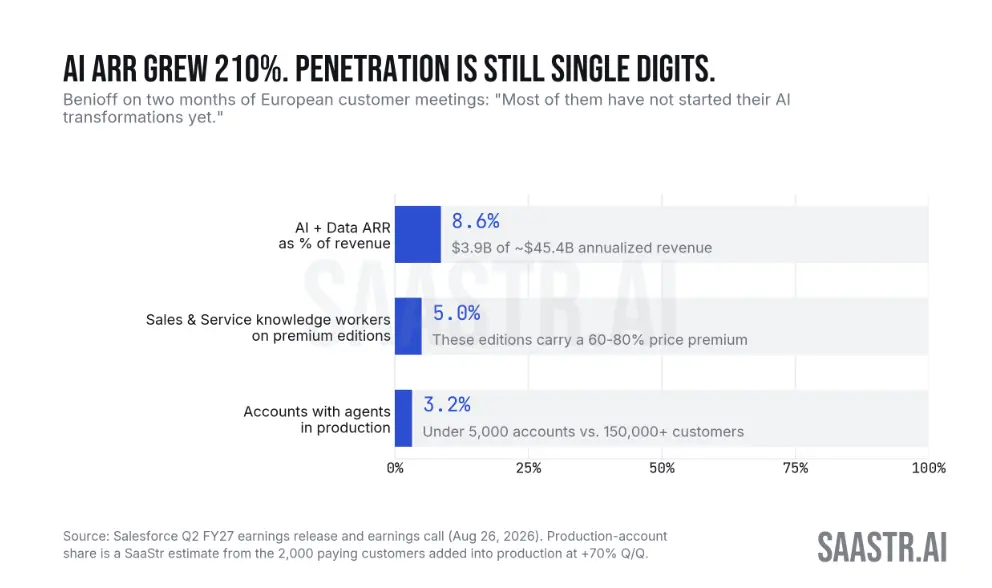
Salesforce’s artificial intelligence and data offerings have scaled rapidly, reaching an annualized run rate (ARR) of approximately $3.9 billion, representing roughly 8.6% of total revenue.
- Deconstructing the Metrics: The headline $1.5 billion Agentforce ARR figure requires context: effective this quarter, Salesforce broadened its definition of Agentforce ARR to include Slackbot and Headless 360. Consequently, the reported 240% year-over-year growth is measured against a baseline that has been redefined. Furthermore, the broader $3.9 billion bundle groups in Data 360—a foundational data platform that predates the generative AI boom.
- Production Reality: Despite impressive aggregate ARR figures, customer penetration remains remarkably thin. Two years into the rollout of Agentforce, AI accounts for roughly 8% of total revenue, but only about 3% of total accounts are actively running agents in production, and just 5% sit on the premium pricing tier. For competing SaaS firms benchmarking their own AI attach rates against Salesforce, the active production-account metric serves as the most realistic measuring stick.
5. Navigating Four Concurrent Pricing Models
Salesforce is currently attempting to monetize its platform using four distinct pricing mechanisms simultaneously: per-user, per-agent, per-consumption unit (via Flex Credits), and per-outcome.
- The Seat Pricing Dilemma: Addressing the friction of modern deployments, Marc Benioff admitted on the call: "We’re still trapped in some ways in old per user pricing models. But the opportunity to build much more aggressive pricing, to really represent the value that we’re offering our customers, I think is enormous."
- Unit Economics of Agents: Management highlighted active negotiations with major enterprise clients—such as a $40M customer running an activation agent processing 45 million Agentic Work Units (AWUs), weighing outcome-based pricing against unlimited enterprise agreements. Across the board, Agentforce ARR translates to roughly 12 cents per AWU, contrasted against standard human user seat licenses running at $125/user/month. To bridge this gap, Salesforce is rapidly expanding its human sales force, maintaining 15,000 account executives with plans to hire 1,200 more before the fiscal year ends, even as it absorbs $94 million in quarterly restructuring charges.
Official Statements & Leadership Insights
Leadership struck a triumphant yet pragmatic tone during the Q2 earnings call. Marc Benioff framed the quarter as vindication for the company’s aggressive pivot toward autonomous enterprise agents and unified data architectures.
"This was the #1 Q2 in Salesforce history," Marc Benioff emphasized, pointing to record-breaking cash flows and unprecedented enterprise consumption of Agentic Work Units.
However, CFO Robin Washington and operational executives provided necessary ballast, maintaining transparency regarding integration headwinds in MuleSoft and Tableau, and emphasizing that marketing tech recovery is still in its nascent stages. Benioff’s candid admission regarding the company being "still trapped… in old per user pricing models" highlighted the structural friction legacy software giants face as they attempt to transition from human seat-based licensing to consumption- and outcome-based AI monetization.
Future Outlook & What to Watch at Dreamforce
As the B2B tech sector looks past the initial euphoria of the post-earnings rally, industry analysts are turning their attention to upcoming catalysts—chiefly the annual Dreamforce conference and the financial metrics of the coming quarters.
Three key indicators will determine whether Q2 FY27 marked the permanent end of the SaaSpocalypse or merely a temporary relief rally fueled by investment mark-ups:
- Sustained cRPO Acceleration: Will forward contract growth consistently outpace recognized revenue growth through the back half of the fiscal year, confirming a true organic reacceleration?
- Production Adoption of Agentforce: Can Salesforce successfully convert its massive pipeline of AI interest into active, revenue-generating production accounts, pushing past the current ~3% production penetration threshold?
- Pricing Model Evolution: How effectively can Salesforce transition enterprise clients away from legacy per-seat pricing toward consumption- and outcome-based monetization without compressing operating margins?
The tsunami of artificial intelligence has only just begun to wash over the pre-AI enterprise software landscape. Salesforce’s Q2 performance demonstrates that industry titans with deeply entrenched customer relationships and unified data architectures can successfully ride the wave rather than be crushed beneath it. Whether the rest of the SaaS ecosystem can replicate this feat remains the defining question for the enterprise technology sector.