










Executive Overview
The B2B software ecosystem has crossed a threshold that most enterprise roadmaps are entirely unprepared for. According to freshly released operational data from high-growth project management platform Linear and tech incumbent Atlassian, software development has ceased to be an exclusively human domain.
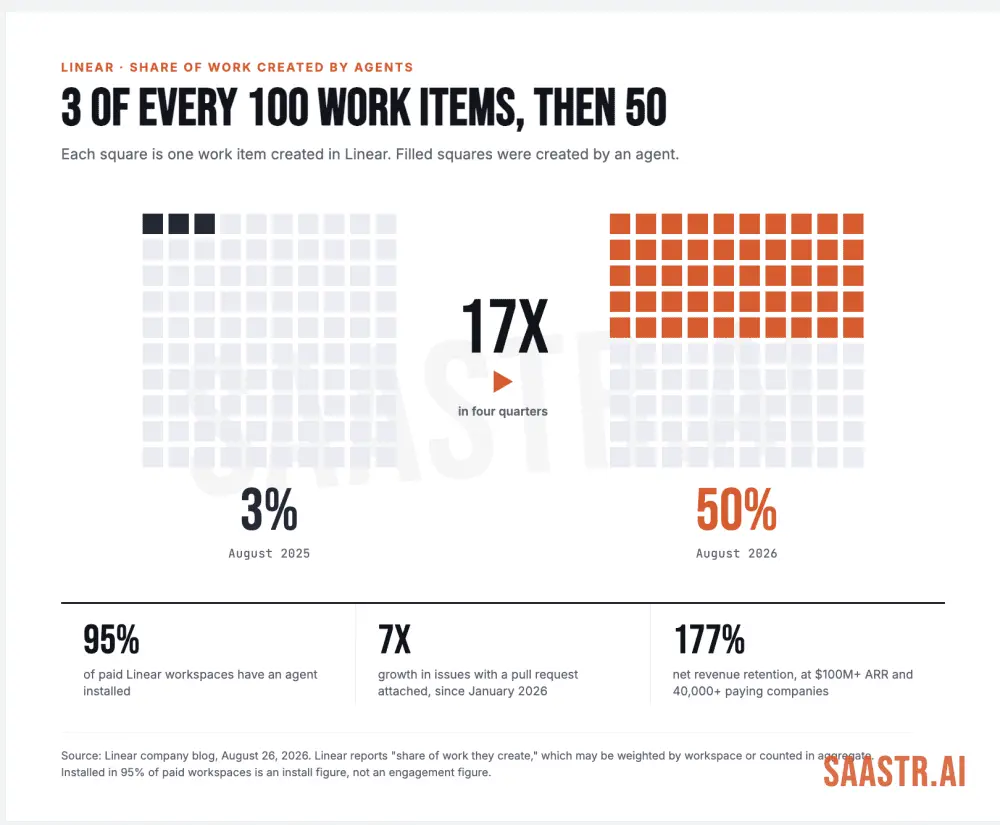
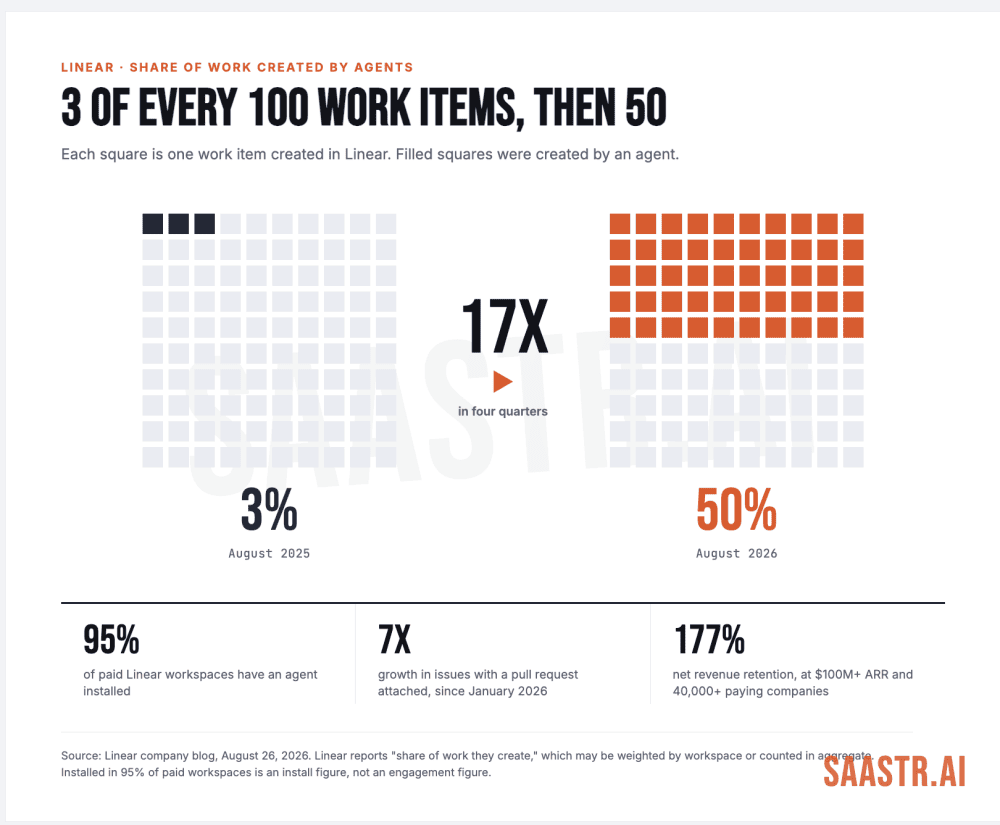
In a landmark structural shift that occurred across a single 12-month window, the share of work items created by autonomous agents inside Linear workspaces skyrocketed from 3% to a staggering 50%. Today, code-writing systems and specialized coding agents are installed in 95% of all paid Linear workspaces. This is not a superficial vanity metric tracking login frequencies or idle button-clicks; it is a fundamental transformation of the raw data composition coursing through one of the industry’s most critical systems of record.
Concurrently, Linear announced a $99 million secondary tender offer at a soaring $2.5 billion valuation—double its Series C valuation from the previous year—without raising a single dollar of primary capital. The company achieved this milestone while remaining cash-flow positive and holding more capital in reserve than it has ever raised in its history.
This report investigates the macroeconomic and structural implications of the "50% Machine Economy." By analyzing parallel disclosures from Atlassian, shifting net revenue retention (NRR) benchmarks, and the pressures facing horizontal mid-market platforms, we explore how software development toolchains are adapting to a reality where machines no longer just consume data—they generate, manage, and close it.
Detailed Chronology: The Twelve-Month Surge
To understand how software engineering workflows evolved so rapidly, one must examine the timeline of agentic adoption. Throughout 2024 and 2025, artificial intelligence in the workplace was largely characterized by auxiliary chat interfaces—glorified sidebars that answered questions or generated boilerplate code snippets. They were passengers in the development loop, rarely trusted to initiate workflows or alter source of truth databases.
Everything changed in early 2025 and accelerated through 2026.
- Early 2025: Autonomous coding agents (such as Cursor, Cognition’s Devin, and internal enterprise prototypes) began interacting with developer environments via APIs. At this stage, agent-generated issues in tracking tools like Linear sat at a modest 3% of total workload creation.
- Mid-2025: Major enterprise teams began integrating Model Context Protocol (MCP) servers and persistent agent platforms directly into their continuous integration/continuous deployment (CI/CD) pipelines. Instead of waiting for a human product manager to file a bug or draft a feature ticket, agents began monitoring pull requests, scanning logs, and autonomously populating backlogs.
- Late 2025 to Early 2026: Adoption curves that typically take enterprise features three years to traverse were compressed into quarters. Linear’s workspace penetration hit 95%, and the volume of machine-generated issues surged.
- Mid-2026: Linear formally reported that 50% of all work items inside its platforms are now generated by non-human actors. Simultaneously, issues featuring an attached pull request submitted by a combined engineering, product, or design workflow grew sevenfold compared to January 2026 levels.
This velocity has left traditional software forecasting models obsolete. Enterprise adoption historically follows a sluggish S-curve: moving from 3% to 8% to 15% over a 36-month period is traditionally cause for celebration. Linear’s leap from a rounding error to half of all created work in four quarters represents an unprecedented acceleration in enterprise tooling.
Supporting Context & Metrics: The Hard Data Behind the Shift
Sifting through enterprise software marketing claims often reveals ambiguous vanity metrics. However, the data points published by Linear and Atlassian provide a rare, quantifiable look at actual operational behavior.
1. Composition vs. Growth Rate
Linear published a composition metric: 50% of created work items originate from machines. Most SaaS providers, by contrast, publish growth rates derived from undisclosed baselines. For instance, Atlassian reported that Jira work items and Confluence pages generated via its MCP server grew nearly 4x quarter-over-quarter, with monthly active MCP server users surpassing 1 million.
While a 4x growth rate sounds impressive, it obscures the denominator—growing from 2% to 8% yields the same headline multiplier as growing from 15% to 60%. Linear’s willingness to publish its composition underscores a confidence born of overwhelming structural integration.
2. The Complete Loop: Issues to Pull Requests
A common critique of early AI adoption is the "spam problem"—automated scripts generating hundreds of low-value tickets that overwhelm human teams without advancing products. Linear countered this skepticism with a crucial second data point: issues paired with a pull request (PR) grew sevenfold since the beginning of the year.
Work is not merely being generated; it is being completed. Machines and humans are closing the feedback loop, transforming raw tickets into finalized, code-attached submissions ready for deployment.
3. Net Revenue Retention (NRR) and Account Expansion
Skeptics previously feared that agentic workflows would empty out user interfaces and destroy seat-based licensing models. If three software engineers can do the work of thirty using agents, enterprises will downsize their seat licenses, crashing SaaS revenue.
The exact opposite is occurring among market leaders:
- Linear maintained a phenomenal 177% Net Revenue Retention (NRR) at over $100M ARR while transitioning to the 50% machine-work model.
- Atlassian reported that MCP adopters expand paid seats faster and grow annual recurring revenue (ARR) at 2x the rate of non-adopters. Furthermore, Rovo users complete 20% more Jira items than traditional users.
Consumption follows work. Agents increase the demand for storage, API calls, compute cycles, and specialized identities within enterprise toolchains, driving robust account expansion even as human headcount growth flattens.
Official Statements and Industry Reactions
The structural bifurcation of the B2B market has prompted starkly different reactions across executive suites, captured in recent shareholder letters, earnings calls, and strategic financing moves.
The Incumbent Resilience: Atlassian’s Record Quarter
Atlassian’s Q4 FY26 shareholder letter dismantled the narrative that legacy project-management giants would be easily displaced by AI-native upstarts. Closing the fiscal year with revenue up 28% to $1.77 billion and subscription ARR hitting $6.6 billion, Atlassian demonstrated that massive, entrenched platforms can successfully weaponize AI to accelerate growth.
Atlassian co-founder Mike Cannon-Brookes emphasized that agents are active contributors to the enterprise "Teamwork Graph," rather than passive consumers. Crucially, Atlassian’s telemetry revealed that 98% of MCP users remained active in the standard Jira UI during the same month, proving that agents and humans operate synergistically within the same collaborative workspace.
The Mid-Market Squeeze
While top-tier incumbents and elite agent-native upstarts are thriving, the squeeze is punishing the horizontal mid-market. Platforms like monday.com and Asana are experiencing diverging fortunes. monday.com reported solid AI monetization metrics (AI products representing 17% of net new ARR) but was forced to cut approximately 20% of its workforce to achieve $100 million in annualized savings, with its stock declining significantly over the prior year. Asana guided to lower single-digit growth rates, highlighting the pressures facing mid-tier workflow tools caught between specialized developers and sprawling enterprise platforms.
Linear’s Strategic Tender Offer
Linear’s decision to execute a $99 million secondary tender offer rather than raising primary capital signals a maturing playbook for capital-efficient, cash-flow-positive tech companies. By allowing employees and early investors to liquidate a portion of their vested equity without diluting existing stakeholders, Linear established its $2.5 billion valuation on its own terms. With more cash in the bank than it has ever raised, the company is proving that modern software leaders do not need to trade equity for survival.
Future Outlook: The Three Questions Every B2B Leader Must Answer
As we look toward the remainder of the decade, the software landscape has irrevocably changed. The debate is no longer about whether generative AI will disrupt project management, but how software architectures must adapt to a reality where machines form the majority of active users.
B2B founders, product leaders, and enterprise architects must evaluate three critical imperatives moving forward:
- What percentage of records in your product were created by an agent last month?
It is no longer enough to claim you have "AI features." If you cannot measure the exact share of database objects—tickets, contacts, tasks, or documents—generated by automated actors versus human clicks, you are flying blind. - Does an agent possess a distinct identity in your product?
Linear succeeded because it built an agent platform treating non-human actors as first-class citizens with unique permissions, tracking capabilities, and security boundaries, rather than treating them as shared bot credentials. Every modern B2B tool must adopt this paradigm. - Does your pricing model scale with work volume or human headcount?
If your revenue model relies strictly on per-seat human licensing while your enterprise clients automate their workloads to triple output without hiring additional staff, you are leaving immense value on the table. Sustainable monetization must evolve alongside consumption.
The shift of software workflows from 3% machine-generated to 50% in a single year is not an isolated anomaly; it is the opening salvo of the Autonomous Enterprise. Companies that build for the machine-human collaborative loop will capture the next generation of enterprise value, while those clinging to legacy seat-based models risk becoming obsolete relics of the pre-agent era.