The modern retail landscape has long been defined by physical inventory—dusty shelves lined with paperbacks, towering stacks of bestsellers, and the unmistakable scent of printed ink. However, as digital consumption patterns continue to shift toward on-demand media, the traditional bookstore concept is undergoing a radical reimagining. According to data from the Audio Publishers Association, more than half of all Americans aged 18 and older—an estimated 157 million people—have listened to an audiobook, signaling a profound cultural pivot toward auditory storytelling.
Capitalizing on this booming market, Amazon-owned audiobook giant Audible orchestrated a bold experiential marketing campaign in May: the Audible Story House. Promoted as the world’s first-ever "bookless bookstore," this temporary, three-floor immersive installation at 260 Bowery in lower Manhattan challenged conventional ideas of what a bookstore could be. Devoid of physical pages, paper bindings, and printed covers, the space relied entirely on cutting-edge technology, tactile design, and community-driven programming to bring invisible narratives into the physical realm.
Operating for just one month—from May 1 to May 31, following a high-profile pop-up debut at BookCon within New York City’s Javits Convention Center in April—the Story House welcomed over 7,000 unique visitors through its free-to-enter doors. More than a simple marketing stunt, the pop-up served as a massive, real-world laboratory for Audible. By tracking deep-engagement metrics, analyzing physical interactions with custom-built "Story Tiles," and observing how modern consumers discover audio content, Audible has gathered invaluable data that will directly influence the design of its digital app and future global activations.
Detailed Chronology: From Concept to Closure
The journey of the Audible Story House began taking shape in early spring, engineered to capture the attention of voracious readers and casual listeners alike during a period of peak literary excitement in New York City.
April: The BookCon Prelude
Before setting up its permanent month-long residency in lower Manhattan, Audible introduced the core concept of the Story House as a pop-up experience during the triumphant return of BookCon at the Javits Convention Center. This initial preview acted as a stress test for the brand’s physical interactive technology. Giving convention-goers a compressed taste of what a bookless retail environment looked like, the early deployment successfully generated early buzz, social media traction, and validated the public’s appetite for tangible interactions with invisible digital goods.
May 1 – May 31: The Bowery Residency
Following the convention preview, the full-scale Audible Story House officially opened its doors at 260 Bowery on May 1. Spanning three meticulously designed floors, the location was partitioned into seven distinct listening spaces, each curated to offer a different sensory relationship with audio literature.
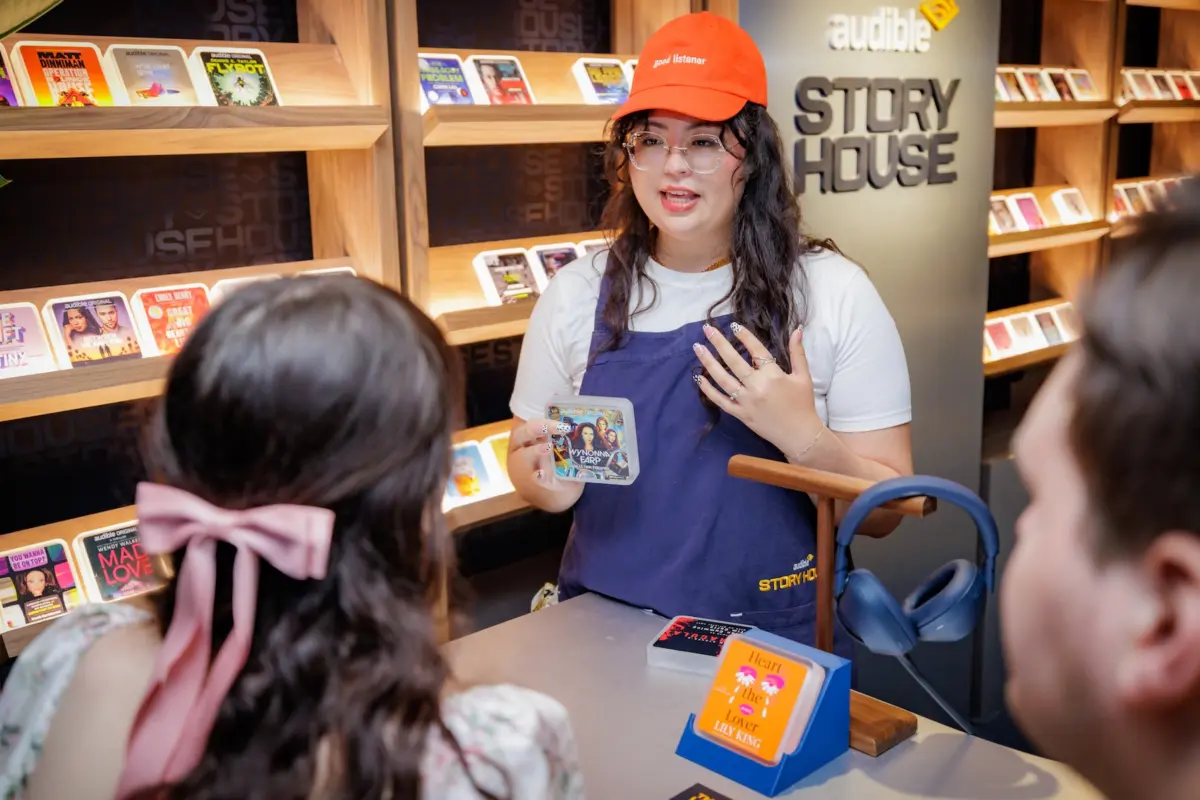
Rather than walking past shelves of printed text, visitors navigated the space using physical "Story Tiles"—specially manufactured blocks embedded with Radio-Frequency Identification (RFID) chips. By placing these tiles onto readers distributed throughout the venue, guests could instantly sample audiobooks through high-end speakers, personal headphones, or their own mobile devices and earbuds.
The installation was far more than a listening booth. It featured an immersive Dolby Atmos surround-sound theater designed to showcase cinematic audio productions, alongside a dedicated "Listening Bar." Staffed by knowledgeable "Story Tenders," the bar functioned similarly to a craft cocktail lounge, providing guests with personalized, conversational book recommendations tailored to their unique tastes.
Beyond passive listening and active sampling, the Story House transformed into a bustling community hub. Over its 301 hours of operation, the space hosted:
Live creator programming and panel discussions with bestselling authors.
Intimate book club gatherings and interactive literary debates.
Hands-on crafting workshops tied to popular narrative themes.
A pop-up cafe operated by Brooklyn’s acclaimed Land to Sea, complete with themed menu items like the fan-favorite "AudiBuddy."
Exclusive, limited-edition merchandise drops that drew long lines down the Bowery.
June: The Aftermath and Finality
Despite its overwhelming popularity and the constant stream of visitors who assumed the location was a permanent fixture of the Manhattan cultural scene, the Story House closed its doors on May 31, vanishing as quickly as it had arrived.
"It was very hard when we closed the doors, I will be honest," admits James Finn, Audible’s global head of brand content marketing. "And a lot of people assumed that it was going to be there permanently, which was a nice compliment to the team that built the space."
Supporting Context & Metrics: Data Behind the Digital Bookshelf
The success of the Audible Story House cannot be measured merely by foot traffic or aesthetic charm; the true value of the month-long experiment lies in the wealth of quantitative and qualitative data collected by Audible’s marketing and product development teams.
Content Consumption and Diversity of Taste
Out of the 301 carefully curated titles featured within the Story House, an astonishing 98% of the audiobooks were listened to "to any degree" by visitors over the course of the month. This statistic highlights a major win for discoverability, proving that when friction is removed and alternative discovery channels are introduced, consumers are remarkably willing to explore content outside their immediate comfort zones.
While the catalogue spanned multiple genres, several standout titles dominated the listening logs:
Project Hail Mary by Andy Weir
The Hive: A Thriller by various contributors
George Orwell’s timeless dystopian classic, 1984
Just Kiss Already by Terry Travis
Audible’s full-cast immersive recording of Harry Potter and the Sorcerer’s Stone
Additionally, the activation coincided strategically with the May 12 release of A Parade of Horribles, the eighth installment in Matt Dinniman’s wildly popular Dungeon Crawler Carl LitRPG series. According to the team, fans flooded the space specifically to engage with the franchise. "People were coming in, and they had already listened to it, and the eighth book had only come out a couple days ahead of time, and they were still tapping it, and they still were excited about that," Finn notes.
Measuring Deep Engagement
Audible established a strict threshold to differentiate casual foot traffic from genuine consumer interest, recording more than 15,000 "deep engagement" experiences during the month. These were defined by interactions where visitors did not simply walk in and immediately leave, nor did they merely tap a single sample and walk out.
Instead, deep-engagement guests spent extended periods exploring multiple floors, participating in scheduled community sessions, attending panel talks, or lingering in the cafe space. This high dwell time proved to the leadership team that physical environments can successfully foster deep emotional connections to digital audio products.
Official Statements and Industry Insights
The motivations, challenges, and ultimate strategic takeaways of the Story House initiative were illuminated in statements provided exclusively to Variety by Audible’s global head of brand content marketing, James Finn.
Reflecting on the core purpose of the installation, Finn emphasized the rarity of gaining real-time, face-to-face feedback at scale:
"What I was excited about was the opportunity to learn a lot more about customers and their experiences in that space. And oftentimes, I don’t have a sample size like that, and I don’t have a situation where we show up for an entire month in a city like New York and really learn more about our existing customers and new listeners."
Making the invisible visible was both the greatest design challenge and the most successful innovation of the project. The physical "Story Tiles" were engineered from scratch because no such medium previously existed for audiobooks.
"We created that technology and that item. It didn’t exist," Finn explains. "The ambition was, how do we take something invisible and make it tangible? So the RFID component with it, we were able to see what people were listening to, and it was fantastic because everybody has different tastes and we saw such an interesting read across the entire slate of content there."
Crucially, the experiment was never intended to remain confined to a single New York pop-up. The ultimate goal has always been translational—translating real-world brick-and-mortar insights into digital user experience enhancements within the Audible app.
"What are the learnings from the actual experience in New York that we can adapt to the experience within the app and within the service?" Finn asks, summarizing the internal corporate review process. The primary takeaway? "Removing friction and allowing more engagement and allowing more of an opportunity for personalization, so that they have the opportunity to go to what’s interesting to them, but to sample and to try."
Future Outlook: Taking the Story House Global
As Audible packs away the physical infrastructure of the Bowery location—including the roughly 1,000 leftover tactile "Story Tiles" that physicalized its digital library—the company is actively strategizing how to deploy the concept on an international scale.
While a permanent, standalone "bookless bookstore" network is not currently slated for an immediate rollout, the core philosophy, design framework, and interactive technologies developed for the Story House are hitting the global exhibition circuit.
Confirming the roadmap for the upcoming year, Finn revealed that Audible is pivoting toward major international literary gatherings rather than localized pop-ups:
"What we’ve been doing is assessing what does Audible Story House look like in our plans for ’27. Right now, what we’re doing is similar to what you saw at BookCon. We’re going to bring a version of that with the core fundamentals to Guadalajara Book Festival, and then Frankfurt Book Fair."
By scaling down the installation into portable, highly curated modular experiences for premier global book fairs in Mexico and Germany, Audible aims to test how international audiences interact with tactile audio discovery.
As the audiobook industry continues its exponential growth—backed by the millions of listeners tuning in across the United States and beyond—experiments like the Story House prove that the future of reading is not bound by paper, but propelled by sound. By bridging the physical and digital worlds, Audible is redefining the modern bookstore, ensuring that even without turning a single page, the story continues to captivate.