By the Editorial Desk
Published: August 2026
Executive Overview
Nearly four years have passed since the seismic launch of ChatGPT, swiftly followed by Anthropic’s Claude and a sweeping paradigm shift across the digital landscape. Despite the ubiquitous presence of generative artificial intelligence (genAI) in daily consumer workflows, marketers, search engine optimization (SEO) professionals, and digital analysts have largely operated in the dark. For years, the industry has lacked granular, transparent data regarding how consumers actually format their prompts, what conversational patterns they employ, and how specific platforms construct their underlying response methodologies.
For the most part, digital strategists have been forced to rely on legacy search query data, reverse-engineering traditional keyword metrics to infer genAI interactions. While Microsoft’s Bing stepped into the transparency arena early by reporting specific "Grounding Queries"—the foundational prompts that drive its "fan out" response architecture—Google’s massive ecosystem remained a black box.
That is, until now. Recent discoveries confirm that Google’s "AI Mode" quietly logs both initial user prompts and conversational follow-up queries directly into the standard search ecosystem. These interactions eventually trickle down into Google Search Console (GSC).
For forward-thinking SEO practitioners, this revelation unlocks a goldmine of previously hidden consumer intent data. By leveraging advanced regular expressions (regex), third-party API integrations, and built-in AI analytics tools, digital marketers can finally isolate generative AI prompts from standard keyword traffic. This article provides an authoritative, investigative deep dive into how Google Search Console is recording genAI interactions, why this matters for the future of search visibility, and actionable methodologies for extracting, analyzing, and applying this emerging data to your optimization strategies.
Detailed Chronology: Uncovering the Google Search Console AI Leak
The trail to discovering how Google logs generative AI prompts began with an anomaly that baffled digital marketers for months. As conversational search experiences matured, SEO professionals worldwide noticed unusual, highly conversational strings appearing in their Google Search Console performance reports. Instead of concise, transactional keyword phrases like "best project management software" or "how to track chatgpt rankings," reports began populating with bizarrely human queries.
The breakthrough came when Anastasia Kourou, an SEO Manager for Greece-based Relevance Digital Agency, decided to investigate a peculiar set of data points in her client dashboards. Kourou noticed that Search Console was registering fragmented, conversational queries that bore no resemblance to traditional search behavior. Entries such as simple conversational confirmations—including standalone inputs like "yes" and "yes, pricing"—were showing up as legitimate search queries driving impressions.
Recognizing the anomaly, Kourou took the conversation public. She tagged Google Search Engineer John Mueller on LinkedIn, directly asking why Search Console was indexing these genAI-like conversational fragments as search queries.

In a confirmation that sent ripples through the SEO community, Mueller verified that these peculiar entries were not data glitches or crawler anomalies. Rather, they represented genuine follow-up prompts entered by human users operating within Google’s AI Mode. Because AI Mode relies on continuous, multi-turn conversational threads, the platform logs these interactive follow-ups within the overarching search infrastructure, inadvertently exposing them to webmasters through standard reporting channels.
Following Mueller’s confirmation, the SEO community mobilized. Jean-Christophe Chouinard, an SEO strategist at Tripadvisor, expanded upon initial filtering techniques by publishing sophisticated regular expressions designed to capture not just long-tail conversational starters, but the subtle, multi-word conversational continuations—such as "yes, please" and "tell me more"—that characterize modern AI interactions.
This pivotal exchange marked a turning point: Search Console, designed decades ago to track rigid keyword-and-link behavior, is now quietly capturing the conversational DNA of the generative AI era.
Supporting Context & Metrics: The Quest for GenAI Transparency
To understand the magnitude of this discovery, one must look at the broader landscape of search engine transparency. Since the generative AI revolution began, platform opacity has been one of the greatest hurdles for digital marketers.
The Data Desert of Conversational AI
When standalone chat interfaces like ChatGPT and Claude captured market share, they did so entirely outside the traditional web analytics ecosystem. Users query these systems in privacy-protected, walled-garden environments. Brands have had virtually zero visibility into the exact phrasing consumers use when asking AI models for recommendations, product comparisons, or service evaluations.
Traditional search metrics—cost-per-click (CPC), search volume, and keyword rankings—were built for a deterministic web. They assume a user types a query, scans a list of ten blue links, and clicks a destination. Generative AI, by contrast, operates on probabilistic synthesis. It reads across the web, extracts core concepts, and synthesizes an original answer. Without knowing the prompts that trigger these syntheses, marketers cannot optimize their content for Large Language Models (LLMs)—a discipline increasingly known as Generative Engine Optimization (GEO).
Bing’s Early Lead vs. Google’s Massive Footprint
Microsoft’s Bing was an early pioneer in acknowledging this shift. By explicitly reporting "Grounding Queries" in its reporting infrastructure, Bing provided a window into how its Copilot technology breaks down complex user requests into smaller sub-queries to gather comprehensive web data.
However, Google commands an overwhelming majority of global search market share. While Bing’s transparency is commendable, Google’s integration of AI Mode across billions of consumer touchpoints makes its data infinitely more representative of global consumer behavior. The confirmation that AI Mode queries bleed into Google Search Console bridges the gap between traditional search data and modern LLM analytics, offering the closest thing to a universal window into consumer prompting habits.
Official Statements and Technical Mechanics
To effectively leverage this data, SEO professionals must understand the technical mechanics of how Google Search Console processes these queries and what industry experts advise regarding their interpretation.
Decoding John Mueller’s Insights
John Mueller’s LinkedIn clarification underscored a fundamental reality of modern search architecture: the line separating traditional keyword queries from conversational prompts is blurring. As search engines evolve into conversational answer engines, the backend infrastructure inevitably merges the telemetry of both experiences.
When a user engages with Google’s AI features, the system treats the conversational session as a continuous query lifecycle. The initial prompt—often structured as a complete, complex question or instruction—is logged alongside any subsequent clarification inputs.
The Nature of AI Mode Queries in GSC
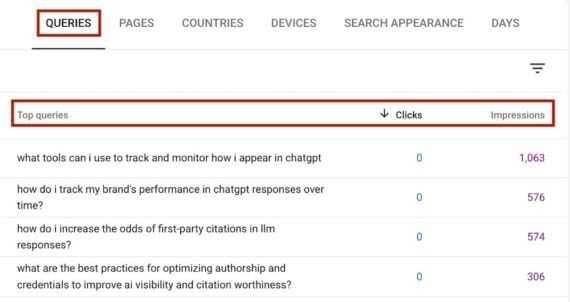
When analyzing these queries in your Search Console reports, you will typically notice distinct characteristics:
- Extreme Length: Unlike traditional keywords (which average two to four words), AI prompts frequently span ten to twenty words or more, framing an explicit scenario, constraint, or persona ("Act as a financial advisor and explain…").
- Zero Clicks, High Impressions: Many of these prompt-driven queries register high impression counts relative to their click-through rates. This occurs because the AI interface often answers the user’s question directly within the search results page or chat window, reducing the necessity for the user to click through to an external website.
- Competitor Tracking Artifacts: A subset of these long queries may actually stem from automated prompt-tracking software and AI monitoring tools deployed by competing brands. While these are not human queries, they offer invaluable intelligence regarding what metrics and keywords your competitors are actively monitoring.
Actionable Strategy: How to Identify and Act on AI Prompts in GSC
Because Google Search Console’s standard front-end user interface is limited in its ability to parse massive datasets, uncovering these hidden prompts requires targeted technical filtering. Here is a step-by-step framework for isolating and leveraging genAI prompts within your analytics stack.
1. Filtering via Regular Expressions (Regex) in GSC
To separate standard keyword queries from long-tail conversational prompts, you must use regular expressions within the Search Console performance report.
- Navigate to your Google Search Console property.
- Click on the Performance tab and ensure queries are selected.
- Click + New and select Query.
- Change the filter dropdown from "Queries containing…" to Custom (regex).
- Enter a regex filter designed to capture long-tail phrasing. For example, to isolate queries containing ten or more words, input the following expression:
([^” „]*s)10,? - Apply the filter.
You will instantly see a transformation in your data table. The rigid keyword phrases will vanish, replaced by long, conversational search strings, complex questions, and multi-clause instructions.
Advanced Tip: For a more comprehensive view that captures short follow-up prompts (such as "yes, please" or "tell me more" that occur within an AI session), implement the extended regex frameworks shared by enterprise SEO practitioners like Jean-Christophe Chouinard in your analytics dashboards.
2. Leveraging External Tools and APIs for Scale
While GSC’s front-end interface is useful for quick spot-checks, it caps visible data and lacks advanced analytical capabilities. To truly make sense of thousands of prompts, you must pull data via the Search Console API.
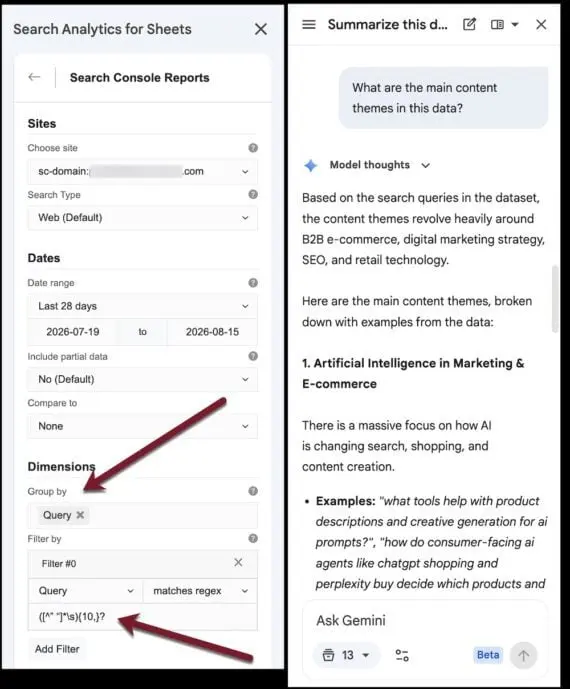
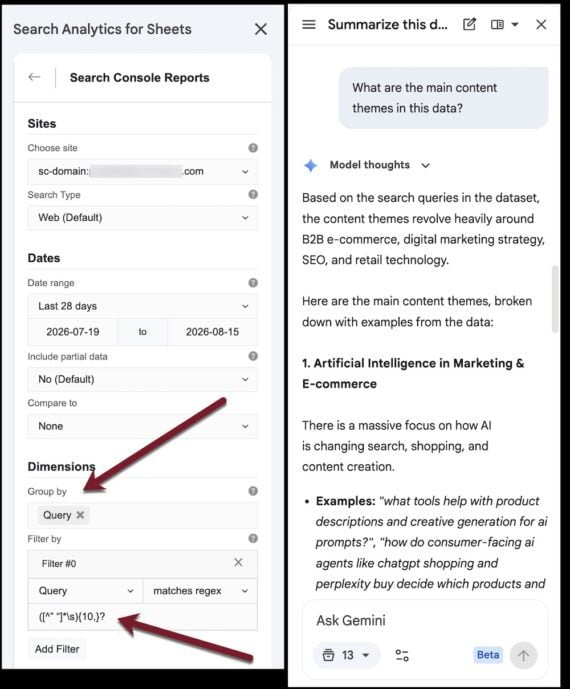
While custom Python scripts or enterprise data warehouses are options, free third-party tools provide accessible pathways without requiring developer resources. For instance, tools like Search Analytics for Sheets (a popular Google Sheets add-on) allow you to securely pull up to 25,000 queries directly from your Search Console property into a spreadsheet environment.
Once the data is exported, you can integrate built-in AI capabilities—such as Google’s Gemini sidebars within Google Workspace—to analyze, categorize, and group the queries. Instead of manually reading thousands of conversational strings, you can prompt Gemini to:
- Group the long-tail queries into core content themes and user intent clusters.
- Identify recurring pain points, questions, or product requirements that your current content strategy fails to address.
- Flag anomalies, such as automated competitor tracking bots or emerging industry terminology.
3. Translating Prompt Data into Content Optimization Tactics
Identifying the prompts is only half the battle; the true value lies in how you adapt your digital marketing strategy to address them. Because prompts are inherently detailed, contextual, and unique, traditional keyword optimization tactics will fall short. Instead, apply the following optimization frameworks:
- Adopt Comprehensive Content Structures: AI prompts reveal that users are asking nuanced, multi-part questions. Ensure your content addresses the "why" and "how," rather than just the "what." Use detailed FAQs, case studies, and step-by-step guides that match the exhaustive nature of consumer prompts.
- Optimize for Semantic Entity Association: LLMs do not look for exact-match keywords; they evaluate entities, relationships, and contextual authority. Review the recurring concepts within your extracted AI prompts and ensure your site architecture clearly establishes topical authority across those interrelated subjects.
- Prepare for Zero-Click Conversational Reality: Because many AI prompts result in zero-click summaries, your goal must expand beyond traditional organic traffic acquisition. Focus on brand positioning and citation optimization. Ensure your brand is cited authoritatively within the sources that LLMs pull from when synthesizing answers for these high-value prompts.
Future Outlook: The Next Frontier of Search Analytics
The revelation that Google Search Console logs AI Mode prompts marks a crucial evolution in search marketing. As artificial intelligence continues to reshape how humanity accesses information, the boundary between "searching" and "prompting" will dissolve entirely.
Looking ahead, we can anticipate several major developments in the analytics ecosystem:
- Native AI Analytics Suites: It is only a matter of time before search engines provide dedicated reporting views explicitly separating conversational AI interactions from traditional web search queries, offering transparent metrics on citation frequency and generative visibility.
- The Rise of Generative Engine Optimization (GEO): As marketers gain better visibility into prompt structures, SEO will increasingly merge with natural language processing strategies. Agencies will build proprietary prompt-logging databases to reverse-engineer how specific LLMs weigh brand recommendations.
- Privacy and Data Governance Challenges: As platforms capture deeper conversational telemetry, balancing consumer data privacy with marketer transparency will remain a central regulatory battleground. Marketers must remain agile, utilizing permitted API pathways and first-party data aggregation to maintain visibility.
For now, the tools are already in your hands. By harnessing regular expressions, leveraging API-driven spreadsheet integrations, and interpreting the conversational data hiding in plain sight within Google Search Console, digital marketers can step out of the dark. Unmasking the AI prompt is no longer an impossible endeavor—it is the competitive edge defining the next generation of search optimization.