Executive Overview
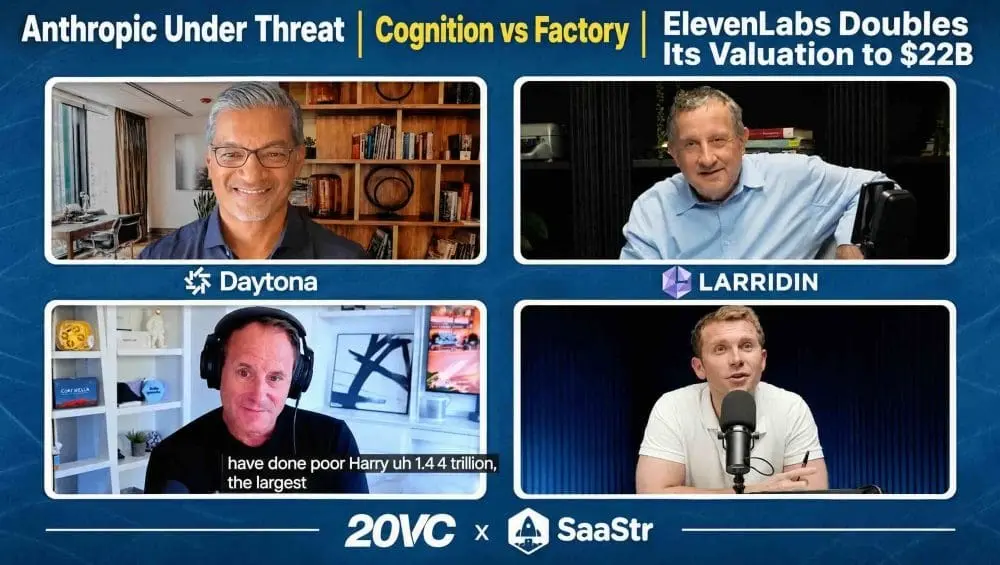
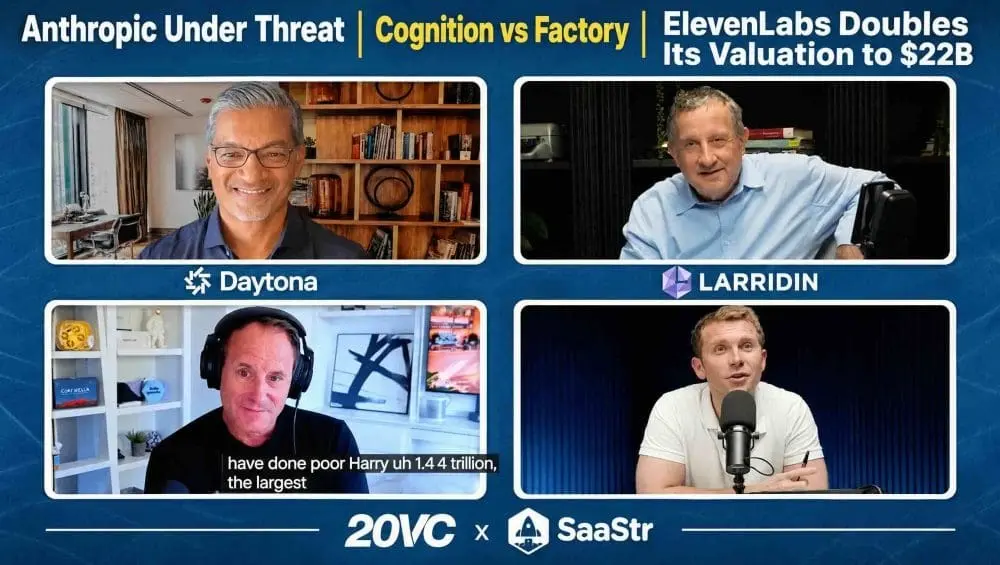
The artificial intelligence economy has officially crossed a threshold from speculative exuberance to high-stakes industrial consolidation. In a market dominated by dizzying capital inflows and relentless technological obsolescence, the latest installment of 20VC x SaaStr—featuring host Harry Stebbings alongside tech investors Rory O’Driscoll and Jason Lemkin—lays bare the raw, unapologetic math shaping the current landscape.
The focal point of this seismic shift is SpaceX’s aggressive $60 billion acquisition of AI code editor Cursor, a move that bypassed a pending $50 billion Andreessen Horowitz-led round by offering overwhelming terms, a $10 billion breakup fee, and complete operational autonomy. But the Cursor blockbuster is merely the tip of the iceberg. From Stripe dropping billions to absorb routing infrastructure like OpenRouter, to Anthropic’s explosive arithmetic crossing the threshold into profitability, to private equity giants like Silver Lake deploying precise financial engineering on legacy tech stalwart Workday, the rules of software valuation have been entirely rewritten.
Beneath the headline-grabbing valuations lies a fundamental economic question: Can the AI ecosystem actually scale to the projected $200 billion to $600 billion in revenue targets? According to industry experts, the math relies on a brutal new corporate reality: roughly $100,000 in annual token consumption per engineer, paired with a 30% to 40% reduction in software engineering headcount. This report investigates the mechanics, metrics, and maneuvers driving the most volatile and lucrative cycle in technology history.
Detailed Chronology and Strategic Breakdown
1. The Anatomy of the $60 Billion Cursor Deal
When SpaceX closed its acquisition of Cursor at a $60 billion valuation, skeptics initially balked at the astronomical multiple—roughly 15 times current revenue or under 10 times the $6 billion the company is tracking toward by year-end. However, as Rory O’Driscoll noted, buying at 15 times revenue with paper that trades at 40 times (in the case of SpaceX) is immediately accretive.
Cursor’s trajectory has been nothing short of a Hollywood thriller. Barely 12 months prior, industry insiders were writing its obituary. Rocketing to half a billion in revenue, Cursor was suddenly blindsided by the launch of competing developer tools like Claude Code. Many observers declared the platform functionally dead. Yet, Cursor’s leadership made a decisive pivot: they went multimodel early. That single strategic call resurrected the company, turning what looked like a dying asset into a $60 billion outcome.
2. The Elon Musk Playbook: Solving the Gross Margin Problem
Why did SpaceX buy a company widely criticized by venture capitalists for having a terrible gross margin structure—selling a dollar’s worth of tokens for well under a dollar?
The answer lies in a masterclass of structural arbitrage. Cursor’s single largest operating expense was external inference costs paid to frontier lab providers. By placing Cursor under the umbrella of SpaceX—and specifically integrating its data and compute demand with Elon Musk’s Colossus cluster—that external inference cost instantly transforms into internal revenue.
As O’Driscoll summarized, "Your gross margin problem is my revenue opportunity for my Colossus cluster." The set of buyers who can execute this play is exceptionally small, requiring hyper-scale compute infrastructure without an immediate, native developer ecosystem to consume it. Meta and SpaceX were the primary contenders; SpaceX moved first.
3. Stripe’s Aggressive M&A Spree: OpenRouter and Beyond
In a parallel power move, Stripe shelled out approximately $7 billion for OpenRouter, the premier LLM routing layer led by Alex Atallah, just four months after OpenRouter closed a $1.3 billion funding round.
Stripe’s historical core competency has always been absorbing complex technical plumbing in exchange for a percentage of transaction flow. Model selection, multi-API integrations, and routing represent the exact same shape of problem. While bears argue that enterprise workflows will ultimately consolidate around two or three primary frontier models—rendering routing layers obsolete for heavy B2B use cases—Stripe is playing a multi-horizon game. The acquisition serves as a TAM (Total Addressable Market) expansion bet, neatly complementing Stripe’s parallel consolidation maneuvers, such as its reported pursuit of PayPal.
Supporting Context & Market Metrics
The $600 Billion Revenue Math: Tokens vs. Headcount
To justify the astronomical market caps and infrastructure commitments of the current AI boom, the industry must eventually capture hundreds of billions in enterprise value. Breaking down the math reveals a stark reality:
- The Addressable Market Fallacy: Popular framing often cites "one billion global knowledge workers." However, when filtered through global income distribution, purchasing power parity, and sector realities (such as teachers and nurses who are not immediate AI software replacement targets), the core market shrinks. In the U.S., there are roughly 83 million knowledge workers, but the true software-adjacent core sits at roughly 5 million professionals, commanding an aggregate annual salary pool of about $600 billion.
- The New Corporate Equation: According to Jason Lemkin, the sustainable steady state for enterprise engineering is emerging as a clear formula: $200,000 in fully loaded wages + $100,000 of parallel AI agent tokens per engineer, paired with a 30% to 40% reduction in total team size.
- The Variance: Ramp data highlights an enormous dispersion in corporate AI adoption. The top 1% of tech-forward enterprises spend upwards of $7,000 per employee monthly on AI tooling (allocating up to 50 cents of AI spend for every dollar of salary), while the median enterprise lingers near $100 per head.
Valuation Realities: Open Systems vs. Closed Systems
The divergence in software valuations was thrown into sharp relief by Silver Lake’s $43 billion buyout of legacy tech giant Workday, which trades at a much more grounded 5.3 times revenue.
- Closed Systems (Workday): Highly protected from autonomous AI agents siphoning native value because their architecture is deeply insulated. They offer predictability, steady cash flows, and robust operating margins (around 35% on $10 billion of revenue).
- Open Systems (Salesforce): Highly extensible, fostering vibrant third-party ecosystems (e.g., Gong, Outreach, Salesloft) built directly on top of their data layers. While these ecosystems drive immense platform innovation, they also expose the core vendor to headless API routing and abstraction by nimble AI competitors.
Expert Perspectives & Quotable Insights
The discourse on 20VC x SaaStr captured the psychological and strategic duality of the current market cycle: relentless optimism clashing against cold, hard financial engineering.
"We’ve been doing this show about 70-something weeks and it almost seemed like Cursor was dead. Nobody’s portfolio companies were using it. I’m not even sure Claude Code had launched when we started. There have probably been three different Cursors since we started the show. This was not linear progress to $60B, and most teams would have given up on that journey."
— Jason Lemkin"The negatives you can cite along the way tend to be true. They were real. The positives in terms of market trajectory just outweighed them. Your gross margin problem is my revenue opportunity for my Colossus cluster."
— Rory O’Driscoll"SpaceX closes the $60 billion all-stock takeover of Cursor, minting thousandfold returns… When a company is mid-round at a known price, you don’t run a process against it. You put a number on the table that makes the round irrelevant."
— Harry Stebbings
Future Outlook: The Road to 2027 and Beyond
As the AI ecosystem barrels toward 2027, several defining trends will dictate which companies survive and which become casualties of technological acceleration:
- The IPO Window and Profitability Pressure: Frontier labs like Anthropic are racing toward public markets. While their initial profitability metrics are currently driven by hyper-growth arithmetic—where revenue scales from billions to tens of billions faster than overhead can possibly expand—public market scrutiny will eventually demand sustainable gross margins and transparent handling of off-balance-sheet compute liabilities.
- The Premium on Speed: The common thread tying together SpaceX’s buyout of Cursor, Stripe’s acquisition of OpenRouter, and Silver Lake’s structural engineering of Workday is velocity. In a market moving at compounding speeds, the traditional multi-year "build versus buy" analysis is entirely defunct. Enterprises and tech behemoths alike are willing to pay massive premiums to acquire live capabilities instantly.
- The Reckoning for Laggards: Companies that lack native AI integration in their product suites, maintain bloated middle-management layers, or rely on defensive moats like high customer switching costs without delivering ongoing efficiency gains face a severe structural crisis. As CFOs aggressively cap exponential AI token spend and tie budgets directly to measurable productivity output, the era of performative AI spending is officially over. Productive execution is now the sole metric that matters.