Executive Overview
For nearly a decade, the symbiotic relationship between customer communication platform Podium and home services software titan ServiceTitan looked like the gold standard of B2B software integrations. Contractors used ServiceTitan as their command center—scheduling dispatches, managing price books, generating invoices, and storing the vital records of roughly 7,500 home service companies. Meanwhile, Podium served as the indispensable frontline: the phone number plastered across the service trucks, the website chat widget, the automated review collection engine, and the SMS thread that brought customers to the door.
That nine-year partnership imploded in dramatic fashion when Podium Co-Founder and CEO Eric Rea publicly disclosed that ServiceTitan had pulled the plug on their shared integration. Roughly 1,000 mutual customers were given just 30 days’ notice—right in the sweltering heat of peak HVAC season—that the integration was being switched off.
While public chatter on LinkedIn initially framed the incident as a standard B2B commercial dispute, industry insiders and technology observers recognize it as something far more consequential. This is the first major casualty of the Agent Era.
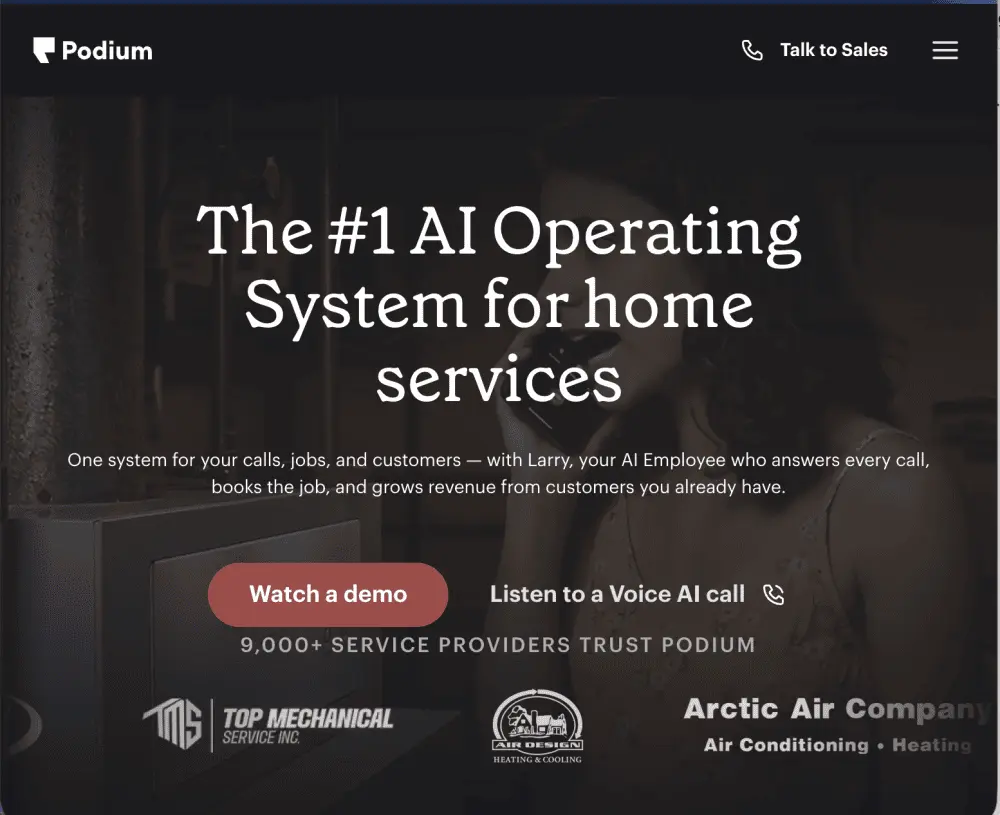
As artificial intelligence evolved from simple text bots into autonomous agents capable of independent reasoning and multi-step execution, the "front-end layer" grew powerful enough to absorb the back-end system of record. Podium’s rapid pivot toward an AI-driven Operating System—complete with its own field service management (FSM) capabilities and rapid data-migration teams—transformed it from a complementary partner into a direct competitor.
This deep dive investigates the anatomy of this high-stakes partnership breakdown, the changing economics of APIs in the age of autonomous agents, and what this bitter divorce means for the thousands of contractors caught in the crossfire.
Detailed Chronology: From Symbiosis to Strategic Rupture
To understand how a nine-year partnership deteriorated into a 30-day eviction notice, we must examine the shifting tectonic plates of software architecture. The conflict did not erupt overnight; it was years in the making, catalyzed by the explosive rise of generative AI.
1. Nine Years of Mutually Beneficial Value Creation
For the better part of a decade, the data flows between Podium and ServiceTitan were deeply integrated. Contractors enabled four primary data pipelines: contact synchronization, lead writeback, payment writeback, and conversation history writeback.
Three of these four channels pushed external data directly into ServiceTitan. When Podium captured a lead off a website or a text line, processed a payment, or archived a text message thread, that data landed squarely on the ServiceTitan customer record. For ServiceTitan, this made their platform exponentially stickier. They acquired a world-class communications and marketing layer without having to build it from scratch.
For Podium, the partnership unlocked access to an elite base of roughly 7,500 high-value contractors, alongside a live, bidirectional feed of appointments, jobs, and customer data out of the system of record. Crucially, Podium was never exclusive to ServiceTitan; it maintained identical integrations with competing platforms like Housecall Pro and ServiceFusion.
2. The AI Inflection Point: Zero to $100M ARR
The breaking point arrived when Podium transformed its product roadmap. Over a remarkably compressed timeframe, Podium’s agentic AI business surged from zero to $100 million in Annual Recurring Revenue (ARR). The company rebranded its offering as an "AI Operating System" and began shipping its own FSM features alongside dedicated customer data migration teams.
A traditional marketplace app does not need a migration team. Offering a 14-day history and contact migration service signals a clear "rip-and-replace" motion. Podium was no longer content sitting politely on top of ServiceTitan; it was building an autonomous engine capable of bypassing the system of record altogether.
3. The New Rules of Engagement
Recognizing the existential threat, ServiceTitan moved defensively. On June 24, 2026, the company published a revised set of Marketplace certification requirements. The policy laid down strict boundaries covering security, performance, predictability, data transparency, revenue share, and mutual benefit.
Buried within the documentation was a sentence that telegraphed the inevitable clash:
“ServiceTitan welcomes partners whose products overlap with parts of its own, as long as they’re not using the partnership and ServiceTitan’s support to gradually displace additional parts of ServiceTitan.”
Just seven weeks after publishing these revised rules, ServiceTitan executed the policy, severing ties with Podium and giving mutual clients a 30-day window to adapt. Notably, this rule change was not an impossible hurdle for every vendor; in February 2026, Hatch—another AI customer communication platform serving over 1,000 ServiceTitan customers—successfully secured its certification. The issue was not AI communication tools in general; it was Podium’s specific trajectory toward displacement.
Supporting Context, Metrics, and the API Revolution
The API Terms Rewrite
Long before the plug was pulled on the integration, the legal and technical frameworks governing software platforms shifted dramatically. Four months prior to the dispute, ServiceTitan updated its API terms to place strict limitations on artificial intelligence and autonomous workflows.
Historically, handing out open API access was a low-risk strategy for software platforms. An app sitting on top of a database could augment the user experience, but it could never become the platform.

AI agents broke this paradigm. An agent’s defining behavior is autonomy: perceiving an environment, reasoning through a goal, and deciding what actions to take next. When an API permits broad read and write access, an autonomous agent can systematically orchestrate workflows, manage customers, and execute transactions. Once the daily workflow migrates to the agent layer, the underlying system of record is reduced to a commodity database. By restricting API calls to a predefined, rigid operation set, platforms like ServiceTitan attempted to slam the door on autonomous operators that threatened to hollow out their core utility.
Head-to-Head: The Convergence of Product Lines
The core tension of this breakup stems from a brutal economic reality: both companies are now selling fundamentally the same product, but only one owns the primary database.
- ServiceTitan’s "Max" Suite: Features AI agents designed to throttle demand generation to fill contractor capacity gaps, voice agents capable of answering incoming calls and booking jobs directly, and field agents that auto-generate estimates on-site.
- Podium’s AI Operating System: Features autonomous digital employees that answer phones, schedule appointments, follow up on pending estimates, chase unpaid invoices, and upsell maintenance memberships during booking calls.
Skeptics of software incumbents often argue that dominant players stop innovating once their customer base faces high switching costs. However, ServiceTitan’s financial performance challenges this narrative. For the quarter ending April 30, 2026, ServiceTitan reported:
- Revenue: $268.8 million, up 25% year-over-year.
- Gross Transaction Volume (GTV): $21.7 billion, up 23%.
- Net Revenue Retention (NRR): Remaining comfortably above 110%.
- Operating Margin: Non-GAAP operating margin expanded to 15.2%, up from 7.5% the previous year.
- Full-Year Guidance: Raised to $1.13 billion.
While ServiceTitan’s free cash flow remains temporarily negative ($9.6 million) due to aggressive capital deployment into AI inference and its Max product suite, the company is actively utilizing its financial muscle to capture the agent layer within its own vertical.
The traditional software moat was built on switching costs—the immense friction of moving historical data and retraining staff. AI tools like Podium’s 14-day migration engine dramatically compress those switching costs, forcing legacy platforms to compete purely on product superiority for the first time in years.
Official Statements and Industry Reactions
The public fallout played out across tech blogs, industry newsletters, and social media platforms like X (formerly Twitter) and LinkedIn.
Eric Rea’s public disclosure captured the sentiment of disruption, highlighting a direct message from a home services multi-brand owner who marveled at Podium’s autonomous capabilities: "There is no competitor to ServiceTitan until the demo I saw from you guys today."
Industry analysts quickly divided into two distinct camps:
- The Pro-Platform Argument: Defenders of ServiceTitan argue that a platform has every right to protect its ecosystem. Allowing a partner to leverage API access to build a competing replacement engine is commercial suicide. In platform economics, he who controls the workflow commands the monetization.
- The Pro-Agent Argument: Proponents of the agentic shift argue that legacy systems of record are fighting a losing rear-guard action. As AI agents abstract the user interface, the underlying database becomes invisible. In this view, 30-day termination notices during peak operating seasons are heavy-handed tactics that ultimately punish the end-user.
Perhaps the most aggrieved parties in this high-stakes corporate chess match are the contractors themselves. Small business owners who rely on these tools never signed a direct agreement governing the API handshake between Podium and ServiceTitan. They simply purchased two software subscriptions designed to make their businesses run more efficiently.
When the integration collapsed, these business owners were left scrambling. Mid-season, review collection scripts broke, automated SMS sequences failed, and customer conversation histories vanished from ServiceTitan dashboards while customer service representatives were actively on calls with clients. For these entrepreneurs, a theoretical platform dispute translated into immediate operational friction.
Future Outlook: The Post-API Landscape
The Podium-ServiceTitan clash serves as a bellwether for the entire software-as-a-service (SaaS) industry. As we venture deeper into the Agent Era, several macro-trends are set to reshape the enterprise software ecosystem:
1. The Redefinition of "Partnership"
The traditional definition of a software ecosystem—where third-party apps happily build extensions on top of a dominant platform—is fracturing. Platforms will increasingly scrutinize partner roadmaps for agentic overlap. Any third-party tool capable of executing multi-step workflows or customer interactions will face rigorous certification hurdles, revenue-share demands, or outright exclusion.
2. The Weaponization of APIs
APIs will no longer be treated as open highways for innovation. Expect software platforms to implement strict, granular limitations on read/write permissions, particularly regarding data that feeds external AI models. Platforms will fiercely guard their data monopolies to prevent third-party agents from building parallel intelligence layers.
3. Compression of Switching Costs
AI-powered data migration and autonomous onboarding agents will continue to lower the barriers to software switching. When an AI operating system can ingest legacy data, map workflows, and retrain staff in a fraction of the traditional time, the traditional "lock-in" moat evaporates. Incumbents will be forced to compete on continuous innovation rather than defensive inertia.
4. Direct Accountability to End-Users
As platform disputes inevitably disrupt downstream operations, software vendors must design more resilient transition protocols. Leaving paying customers in the lurch with a 30-day notice during peak operational seasons risks alienating the very user base both platforms are fighting to control.
Conclusion
The breakdown of the nine-year partnership between Podium and ServiceTitan is more than a localized commercial dispute; it is the opening salvo in the war for the Agent Era. As autonomous software agents begin to absorb traditional systems of record, the boundaries between partners and competitors will continue to blur. For contractors, developers, and investors alike, the message is unmistakable: in the world of modern software, yesterday’s integration partner may well be tomorrow’s most dangerous rival.