Executive Overview
The intersection of artificial intelligence, government regulation, and digital commerce has entered a perilous new phase. With the formal rollout of Regulation (EU) 2024/1689—widely known as the European Union AI Act—policymakers have formally codified a mandate for transparency regarding synthetic media. While the regulation aims to protect consumers from deception and misinformation, its operational demands carry profound downstream consequences for enterprise marketers, small business owners, and content creators.
At the center of this storm is a technical requirement: the machine-detectable identification of AI-generated content. In direct response to the EU’s regulatory pressures, frontier AI lab Anthropic recently announced that all upcoming iterations of its Claude model family will natively integrate sophisticated, text-based watermarks. Competitors across the artificial intelligence landscape are racing to adopt similar mechanisms.
While heralded as a win for digital provenance, this infrastructure creates a covert apparatus for algorithmic surveillance. By embedding invisible, machine-readable signatures into synthetic text, platforms, search engines, and governments gain the technical capability to systematically segregate, downgrade, or censor content based entirely on its mode of production rather than its substantive quality.
For the digital marketing industry—which has rapidly adopted generative AI tools to scale operations, draft product descriptions, and optimize customer communications—this technological pivot threatens to undo years of efficiency gains. As programmatic detectors become ubiquitous, marketing content risks being marginalized into digital ghettoes, categorized not by its value to the consumer, but by the computational pedigree of its creation.
Detailed Chronology: From Legislative Frameworks to Cryptographic Signatures
The path toward mandatory text watermarking has been paved by a steady convergence of legislative overreach and cryptographic engineering. Understanding how we arrived at this precipice requires tracing the sequence of events that transformed a theoretical computer science problem into a frontline commercial battleground.
The Legislative Catalyst: Regulation (EU) 2024/1689
The genesis of the current crisis lies in the long, contentious drafting process of the European Union AI Act. As large language models (LLMs) began producing human-quality prose at scale, European lawmakers grew increasingly anxious about the potential for automated fraud, deepfakes, and mass disinformation campaigns.
When the EU AI Act was officially adopted, it established tiered obligations based on risk. Among these was a strict transparency mandate: providers of generative AI systems must ensure that synthetic audio, image, video, and text outputs are marked in a machine-readable format and detectable as artificially generated or manipulated.
While audiovisual deepfakes had long been the primary focus of regulators, text presented a unique challenge. Unlike pixels or audio frequencies, letters and words are discrete, symbolic tokens. Traditional metadata can be stripped away the moment a user copies and pastes text into a content management system or social media editor. To satisfy the EU’s legal thresholds, the watermarking had to live inside the text itself, embedded within the statistical fabric of the language.
Anthropic’s Pivot and the Adoption of SynthID
Faced with compliance deadlines and the threat of catastrophic European market exclusion, major AI labs began evaluating detection methodologies. While heuristic approaches—such as scanning for specific punctuation marks, em dashes, or overused transition phrases—proved wildly inaccurate and easily bypassed, a more robust solution emerged from Google’s DeepMind division: SynthID-Text.
In late 2024 and extending into subsequent operational roadmaps, Anthropic confirmed that future versions of Claude would implement text-based watermarking protocols derived from the SynthID framework. This marked a watershed moment. No longer was AI watermarking an academic experiment or an optional API toggle; it was becoming a baked-in architectural feature of commercial foundation models. As Anthropic led the charge, industry observers noted that OpenAI, Meta, and other major players were facing identical compliance pressures, making universal text watermarking an industry-wide inevitability.
The Mechanics of the Generation Process
To understand how SynthID operates, one must first understand how a generative AI model constructs a response. When a user prompts an LLM to write a blog post, a targeted email campaign, or a product description, the model does not write in fluid paragraphs. Instead, it breaks language down into tokens—bite-sized pieces of data that can represent whole words, parts of words, numbers, or individual punctuation marks.
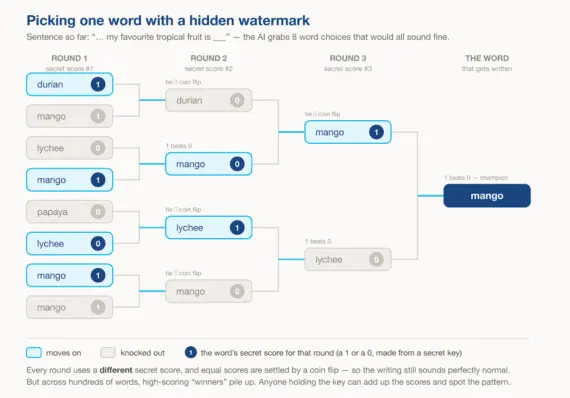
When generating text, the model operates sequentially. Given an initial prompt or sequence of existing tokens, the LLM calculates the statistical probability distribution for the next token. For example, if a model is prompted with the phrase, "My favorite tropical fruit is," it does not pull a pre-written sentence from a database. Instead, it evaluates a vocabulary of thousands of possible words and assigns a probability score to each candidate.
Traditionally, the model might simply select the statistically most likely token (e.g., "mango" or "banana") or introduce a degree of randomness (temperature) to select a less predictable option. SynthID hijacks this exact probabilistic step, transforming the selection process into a sophisticated cryptographic tournament.
The Tournament System: How SynthID Works
Rather than allowing the model to choose the next token purely at random or based solely on standard probability weights, SynthID runs a multi-stage selection tournament behind the scenes for every single token generated.
- Candidate Pool Generation: The model compiles a list of top candidate tokens for the next position in the sentence.
- Pseudo-Random Scoring: A secret, cryptographic key applied by the watermark algorithm assigns hidden, pseudo-random scores to these candidate tokens.
- The Bracket Matchup: The algorithm pits the candidates against one another in a simulated tournament, evaluating both their natural probability score (from the LLM) and their watermark seed score.
- The Winning Token: A specific candidate emerges victorious from the tournament and is written to the output text.
- Iteration: This entire process repeats hundreds or thousands of times for every sentence generated.
Because the underlying cryptographic seed shifts and interacts dynamically with the changing context of the text, there are no fixed "watermarked words." The word "mango" might win a tournament in the first sentence because it aligns with the secret key, but lose in a subsequent sentence.

However, over the course of a long passage, the cumulative effect of these hundreds of micro-tournaments is profound. The resulting text contains a statistically anomalous distribution of seed-influenced tokens—a mathematical fingerprint that would never occur by pure chance in human-written prose.
Detection and Verification
Detecting this watermark does not require querying the original LLM, checking a centralized database, or deploying heavy computational infrastructure. Anyone in possession of the "detector" algorithm and the corresponding secret key can analyze a passage of text.
The detection mechanism splits the suspicious passage into its constituent tokens, reverse-engineers the tournament scores, and calculates whether the chosen tokens correlate strongly with the watermark seed.
- Volume Matters: Length is the primary variable in detection accuracy. A short, two-sentence blurb might accidentally feature a few tournament-winning tokens purely by chance, resulting in a false negative or inconclusive score. Conversely, a comprehensive 1,500–word article provides an abundance of statistical evidence, making the watermark unmistakable.
- Contextual Constraints: Passages heavily constrained by factual accuracy or tight user feedback loops—such as technical documentation or highly specific medical instructions—produce fewer acceptable token alternatives. In these constrained environments, the model’s choices are dictated by reality rather than the watermark seed, making detection slightly more challenging.
- The Threshold: Any passage that scores above a predetermined statistical threshold is flagged as definitively AI-generated or AI-aided.
Supporting Context & Metrics: The Stakes for the Global Digital Economy
The implementation of machine-readable text watermarks does not occur in a vacuum. It interacts directly with a digital ecosystem already strained by concerns over content quality, SEO manipulation, and platform governance.
The Proliferation of Synthetic Content
According to industry analyses, the volume of web content generated by artificial intelligence grew exponentially between 2023 and 2026. For small and medium-sized enterprises (SMEs), generative AI has served as an economic equalizer. Without the capital to maintain sprawling internal marketing departments, smaller businesses have relied on LLMs to draft localized landing pages, manage social media calendars, and scale customer outreach.
The economic efficiency of this shift cannot be overstated. A task that previously required days of copywriting and significant financial outlay can now be executed in minutes, allowing lean teams to compete against enterprise conglomerates.
The Rise of Algorithmic Discrimination
However, the introduction of universal watermarking threatens to invert this advantage. By creating a frictionless, mathematically bulletproof method for identifying synthetic text, the EU AI Act inadvertently provides digital gatekeepers with the ultimate tool for content segregation.
Major digital platforms have already demonstrated an aggressive appetite for filtering out AI-generated material:
- Search Engines: Major search operators have repeatedly updated their algorithmic guidelines regarding automated content. While official stances claim that quality matters more than origin, the presence of a definitive watermark provides search engines with an easy proxy for automated filtering. Pages carrying a high watermark score risk being discounted, de-indexed, or buried on page ten of search results.
- Social Media Networks: Platforms like Pinterest have already begun actively reducing the algorithmic distribution of content identified as synthetic. As watermarking standards take hold, Facebook, LinkedIn, X, and TikTok are expected to implement automated feed suppression for watermarked text.
- Email Service Providers (ESPs): The inbox is the next frontier. Email clients equipped with watermark-detection tools could automatically route AI-assisted cold outreach, newsletters, and marketing campaigns directly into spam folders or dedicated "AI-Generated" tabs, utterly destroying email marketing ROI.
The Danger of False Positives
Perhaps the most alarming technical limitation of statistical watermarking is the inevitability of false positives. Because detection relies on probability thresholds, a human writer working independently may occasionally select sequences of words that happen to align with the statistical fingerprint of a watermarked model.
If platforms or regulatory bodies set their detection thresholds too aggressively to catch bad actors, innocent human writers, editors, and traditional copywriters will find their work erroneously flagged, suppressed, or censored. This collateral damage threatens to chill creative expression and penalize writers whose natural style mirrors algorithmic token selection.
Official Statements and Industry Reactions
The collision between regulatory overreach and commercial deployment has sparked fierce debate across the technology sector, legal academia, and marketing associations.
The Regulatory Perspective: Transparency vs. Surveillance
Defenders of the EU AI Act maintain that mandatory watermarking is a non-negotiable safeguard for a democratic society. Proponents argue that as synthetic text becomes indistinguishable from human prose, citizens have a fundamental right to know the origin of the information they consume.
"Transparency is the bedrock of digital trust," noted a prominent European Commission spokesperson during recent implementation briefings. "Consumers and businesses must have the tools to discern between human discourse and automated generation. Without verifiable markers, the public sphere becomes entirely vulnerable to industrialized manipulation."
Regulators argue that watermarking does not constitute censorship in itself; rather, it provides a transparent label. They contend that any subsequent platform-level filtering is a matter of private enterprise policy rather than state-mandated suppression.
The AI Labs: Compliance Amid Commercial Realities
For foundation model providers like Anthropic, Google, and OpenAI, compliance with the EU AI Act is a commercial imperative, regardless of ideological reservations. Balancing developer utility with regulatory mandates requires walking a tightrope.

In its technical release notes for SynthID-Text, Google DeepMind emphasized that the watermarking protocol was engineered to be robust against tampering—surviving edits, paraphrasing, and translation attempts—while maintaining minimal impact on the linguistic quality and perplexity of the generated text.
Anthropic echoed these sentiments when rolling out its watermarking roadmap, framing the move as a proactive measure to ensure enterprise customers can deploy Claude securely within European regulatory perimeters without risking non-compliance penalties.
The Marketing Vanguard: A Proxy for Quality
Conversely, digital marketing associations and trade groups have mounted fierce opposition to the normalization of text watermarking. Critics argue that equating the origin of content with its quality is a logical fallacy that will devastate small business competitiveness.
"Watermarking synthetic content is a Trojan horse," warns a senior policy analyst at an international digital commerce coalition. "By stamping AI-generated text with an unalterable digital tattoo, regulators are handing platforms a turnkey mechanism for censorship. It creates a two-tiered internet where human-crafted content is privileged, and efficient, AI-assisted small business marketing is systematically silenced under the guise of safety."
Marketers point out that a well-prompted, heavily edited, and factually rigorous piece of AI-assisted content provides immense value to the reader. To reduce that content to a flagged liability based purely on its underlying token distribution is viewed as an existential threat to modern content strategy.
Future Outlook: Navigating the Watermarked Horizon
As the digital landscape adjusts to the realities of Regulation (EU) 2024/1689 and widespread SynthID adoption, the next several years will dictate the survival mechanics of digital marketing. Several critical trajectories are poised to shape the industry:
1. The Arms Race of Post-Processing and Evasion
The implementation of automated watermarking will inevitably spawn a counter-market of evasion tools. Just as digital privacy tools arose to combat surveillance capitalism, a new class of software will emerge designed to strip, scramble, or neutralize statistical watermarks without destroying semantic value.
Content generation workflows will likely evolve to include "human-in-the-loop" rewriting layers, prompt-engineering techniques designed to bypass tournament detection, and style-transfer algorithms that inject human-like variance into token selection. However, as detection algorithms grow increasingly sophisticated, this cat-and-mouse game will consume valuable operational resources for marketing teams.
2. Platform Balkanization and Content Ghettoes
We are heading toward a balkanized internet where content provenance dictates visibility. Platforms that embrace open AI integration will stand apart from those that strictly penalize synthetic output.
Marketers will be forced to segment their distribution channels entirely:
- Human-Only Citadel Channels: Premium channels—such as elite corporate publications, high-end newsletters, and verified thought-leadership platforms—will explicitly demand human-authored certification, commanding higher trust and premium ad rates.
- Synthetic Streams: Automated channels, low-cost programmatic advertising, and bulk product catalog descriptions will likely be relegated to segregated, algorithmically suppressed zones where discovery is increasingly difficult and expensive.
3. The Redefinition of "Quality" in SEO and Discovery
Search engines and algorithmic curators will be forced to grapple with the limitations of watermarking as a proxy for quality. As elite enterprises utilize AI-assisted workflows to produce genuinely superior, deeply researched, and accurate content, treating all watermarked text as low-tier spam will degrade search relevance.
Search algorithms will eventually be forced to move beyond simple binary detection (watermarked vs. non-watermarked) and transition toward multi-factor evaluation models that measure user engagement, factual accuracy, and semantic depth, regardless of how the initial draft was tokenized.
Conclusion
Regulation (EU) 2024/1689 and the subsequent deployment of technologies like SynthID-Text represent a profound structural shift in how information is created, monitored, and consumed. While framed as a noble pursuit of transparency and consumer protection, the infrastructure of machine-detectable text watermarking opens the door to widespread algorithmic segregation and censorship.
For digital marketers, the era of uninhibited generative AI efficiency is giving way to a more complex, highly regulated reality. Surviving the watermarked horizon will require rigorous content quality control, diversified distribution strategies, and continuous vigilance against the rising tide of automated digital surveillance.