Executive Overview
The landscape of online copyright enforcement has undergone a seismic, yet largely clandestine, shift. For months, major Hollywood studios and international broadcasters have heralded a revolutionary legal mechanism in the United Kingdom—an unprecedented "omnibus" site-blocking order designed to cripple the digital infrastructure of digital piracy. However, until recently, the actual text of this judicial weapon remained hidden behind a shroud of administrative and legal confidentiality, absent from public databases like BAILII and unavailable to independent journalists and digital rights researchers.
That veil of secrecy was lifted unexpectedly not through a judicial leak or a freedom of information request, but via a routine transparency filing submitted by infrastructure giant Cloudflare to the Lumen Database. The document—a public version of an order handed down by Mr. Justice Mellor on May 7, 2026—reveals extraordinary powers granted to major entertainment conglomerates. Spearheaded by giants such as Columbia Pictures, Disney, Netflix, Paramount, Universal, and Warner Bros., the order compels the United Kingdom’s primary internet service providers (ISPs) to implement broad, highly scalable blocks against pirate domains.
More significantly, the order establishes a framework where rights holders can unilaterally expand their blacklists without returning to court for individual injunctions. By bypassing traditional judicial review for subsequent additions, this legal instrument represents a fundamental evolution in copyright enforcement. It shifts the burden of policing the web from the courts to private entities, creating a template that is already influencing international jurisdictions, including recent site-blocking expansions in Canada. As infrastructure providers like Cloudflare increasingly adopt voluntary enforcement roles, the debate over digital transparency, due process, and the centralization of internet censorship has reached a critical inflection point.
Detailed Chronology: From WIPO Presentations to Cloudflare’s Transparency Filing
The Genesis at WIPO
The story of the UK omnibus order first broke cover internationally in May, when representatives from the Motion Picture Association (MPA) detailed the development before the World Intellectual Property Organization (WIPO). Framed as a cornerstone strategy in the modern war against online infringement, the MPA presented the order as an administrative breakthrough. They argued that traditional, domain-by-domain injunctions were no longer viable in an era of rapid domain recycling and "whac-a-mole" piracy tactics.
According to the MPA’s initial disclosures, the mechanism was crafted to target any "structurally infringing audiovisual piracy services that meet defined criteria." Crucially, it promised that major studios could secure these wide-reaching blocks without initiating fresh, costly court applications for every newly spawned domain name or rebranded streaming portal.

The Missing Judgment
Despite its prominent role in international lobbying and its subsequent citation as a shining precedent in foreign courts—such as a Canadian Federal Court ruling handed down a month later—the actual judgment and order were entirely missing from the public record. Legal watchdogs scouring BAILII (British and Irish Legal Information Institute) and the UK National Archives found nothing. The UK’s major ISPs—BT, EE, Plusnet, Sky, TalkTalk, and Virgin Media—remained tight-lipped, leaving the MPA’s marketing summaries and regulatory presentations as the sole narrative accounts of the ruling.
The Cloudflare Leak
The information vacuum persisted until a recent transparency filing surfaced in the Lumen Database. Submitted by American content delivery network and infrastructure provider Cloudflare, the filing included an attached copy of the UK High Court order. Headed simply as a "Public Version" with confidential schedules redacted, the document finally provided the public, legal scholars, and technologists with their first unvarnished look at the mechanics of modern judicial site-blocking.
Anatomy of the Omnibus Order: Mechanics, Seeds, and Scope
Handed down by Mr. Justice Mellor, the May 7, 2026, order (Columbia Pictures v. BT) formalizes an aggressive alliance between six major Hollywood studios and the UK’s six largest telecommunications providers.
[Hollywood Studios]
       │
       ▼ (Direct Notification / Unilateral Expansion)
[UK ISPs & CDN Providers (Cloudflare)]
       │
       ▼ (Automated / Voluntary Blocking)
[End Users in the UK] ──X──> [Part 2 "Target" Pirate Sites]
The "Seed" Domains and Part 2 Targets
Like previous generations of UK blocking injunctions, the order initiates access restrictions against a baseline series of websites, categorized in Schedule 1 as the "seeds." These include prominent illicit streaming domains such as 345movie.nl, 456movie.nl, cineby.app, movies2watch.watch, and streamm4u.com.co.
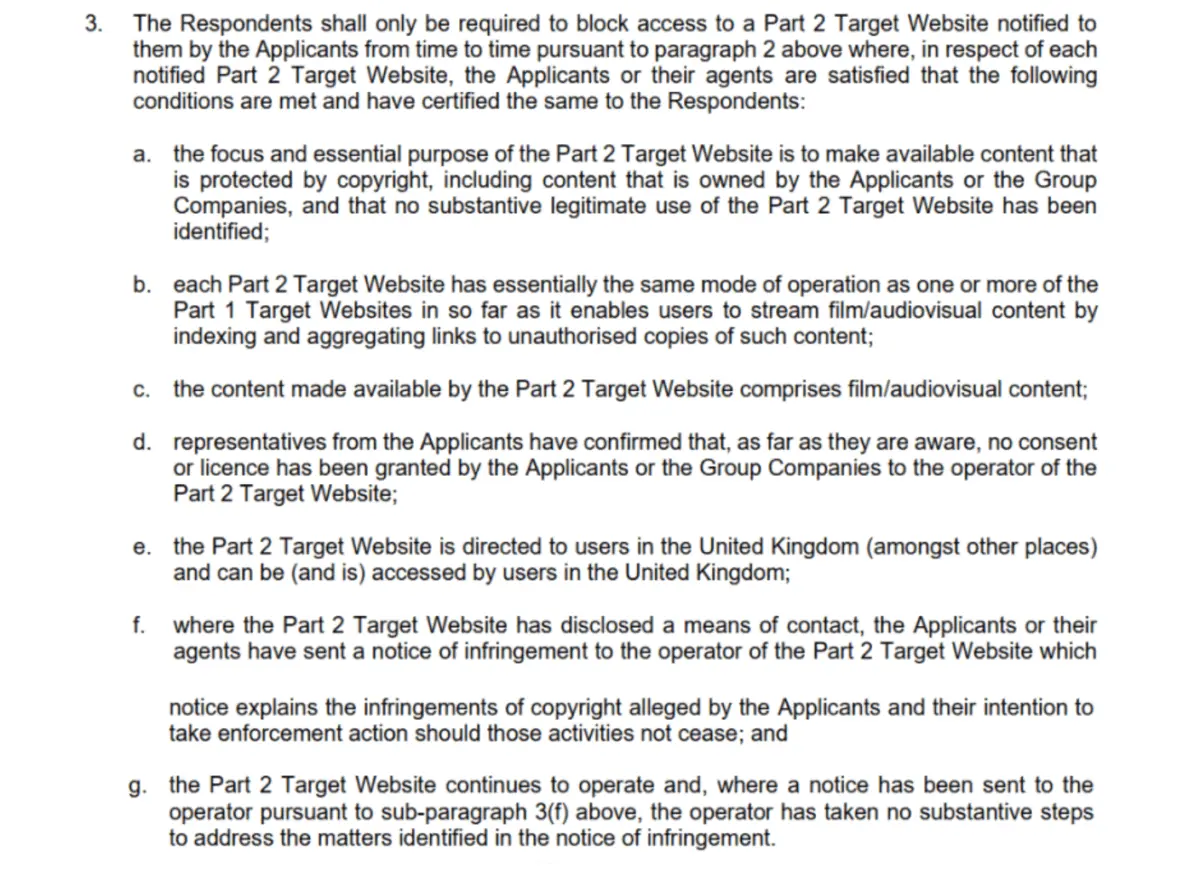
However, Part 2 of Schedule 1 introduces the revolutionary open-ended component of the injunction. While older legal frameworks required clear, pre-identified branding or specific court-approved linkages to extend blocks, the new omnibus order targets any site that shares a functional DNA with the seeds. The text of the order defines these future targets explicitly:

“[E]ach Part 2 Target Website has essentially the same mode of operation as one or more of the Part 1 Target Websites in so far as it enables users to stream film/audiovisual content by indexing and aggregating links to unauthorised copies of such content.”
The "Add Site" Criteria and Administrative Discretion
To prevent the scope from becoming entirely boundless, the order establishes specific evidentiary criteria that newly flagged sites must satisfy. These requirements generally dictate that the target must be actively streaming unauthorized audiovisual content within the UK, and it must demonstrate unresponsiveness to legal takedown notices or complaints.
Yet, the mechanism for adding these sites to the national blocklist lacks independent judicial oversight. When rights holders identify a new platform meeting the Part 2 criteria, they simply notify the ISPs that the conditions have been met. The order explicitly outlines that the ISPs are "wholly reliant on the Applicants accurately identifying" the URLs, holding "no obligation to verify whether the Applicants’ or their agents’ determination is correct."
In practical terms, the enforcement apparatus has been outsourced directly to the civil litigants. Studios act as both prosecutor and judge regarding the expansion of the blocklist, operating entirely outside a courtroom setting once the initial six-month master order is secured.
Supporting Context & Metrics: The Global Ripple Effect and Infrastructure Expansion
The implications of the UK High Court’s omnibus ruling extend far beyond British borders, serving as a blueprint for international anti-piracy frameworks.

International Echoes: The Canadian Precedent
The influence of the UK decision was made explicit in a Canadian Federal Court ruling handed down shortly after the MPA’s WIPO disclosures. Canada’s federal judiciary adopted similar logic, pointing to the UK model as a necessary tool to "address increased fragmentation in the Internet piracy landscape." As users migrate continuously from blocked domains to fresh, unblocked mirror sites, courts in common law jurisdictions are increasingly willing to grant broad, preventative administrative powers to copyright holders.
Voluntary Infrastructure Compliance: The Cloudflare Phenomenon
Perhaps one of the most striking revelations of the leaked document is the involvement of entities not originally named as primary respondents in the lawsuit. Cloudflare, a US-based content delivery network, is not a formal party to Columbia Pictures v. BT. Nevertheless, the infrastructure firm voluntarily complies with the spirit of such blocking orders for UK-based traffic when targeted sites utilize its CDN services.
For end users, this manifests as an HTTP 451 Error ("Unavailable For Legal Reasons") when attempting to navigate to domains like movies2watch.watch. By voluntarily aligning its routing policies with UK judicial sentiment, Cloudflare demonstrates how private infrastructure providers are increasingly acting as global enforcers of national court orders, further consolidating the centralization of internet traffic filtering.
Guardrails, Limitations, and the Six-Month Sunset Clause
Despite the sweeping nature of the powers granted to Hollywood, the order is not entirely devoid of procedural safeguards:
- Overblocking Protections: Rights holders are strictly prohibited from instructing ISPs or network operators to block specific IP addresses if the underlying server hosts legitimate, non-infringing web properties alongside pirate portals. This aims to mitigate collateral damage and accidental censorship of innocent publishers.
- Right of Objection: Operators of mistakenly targeted domains or affected third parties retain the legal right to challenge their inclusion on the blocklist.
- The Six-Month Sunset Clause: The order features a strict temporal limitation, stating that it "shall cease to have effect at 23:59pm on the date 6 months from the date of this Order, unless the Court orders otherwise."
While critics might view this sunset clause as a meaningful check on state-sanctioned blocking, legal experts note that it functions primarily as a procedural formality. In practice, Hollywood studios will simply return to the High Court every six months to seek automatic renewals, turning what was originally conceived as a temporary emergency measure into a permanent, rolling fixture of UK telecommunications law.

Official Statements and Industry Perspectives
The divide between entertainment industry advocates and digital rights proponents regarding the omnibus order highlights deep ideological fractures concerning the governance of the modern web.
The Rights Holder Perspective
For organizations like the MPA and the major studios backing the litigation, the order is viewed as a vital, common-sense modernization of legal procedures. Speaking anonymously due to ongoing litigation strategies, entertainment sector legal representatives have consistently argued that traditional court processes are structurally incapable of keeping pace with the agile, automated domain-spawning techniques employed modern streaming syndicates.
From their viewpoint, the omnibus order eliminates bureaucratic redundancy, reduces the financial drain of endless litigation over identical infringement models, and restores economic parity to an industry plagued by digital leakage. Proponents emphasize that guardrails—such as IP-sharing protections and challenge mechanisms—sufficiently balance copyright enforcement against the risk of overzealous censorship.
The Digital Rights and Transparency Critique
Conversely, civil liberties advocates, transparency campaigners, and open-internet researchers have raised profound concerns regarding the opaque nature of the ruling. The irony that the only public copy of a major national court order emerged through a third-party corporate transparency filing rather than official judicial channels has not been lost on legal scholars.
Critics argue that by removing the judiciary from the day-to-day expansion of the blocklist, the UK High Court has effectively privatized internet censorship. Without a publicly accessible, transparent master list of blocked domains—and lacking mandatory independent reviews for every newly added URL—journalists, researchers, and consumers are left blind. There is no public accountability to verify whether domains are being mistakenly suppressed, nor is there an easily navigable public registry to audit the cumulative scope of the government-backed, ISP-enforced internet filter.

Future Outlook: The Horizon of Digital Censorship
As the legal framework underpinning the UK’s omnibus blocking order cements itself into routine operational practice, several key questions remain on the horizon.
- Proliferation to Other Jurisdictions: Given the rapid cross-pollination of legal precedents between the UK, Canada, Australia, and the European Union, similar omnibus-style, administrative expansion orders are expected to be tabled in other Commonwealth and Western jurisdictions.
- The Evasion Arms Race: Technical analysts note that while domain-level blocking remains highly effective against casual consumers, it continues to drive sophisticated users toward decentralized alternatives, encrypted DNS setups, VPNs, and peer-to-peer protocols. Whether administrative blocking can meaningfully dent overall consumption numbers—or merely displace traffic—remains a subject of intense empirical debate.
- The Transparency Imperative: Pressure is mounting on both the courts and participating ISPs to institute mandatory public transparency registries for all active blocking lists. As infrastructure gatekeepers like Cloudflare continue to automate regional censorship protocols, the demand for verifiable public oversight will only intensify.
For now, the May 7, 2026, omnibus order stands as a watershed moment in digital copyright law. It demonstrates how traditional legal institutions are adapting to the fluid speed of the internet—trading judicial oversight for administrative velocity, and reshaping the architecture of digital access in the United Kingdom and beyond.