Executive Overview
In the high-stakes theater of early-stage B2B technology startups, a peculiar and costly psychological drama plays out with algorithmic predictability. A founder, having recently secured a fresh injection of venture capital, goes to market in search of commercial acceleration. They interview and eventually hire a seasoned sales executive boasting a stellar resume from a well-known industry titan—a company with a household tech logo and a bulletproof market reputation.
The expectation is simple, almost gravitational: this veteran AE will step into the startup, apply their playbook, and immediately begin closing deals.
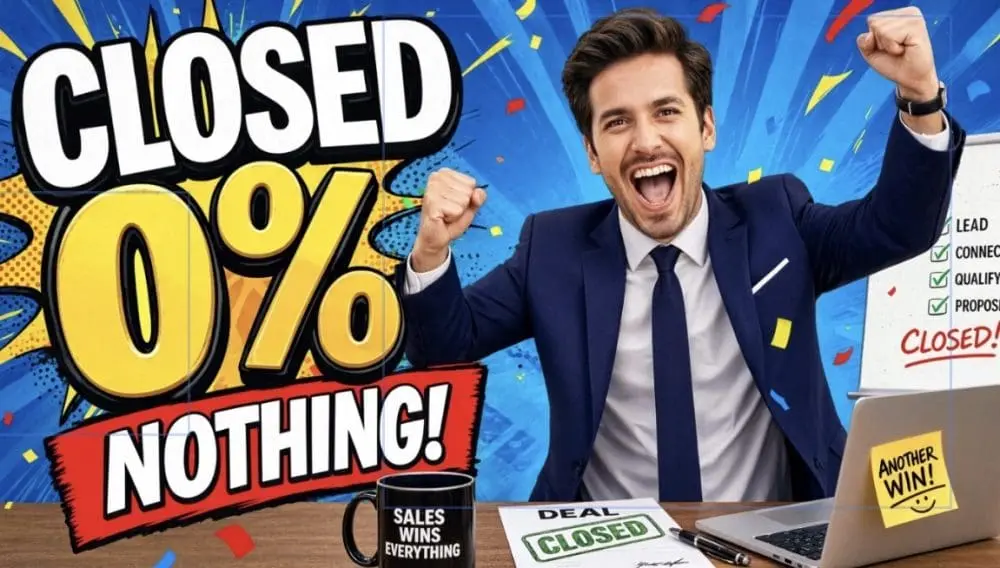
Yet, months later, a sobering reality sets in. The high-pedigree hire has closed literally zero revenue. Their pipeline is an elaborate labyrinth of stagnation, characterized by endless discovery calls, polite prospect emails, and zero signed contracts.
According to recent benchmark surveys from SaaStr, this scenario is far from an isolated anomaly. Data reveals that a mere 18% of early-stage organizations enjoy a scenario where 70% or more of their sales representatives attain quota. The vast majority of early-stage teams languish between 20% and 40% attainment—or worse. Lurking beneath those bleak averages is a devastating cohort: representatives who close essentially nothing over an entire fiscal year. Welcome to the "Zero-Percent Quota Club."
The conventional knee-jerk reaction from executive leadership is to blame the individual: the rep is lazy, lacks grit, or has coasted on the coattails of a stronger brand. However, industry veterans and revenue leaders argue that this diagnosis is fundamentally backwards. In modern tech sales, mediocre representatives are rarely inputs of failure; they are outputs of systemic dysfunction.
When a sales organization lacks a combination of extreme product-market fit, tight operational processes, and substantial cross-functional support, even seasoned professionals will hit 0% of their quota. Conversely, when those three systemic pillars are firing on all cylinders, even mediocre sales reps can reliably hit 50% to 90% of their quotas—and occasionally more during market spikes.
This deep-dive investigation explores why elite-pedigree reps fail in early-stage environments, how founders misdiagnose the root cause of their revenue drought, and what actionable steps leadership must take to transform their go-to-market engine from a house of cards into a repeatable, scalable machine.
Detailed Chronology: The Lifecycle of a Failed Sales Hire
To understand why the Zero-Percent Quota Club exists, it is instructive to trace the chronological lifecycle of a typical enterprise sales hire entering an underprepared startup.
Phase 1: The Honeymoon and the Halo Effect (Months 1–2)
The hire arrives with high energy, polished communication skills, and a rolodex of enterprise terminology. During the first thirty days, the representative undergoes onboarding—usually consisting of a scattering of Notion documents, a handful of recorded Zoom demos, and conversational overviews of the product roadmap. The leadership team feels a palpable sense of relief, believing the heavy lifting of revenue generation has been outsourced to a professional.
Phase 2: The Friction of Reality (Months 3–5)
The representative begins outbound prospecting or handling inbound leads provided by early marketing efforts. Immediately, they encounter systemic friction. Inbound leads are frequently outside the Ideal Customer Profile (ICP). Pricing is not standardized; every prospective client demands a custom discount, forcing the rep to check in with the CEO or CTO for ad-hoc approvals.
Technical questions arise that the sales rep cannot answer, and because there is no dedicated Solutions Engineer (SE), the conversation stalls. A security review or legal redline is requested, but no single person owns the compliance process. The review drags on for six weeks in a legal black hole.
Phase 3: The Activity Illusion (Months 6–9)
Realizing they cannot close deals through standard methods, the representative retreats into the safety of "activity metrics." They book meetings, update the CRM meticulously, and report steady pipeline growth to management. To the untrained eye of a founder, the rep looks busy and productive. In reality, the pipeline is a ghost town of unqualified opportunities that will never convert. The buyer has no pressing urgency, the product does not quite solve their specific edge cases, and the sales process is entirely improvised.
Phase 4: The Terminal Collapse and Departure (Months 10–12)
The fiscal year closes with zero revenue generated. Frustrated and disillusioned, the representative either resigns or is terminated. The founder concludes that large-company reps are unsuited for startups and resolves to hire younger, "hunger-driven" junior reps instead.
The cycle then repeats with a new victim. The fundamental flaw in this chronology is that management continuously changes the actor while leaving the stage fundamentally broken.
Supporting Context & Metrics: Decoding the Systemic Failure
To contextualize this phenomenon, industry analysts point to the stark structural differences between how sales operate in a scaled enterprise versus an early-stage startup.
In a mature, well-oiled sales organization with extreme product-market fit, the commercial process is engineered to be foolproof. Consider the daily environment of a representative at a rocket-ship SaaS firm:
- Qualified Inbound Flow: Leads arrive with pre-existing category awareness. The buyer often already knows the brand name and has consumed comparison reviews before the first discovery call.
- Standardized Commercials: Pricing is publicly listed or rigidly standardized. Discount matrices are predefined.
- Robust Collateral: A comprehensive suite of assets exists—including professional slide decks, standardized demo scripts, and mutual action plans.
- Technical Assistance: A dedicated Solutions Engineer runs the technical validation, while pre-answered security questionnaires (often numbering in the hundreds) are deployed instantly to satisfy IT procurement.
In this environment, the sales representative’s job is primarily administrative and navigational: keep the process moving forward, avoid self-inflicted errors, and ask for the order. A representative of mediocre capability can execute these steps consistently, hitting 70% of their plan year after year. They look like high performers on paper because the machinery around them carries the weight.
Now, contrast that utopian setup with the reality of an early-stage company lacking these operational guardrails:
- Ad-Hoc Discovery: The sales rep must convince skeptical prospects who have never heard of the category, let alone the brand.
- Improvised Pricing: Every single deal requires a bespoke pricing conversation and a custom proposal built from scratch.
- Technical Deficits: Without an SE, the rep is forced to bluff through complex architectural questions, eroding trust with technical buyers.
- Administrative Quagmires: Legal redlines and security compliance reviews languish for weeks because no one internally owns the workflow.
When a representative accustomed to the former environment is dropped into the latter, they are suddenly expected to perform work that is fundamentally outside their job description. They are forced to act as product marketers, pricing strategists, technical architects, and legal negotiators simultaneously. That is not an AE’s job description; that is founder work, or at the very least, VP of Sales work. A 50th-percentile account executive has never done this work and will never be equipped to do it successfully.
Official Statements and Expert Insights
Jason Lemkin, founder of SaaStr and a veteran SaaS investor, has long sounded the alarm regarding the misconceptions surrounding sales execution in early-stage ventures. In recent analyses, Lemkin distilled the baseline requirements for modern sales functionality into a clear formula:
"In sales orgs with extreme product-market fit, tight processes, and substantial support… mediocre sales reps can often hit 50%-90% of quota. Sometimes even more for stretches. In sales orgs without all three, they often hit 0% of quota."
According to Lemkin, founders chronically underestimate the degree to which their top-performing representatives are masking systemic cracks in the organization. Most startups operate with one or two reps who consistently hit—or even exceed—quota, reaching 150% of plan. Founders point to these outliers as proof that the go-to-market engine is healthy, diagnosing the underperformance of the remaining 80% of the team as a simple talent deficiency.
However, industry experts emphasize that these top-tier outlier reps are not succeeding because of the system; they are succeeding in spite of it. These rare individuals possess an uncommon blend of scrappiness and resilience, allowing them to construct their own improvised processes, write their own pitches, and bypass missing technical support. They are essentially operating as mini-entrepreneurs within the company.
When one of these star reps eventually departs, the territory does not merely experience a dip in performance—it plummets to absolute zero. This happens because the "process" that made them successful walked out the door with them, completely undocumented and unreplicable.
Lemkin maintains a strict litmus test for organizational readiness: "Two reps hitting quota has been my threshold forever for hiring a VP of Sales, and it applies here too. Two reps at plan means something repeatable might exist. One rep at plan and eight at 0% means you have one talented individual and no sales organization."
Future Outlook: Remediation and the Path Forward
For founders and revenue leaders currently presiding over a "Zero-Percent Quota Club," continuing down the path of traditional hiring and firing is a recipe for cash burn and organizational exhaustion. Turning the ship around requires a deliberate, chronological overhaul of the commercial infrastructure.
1. Freeze Sales Headcount Immediately
Pouring additional sales representatives into a broken, leaky system is financial malpractice. Each new enterprise AE represents a fully loaded cost exceeding $250,000 annually, not to mention the immense management overhead required to support them. Adding headcount to a non-functional engine does not scale revenue; it scales the failure rate.
2. Reverse-Engineer the Sole Outlier
If the organization has one representative who is somehow managing to close deals, leadership must stop treating them as an isolated data point and start treating them as a blueprint. Executives should sit in on every live call, review recordings meticulously, and document exact phrasing, objection-handling techniques, and post-call follow-ups. That raw transcript is the company’s first true sales playbook.
3. Prioritize Support Before Talent
In organizations experiencing widespread quota failure, the highest-return capital allocation is almost never another Account Executive. Instead, startups must invest in operational leverage:
- Solutions Engineering: Hire technical resources to take over product demonstrations and architecture reviews.
- Product Marketing: Build standardized collateral, battle cards, and messaging guides that articulate clear value propositions.
- Legal & Compliance Ownership: Assign a dedicated internal owner to streamline security questionnaires and legal redlines so deals stop dying in administrative purgatory.
4. Confront Product-Market Fit with Radical Honesty
If commercial transactions continue to stall unless the founder personally steps in to discount the product, offer custom builds, or leverage personal relationships, the root problem is not sales execution—it is product-market fit. Deploying aggressive sales strategies against weak product-market fit is the most expensive, painful way to learn a bitter lesson. Many promising startups have burned through an entire Series A round discovering this too late.
5. Build for the Average Performer
The ultimate epiphany for early-stage founders is shifting the objective from hunting for mythical "sales unicorns" to building a predictable environment where average, mediocre representatives can thrive.
When extreme product-market fit is established, operational processes are locked down, and cross-functional support is robust, ordinary people become productive. Solving the systemic problem of making average reps successful is infinitely more achievable—and far less expensive—than endlessly searching for elite talent that rarely exists at early-stage startup price points.
Ultimately, the competitive bar for modern tech companies is not finding great salespeople. It is building an organization where average salespeople can consistently win. Reaching that milestone requires both visionary executive leadership (such as a seasoned VP of Sales or CRO) and an unshakeable commitment to authentic product-market fit.