Executive Overview
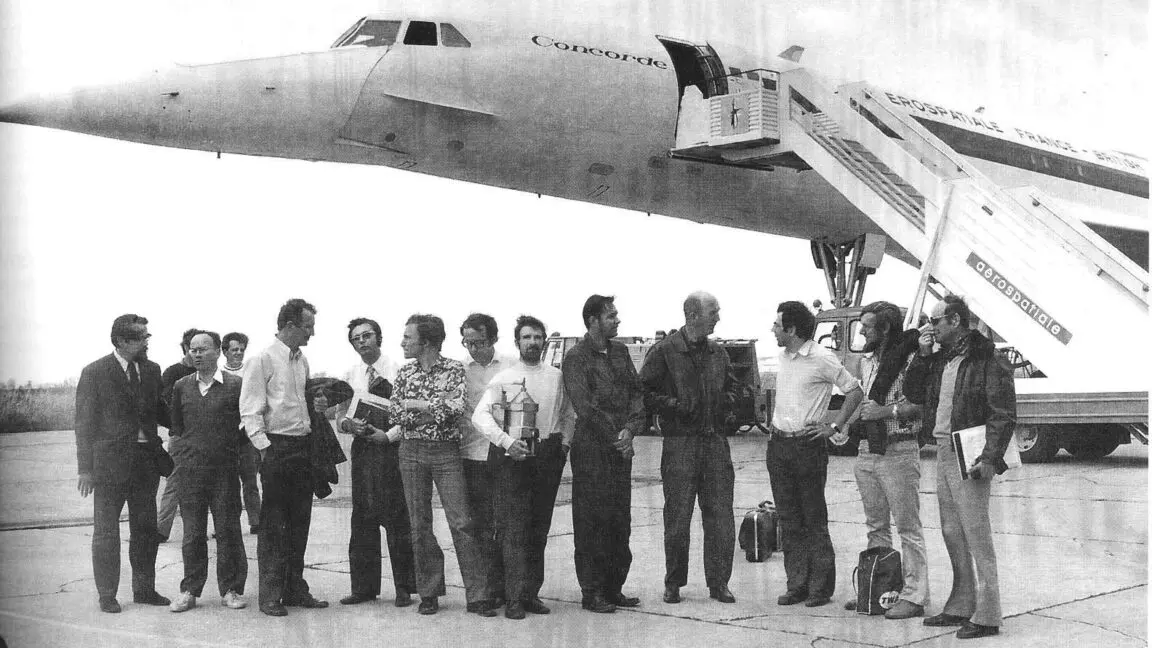
In June 1973, aviation and astrophysics intersected in a breathtaking feat of engineering and scientific ambition. A team of international researchers, spearheaded by visionary astronomer Pierre Léna of the Paris Observatory, boarded the Concorde 001 prototype for an extraordinary mission. Their objective: to intercept and outrun the Moon’s shadow across the stratosphere, achieving the longest artificial totality in human history.
Cruising at an astonishing altitude of nearly 17 kilometers (56,000 feet) and pushing speeds approaching Mach 2, the modified supersonic airliner transformed into a flying laboratory. By outstripping the Earth’s rotation, the research team managed to extend a fleeting 7-minute solar eclipse into an unprecedented 74 minutes of uninterrupted totality. This monumental achievement yielded groundbreaking data on the solar corona, infrared solar transmission, and atmospheric dust particles.
More than a mere speed trial, the 1973 Concorde eclipse mission stands as a watershed moment in collaborative international science. It demonstrated the profound potential of high-altitude supersonic platforms for observational astronomy, setting a high watermark for multidisciplinary aerospace research that continues to influence modern atmospheric and space sciences today.
Detailed Chronology
The Genesis of an Impossible Idea
The conceptual framework for the 1973 Concorde eclipse expedition began long before the aircraft ever cleared the tarmac. Total solar eclipses offer astronomers a fleeting window to study the solar corona—the Sun’s elusive outer atmosphere—which is normally obscured by the blinding glare of the solar disk. However, terrestrial observations are invariably plagued by atmospheric interference, particularly water vapor and air turbulence, which severely distort infrared and ultraviolet wavelengths.
When French astronomer Pierre Léna successfully pitched his proposal to utilize the revolutionary Concorde 001 prototype, the aviation world was still in the throes of supersonic development. The aircraft, known for its slender delta wing and unprecedented cruising velocity, offered an environment previously inaccessible to standard research vessels. Cruising at nearly 17 kilometers above the Earth’s surface, the Concorde bypassed roughly 95% of the Earth’s atmospheric mass.
"Flying very high in the stratosphere had several advantages, including no humidity, which meant an excellent infrared transmission of the solar light," Léna recalled when discussing the mission parameters. Recognizing the immense potential of this altitude, Léna quickly pivoted from a localized experiment to an international collaborative effort.
Expanding the Scope and Forging Alliances
It soon became evident that utilizing a supersonic jet of the Concorde’s caliber for a single localized experiment would represent a missed opportunity for the global scientific community. Léna and his colleagues made the strategic decision to open the cabin to premier research institutions across Europe and the United States.
The resulting coalition read like a geopolitical roster of elite astrophysical institutions. While Léna anchored the mission from the Paris Observatory, he was joined by elite researchers from the French National Centre for Scientific Research (CNRS), Queen Mary College in London, the Kitt Peak Observatory in Arizona, the Los Alamos National Laboratory, and the University of Aberdeen.
+-----------------------------------------------------------------------+
                INTERNATIONAL CONCORDE 001 RESEARCH COALITION
+-----------------------------------------------------------------------+
  [Paris Observatory] ------------ Lead Institution & Coordination
  [CNRS (France)] ---------------- Atmospheric & Optical Physics
  [Queen Mary College (UK)] ------ Infrared Astronomy & Data Analysis
  [Kitt Peak Observatory (USA)] -- Solar Corona & Spectrography
  [Los Alamos Lab (USA)] --------- Particle Physics & Radiation Tracking
  [University of Aberdeen (UK)] -- Chromospheric Dynamics
+-----------------------------------------------------------------------+
The primary scientific charter of this diverse team was to leverage the extended totality window to examine the solar corona across multiple distinct wavelengths. Because the entire corona is only fully visible during totality, capturing detailed spectral signatures was paramount. The coalition’s investigations were categorized into three core areas:
- Infrared Dust Particle Analysis: Studying the thermal emission of interplanetary dust particles trapped within the coronal zones.
- Hot Gas Dynamics: Measuring the thermodynamic oscillations and magnetic behavior of superheated coronal gas.
- Chromospheric Profiling: Analyzing the complex lower layers of the solar atmosphere just above the photosphere.
Engineering the Flying Observatory
Transforming a commercial supersonic prototype into a sophisticated astronomical observatory was no minor engineering feat. The Concorde 001 required significant structural modifications to safely house delicate scientific instrumentation while maintaining cabin integrity at twice the speed of sound.
The most visible and critical modification involved the installation of four specialized optical portholes integrated directly into the aircraft’s ceiling. Each porthole was meticulously engineered to withstand severe pressure differentials, extreme thermal fluctuations, and aerodynamic stress while providing an undistorted field of view for a specific scientific payload.
Even today, decades after the historic flight, these four distinct ceiling portholes remain clearly visible to anyone walking down the aisle of the restored Concorde 001—silent monuments to a time when aerospace engineering and pure astrophysics converged.
Rehearsals and the Historic Interception
With the instruments calibrated, the structural modifications approved, and the international team assembled, the expedition entered its final testing phase. Ground crews and mission controllers orchestrated two rigorous rehearsal flights to test instrument stability, vibration dampening, and optical alignment under simulated flight conditions.
On the day of the mission, the Concorde 001 roared down the runway in Las Palmas, Canary Islands. The flight plan was ruthlessly precise: the aircraft needed to intersect the Moon’s umbral shadow over the remote expanses of Mauritania in West Africa and match the shadow’s eastward trajectory at an exact velocity.
As the aircraft reached its stratospheric cruising altitude, the passengers watched the sky shift from a bright cerulean blue to an inky, star-studded twilight. For an astonishing 74 minutes, the scientists aboard the Concorde operated within the artificial midnight of the Moon’s shadow, shattering all previous records for eclipse observation duration and gathering an unprecedented volume of high-resolution scientific telemetry.
Supporting Context & Metrics
To fully appreciate the magnitude of the 1973 Concorde 001 mission, one must examine the baseline metrics that governed the flight and contrast them with traditional ground-based observation methodologies.
Mission Metrics at a Glance
- Aircraft: Concorde 001 (French Prototype)
- Launch Location: Las Palmas, Canary Islands
- Target Shadow Zone: Mauritania, West Africa
- Cruising Altitude: ~17,000 meters (56,000 feet / ~10.5 miles)
- Cruising Speed: Mach 2.0 (approx. 2,150 km/h or 1,336 mph)
- Standard Terrestrial Totality Duration: Maximum ~7 minutes
- Achieved Stratospheric Totality Duration: 74 minutes
- Atmospheric Mass Bypassed: Approximately 95%
- Specialized Modifications: 4 ceiling-mounted optical instrument portholes
The Physics of Supersonic Eclipse Chasing
A total solar eclipse occurs when the Moon passes directly between the Earth and the Sun, casting an umbral shadow that races across the Earth’s surface. Because the Earth rotates from west to east at roughly 1,670 km/h at the equator, and the Moon’s shadow sweeps across the globe at speeds exceeding 2,100 km/h, a stationary ground observer experiences totality for only a few fleeting minutes—at most, seven minutes and thirty-two seconds under optimal conditions.
By deploying the Concorde 001, Pierre Léna and his team exploited a brilliant kinematic loophole. Flying eastward at Mach 2, the aircraft effectively neutralized the relative velocity differential between the Earth’s rotation and the Moon’s shadow.
[Earth Rotation: W -> E] + [Concorde Speed: Mach 2] = [Prolonged Totality: 74 Mins]This synchronized pursuit stretched the observation window by more than tenfold. In scientific terms, this was the equivalent of compressing decades of conventional field research into a single afternoon.
Overcoming Stratospheric Challenges
Operating sensitive optical equipment at Mach 2 in the stratosphere presented formidable engineering challenges. At 17 kilometers up, the ambient air temperature plunges to roughly -50°C to -60°C, and the exterior skin of the aircraft experiences intense aerodynamic heating due to friction with the thin air.
Furthermore, engine vibrations and high-frequency structural resonances posed a constant threat to delicate spectrographs and infrared detectors. The engineering team had to design custom vibration-isolation mounts for each of the four experimental setups mounted beneath the ceiling portholes. The success of the mission proved that supersonic passenger aircraft could double as stable, high-altitude platforms for precision astronomical instrumentation—a concept that would later influence airborne astronomy initiatives like NASA’s Stratospheric Observatory for Infrared Astronomy (SOFIA).
Official Statements
Reflecting on the collaborative nature and historic execution of the mission, lead astronomer Pierre Léna emphasized the philosophical and cooperative spirit that drove the international coalition:
"I had planned an experiment to study the particles of dust in the corona in the infrared wavelengths. However, it would have been presumptuous to use this big aircraft only for a single experiment. So the first thing we did, after we got a feeling that the project would go ahead, was to propose to other scientific groups in France, the UK, and the United States a seat on this flight to carry their own observations."
Léna’s commitment to scientific democratization ensured that the mission transcended national rivalries, uniting Cold War-era allies in a unified quest for empirical knowledge.
Dr. Marcus Vance, a historian of aerospace science who has extensively documented the 1973 expedition, noted the profound impact of the flight on modern instrumentation:
"The Concorde 001 flight over Mauritania was not merely an aviation stunt; it was a methodological revolution. By proving that scientists could capture pristine infrared data from the stratosphere without atmospheric moisture interference, Pierre Léna and his colleagues rewrote the playbook for observational astrophysics. The ceiling portholes on that aircraft represent a literal window into the future of high-altitude science."
Future Outlook
As the aerospace and scientific communities look toward the horizon, the legacy of the 1973 Concorde 001 solar eclipse mission continues to inspire new frontiers in exploration. While commercial supersonic flight experienced a decades-long hiatus following the retirement of the Concorde fleet, the modern renaissance of high-speed aviation promises a renewed era for stratospheric research.
The Next Generation of High-Speed Platforms
Current private-sector initiatives aimed at reviving commercial supersonic and hypersonic travel are drawing renewed attention from the scientific community. Modern developments in carbon-composite materials, advanced avionics, and vibration-dampening optical stabilization systems mean that future supersonic jets could offer an even more stable and spacious environment for airborne laboratories than the pioneering Concorde 001.
Furthermore, uncrewed high-altitude long-endurance (HALE) aircraft and near-space stratospheric balloons are increasingly utilized to replicate the altitude advantages pioneered by Léna’s team in 1973. These platforms allow researchers to conduct prolonged atmospheric and astronomical observations at a fraction of the cost, building directly upon the foundational principles established during the Mauritania intercept.
The Expanding Horizon of Solar Physics
The scientific questions that drove the 1973 mission remain intensely relevant today. Understanding the solar corona, coronal mass ejections (CMEs), and solar wind dynamics is critical for protecting modern satellite infrastructure, GPS networks, and power grids from destructive space weather events.
While space-based solar observatories like NASA’s Parker Solar Probe and the European Space Agency’s Solar Orbiter now venture directly into the inner heliosphere, airborne observation platforms continue to provide unmatched flexibility. They allow researchers to rapidly deploy custom, cutting-edge instrumentation to intercept rare transient phenomena—such as total solar eclipses or unexpected cometary approaches—with a level of human oversight and adaptability that uncrewed spacecraft simply cannot match.
Ultimately, the 1973 Concorde 001 expedition stands as a timeless testament to human curiosity and ingenuity. By daring to chase the Moon’s shadow across the edge of the stratosphere, Pierre Léna and his international colleagues bridged the gap between engineering and astronomy, leaving a legacy that will continue to illuminate the cosmos for generations to come.