








Executive Overview
In a milestone transaction that underscores the profound valuation recalibration across the broader software-as-a-service (SaaS) landscape, Milan-based serial tech acquirer Bending Spoons has announced the acquisition of Airtable in an all-cash deal. The transaction values Airtable at an enterprise value of $1.285 billion, which balloons to roughly $2.25 billion in total equity value when factoring in Airtable’s formidable net cash reserves. Subject to standard regulatory reviews, the agreement is slated to officially close before the conclusion of the calendar year.
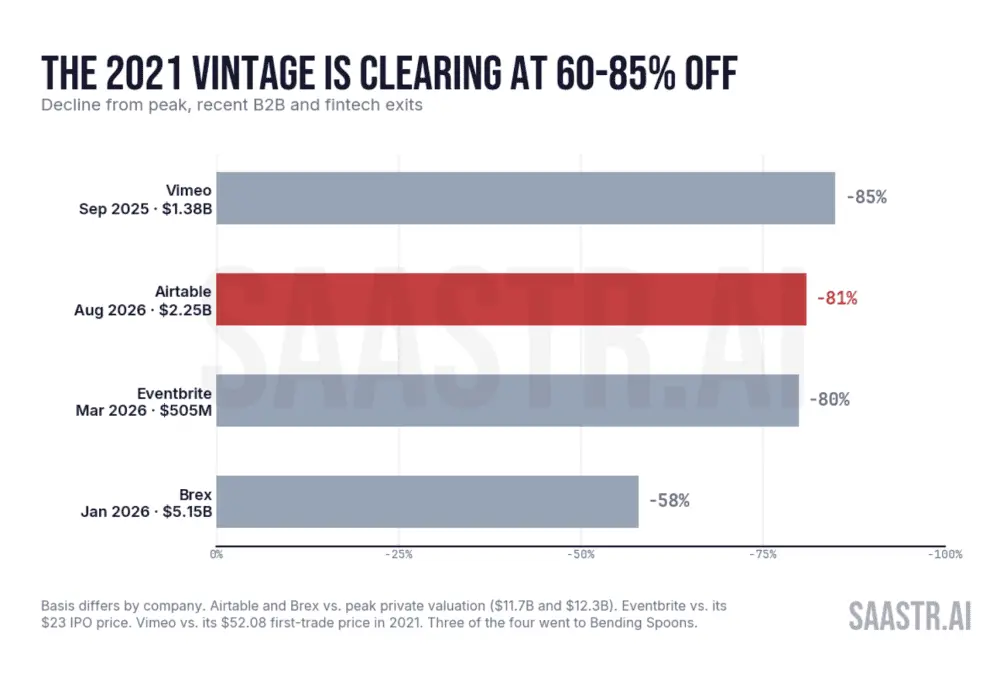
For an entity that once commanded an eye-watering $11.7 billion post-money valuation at the peak of the 2021 hyper-liquidity cycle, this exit represents an 81% decline from its historical high-water mark. Yet, viewed through the unvarnished lens of current market fundamentals, the acquisition price translates to approximately 2.7x Airtable’s projected $480 million in Annual Recurring Revenue (ARR) as of June 2026.
Far from signaling a distress sale by a broken company, the acquisition brings together one of the most distinguished B2B application pioneers of the past decade with a ruthless, AI-first turnaround specialist. Airtable enters this chapter boasting a robust financial profile: steady 20% year-over-year revenue growth, rock-solid gross margins hovering near 90%, positive cash flow operations generating upwards of $100 million annually since late 2024, and an enterprise customer base featuring over 500,000 organizations—including an astounding 80% of the Fortune 100.
Nevertheless, the transaction offers a masterclass in the harsh economic realities facing high-growth tech companies that transition into steady, mid-growth cash cows. It lays bare the critical importance of growth velocity, the protective mechanics of liquidation preference stacks, and the sobering reality of what the market is genuinely willing to pay for mature B2B software assets.
Detailed Chronology: From the "Lego of Software" to Market Reality
The Ascent: Building a Category-Defining Giant (2012–2021)
Founded in 2012 by Howie Liu, Andrew Ofstad, and Emmett Nicholas, Airtable set out to solve a ubiquitous problem: marrying the unstructured flexibility of a spreadsheet with the robust structural integrity of a relational database. Billed lovingly by its early evangelists as the "Lego of software," the platform captured the imaginations of developers, project managers, and enterprise business units alike.
Airtable mastered the classic bottoms-up SaaS go-to-market motion. Individual knowledge workers adopted the tool organically to organize everything from marketing campaigns to product roadmaps, eventually dragging their enterprise IT departments along to purchase enterprise-wide deployments.
This meteoric trajectory culminated in December 2021, when the company closed a massive $735 million funding round at an $11.7 billion post-money valuation, pricing shares at $187.28 apiece. At the time, Airtable’s ARR stood at approximately $156 million, cementing the round at a dizzying 75x forward revenue multiple. It was the absolute zenith of the zero-interest-rate policy era.
The Cycle Turns: The Pivot, the Pain, and the Meme Cycle (2022–2024)
As macroeconomic conditions shifted violently in 2022 and 2023, the gravity-defying multiples of the pandemic boom evaporated. Growth decelerated as enterprise software budgets tightened. Airtable was forced to restructure, executing two rounds of layoffs that impacted a total of 491 employees. The tech ecosystem, fickle as ever, briefly turned the company into a punchline with the "Airtable is dead" meme cycle of 2023.
However, management refused to let the enterprise fracture. Rather than burning through cash to chase unsustainable growth percentages, leadership engineered a remarkable operational pivot. By late 2024, Airtable had aggressively cut operational expenditures to achieve cash-flow positivity, successfully ring-fencing roughly half of the total capital it had historically raised on its balance sheet. Crucially, enterprise net retention remained resilient, and the engineering teams continued to ship product.
The AI Re-Architecture and the Arrival of 20% Growth
Crucially, Airtable did not simply issue superficial, press-release-driven announcements regarding artificial intelligence. Under the direct leadership of co-founder and CEO Howie Liu—who famously rolled up his sleeves to return to writing code—the company executed a profound, foundational re-architecture of its platform to embed generative AI capabilities natively into its relational framework.
This was not an exercise in window dressing; it was a deeply technical overhaul designed to keep the product defensible against an onslaught of agile, AI-native upstarts. The result was stabilization: a healthy, cash-generating business operating at roughly 20% year-over-year growth on a massive $480 million ARR base.
Yet, in today’s public and private markets, 20% growth on a scaled SaaS asset does not secure a high-growth compounder multiple. It prices you firmly as a durable, cash-flow-generating asset.
Supporting Context & Metrics: Why It Sold, and Why Now
The Strategic Impasse
Airtable possessed no immediate forcing function to sell. It carried zero debt, maintained no structural burn rate, and sat comfortably upon roughly $700 million in cash. Theoretically, the company could have remained privately held indefinitely.
The primary bottleneck was the path to liquidity and valuation realization. Airtable had no viable path back to an $11.7 billion valuation. The contemporary initial public offering (IPO) window harshly rewards companies exhibiting either massive scale paired with hyper-growth or true, AI-driven re-acceleration. Airtable possessed the former, but its growth had plateaued to a steady 20%. Filing an S-1 public registration statement at a 20% growth rate would have necessitated pricing the IPO at a severe discount to its last private round—a painful reality to endure on the public markets in perpetuity.
Simultaneously, the private secondary market had been steadily marking down the stock for three consecutive years. A 66% haircut in January was treated by many observers as market capitulation, yet the final clearing price landed another 44% lower seven months later. Private marks are ultimately administrative guesses; the M&A market provides the definitive price.
Furthermore, the competitive landscape had fundamentally shifted. The core value proposition that Airtable owned for a decade—empowering non-technical operators to build custom software applications without writing code—was increasingly being disrupted from below. Next-generation development platforms and code-generation environments allow non-engineers to spin up production-grade software rapidly, bypassing traditional seat-based pricing models. Airtable’s foundational promise had been systematically commoditized.

The Hyperagent Carve-Out
A nuanced and critical detail embedded within the transaction’s SEC filings is a pre-signing corporate reorganization. According to transaction disclosures, the assets and liabilities associated with "Hyperagent"—Airtable’s nascent platform for building and running autonomous AI workers across business software, spearheaded by Liu—were transferred out of the core entity being acquired into a separate, independent corporate structure named Hyperagent Inc.
Announced earlier in the year alongside initiatives like the "Founding 500" program (which injected $10 million in inference credits into agent-first startups), Hyperagent represented Liu’s vision for the next frontier of automation.
Because Bending Spoons cited the exact same ~$480 million ARR figure post-carve-out, analysts note that Hyperagent was contributing virtually zero revenue at the time of the sale. Consequently, the 20% growth rate and the 2.7x valuation multiple remain undisturbed. While the ultimate ownership distribution of Hyperagent Inc. remains private—likely distributed pro-rata to existing shareholders rather than reserved exclusively for founders—the structural maneuver ensured that Liu’s ambitious AI agent bet survived the corporate transaction intact.
The Economics of the Cap Table: Who Makes What?
To fully comprehend why this deal materialized, one must dissect Airtable’s capitalization table, historical fundraising totals ($1.4 billion raised across seven rounds), and the mechanics of its liquidation preference stack.
Assuming a standard 1x non-participating preferred stock structure (typical for late-stage venture deals of that vintage), roughly $1.29 billion of the transaction proceeds are siphoned off the top to satisfy preferred shareholders, who collectively owned approximately 25% of the company’s shares. This left roughly $900 million to $1 billion to be distributed among common stockholders, who held the remaining 75% of the equity.
- For Preferred Investors: The crossover funds that participated in the hyper-valued 2021 rounds essentially secured a return of capital (or modest par value preservation) rather than absorbing a total write-down, aided entirely by the protective armor of their liquidation preferences.
- For the Founders: Co-founder Howie Liu’s equity stake—pegged by Forbes at roughly 10% during the Series C in 2018—was inevitably diluted through subsequent rounds (Series D, E, F) and pool refreshes, likely landing in the 6% to 8% range by the time of the sale. At a common stock payout equivalent to roughly $18 to $25 per share, Liu’s payout sits in the $90M to $130M range, with co-founders Ofstad and Nicholas taking home proportionally less. While undoubtedly life-changing wealth for a 14-year entrepreneurial journey, it represents a fraction of what the 2021 Series F valuation implied.
- For Employees: For rank-and-file employees holding stock options struck against the lofty $11.7 billion valuation mark, the financial outcome is severe: underwater options yield zero value. Furthermore, employees who held common stock realized returns significantly below the private market valuation estimates recorded earlier in the year. Conversely, employees who successfully liquidated portions of their holdings in secondary transactions over the preceding 12 months fared substantially better than those who held through to the definitive sale.
Bending Spoons’ Playbook and Market Comparisons
The Buyer: Bending Spoons
Founded in Milan, Bending Spoons made waves by executing an initial public offering on the Nasdaq on July 1, 2026, pricing at $29 per share (representing an initial valuation of approximately $18.4 billion) and closing its first trading day up nearly 40%. The Airtable acquisition marks the company’s inaugural M&A transaction as a publicly traded entity.
Bending Spoons has meticulously built a reputation as a serial tech roll-up powerhouse. Its sprawling portfolio includes iconic consumer and enterprise brands such as Evernote, WeTransfer, Meetup, StreamYard, Issuu, Brightcove, Vimeo, AOL, and Eventbrite. The playbook is brutally consistent: acquire established, beloved brands characterized by stalled top-line growth, modernize and re-engineer the underlying technology stack, execute aggressive headcount rationalization, optimize pricing architectures, and hold the asset indefinitely for cash generation.
CEO Luca Ferrari has publicly noted that approximately 90% of Bending Spoons’ internal code is now written by artificial intelligence, driving revenue-per-employee metrics from $1.12 million in 2023 to an astonishing $2.57 million by 2025.
However, this aggressive compounding machine carries substantial balance sheet leverage. As of March 31, 2026, Bending Spoons carried approximately $4.4 billion in total debt against roughly $1.06 billion in shareholders’ equity, resulting in interest expenses of $93.2 million in the first quarter alone, while generating essentially flat GAAP net income on $1.31 billion in annual revenue.
For Airtable’s 935 employees and its extensive customer base, historical precedent suggests imminent structural changes: significant headcount reductions within one to two quarters post-close, upward price adjustments, tightened free-tier restrictions, and the introduction of metered AI credit consumption models.
Industry Comps: Is 2.7x an Anomaly or the New Baseline?
Skeptics might argue that Airtable’s 2.7x multiple reflects a distressed discount levied by a predatory cost-cutter. However, broader market comparables demonstrate that this valuation aligns closely with prevailing institutional parameters for mid-growth B2B software assets.
Consider Verint, a quintessential private equity software buyout: generating $909 million in revenue, $106 million in operating income, and maintaining 3,800 employees with AI-driven ARR growing at 21%, Thoma Bravo acquired the asset at a 2.2x revenue multiple, subsequently executing widespread workforce reductions within six months.
While top-tier SaaS companies exhibiting hyper-growth continue to command 6x to 7x multiples—exemplified by Thoma Bravo’s $12.3 billion take-private of Dayforce and its $2 billion acquisition of Olo—the vast expanse of B2B SaaS companies growing under 25% are facing a severe compression in pricing power. Brex’s acquisition by Capital One in January at a 58% discount to its peak valuation tells a parallel story across the fintech sector.
Future Outlook & Strategic Takeaways for Founders
The acquisition of Airtable by Bending Spoons serves as a watershed moment for the software industry, offering stark, actionable lessons for technology founders navigating the post-zero-interest-rate environment:
- Growth Rate Dictates Valuation Multiples: A 2.7x ARR multiple is the prevailing market clearing price for a fundamentally sound, highly efficient business that has ceased hyper-compounding. Excellent gross margins (90%), massive enterprise penetration (80% of the Fortune 100), and positive cash flow cannot rescue a valuation if top-line growth decelerates below 25%.
- The Perils of the Preference Stack: Liquidation preferences are not mere legal formalities; they dictate the ultimate distribution of exit proceeds. Every dollar raised at an inflated, peak-market valuation represents a senior claim that sits directly ahead of common equity.
- Strategic Secondary Liquidity: Founders and employees should carefully weigh opportunities for secondary liquidity. Holding out indefinitely for a public market IPO can expose equity holders to catastrophic valuation resets that far outweigh the risks of taking chips off the table early.
- AI as Defensive Hygiene: Implementing native artificial intelligence capabilities has transformed from an offensive growth catalyst into basic operational hygiene. Re-architecting a product for the AI era is the baseline requirement to stay in the game—it does not automatically guarantee a return to premium valuation multiples.
- The Thinning Buyer Universe: For mature B2B companies generating between $300 million and $800 million in ARR with moderate growth, the roster of potential institutional buyers is remarkably thin. When private equity and strategic acquirers pass on a premier asset at a given price point, founders are left with a stark binary choice: accept a realistic market-clearing bid or retain an asset destined to be milked for operational cash flow rather than growth.
Ultimately, Airtable’s journey from an $11.7 billion high-flying unicorn to a $2.25 billion disciplined cash-flow engine encapsulates the maturation of an entire software generation. It proves that while great products can survive market cycles, they must ultimately answer to the unforgiving arithmetic of current market realities.