






Executive Overview
In a significant push to reshape digital advertising, TikTok has announced the integration of ByteDance’s advanced Dreamina Seedance 2.5 artificial intelligence video generation model into its commercial toolkit. Rolled out to select paid advertisers in key markets, this cutting-edge upgrade marks a major leap forward in AI-driven marketing technology. By doubling the maximum length of AI-generated clips, vastly expanding reference inputs, and vastly improving visual realism, TikTok aims to give brands the creative firepower needed to execute complex, high-end storytelling campaigns directly within the platform’s ecosystem.
However, this commercial rollout occurs against a precarious backdrop. While enterprise tech developers and marketing executives celebrate the creative possibilities unlocked by generative AI, everyday social media users are increasingly pushing back against the saturation of synthetic media. Across the broader digital landscape, platforms from Snapchat to Pinterest and Reddit are scrambling to curb the influx of low-quality automated content—frequently disparaged as "AI slop."
As TikTok bets heavily on the capabilities of the Dreamina Seedance 2.5 model to drive ad engagement, it walks a strategic tightrope: balancing the insatiable demand of advertisers for scalable, high-performing content production against the risk of alienating an audience weary of synthetic intrusion in their feeds. This in-depth report explores the technical dimensions of TikTok’s latest AI integration, the macroeconomic context of the creator economy, and the widening chasm between ad-tech innovation and consumer sentiment.
Detailed Chronology: The Evolution of TikTok’s AI Advertising Suite
To understand the magnitude of the Dreamina Seedance 2.5 integration, one must examine the rapid trajectory of ByteDance’s in-house generative AI development and its deployment within TikTok’s monetization infrastructure.
The Springboard: Dreamina 2.0 (April 2024)
The foundation for the current upgrade was laid in April 2024, when TikTok formally introduced Dreamina 2.0 into its Symphony ad-creation toolkit. Designed to democratize high-end video production, Dreamina 2.0 allowed brands—particularly small-to-medium-sized businesses (SMBs) lacking massive production budgets—to type text prompts and generate serviceable, dynamic video clips for ad placements.
While revolutionary for its time, Dreamina 2.0 came with notable constraints. Clips were capped at a strict 15-second limit, which, while well-suited for traditional short-form vertical advertising, limited the narrative depth brands could achieve. Furthermore, the model’s ability to interpret multi-modal references was limited, frequently leading to continuity errors, warping in product proportions, and erratic lighting shifts across frames. Despite these limitations, the tool was rapidly adopted by performance marketers eager to test programmatic creative variants at scale.
The Summer of Experimentation and Model Refinement
Following the initial rollout of Dreamina 2.0, ByteDance engineers worked aggressively behind the scenes to address the core complaints of enterprise advertisers: lack of physical realism, poor multi-object tracking, and insufficient duration for narrative arcs. By late 2023 and early 2024, foundational video models across the tech industry—exemplified by OpenAI’s Sora and Runway’s Gen-3—began shifting the paradigm of what generative video could achieve.
ByteDance positioned its proprietary Dreamina Seedance framework as a direct competitor in this high-stakes race. By leveraging its vast computational resources and deep learning architectures, the parent company refined the model to better grasp real-world physics, spatial awareness, and cinematic consistency.
The Dreamina Seedance 2.5 Integration (Present Day)
Unveiled officially on Monday, the integration of the Dreamina Seedance 2.5 model into the TikTok Symphony ad ecosystem represents a quantum leap from its predecessor. Engineered specifically with the eccentricities and preferences of the TikTok audience in mind, the updated model is no longer merely a novelty tool for generating background loops; it is a sophisticated, end-to-end production studio designed to handle intricate, multi-layered visual narratives.
Technical Specifications: What’s New in Dreamina Seedance 2.5?
The primary value proposition of Dreamina Seedance 2.5 lies in its technical enhancements, which directly target the traditional bottlenecks of generative video production. Industry analysts reviewing the platform’s white papers and release notes have highlighted several critical upgrades:
1. Doubled Clip Duration (30 Seconds)
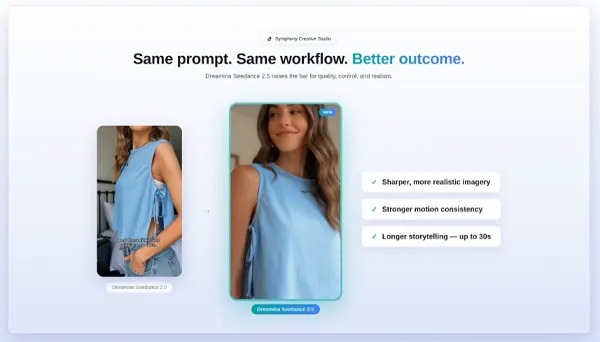
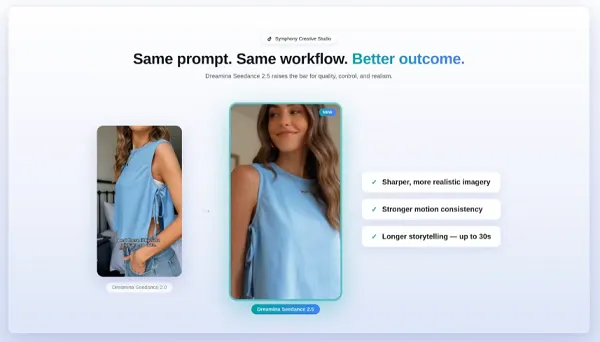
The most palpable upgrade for creative directors is the extension of maximum clip generation from 15 seconds to 30 seconds. In the fast-paced world of short-form video, an extra 15 seconds transforms a quick visual hook into a complete narrative arc. Advertisers can now introduce a problem, demonstrate a product feature in action, build emotional resonance, and deliver a comprehensive call-to-action (CTA) entirely within a single, AI-generated cohesive shot or tightly stitched sequence.
2. Massive Expansion of Multi-Modal References
Under the previous iteration, advertisers were constrained to a maximum of 9 reference inputs (such as brand assets, mood boards, or product photos) to guide the AI generation process. Dreamina Seedance 2.5 shatters this ceiling, allowing users to upload up to 50 multi-modal references—encompassing combinations of high-resolution images, video clips, and audio files.
This hyper-detailed input capability enables unprecedented brand alignment. Advertisers can feed the model exact product dimensions, specific brand color palettes, character designs from existing campaigns, and distinct audio cues, ensuring the resulting output feels native to the brand’s established identity rather than generic machine-generated art.
3. Hyper-Realistic Imagery and Physics Consistency
One of the most pervasive criticisms of early AI video was the uncanny valley effect: melting hands, inconsistent lighting, warping backgrounds, and characters whose facial features morphed mid-sentence.
TikTok claims that Seedance 2.5 delivers significantly "sharper, more realistic imagery." More importantly, the model boasts advanced architectural features dedicated to preserving lighting, motion, and character consistency across the entire duration of the clip. By achieving a deeper semantic understanding of product context, spatial proportions, and complex scene compositions, the model minimizes artifacting. This allows brands to execute ambitious, cinematic concepts that culminate in a polished, professional finish without the need for expensive post-production software or physical studio shoots.
The Broader Landscape: A Collision of Ad-Tech and User Backlash
While the technological capabilities of Dreamina Seedance 2.5 are undeniably impressive, TikTok’s timing introduces a fascinating paradox. The platform is doubling down on AI-generated commercial assets precisely at a time when the broader social media ecosystem is experiencing a severe consumer rebellion against synthetic content.
The Rise of "AI Slop" and Platform Reversals
For the past two years, feeds across the internet have been inundated with low-effort, algorithmically generated images, videos, and text—colloquially termed "AI slop." Users have made it abundantly clear that they visit social platforms to connect with real humans, authentic creators, and genuine communities, not to be bombarded by uncanny, automated artifacts designed purely to game engagement metrics.
Recognizing this existential threat to user retention, major platforms have begun rapidly reversing course on automated content promotion:
- Snapchat: In a landmark policy shift, Snapchat announced that it will no longer algorithmically promote or recommend wholly AI-generated content within its Spotlight short-video feed, prioritizing authentic user submissions instead.
- Pinterest: To combat feed pollution, Pinterest introduced dedicated user toggles allowing individuals to actively reduce the volume of AI-generated content appearing in their recommended topics and home feeds.
- Reddit and X (formerly Twitter): Both platforms have ramped up defensive measures. Reddit has grappled with tens of millions of daily spam views driven by automated bots, while X has tightened monetization rules to strip ad revenue from accounts spreading AI deepfakes and geopolitical misinformation.
TikTok’s Internal Contradiction: Transparency vs. Promotion
TikTok finds itself navigating a delicate balancing act. On one hand, the company has taken proactive steps to acknowledge user fatigue regarding synthetic media. Over the past year, TikTok rolled out comprehensive AI literacy and transparency initiatives, ensuring that viewers are explicitly notified when content has been generated or heavily altered using artificial intelligence. Furthermore, the platform introduced a user-facing preference setting allowing individuals to explicitly signal that they wish to see fewer AI-generated posts in their personalized "For You" feeds.
To introduce an industrial-strength AI video generator for advertisers directly into this climate creates a profound strategic friction. If consumers are actively seeking ways to purge their feeds of artificial content, flooding those same feeds with hyper-realistic, AI-generated brand commercials risks alienating the user base.

Industry experts warn that audiences are becoming increasingly adept at spotting synthetic cues. Advertisers who deploy poorly integrated AI ads—or rely too heavily on uncanny generation without human oversight—face a very real risk of consumer backlash, brand safety scandals, and immediate ad-skipping behavior.
Official Statements and Industry Reception
In its official communications regarding the rollout, TikTok leadership has emphasized empowerment, creativity, and efficiency rather than mere automation.
"The integration of the Dreamina Seedance 2.5 model is designed to lower the barrier to entry for high-end storytelling," a TikTok spokesperson noted during the announcement. "By providing creators and brands with advanced tools that honor spatial context, lighting, and character fidelity, we are enabling our business community to bring ambitious creative visions to life with unprecedented precision and polish."
Despite corporate optimism, third-party digital marketers and brand strategists are adopting a more pragmatic, measured approach. Speaking anonymously due to active agency partnerships with major platforms, one senior media buyer observed:
"The technical specs of Seedance 2.5 are undeniably drool-worthy. The ability to input 50 references and get a stable, 30-second vertical clip solves massive budget constraints for mid-market brands. However, the elephant in the room is audience trust. Consumers on TikTok have finely tuned bullshit detectors. If an ad looks even slightly synthetic, thumb-swipes happen in milliseconds. Advertisers cannot treat this as a ‘set-it-and-forget-it’ tool; it requires meticulous prompt engineering and human creative oversight to ensure it resonates rather than repels."
Future Outlook: Where Goes AI Advertising?
As the rollout of Dreamina Seedance 2.5 proceeds in its initial phased deployment—targeting select paid advertisers in select markets—the broader digital marketing industry will be watching closely to measure its efficacy.
Key Metrics for Success
Over the coming quarters, the success of TikTok’s upgraded ad suite will be judged not by technical benchmarks alone, but by core performance indicators:
- Engagement and Completion Rates: Do users watch 30-second AI-generated ads all the way through, or do drop-off rates spike compared to human-shot content?
- Ad Recall and Conversion Lift: Do sophisticated multi-modal inputs translate into tangible return on ad spend (ROAS) for enterprise brands?
- Consumer Sentiment Indexes: Will the influx of higher-quality AI ads trigger a new wave of user complaints, or will improved realism successfully bridge the uncanny valley?
The Imperative of Hybrid Creativity
Ultimately, the debut of Dreamina Seedance 2.5 signals that generative AI in advertising is no longer an experimental frontier; it is the established battleground. As AI models grow increasingly sophisticated—capable of handling complex physics, longer durations, and massive reference libraries—the dividing line between success and failure will not be the technology itself, but how it is wielded.
For brands navigating this volatile landscape, the path forward requires discretion. The most successful campaigns will likely eschew fully automated, impersonal "slop" in favor of a hybrid creative model: leveraging cutting-edge tools like Dreamina Seedance 2.5 to handle heavy lifting, background generation, and rapid iteration, while anchoring every campaign in authentic human storytelling, emotional resonance, and genuine cultural context. Only by respecting the intelligence—and the skepticism—of the modern social media user can advertisers harness the full power of ByteDance’s latest technological leap without burning their own brand equity.