For over three decades, the Hubble Space Telescope has served as humanity’s orbital eye on the cosmos, revolutionizing our understanding of the universe and capturing the public imagination with breathtaking imagery of distant nebulae, colliding galaxies, and ancient star clusters. Now, LEGO is paying homage to this legendary astronomical observatory through a meticulously crafted addition to its LEGO Icons line. Designed with an unprecedented level of internal and external accuracy, the newly unveiled LEGO Icons Hubble Space Telescope set goes far beyond a simple display model.
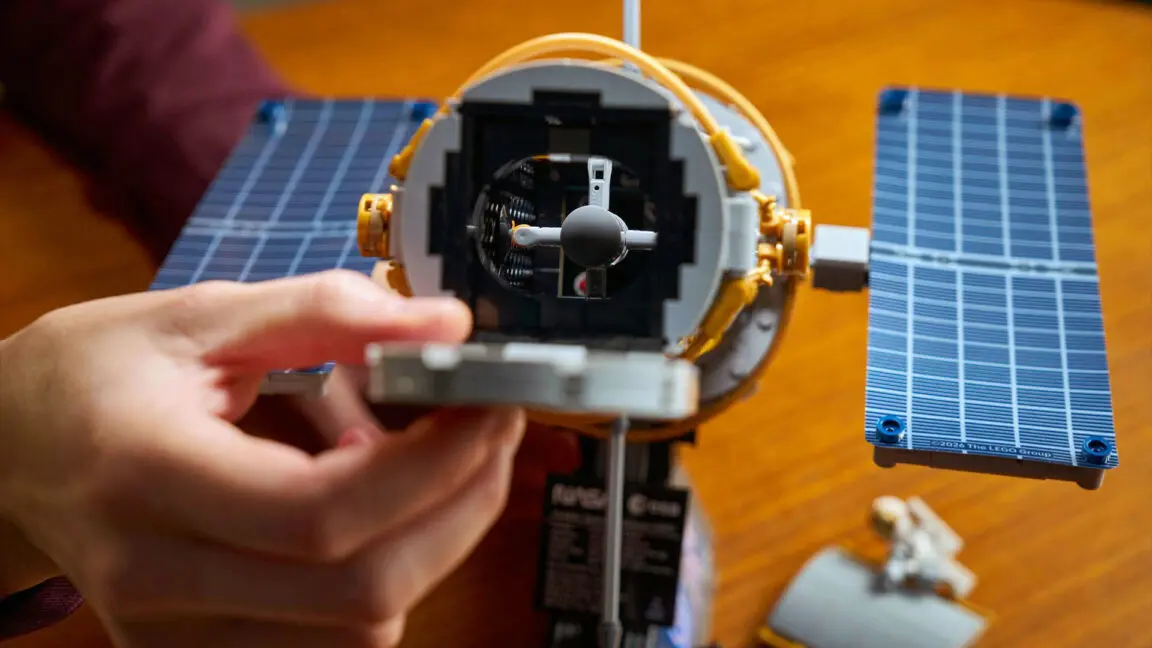
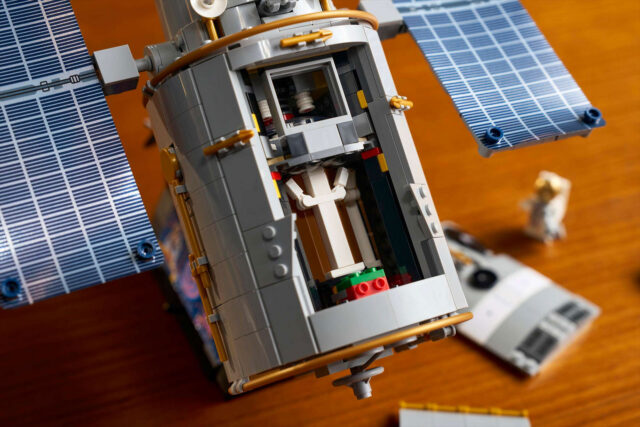
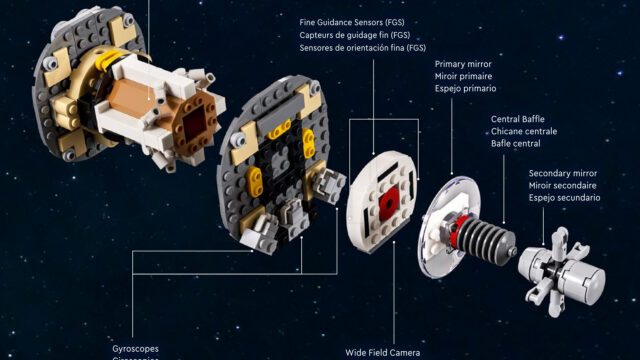
At a glance, the model captures the iconic silhouette of the orbital observatory, complete with its characteristic solar array wings and communications antennae. However, removing the model’s exterior panels reveals a staggering commitment to engineering realism. Inside, LEGO designers have recreated the complex suite of scientific instruments, gyroscopes, and guidance systems that allow the real-life satellite to perform deep-space observations. Configured to reflect Hubble’s modern state following its historic fifth and final space shuttle servicing mission in 2009, the set is a masterclass in scale model engineering.
Accompanied by a minifigure-scale display stand featuring translucent panels that showcase Hubble’s most famous cosmic portraits—including the Pillars of Creation in the Eagle Nebula, the Whirlpool Galaxy, and the Butterfly Nebula—this set bridges the gap between high-end collectible display pieces and educational STEM artifacts. This report examines the intricate design choices, historical context, and structural marvels packed into LEGO’s latest astronomical tribute.
Detailed Chronology: The Evolution of Hubble and Its LEGO Counterpart
To fully appreciate the design of the new LEGO model, one must understand the unique operational history of the Hubble Space Telescope. Launched in April 1990 aboard the Space Shuttle Discovery (STS-31), Hubble was envisioned not as a static satellite, but as a serviceable observatory that could be visited, repaired, and upgraded by astronauts in orbit.
The Servicing Era (1993–2009)
Shortly after its deployment, scientists discovered a flaw in Hubble’s primary mirror, resulting in blurred imagery. This necessitated the first daring servicing mission in December 1993 (STS-61), during which astronauts successfully installed corrective optics. Over the next decade and a half, four subsequent servicing missions replaced worn-out components, upgraded computer systems, and installed state-of-the-art scientific instruments.
The LEGO set specifically mirrors Hubble’s post-2009 configuration, capturing the exact array of instruments left behind by the crew of STS-125 aboard the Space Shuttle Atlantis during the final servicing mission.
Inside the Hull: Replicating State-of-the-Art Science
Removing the model’s modular panels exposes a faithful brick-built rendition of the internal hardware that keeps Hubble operational today:
Space Telescope Imaging Spectrograph (STIS): Represented in miniature form, this instrument splits light into its component colors to analyze the chemical composition, temperature, and motion of astronomical objects.
Cosmic Origins Spectrograph (COS): Designed primarily to study the ultraviolet universe, the COS looks at the large-scale structure of the cosmos and the evolution of galaxies.
Advanced Camera for Surveys (ACS): The workhorse instrument responsible for many of Hubble’s most iconic deep-field images.
Near Infrared Camera and Multi-Object Spectrometer (NICMOS): Providing infrared viewing capabilities, allowing Hubble to peer through dense interstellar dust clouds.
In addition to these core scientific payloads, the model accurately incorporates three operational gyroscopes (critical for stabilizing the telescope) and five fine guidance sensors. Externally, the model features the latest iteration of Hubble’s solar array wings, noting in the instruction manual that designers deliberately selected the final, most efficient solar panels installed during the 2009 mission.
Supporting Context & Metrics: Hidden Details and Engineering Ingenuity
What separates an ordinary toy from a high-end LEGO Icons release is the attention to sub-surface details, clever parts usage, and historical fidelity. The design team embedded numerous hidden Easter eggs and technical nods throughout the build, balancing visible aesthetics with structural authenticity.
Mechanics and Exterior Accoutrements
The Capture Mechanism: At the base of the telescope, a standard LEGO steering wheel element is ingeniously repurposed to represent the mechanical capture fixture. This is the exact mounting point that would be utilized by a future robotic or crewed vehicle should humanity decide to retrieve, boost, or safely deorbit the telescope.
Pressure Vents & Sunshades: Nearby stickers simulate the delicate venting system used to equalize internal pressure within Hubble’s chassis while simultaneously preventing stray external sunlight from bleeding into the optical path and ruining long-exposure observations.
Fixed-Head Star Trackers: Decals and dark circular aft-body openings accurately simulate the ports for Hubble’s three fixed-head star trackers. By locking onto specific reference stars within their field of view, these trackers help the onboard computers determine the telescope’s precise spatial attitude.
The Display Stand and Translucent Gallery
No display model is complete without an appropriate presentation base. The LEGO Hubble set includes a sturdy black display stand accompanied by a plaque detailing key historical milestones, including the specific calendar dates of all five Space Shuttle servicing missions.
Crucially, the stand features three pre-printed translucent brick elements. Each transparent plate illuminates a legendary cosmic target captured by the telescope:
The Eagle Nebula (“Pillars of Creation”): A colossal column of interstellar gas and dust located roughly 6,500 light-years from Earth.
The Whirlpool Galaxy (M51): A grand-design spiral galaxy interacting with a smaller companion galaxy.
The Butterfly Nebula (NGC 6302): A stunning bipolar planetary nebula displaying complex wings of superheated gas.
The Minifigure and the 35th Anniversary Badge
Built strictly to minifigure scale, the set includes a specialized astronaut figure equipped with an Extravehicular Mobility Unit (EMU)—the classic white spacesuit utilized during spacewalks. While skipping generic national or flight insignias to maintain broad appeal, the back of the astronaut’s Portable Life Support System (PLSS) backpack features a micro-decal of NASA’s official celebratory logo commemorating Hubble’s first 35 years of scientific discovery.
Official Statements & Design Philosophy
The philosophy behind the LEGO Icons Hubble Space Telescope extends beyond commercial play value; it is explicitly designed as a historical monument to international scientific achievement.
In the introduction to the official instruction manual, the lead set designers articulated their vision for the project:
"The astounding images and data provided by the Hubble Space Telescope have brought the farthest reaches of the universe closer to Earth. We’re just beginning to comprehend its historic significance, and it continues to inspire scientists and spark the public’s imagination. We wanted to honor that legacy."
Space exploration historians and LEGO enthusiasts alike have praised the set for its dual nature. It serves simultaneously as an accessible physical model for younger space enthusiasts and a sophisticated structural display piece for adult collectors (AFOLs) who remember watching the historic 1990 deployment live on television. By detailing the interior instruments—components that are normally locked away forever inside a sealed carbon-composite metal shell—LEGO provides builders with an intimate mechanical understanding of how orbital telescopes operate.
Future Outlook: The Legacy of Hubble in the Era of James Webb
As humanity pushes further into the cosmos with successor observatories like the James Webb Space Telescope (JWST) and the upcoming Nancy Grace Roman Space Telescope, the cultural and scientific footprint of Hubble remains untouched. While JWST commands headlines with its infrared peering capabilities, Hubble continues to serve as an irreplaceable workhorse in the ultraviolet and visible spectrums, frequently operating in tandem with its younger orbital siblings.
The release of this LEGO set underscores a broader cultural trend: the immortalization of landmark scientific hardware through pop-culture mediums. By transforming a complex, multi-billion-dollar orbital asset into standard interlocking plastic bricks, LEGO has created a tactile bridge between aerospace engineering and everyday households.
Whether it inspires a new generation of astrophysicists, serves as a desktop conversation piece for aerospace engineers, or simply provides a relaxing weekend build for an astronomy enthusiast, the LEGO Icons Hubble Space Telescope ensures that humanity’s most famous window to the stars will remain firmly anchored in our collective imagination for decades to come.