








Executive Overview
In the modern enterprise software landscape, passing every automated check in a deployment pipeline no more guarantees a successful release than a clean bill of health guarantees immunity from sudden illness. Time and again, engineering teams find themselves staring at a wall of green checkmarks, yet hesitation grips the organization. Essential security evidence may be languishing in an entirely different siloed system, disaster recovery plans remain incomplete, and accountability for the final "go/no-go" decision is obscured by ambiguity.
The root cause of this persistent anxiety is rarely a lack of technical tooling; rather, it lies in a structural disconnect: the failure of the delivery system to effectively map its technical capabilities to overarching organizational responsibilities.
To resolve this systemic friction, PeopleCert published the DEVOPS INSTITUTE Official Book: The DevOps Standard. Serving as a vendor-neutral definition and operating model, this landmark publication provides practitioners with a shared, universal reference framework for examining software delivery across complex boundaries—including the rapidly expanding domain of AI-assisted engineering. Far from being merely another theoretical framework, The DevOps Standard gives cross-functional teams the practical vocabulary and diagnostic criteria they need to identify exactly which delivery capabilities require attention, and what concrete evidence is necessary to demonstrate genuine operational improvement.
Detailed Chronology: The Evolution of a Universal Standard
The journey toward The DevOps Standard—officially released on October 1, 2026—did not happen in a vacuum. For over a decade and a half, the DevOps movement transformed how organizations thought about agility, continuous integration, and operations. Yet, as the industry matured, a fragmented landscape of definitions emerged. Tool vendors pushed narrow automation narratives, enterprise consultancies marketed proprietary maturity models, and internal platform teams wrestled with definitions of "DevOps" that ranged from automated testing scripts to full-stack infrastructure ownership.
Recognizing the urgent need for industry harmonization, the DevOps Institute and PeopleCert embarked on a multi-year initiative to synthesize decades of empirical data, community feedback, and enterprise case studies into a single, cohesive standard.
The Path to Publication
- Phase One (Foundational Research): Industry experts, enterprise architects, and continuous delivery pioneers analyzed the common points of failure in enterprise pipelines. They discovered that while continuous integration (CI) and continuous delivery (CD) had drastically accelerated code production, governance, compliance, and cross-departmental alignment remained perpetually bottlenecks.
- Phase Two (Collaborative Synthesis): Led by industry veterans and practitioners, the editorial and review teams worked closely with global enterprise stakeholders to draft a framework that was simultaneously rigorous enough for regulated industries and flexible enough for hyper-growth startups.
- Phase Three (Publication & Global Rollout): Released on October 1, 2026, The DevOps Standard established a definitive, vendor-neutral baseline designed to unify disparate engineering disciplines under a shared socio-technical banner.
Defining the Core: A Socio-Technical System
At the heart of the new standard lies a precise, comprehensive definition that moves the industry past the tired debate of whether "DevOps is just a culture" or "DevOps is just infrastructure automation." The DevOps Standard formally defines DevOps as:
"A socio-technical system that integrates people, process, and technology practices to support the efficient, safe, and reliable delivery of software-enabled products and services."
This definition serves as an immediate, concrete anchoring point for organizations. By explicitly framing DevOps as a socio-technical system, the standard acknowledges a fundamental truth of modern software engineering: technical choices cannot be divorced from human behavior, team topologies, and organizational workflows.
DevOps encompasses the daily working relationships, governance frameworks, and technical capabilities through which an enterprise changes and operates its products and services. Consequently, the standard reaches deep into areas often overlooked by traditional pipeline-centric views: product design, executive leadership, regulatory security, release management, and production-driven learning. While a central platform engineering or automation team can—and should—contribute vital capabilities, the ultimate responsibility for safe, efficient delivery remains distributed across the entire organization.
The Anatomy of a Modern Release: An Illustrative Retail Scenario
To understand how this definition translates into everyday engineering realities, consider a typical change within a major online retailer’s inventory availability service.
An engineer leverages an AI coding assistant to implement a newly optimized allocation rule designed to handle flash-sale traffic surges. Automated unit tests pass, and the security scanner returns no high-severity vulnerabilities. In a traditional pipeline-centric view, this change is cleared for immediate production deployment.
However, applying the socio-technical lens of The DevOps Standard reveals a starkly different picture. The organization still lacks vital operational evidence:
- Concurrency Validation: Will concurrent customer orders behave correctly under high-load conditions without creating race conditions?
- Data Protection: Does the modified allocation logic inadvertently expose sensitive inventory or pricing data across authorization boundaries?
- Observability and Containment: Can operations engineers quickly detect and contain incorrect availability calculations if the new rule fails in production?
- Product Alignment: Does product ownership have empirical proof that the change actually reduces overselling without unjustifiably rejecting valid customer orders?
Passing pipeline checks is merely table stakes. True release readiness requires bridging technical output with holistic product and operational evidence.
Supporting Context & Metrics: Two Views of the Same Delivery System
To help organizations navigate these complex interdependencies, The DevOps Standard introduces a dual-perspective operating model: the DEVOPS INSTITUTE Operating Model, which bridges the Nine Pillars of Practices with a four-layer DevOps Architecture Blueprint.
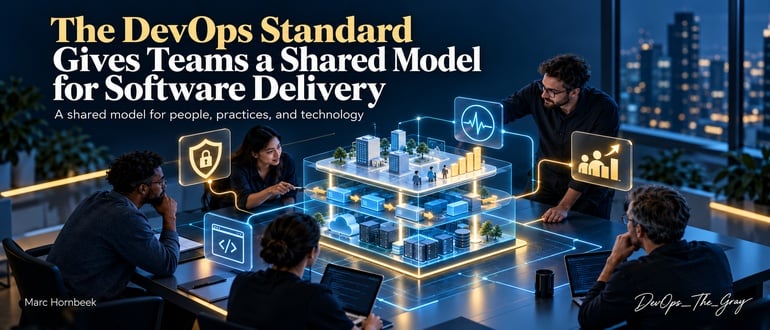
[DEVOPS INSTITUTE Operating Model]
 ├── Nine Pillars of Practices (The "Practice" View: People, Process, Technology)
 └── Four-Layer Architecture Blueprint (The "Delivery Architecture" View)
      └── Continuous Governance & Feedback (Connecting Work to Value & Learning)
The Nine Pillars of Practices
The operating model organizes the core competencies of software delivery into nine interdependent pillars. Importantly, the standard does not prescribe a fixed, linear implementation sequence; rather, it recognizes that organizations must tune these pillars based on their unique operational constraints:
- Leadership: Cultivating psychological safety, strategic clarity, and aligned incentives.
- Collaborative Culture: Breaking down silos between development, security, operations, and business units.
- Design for DevOps: Architecting systems for testability, modularity, and operational resilience.
- Continuous Integration: Rapidly and reliably merging and validating code increments.
- Continuous Testing: Automated verification of functional and non-functional requirements.
- Elastic Infrastructure: Provisioning and scaling environments dynamically on demand.
- Continuous Security: Embedding security controls throughout the entire software development lifecycle (SDLC).
- Continuous Delivery and Deployment: Ensuring software is always in a releasable state and safely deployed to production.
- Continuous Monitoring and Observability: Gaining deep, real-time insight into system health and user experience.
Returning to our retail inventory example, if a team experiences frequent testing failures, looking only at the Continuous Testing pillar—perhaps by purchasing yet another test automation tool—will likely fail to solve the underlying problem. The root cause may instead originate in insufficient concurrency scenarios (a Design for DevOps failure), unreliable staging environments (an Elastic Infrastructure flaw), or unclear ownership of acceptance criteria (a Leadership and Culture challenge). The Nine Pillars allow engineering leaders to investigate actual constraints rather than chasing superficial symptoms.
The Four-Layer Architecture Blueprint
Complementing the Nine Pillars, the Blueprint’s four layers make the operating implications of software delivery crystal clear:
- Layer 1: Infrastructure and Environments (Provisioning, configuration, and state management)
- Layer 2: Delivery Pipeline (Build, test, packaging, and validation workflows)
- Layer 3: Release Orchestration (Deployment strategies, progressive exposure, and governance gates)
- Layer 4: Value Stream Management & Feedback (Business value realization, telemetry, and learning loops)
A single Pillar often contributes across multiple layers. For instance, Continuous Security is not isolated to a static code analysis tool in the pipeline; it actively influences environment configuration (Layer 1), pipeline validation checks (Layer 2), release sign-off decisions (Layer 3), and incident response protocols (Layer 4). Teams must use the Blueprint to map these multi-layered contributions rather than treating practices as isolated silos assigned to single departments.
Official Statements and Industry Insights
The release of The DevOps Standard marks a watershed moment for enterprise IT governance. Industry veterans and contributors emphasize that the standard was explicitly engineered to combat "metrics theater"—the phenomenon where organizations optimize local pipeline speed while remaining blind to systemic delivery risk.
"A release can pass every pipeline check and still leave an organization uncertain about whether to proceed," notes the lead contributor to The DevOps Standard. "Security evidence may exist in another system, the recovery plan may be incomplete, and nobody may own the final decision. The difficulty lies in how the delivery system connects its capabilities and responsibilities."
By establishing a vendor-neutral baseline, PeopleCert has provided enterprise leadership with an objective instrument to evaluate delivery capability. Governance is no longer viewed as a bureaucratic hurdle that slows down software delivery; instead, governance becomes an integrated, automated design pattern within the socio-technical flow.
When governance is properly designed into the flow, teams define upfront the exact evidence needed, identify who holds the authority to accept residual risk, and automate routine compliance checks while preserving human oversight for consequential, high-risk decisions. If executive approval still requires scrambling to reconstruct audit evidence from scattered, disconnected systems, organizations learn that investing in better connectivity between those systems matters infinitely more than shaving a few seconds off compilation times.
Future Outlook: AI Integration and Evidence-Based Evolution
Looking toward the horizon, the most profound test of any modern engineering standard is how it handles the integration of Artificial Intelligence. As generative AI coding assistants, autonomous agents, and AI-driven release validators become ubiquitous in the enterprise, the surface area for unverified software changes expands exponentially.
The DevOps Standard addresses this paradigm shift head-on by placing AI-assisted artifacts and decisions firmly within the exact same socio-technical delivery operating model as human-generated work. AI involvement does not bypass organizational rigor; rather, it amplifies the need for explicit, traceable evidence.
Governing AI in the Delivery Pipeline
Under the new standard, AI-assisted work requires strict adherence to four operational pillars:
- Traceability: Every AI-generated line of code, configuration change, or automated script must maintain a clear lineage regarding its prompt origin, model version, and human reviewer.
- Validation: AI-generated artifacts must undergo rigorous automated and manual validation against expected system behaviors, just like human contributions.
- Accountability: Organizations must establish precise boundaries governing what an AI assistant or autonomous agent is permitted to execute independently, versus what conditions mandate mandatory human review and sign-off.
- Decision Support: When AI tools summarize release readiness or security posture, that summary must have an identifiable evidentiary basis and undergo appropriate peer review before supporting consequential production decisions.
Practical First Steps for Organizations
For organizations seeking to operationalize The DevOps Standard, the framework advises against attempting a sweeping, disruptive "big bang" transformation. Instead, engineering leaders should adopt an incremental, evidence-based approach:
- Select One Constraint: Choose a recent, representative software change where work unexpectedly stalled, evidence was ambiguous, or operational feedback arrived too late.
- Map the Constraint: Trace the failure across the Nine Pillars and the Four-Layer Architecture Blueprint to identify systemic root causes.
- Assign Ownership and Measure: Name an explicit improvement owner, define the expected outcome, and measure whether the resulting intervention demonstrably improved release confidence and stability.
By grounding transformation efforts in observable results rather than abstract confidence scores or tool inventories, organizations can finally realize the true promise of DevOps.
A free digital copy of The DevOps Standard is publicly available through PeopleCert and the DevOps Institute.