








Executive Overview
In an era defined by the rapid proliferation of generative artificial intelligence, sophisticated deepfakes, and automated resume padding, establishing authentic digital trust has never been more challenging—or more critical. Addressing these mounting security concerns head-on, LinkedIn has announced a sweeping expansion of its in-stream user and business verification framework. This latest rollout introduces peer-to-peer work history confirmations, enhanced corporate controls allowing verified brands to purge false employee listings, and extended cross-platform identity integrations with major third-party services.
The professional networking giant, owned by Microsoft, frames this initiative as a multi-million-dollar defense of its platform’s data integrity. As AI tools make it trivially easy to manufacture fake credentials, synthetic portfolios, and non-existent professional histories, LinkedIn is striving to position itself as the gold standard for digital identity in the professional sphere. According to company metrics, over 115 million members have already utilized LinkedIn’s free verification tools to validate their identities or workplaces. Furthermore, platform data indicates a tangible professional return on investment for authenticated users, who experience an average of 50% higher post engagement and nearly 90% more profile views compared to their unverified peers.
However, the rollout of these new features—particularly the requirement for businesses to purchase premium subscriptions to police their organizational rosters, alongside user opt-out clauses for verification badges—has sparked intense debate across the tech and HR communities. This deep-dive investigative report examines the mechanics, implications, and strategic motivations behind LinkedIn’s comprehensive verification overhaul.
Detailed Chronology: The Evolution of LinkedIn’s Trust Infrastructure
LinkedIn’s journey toward a completely verified ecosystem has accelerated significantly over the past several years, evolving from a passive resume repository into an active, cryptographic trust network.
The Foundation: Third-Party ID Verification
The groundwork for the current architecture was laid with LinkedIn’s initial user verification initiative, which allowed members to confirm their government-issued identities free of charge via integrated third-party verification partners such as CLEAR, Persona, and DigiCert. This system solved the baseline problem of proving that an account belonged to a real human being, mitigating the risk of bot-driven influence campaigns and romance or financial scams operating under the guise of recruiters.
The Corporate Frontier: Company Page Verification
As individual verification matured, LinkedIn realized that enterprise security required trust at the organizational level as well. In August 2024, the platform rolled out official company page verifications. Initially restricted and difficult to obtain, this feature was progressively expanded throughout the following year to incorporate brands participating in the Premium Company Page plan. Eligibility criteria remained tightly controlled, tying verified brand status to active platform engagement—such as regular posting and responsiveness—alongside a commercial relationship with LinkedIn, such as purchasing targeted advertisements or subscribing to premium enterprise tiers.
The Current Expansion: Peer Confirmation and Third-Party Interoperability
Building upon these structural foundations, LinkedIn’s latest update introduces two transformative capabilities:
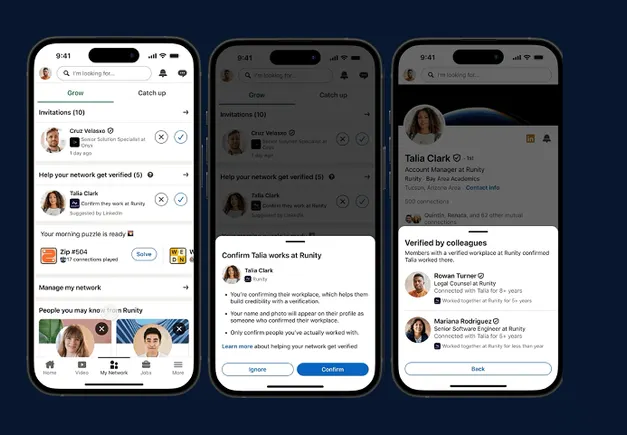
- Colleague Verification: Testing a social-validation loop where historical colleagues can vouch for a user’s past employment claims.
- Ecosystem Interoperability: Expanding digital credential displays to external platforms through fresh partnerships with Truecaller, PeerSpot, Adobe, TrustRadius, and UserTesting.
The Mechanics of Trust: How the New Verification Features Work
To understand how LinkedIn’s updated verification matrix operates in practice, it is necessary to examine the specific mechanics governing peer-to-peer validation and corporate profile cleanup.
1. Colleague Verification and the Social Validation Loop
Resume fraud—ranging from minor embellishments of job titles to entirely fabricated tenures at prestigious firms—has long plagued the recruitment industry. LinkedIn’s new peer verification feature aims to dismantle this practice through crowdsourced accountability.
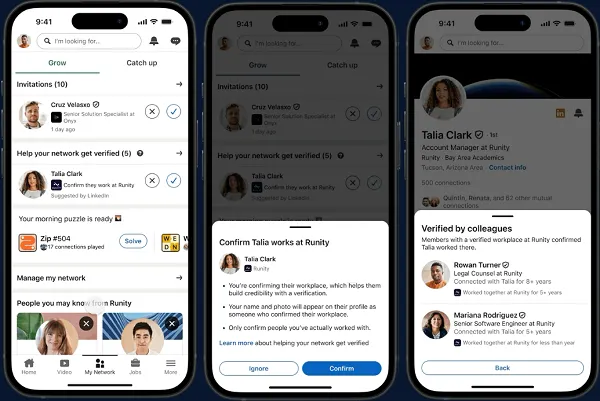
- The Prompt System: LinkedIn members will now receive automated prompts within the application asking them to confirm whether other members genuinely worked with them at matching historical employers.
- Threshold-Based Badges: Once a user accumulates a sufficient volume of peer confirmations from individuals whose own profiles establish historical overlap at the company in question, LinkedIn automatically attaches a verification badge to that specific section of the user’s experience history.
- The Opt-Out Controversy: In a twist that has drawn skepticism from data integrity experts, LinkedIn has confirmed that users will be permitted to opt out of displaying these peer-verification badges on their profiles if they choose. While this privacy concession accommodates users who wish to maintain a low profile or shield past professional relationships, critics argue it could undermine the absolute reliability of the system. Conversely, industry analysts suggest that as adoption scales, the conspicuous absence of verification badges on profiles may itself become a red flag for savvy recruiters.
2. Enterprise Roster Control: Empowering Verified Company Pages
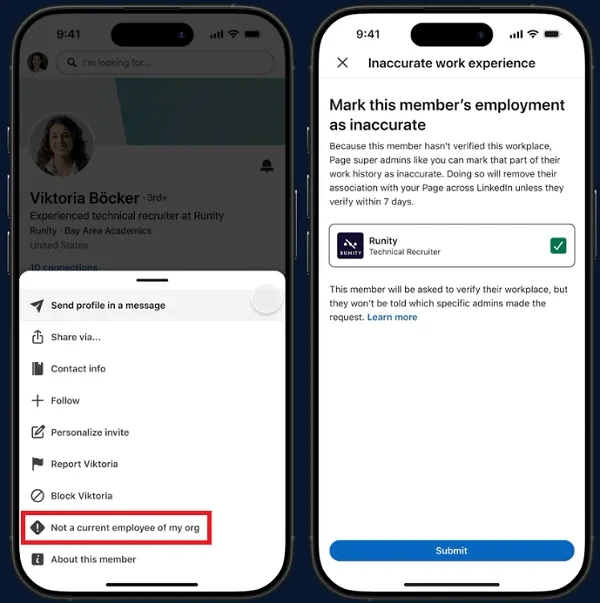
For corporate entities, managing brand reputation and mitigating liability from bad actors falsely claiming employment has historically been an uphill battle. Scammers frequently list themselves as executives or senior engineers at Fortune 500 companies to lend false credibility to phishing schemes, fraudulent investment opportunities, or social engineering attacks.
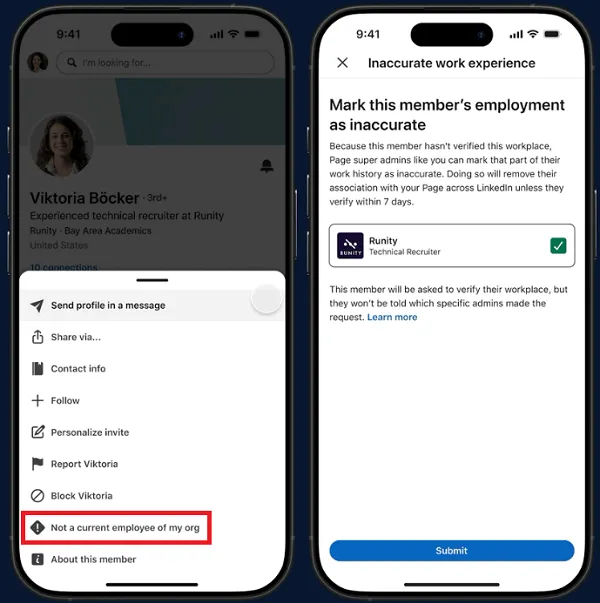
- The Purge Capability: Under the new system, verified company pages gain the administrative power to remove individuals who have falsely listed themselves as current employees of that specific business.
- The Pay-to-Play Barrier: There is a catch, however. This critical security feature is currently restricted exclusively to verified company pages. Because company verification eligibility is heavily tied to commercial relationships with LinkedIn—such as purchasing ads or maintaining a Premium Company Page subscription—smaller businesses and startups may find themselves priced out of the ability to actively police their own employee rosters on the platform. This monetization of basic brand protection has drawn criticism from small business advocacy groups who argue that digital safety should be a universal baseline rather than a tiered luxury product.
3. Cross-Platform Interoperability
Identity verification on LinkedIn is no longer confined within the walled garden of the platform itself. By partnering with external platforms like Truecaller, PeerSpot, Adobe, TrustRadius, and UserTesting, LinkedIn is transforming its identity and workplace verification badges into a portable digital passport. Users can now project their verified professional standing across disparate digital ecosystems, raising the stakes for maintaining a clean, authentic LinkedIn profile.
Supporting Context & Metrics: The Economics of Digital Verification
The urgency behind LinkedIn’s multi-million-dollar investment in verification architecture cannot be overstated. As the professional landscape undergoes a seismic shift driven by generative AI, the metrics surrounding trust, engagement, and platform integrity paint a vivid picture of why authentication has become the platform’s core strategic priority.
The AI Threat Multiplier
Generative artificial intelligence has democratized deception. Today, bad actors can deploy AI models to generate hyper-realistic profile photos, draft flawless employment histories, and synthesize recommendations from non-existent mentors in a matter of seconds. Automated bots can apply to thousands of jobs simultaneously, overwhelming human resources departments and choking applicant tracking systems with fraudulent submissions. Without robust cryptographic and social verification layers, platforms like LinkedIn risk descending into "dead internet" territory, where trust is eroded to the point of functional obsolescence.
Platform Growth and Engagement Metrics
Despite the challenges, LinkedIn’s verification drive is yielding quantifiable results:
- Adoption Milestone: Over 115 million members have successfully verified their identity or workplace for free, a notable increase from the 100 million verifications reported in December 2025.
- The Engagement Premium: Verified members enjoy tangible professional benefits. Internal LinkedIn data reveals that authenticated users experience 50% more post engagement and close to 90% more profile views than their unverified counterparts.
- Recruiter Confidence: For talent acquisition professionals, verified profiles drastically reduce time-to-hire metrics by eliminating the preliminary friction of background vetting and credential verification.
Official Statements and Industry Perspectives
Addressing the philosophical and technical underpinnings of the update, LinkedIn leadership emphasized the existential importance of trust in the modern digital economy.
"As AI reshapes the workplace, trust has become our most valuable professional asset," LinkedIn stated in an official company briefing. "LinkedIn has invested tens of millions of dollars in verification, helping to build a more trusted professional community where more than 115 million members have now verified their identity or workplace for free."
Industry analysts have offered mixed reactions to the rollout. Cybersecurity experts have praised the integration of peer-to-peer verification and cross-platform credentials as a necessary evolution against synthetic identity fraud. However, labor economists and consumer advocates have raised legitimate concerns regarding the commercial gating of corporate brand protection tools.
"While giving companies the ability to remove fraudulent employees is a massive win for corporate security, tying that feature exclusively to paid premium tiers creates a two-tiered security landscape," notes Sarah Jenkins, a digital identity researcher at the TechEthics Institute. "Well-funded corporations can easily protect their brand equity, while smaller enterprises are left vulnerable unless they fork over subscription fees to a Microsoft subsidiary. Security should not be a monetized feature."
Furthermore, the decision to allow users to opt out of peer-verification badge displays has left many wondering how the platform will handle edge cases where genuine employees choose privacy over public validation, potentially penalizing honest workers who prefer discretion.
Future Outlook: What Lies Ahead for Professional Identity
As LinkedIn continues to refine its verification matrix, the platform is charting a course toward an entirely authenticated professional internet. Several key trends are expected to define the road ahead:
- Mandatory Verification for High-Risk Sectors: While verification remains largely voluntary for individual users today, regulatory pressures and the rising tide of financial fraud may eventually push industries like finance, healthcare, and government contracting to mandate verified LinkedIn credentials for all practicing professionals.
- Decentralized Identity Integration: Industry watchers anticipate that LinkedIn may eventually bridge its centralized verification database with decentralized identity (DID) standards and blockchain-backed verifiable credentials, allowing professionals to own and port their employment histories independently of any single platform.
- AI-Driven Fraud Detection Countermeasures: As fraudsters adapt to peer verification—potentially by utilizing coordinated rings of fake accounts to cross-verify each other’s fabricated work histories—LinkedIn will inevitably be forced to deploy advanced machine learning algorithms to detect anomalies and synthetic social graphs within the peer-confirmation network.
Ultimately, LinkedIn’s aggressive push into stream verification marks a pivotal turning point in the history of social media and professional networking. By elevating trust from a passive feature to an active, measurable currency, the platform is attempting to future-proof its ecosystem against the existential threats of the artificial intelligence age. Whether these measures will successfully weed out bad actors without alienating privacy-conscious users or pricing out smaller businesses remains the defining question for the platform’s next chapter.