







WASHINGTON — For nearly thirty years, the global entertainment industry and intellectual property (IP) rights-holders have waged a public relations and lobbying campaign connecting digital piracy not merely to lost box office receipts, but to far graver societal ills. From the counterfeit CD smuggling rings of the late 1990s to modern-day illicit streaming networks, the narrative advanced by industry groups has steadily evolved.
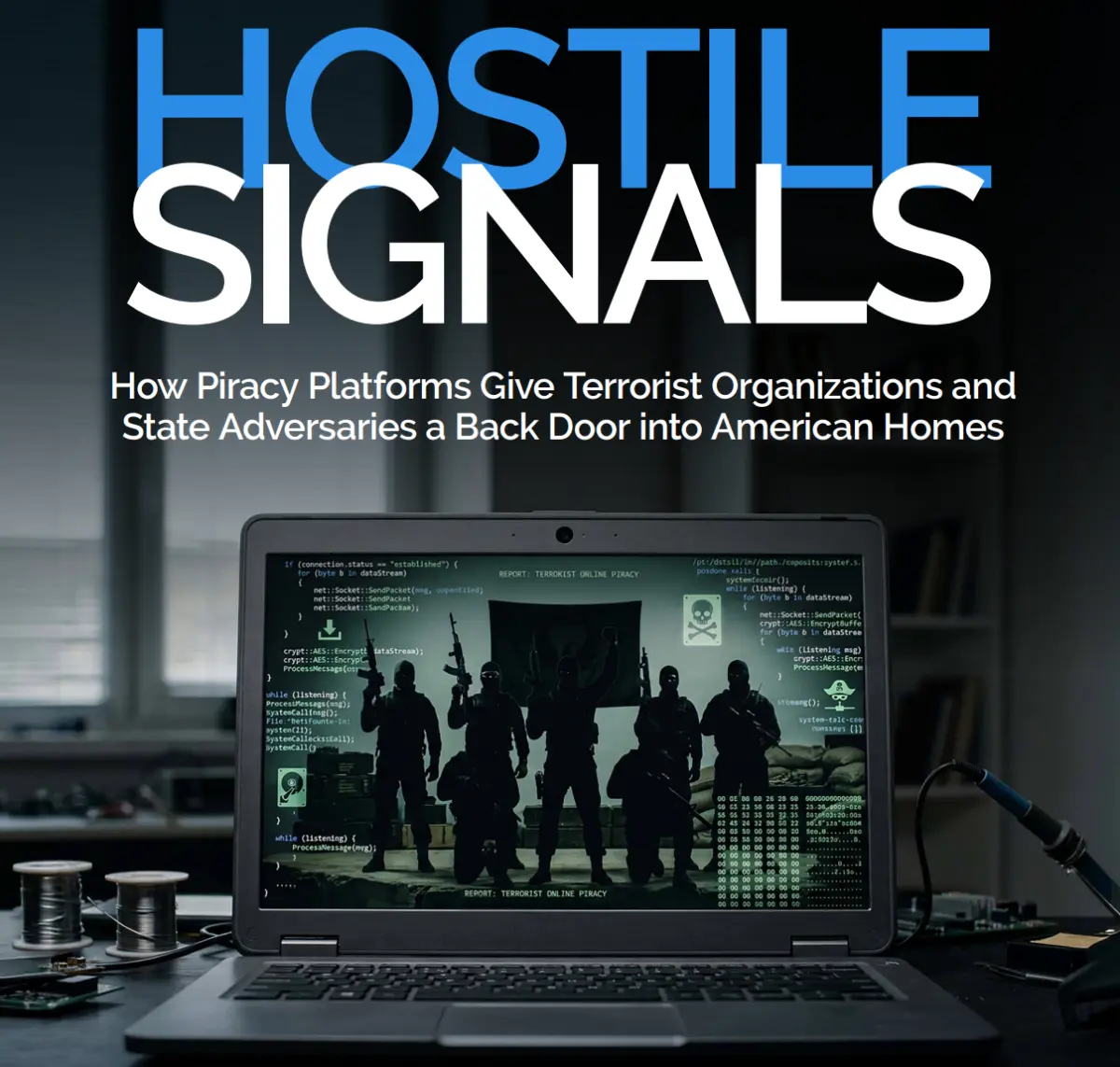
Now, a provocative new investigation released by the Washington-based advocacy group the Digital Citizens Alliance (DCA)—in collaboration with Atlanta-based security firm risk3sixty—takes this rhetoric to a controversial new frontier. Titled Hostile Signals, the report argues that unauthorized IPTV (Internet Protocol Television) services are no longer just economic parasites siphoning revenue from cable and streaming giants. Instead, the study contends that these clandestine digital networks operate as unchecked, sanction-circumventing broadcasting channels capable of delivering terrorist propaganda and state-sponsored radicalization directly into American households.
Arriving deliberately on the precipice of the 25th anniversary of the September 11 terrorist attacks, the report leverages high-stakes national security anxieties to push a familiar legislative remedy: the implementation of aggressive, court-ordered website-blocking mandates in the United States.
Yet, beneath the alarming statistics and emotional appeals lies a complex web of nuance, questions regarding actual viewership, and an ongoing Washington policy battle over the future of the open internet.
Executive Overview
The core thesis of Hostile Signals is straightforward: commercial pirate IPTV providers, often marketed as cheap alternatives to mainstream cable bundles, routinely include foreign television networks linked to designated terrorist organizations and sanctioned state actors.
Between May and August, security researchers at risk3sixty evaluated 25 commercial pirate IPTV services accessible via U.S. internet connections. According to their findings, 17 of those 25 services—or 68%—carried at least one television channel tied to a designated terrorist group or an adversarial state broadcaster.

Prominently featured among these streams was Al-Manar, the official television station of Hezbollah. The network, which has been designated a terrorist entity by the U.S. government due to its historical involvement in attacks resulting in hundreds of American deaths, was found on all 17 of the non-compliant platforms. Other streams included the Houthi-run Al-Masirah channel, Iran’s state-backed Al-Alam, and Hamas’s Al-Aqsa TV.
The DCA report frames this discovery as a severe national security loophole, asserting that the commercial accessibility of these channels via unauthorized streaming boxes effectively bypasses two decades of federal counter-terrorism and sanctions enforcement.
+-------------------------------------------------------------------+
|                  THE DCA / RISK3SIXTY FINDINGS                    |
+-------------------------------------------------------------------+
|  • IPTV Services Tested: 25 U.S.-accessible commercial platforms  |
|  • Services Carrying Prohibited Channels: 17 (68%)                |
|  • Hezbollah's Al-Manar Presence: Found on all 17 platforms       |
|  • Other Channels Identified: Al-Masirah, Al-Alam, Al-Aqsa TV     |
+-------------------------------------------------------------------+
By packaging these findings with heavy invocations of 9/11 memory, the report aims to jolt policymakers into action. However, digital rights advocates and technical experts note that the report glosses over key realities: many of these streams are available entirely free on the open internet outside U.S. jurisdiction, and the report presents no empirical evidence that American consumers are actively watching these foreign-language propaganda feeds amidst the thousands of entertainment channels offered by these subscriptions.
Detailed Chronology: The Evolution of the "Piracy-Terrorism" Nexus
To understand the weight and framing of Hostile Signals, it is necessary to examine the historical playbook of rightsholder advocacy. The rhetorical linkage between copyright infringement and transnational organized crime is not a recent phenomenon.
1. The Late 1990s: Counterfeit CDs and Smuggling Rings
As commercial CD burners and mass duplication technology proliferated globally in the late 1990s, the International Federation of the Phonographic Industry (IFPI) began raising alarms. The organization framed unauthorized music distribution not as petty theft, but as the domain of sophisticated criminal syndicates smuggling contraband across international borders.
2. Post-9/11: The Terrorism Pivot
The geopolitical landscape following the September 11 attacks fundamentally altered how lobbying groups framed domestic regulatory issues. In 2003, the U.S. House of Representatives held a landmark hearing explicitly examining intellectual property theft’s "links to organized crime and terrorism."

During these hearings, then-Interpol Secretary General Ronald Noble delivered testimony asserting that IP crime had transformed into "the preferred method of funding for a number of terrorist groups." This set the stage for a decades-long strategy of aligning copyright enforcement with national security imperatives.
3. 2009: The RAND Corporation Report
The most frequently cited anchor for this narrative emerged in 2009, courtesy of a motion picture industry-funded study conducted by the RAND Corporation. The report explicitly drew lines connecting film piracy, organized crime networks, and terrorist financing.
Although critics at the time—and in subsequent years—pointed out that the study frequently blurred the distinct legal lines between physical goods counterfeiting (such as fake luxury items or pirated optical discs) and digital downloading, the RAND report became a cornerstone citation for industry lobbyists seeking harsh legislative crackdowns.
4. 2017 to Present: Bundling Threats and IPTV
In the modern era, organizations like the Digital Citizens Alliance have kept the tradition alive by bundling copyright infringement with broader digital harms. In 2017, the DCA published reports linking online piracy platforms to ISIS recruitment videos, malware distribution, and disinformation campaigns. As recently as May of this year, the group released findings connecting pirate IPTV to illicit drug networks, illegal weapons trafficking, and traditional organized crime families.
Hostile Signals represents the culmination of this evolution, shifting the focus from financial sustenance to direct content delivery and sanctions circumvention.
Supporting Context & Metrics: Inside the Hostile Signals Investigation
The technical investigation underpinning the DCA’s latest report was conducted by risk3sixty, an Atlanta-based cybersecurity firm. Investigators purchased subscriptions to 25 consumer-facing, commercial pirate IPTV services using standard U.S. broadband connections between May and August.

Out of the 25 platforms evaluated, 17 were found to be redistributing channels explicitly banned under U.S. sanctions and counter-terrorism statutes.
Breakdown of Identified Channels
- Al-Manar (Hezbollah): Identified on all 17 non-compliant platforms. The U.S. government blocked the satellite distribution of Al-Manar as early as 2004, and federal prosecutors have previously secured convictions against individuals facilitating its retransmission in the United States.
- Al-Masirah (Houthi Movement): Present on 9 of the 17 platforms.
- Al-Alam (Iranian State Broadcaster): Present on 7 platforms.
- Al-Aqsa TV (Hamas): Present on 2 platforms.
The report highlights specific commercial pirate IPTV operators—including services such as Lion OTT, Sansat VIP, OTTOcean, Belitvision, and Wish IPTV—arguing that their ease of access from domestic IP addresses demonstrates a profound failure in current border enforcement and digital policing.
Nuance and Counter-Analysis: Separating Rhetoric from Reality
While the technical findings regarding the presence of these channels on pirate networks are largely verifiable, independent observers and technical experts emphasize that the report’s sensationalized conclusions require significant contextualization.
1. The Open Web Exception
A critical nuance often minimized in the report is that many of the flagged broadcasts—including Hezbollah’s Al-Manar—do not require a pirate subscription to view. They are freely accessible via the open internet on websites hosted outside U.S. jurisdiction.
For instance, while the U.S. Department of Justice seized 13 Hezbollah-linked domain names in 2023 (including seven bearing the network’s name), the broadcaster’s primary web portal operates under Lebanon’s .lb country-code top-level domain. This domain falls entirely outside the legal reach of American authorities and continues to stream live video feeds to any global visitor, including those in the United States, via a standard web browser.
Consequently, critics argue that targeting commercial IPTV providers does little to stem the foundational availability of these state-sponsored or militant broadcasts on the open web.

2. Viewership and Engagement Metrics
The Hostile Signals report concedes an important caveat: its findings say nothing concrete about actual viewership. Pirate IPTV services typically package thousands of global channels—spanning mainstream sports, international news, and entertainment packages—into a single subscription.
The presence of a fringe Arabic-language news or propaganda channel within a multi-thousand-channel lineup does not inherently equate to active consumption by subscribers, many of whom purchase the services exclusively for premium sports and blockbuster movies without navigating to obscure ideological programming. Furthermore, these broadcasts typically lack English-language subtitles, severely limiting their targeted pull among general U.S. audiences.
Official Statements and Policy Implications
Despite these technical caveats, the strategic timing of the Hostile Signals release is unmistakable. Washington is currently locked in a fierce legislative battle over domestic copyright enforcement mechanisms, and industry stakeholders are leveraging national security arguments to tilt the scales.
+-------------------------------------------------------------------+
    THE PUSH FOR U.S. SITE-BLOCKING LEGISLATION
+-------------------------------------------------------------------+
|  • Proposed Bills: American Copyright Protection Act (ACPA)       |
|                    Foreign Anti-Digital Piracy Act (FADPA)        |
|  • Key Proponents: Rep. Darrell Issa, Rep. Zoe Lofgren, MPA       |
|  • Stated Goal: Allow copyright holders to compel ISPs to block   |
|                 access to unauthorized foreign streaming domains. |
+-------------------------------------------------------------------+
The Push for Site-Blocking Legislation
The primary policy recommendation of the DCA report is the formal adoption of broad site-blocking mandates in the United States—a mechanism long championed by the Motion Picture Association (MPA) and music industry groups. Under a site-blocking regime, copyright holders can petition courts to compel domestic Internet Service Providers (ISPs) to block subscriber access to designated infringing domains at the DNS and IP levels.
This legislative push is already gaining momentum on Capitol Hill. Lawmakers have introduced measures such as Rep. Darrell Issa’s American Copyright Protection Act (ACPA) and Rep. Zoe Lofgren’s Foreign Anti-Digital Piracy Act (FADPA). Key congressional figures have indicated that a consolidated, bipartisan, and bicameral site-blocking bill is drawing closer to introduction.
In August, MPA Chief Charles Rivkin and leadership from the federal Intellectual Property Rights Coordination Center (IPR Center) explicitly invoked international sporting events and domain seizures to lobby for the same statutory site-blocking powers, arguing that traditional domain seizures are insufficient to stop fluid, overseas piracy syndicates.

Future Outlook
The release of Hostile Signals marks a calculated escalation in the ongoing war over digital governance. By intertwining the economic grievances of copyright holders with urgent geopolitical fears surrounding terrorism and national security, the Digital Citizens Alliance and its industry backers have provided ammunition to lawmakers eager to reshape the digital regulatory landscape.
For opponents of site-blocking—including civil liberties organizations, digital rights advocates, and major tech companies—the report represents a familiar and concerning tactic: the "weaponization" of national security to secure domestic legal powers that might otherwise face fierce resistance on purely economic grounds. Critics warn that establishing judicial and technical frameworks to block access to "pirate" servers carrying foreign broadcasts creates a slippery slope toward broader internet censorship and infrastructural overreach.
As Congress weighs the merits of bills like the ACPA and FADPA, the debate over Hostile Signals will undoubtedly echo through legislative committee rooms. Whether policymakers will view pirate IPTV platforms as active conduits of international terror—or simply as an exaggerated pretext to pass long-sought copyright protections—remains one of the most contentious battles shaping the future of the American internet.