








Executive Overview
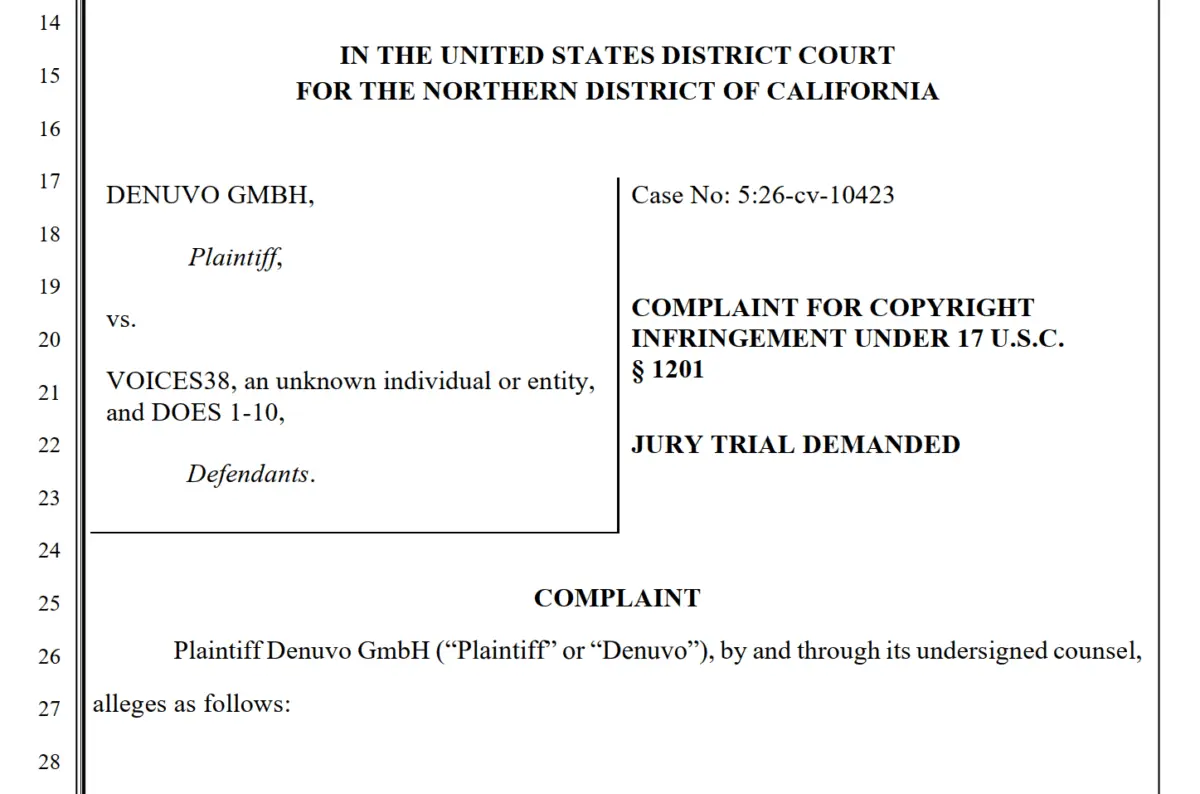
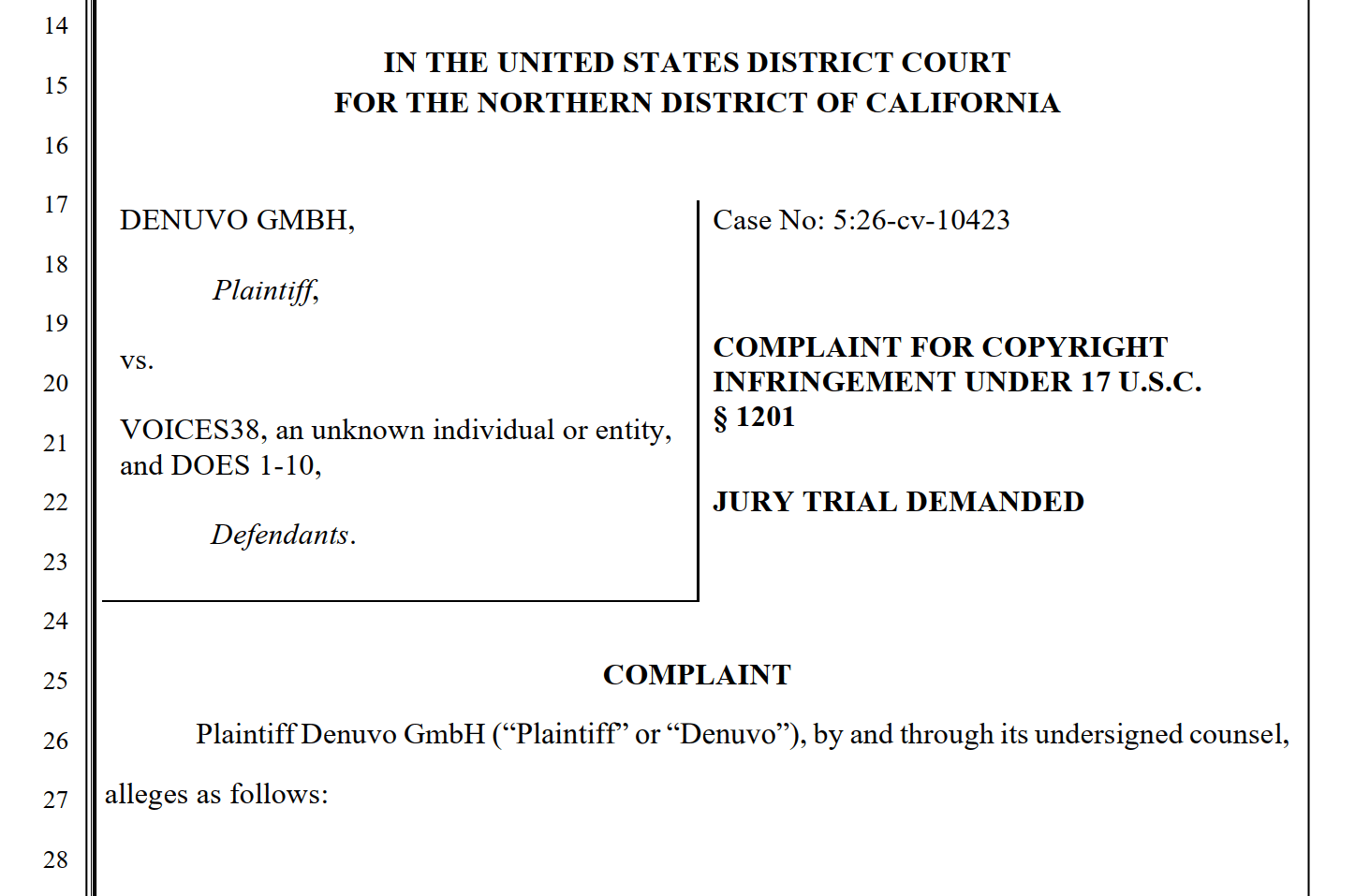
In an unprecedented legal escalation within the digital rights management (DRM) and video game piracy landscape, Austrian anti-tamper titan Denuvo GmbH has launched a direct offensive against the digital underground. Filed in the U.S. District Court for the Northern District of California, Denuvo’s newly minted lawsuit targets an anonymous, highly prolific software reverse-engineer and game cracker known exclusively by the handle "voices38."
For years, the battle lines over game security were drawn primarily by major publishers—such as Electronic Arts, Ubisoft, Capcom, and Sony—who brought traditional copyright infringement claims against digital pirates and unauthorized distributors. Denuvo, as a foundational third-party security provider, traditionally remained behind the scenes, supplying the algorithmic armor intended to protect multi-million-dollar software investments during their lucrative launch windows.
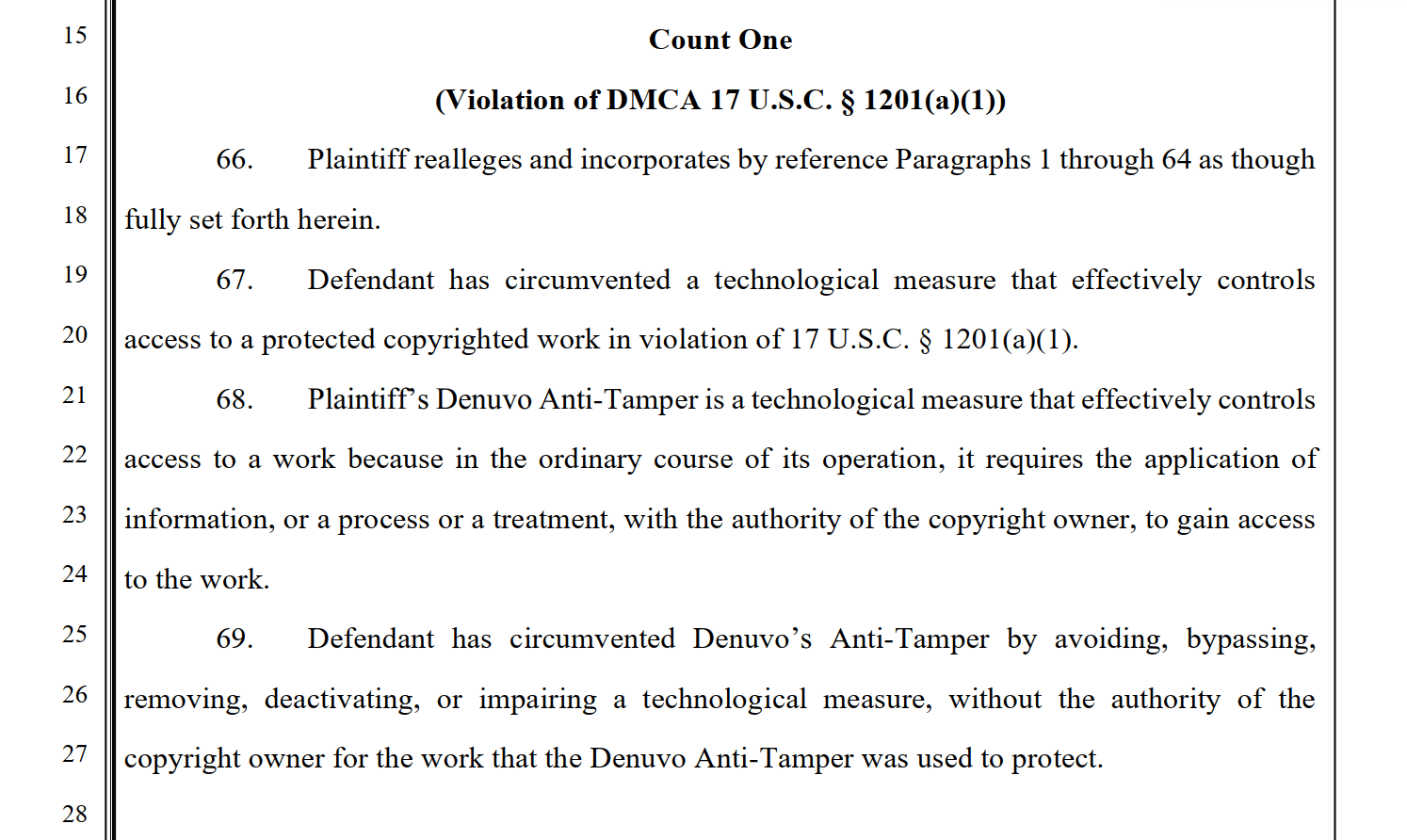
This lawsuit shatters that precedent. Because Denuvo does not hold the underlying copyrights to the video games it protects, the company cannot sue under standard copyright infringement statutes. Instead, Denuvo has anchored its legal complaint in the Digital Millennium Copyright Act (DMCA), utilizing the statute’s strict anti-circumvention provisions to argue that the deliberate dismantling of its Anti-Tamper technology inflicts direct, measurable financial and reputational harm on its core enterprise.
Targeting 26 specific titles—ranging from older legacy releases like FIFA 20 to massive modern blockbusters such as Hogwarts Legacy, Black Myth: Wukong, and Star Wars Outlaws—the lawsuit attempts to pierce the veil of online anonymity. Armed with a docket of digital breadcrumbs, including a Discord user ID, a Reddit account, and seven linked Steam profiles, Denuvo is moving to unmask the human behind the keyboard via federal subpoenas. This case represents a watershed moment for the video game industry, signaling that anti-piracy firms are no longer content to let game publishers shoulder the legal burden of neutralizing persistent software crackers.
Detailed Chronology: The Rise of ‘voices38’ and Denuvo’s Legal Retaliation
The 2025 Cracking Renaissance and the Limits of Hypervisors
The digital security landscape surrounding Denuvo’s Anti-Tamper software has faced unprecedented turbulence. Earlier this year, the anti-piracy community witnessed a major paradigm shift when a wave of advanced hypervisor bypasses emerged. These sophisticated exploits allowed game pirates to effectively "crack" and play Denuvo-protected titles on their exact release days, bypassing the software’s deep system-level checks by manipulating virtualization layers. Irdato—Denuvo’s parent company—scrambled to issue countermeasures, promising rapid updates to seal these structural vulnerabilities.
However, hypervisor bypasses were not the security firm’s only operational headache. While sophisticated threat actors tinkered with low-level system virtualization, a substantial segment of the pirating community yearned for a return to simplicity. Complex hypervisor exploits often required users to tamper with critical Windows security features, such as Virtualization-Based Security (VBS) or kernel-level settings, alienating casual users who feared system instability or malware vectors.

Enter ‘voices38’: The Traditionalist Cracker
Sensing an untapped market demand for user-friendly, old-school software solutions, an anonymous developer operating under the moniker "voices38" stepped into the spotlight. Unlike hypervisor exploit developers, voices38 focused on direct binary modification—patching Denuvo’s internal authentication and integrity checks directly within the game executables.
These traditional cracks allowed users to run modified games natively without disabling native Windows security protocols. The approach resonated deeply with the underground community, propelling voices38 to local celebrity status on platforms like Reddit. Throughout the summer, the cracker’s output accelerated dramatically. The peak of this productivity wave occurred earlier this month, when voices38 astonishingly dropped five distinct Denuvo-protected game cracks in a single 24-hour window.
This brazen, high-volume assault did not escape the notice of Denuvo’s telemetry and engineering teams in Austria. Recognizing that voices38 was systematically undercutting the commercial value of their product across multiple major publishing portfolios, Denuvo’s legal representation initiated a comprehensive digital forensics investigation, culminating in federal court filings in California.
Legal Analysis: Navigating the DMCA Anti-Circumvention Maze
The core of Denuvo’s legal strategy rests on a clever, yet legally complex, interpretation of U.S. intellectual property law: The Digital Millennium Copyright Act (DMCA).
The Standing Hurdle: Why Denuvo Had to Sue
In standard software piracy litigation, copyright holders—the game publishers who fund, create, and market the software—file lawsuits alleging copyright infringement under Title 17 of the United States Code. These lawsuits typically seek statutory damages for unauthorized reproduction, distribution, and public display of copyrighted works.
Denuvo GmbH, however, occupies a unique position. As a software-as-a-service (SaaS) provider, Denuvo licenses its proprietary Anti-Tamper technology to publishers like Electronic Arts, Square Enix, and Sega. Denuvo secures the software, but it does not own the software’s copyright. Consequently, Denuvo lacks legal standing to sue for traditional copyright infringement on behalf of titles it merely protects.
Weaponizing Section 1201 of the DMCA
To circumvent this standing barrier, Denuvo turned to Section 1201 of the DMCA (17 U.S.C. § 1201), which governs the circumvention of copyright protection systems.
The statute explicitly prohibits two primary activities:
- Technological Circumvention: Bypassing a technological measure that effectively controls access to a copyrighted work.
- Trafficking in Circumvention Tools: Manufacturing, importing, offering to the public, providing, or otherwise trafficking in technology, products, services, or devices that are primarily designed or produced to circumvent access controls.
Denuvo’s legal complaint argues that voices38 has systematically violated both provisions. By reverse-engineering Denuvo’s Anti-Tamper executable wrappers, stripping out licensing verifications, and distributing patched binaries across platforms like Reddit and public forums, the defendant has engaged in unauthorized technological circumvention and distributed trafficking vectors for copyright infringement.
Crucially, Section 1201 allows any person injured by a violation of its anti-circumvention provisions to bring a civil action in a federal district court. Denuvo argues that its entire business model—which relies on convincing AAA and indie publishers that its anti-tamper software is virtually impenetrable—is directly undermined by public cracks. Every successful, unpunished crack by voices38 devalues Denuvo’s market offering, resulting in direct economic injury that grants the company clear standing to sue.
The Digital Footprint: Unmasking ‘voices38’
Because online anonymity is standard operating procedure for high-profile software crackers, Denuvo’s initial complaint names the primary defendant simply as an "unknown individual or entity (doing business as ‘voices38’)," alongside ten unnamed "Doe" defendants representing potential collaborators, distributors, or mirror hosts.
Despite the pseudonymity, Denuvo’s legal filing reveals that the company’s investigative teams have mapped out a robust digital footprint linking the online persona to real-world infrastructure.
+-----------------------------------------------------------------+
                 DENUVO'S FORENSIC TRAIL
+-----------------------------------------------------------------+
       |
       +---> Discord User ID (Primary community coordination)
       |
       +---> Reddit Account: u/voices38 (Public release vector)
       |
       +---> 7 Distinct Steam Profiles (Linked acquisition vectors)
             |
             +---> Potential credit card / payment identification
             +---> Real-world billing addresses via upcoming subpoenas
The Subpoena Strategy
The inclusion of specific digital identifiers is not merely illustrative; it is a tactical prerequisite for judicial discovery. Modern video game encryption is robust, and games cannot simply be cracked out of thin air—they must first be legally purchased to obtain clean, uncompressed executable binaries and asset files for reverse engineering.
By cataloging seven specific Steam profiles, a Discord user ID, and the u/voices38 Reddit account, Denuvo has laid the groundwork to request judicial permission to issue Federal Rule of Civil Procedure 45 subpoenas. Once approved by the court, these subpoenas will be served on corporate entities including Valve Corporation (Steam), Reddit, Inc., and Discord, Inc.
These third-party platforms will be legally compelled to turn over underlying account registration data, associated email addresses, IP connection logs, and—most crucially—payment information. Because purchasing AAA titles on Steam requires valid credit card transactions, PayPal accounts, or regional financial instruments, financial trails frequently pierce the veil of digital anonymity, exposing the real-world identity of software modifiers.
Supporting Context & Metrics: The Scale of the Crack List
Denuvo’s comprehensive legal complaint provides a fascinating window into the modern gaming industry’s release pipeline, cataloging 26 specific titles targeted by voices38. The list reads as a veritable "who’s who" of modern gaming, spanning multiple generations, platforms, and major global publishers.
The 26 Target Titles Cited in the Lawsuit
| # | Game Title | Publisher |
|---|---|---|
| 1 | Need for Speed Heat | Electronic Arts |
| 2 | EA Sports FIFA 20 | Electronic Arts |
| 3 | Star Wars: Squadrons | Electronic Arts |
| 4 | Need for Speed: Hot Pursuit Remastered | Electronic Arts |
| 5 | EA Sports FIFA 21 | Electronic Arts |
| 6 | Hi-Fi Rush | Bethesda Softworks |
| 7 | F1 2021 | Electronic Arts |
| 8 | Dead Space Remastered | Electronic Arts |
| 9 | Doom: The Dark Ages | Bethesda Softworks |
| 10 | Mafia: The Old Country | 2K Games |
| 11 | LEGO Batman: Legacy of the Dark Knight | Warner Bros. Games |
| 12 | Hogwarts Legacy | Warner Bros. Games |
| 13 | Total War: Three Kingdoms | SEGA |
| 14 | Starlink: Battle for Atlas | Ubisoft |
| 15 | Shining Resonance Refrain | SEGA |
| 16 | PES 2020 | Konami |
| 17 | Shin Megami Tensei III Nocturne HD Remaster | SEGA |
| 18 | Scott Pilgrim vs. The World: The Game | Ubisoft |
| 19 | Anno 1800 | Ubisoft |
| 20 | Sonic Frontiers | SEGA |
| 21 | Assassin’s Creed Mirage | Ubisoft |
| 22 | Pragmata | Capcom |
| 23 | Resident Evil Requiem | Capcom |
| 24 | Black Myth: Wukong | Game Science |
| 25 | Stellar Blade | Sony Interactive Entertainment |
| 26 | 007 First Light | IO Interactive |
The Cat-and-Mouse Game of Fast-Moving Output
One notable detail highlighted in legal analyses is the dynamic nature of the complaint itself. Even as the legal paperwork was being finalized and filed in Northern California, the target list was already obsolete. In the weeks following the initial filing, voices38 continued unperturbed, dropping high-profile cracks for titles such as Persona 3 Reload and Star Wars Outlaws.
To account for this rapid cadence, Denuvo’s legal prayer for relief explicitly requests a permanent injunction that extends not only to the 26 enumerated games but also to all future software titles utilizing Denuvo Anti-Tamper technology that have yet to be developed or released.
Future Outlook: Industry Implications and the Road Ahead
As this landmark legal battle enters its formative stages, legal scholars, game developers, and piracy analysts are closely monitoring its trajectory. What happens next could fundamentally reshape the economics of video game security.
1. The Power of Default Judgments and Injunctions
Even if Denuvo’s subpoenas fail to unmask the physical human behind the "voices38" handle—due to sophisticated operational security, VPN usage, or cryptocurrency funding—the lawsuit is far from an exercise in futility.
If the defendant chooses not to appear in a U.S. federal court to contest the allegations, Denuvo can move for a default judgment. Securing a default victory grants the company a powerful legal instrument: a permanent, court-ordered injunction. With this injunction in hand, Denuvo can easily compel internet service providers, file hosting services, and social media platforms to instantly scrub download links, mirror repositories, and promotional community pages associated with voices38. Furthermore, it establishes a formal legal precedent affirming that third-party DRM providers possess independent standing under the DMCA to sue reverse engineers directly.
2. A Significant Deterrent Effect in the Underground Community
For years, software crackers operated under the comforting assumption that publishers were the only entities with legal recourse—and that major corporations rarely deemed the exorbitant costs of cross-border litigation worthwhile against anonymous hobbyists.
By demonstrating that a specialized anti-tamper firm is willing to initiate federal litigation in the United States, Denuvo is sending a chilling message to the broader cracking community. The threat of severe statutory damages, combined with the invasive nature of federal discovery and international extradition treaties, may cause other prominent crackers to reconsider the public visibility of their exploits.
3. Conclusion: A New Frontier in Digital Enforcement
The collision between Denuvo GmbH and the anonymous entity known as voices38 marks the end of an era where digital security providers remained quietly in the background while publishers fought the piracy wars alone. By testing the boundaries of DMCA Section 1201, Denuvo is actively rewriting the legal playbook for software protection. Whether this aggressive maneuver succeeds in unmasking voices38 or merely drives the cracking community further into the shadows, the landscape of software preservation and digital rights management has irrevocably changed.