








Executive Overview
The modern go-to-market (GTM) engine is experiencing a quiet industrial revolution. Across the technology sector, artificial intelligence agents are no longer confined to experimental sandboxes or niche pilot programs; they are operating deeply within live, high-stakes production environments.
At organizations like SaaStr, fleets of dozens of active AI agents are autonomously generating millions in revenue. They book complex meetings on Saturday nights, systematically resurrect dead pipeline that human teams abandoned half a year prior, execute comprehensive invoice-to-cash workflows, and log data directly into enterprise CRMs without human intervention.
This technological leap has driven staggering efficiency gains. Human GTM organizations are shrinking—often operating at a fraction of their historical headcounts—while handling greater output than ever before. Yet, beneath the triumphant metrics of automated lead generation and optimized top-of-funnel conversion lies a stark, unaddressed vulnerability that most founders and enterprise executives have failed to price into their models: There is still no truly competent, reliable autonomous AI Account Executive.
While artificial intelligence has effectively industrialized the work of Sales Development Representatives (SDRs), first-line support, and Customer Success Management (CSM) workflows, it stops short at the negotiating table. AI agents can open deals, enrich records, orchestrate multi-channel follow-ups, and process back-office paperwork with mechanical precision. But the critical, high-friction moment where a human buyer decides to exchange capital for a product remains stubbornly locked behind human judgment.
This comprehensive report examines the current state of GTM automation, drawing on production data, industry benchmarks from ICONIQ and Emergence, and insights from leaders at Salesforce, PayPal, Klaviyo, and Anthropic. It explores why closing deals is structurally different from qualifying them, how early-stage self-serve metrics are masking a deeper market reality, and what the evolution of the "augmented AE" means for the future of B2B sales.
Detailed Chronology: The Evolution of Production AI Agents
To understand where the market stands today, it is essential to look at how autonomous agents transitioned from speculative novelties into core infrastructural elements of corporate revenue engines over the past several years.
Phase 1: The Administrative and Top-of-Funnel Takeover (Early-to-Mid 2025)
The initial wave of production-grade AI deployment focused squarely on the edges of the revenue cycle. Rather than attempting to negotiate complex contracts, early implementations targeted the highest-volume, lowest-context tasks: scheduling, initial outreach, and CRM hygiene.
Companies began deploying conversational inbound agents capable of handling hundreds of thousands of live chat interactions. These systems did not negotiate rate cards or interpret nuanced objection-handling; instead, they qualified, routed, and booked meetings around the clock. Simultaneously, early automated win-back campaigns demonstrated that machine-driven persistence could achieve unprecedented open and response rates on ghosted sponsor leads, outperforming human teams simply by virtue of never getting discouraged or distracted.
Phase 2: Workflow Expansion and Quote-to-Cash Automation (Late 2025)
As natural language processing and agentic reasoning advanced, autonomous tools moved deeper into the operational middle and back office. Organizations introduced AI "VP of Marketing" and RevOps agents capable of managing the post-signature lifecycle.
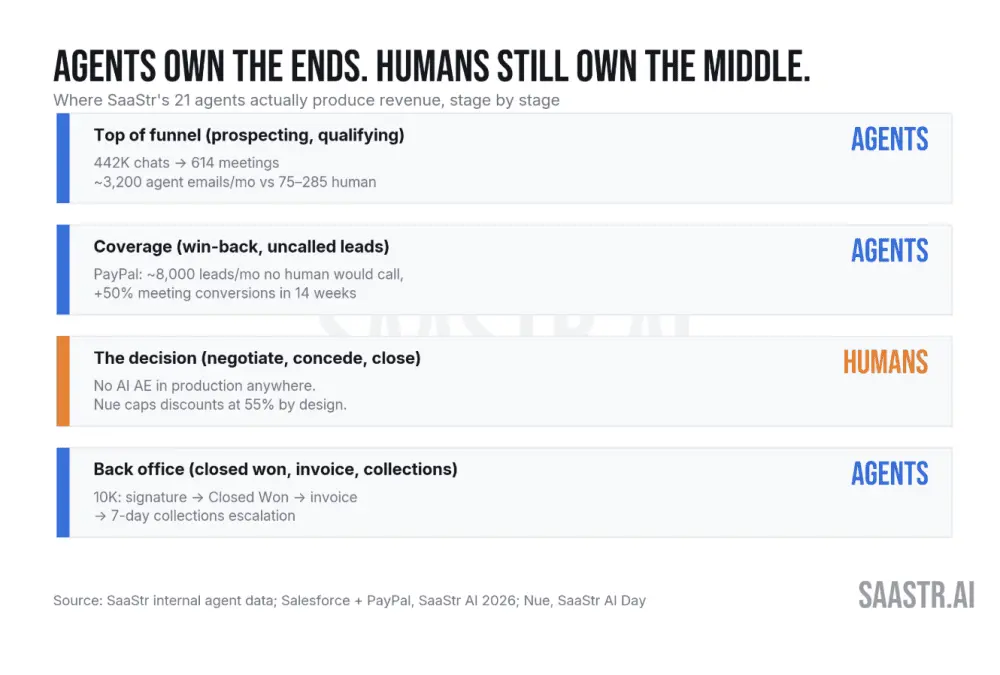
Upon the receipt of an e-signature via platforms like PandaDoc, advanced agents began autonomously flipping opportunities to "Closed Won" in Salesforce, appending missing stakeholder contacts, generating and dispatching invoicing through accounting integrations, and executing multi-stage collections reminders with automated escalation paths.
Phase 3: The Productivity Divergence and the Closing Wall (2026 and Beyond)
By 2026, the structural divergence in AI adoption became clear. Data from major market surveys—including Emergence’s comprehensive study of over 560 B2B companies and ICONIQ’s State of Go-to-Market report—revealed a profound asymmetry in role compression.
SDR and Business Development Representative (BDR) functions experienced massive headcount reductions, with over a third of surveyed companies shrinking their prospecting teams. Conversely, Sales Engineering and Account Executive headcounts held steady or expanded. The industry had successfully automated the mechanics of finding and nurturing leads, but had hit a wall when facing the ambiguity, legal negotiation, and psychological trust-building required to close enterprise contracts.
Supporting Context & Metrics: Where the Numbers Reveal the Reality
To separate marketing hype from production reality, industry analysts have closely examined the quantitative footprint of AI agents across real-world enterprise deployments.
1. The Anatomy of AI-Generated Revenue
At SaaStr, production analytics illustrate precisely where agents contribute to the bottom line versus where humans remain indispensable:

- Inbound Qualification: An inbound agentic layer (utilizing platforms like Qualified) processed over 442,000 chats, converting them into 614 booked meetings and driving more than $1 million in sponsorship revenue. Crucially, the agent’s mandate was strictly qualification and scheduling—it never negotiated pricing terms.
- Win-Back Efficiency: Automated campaigns targeting approximately 1,000 ghosted sponsor leads via Agentforce achieved a 72% open rate and a 10%+ response rate, successfully converting contacts that human teams had written off six months prior.
- Volume Disconnect: AI SDR layers routinely execute upwards of 3,200 personalized email outreaches per month. In contrast, a high-performing human SDR operating at a comparable organizational scale historically managed between 75 and 285 meaningful touches. This highlights a fundamental truth: AI sales tools are not merely faster versions of human workflows; they represent an entirely different unit of operational output.
2. Deflection vs. Elimination in Customer Operations
The pattern of automating the "easy half" of workflows is visible across all GTM functions. In support operations, case studies presented by Pylon at industry summits demonstrated that organizations with thousands of support agents could deflect roughly 50% of incoming tickets using AI without changing total headcount.
This phenomenon occurs because deflected tickets represent low-complexity inquiries. Eliminating them does not reduce the need for human staff; rather, it concentrates the remaining human workforce on high-friction, complex escalations. Klaviyo’s engineering leadership reported a similar threshold, noting that their customer-facing agents reliably train up to 50% to 70% resolution rates before hitting a mandatory handoff point—the exact threshold where human value begins.
3. Pipeline Coverage vs. Deal-Stealing
A common misconception in modern sales leadership is that AI agents are actively stealing deals away from human closers. Real-world deployments tell a different story.
When PayPal integrated Salesforce’s Agentforce to manage roughly 8,000 monthly inbound leads that human sales teams never had the capacity to contact, meeting conversion rates surged by 50% within 14 weeks. The agentic system did not cannibalize existing AE pipelines; instead, it achieved exhaustive coverage of neglected pipeline that would have otherwise been permanently abandoned.
4. Macro Efficiency Metrics: The ICONIQ Data
ICONIQ’s State of Go-to-Market data provides a clear picture of how AI adoption alters organizational structure across various funding and revenue bands:
- At $10M–$25M ARR: AI-forward companies operate with roughly 20 total GTM Full-Time Equivalents (FTEs) compared to 35 for their low-adoption peers—making them 43% leaner while achieving higher quota attainment (67% vs. 59%).
- As Companies Scale: The efficiency gap narrows as deal complexity increases. At the $25M–$100M ARR band, the differential drops to 31% (45 vs. 65 FTEs), shrinking further to 24% at the $100M–$250M band, and 21% at enterprise scale.
If AI agents were fully capable of closing enterprise deals autonomously, this compression curve would accelerate rather than plateau as organizations scale.
Official Statements & Industry Perspectives
The debate over the future of the Account Executive role has drawn commentary from prominent venture capitalists, enterprise tech executives, and high-growth founders.
- Adam Alfano, President at Salesforce: Emphasizing the power of agentic pipeline coverage during industry discussions, Alfano highlighted how autonomous agents unlock latent demand at scale, engaging prospects who fall outside the bandwidth of traditional human outreach models.
- Andrew Bialecki, CEO and Co-founder of Klaviyo: Addressing the operational boundaries of autonomous systems, Bialecki noted that while generative and agentic models excel at navigating standard workflows up to a 70% threshold, the remaining complexity invariably requires human intervention and contextual reasoning.
- Eleanor Dorfman of Anthropic & Grant Lee of Gamma: Analyzing the rise of self-serve enterprise motions, industry leaders note that while some hyper-growth SaaS companies have scaled past $100M ARR with minimal traditional sales teams, this reflects a shift in buyer behavior and product-led growth (PLG) dynamics rather than the presence of an autonomous "AI Closer." Notably, enterprise hiring trends continue to reflect a robust demand for sales talent, with major AI labs maintaining substantial sales-to-engineering hiring ratios as they move upmarket.
- Maia Josebachvili of Stripe: Offering a forward-looking perspective on enterprise transactions, Josebachvili pointed out a transformative paradigm shift: agents are increasingly becoming buyers. As machine-to-machine commerce matures, agent-to-agent transactions will bypass human sales cycles entirely, relying instead on API catalogs, automated policy compliance, and programmatic payment rails.
Future Outlook: The Rise of the Technical AE and the Path to Autonomous Closing
Why is closing structurally harder than qualifying, following up, or executing quote-to-cash workflows? While qualification is fundamentally a classification problem, follow-up a scheduling problem, and billing a workflow problem, closing is a judgment problem operating under deep ambiguity, requiring formal corporate authority.
Four distinct hurdles separate current AI capabilities from the autonomous enterprise closer:
- Ambiguous Stakeholder Dynamics: Enterprise deals rarely involve a single buyer. They require navigating internal corporate politics, unspoken departmental rivalries, and competing executive priorities.
- Custom Legal and Security Frameworks: Real enterprise deals involve bespoke procurement terms, master services agreements (MSAs), and rigorous security audits that demand human accountability and legal interpretation.
- Competitive Bake-Offs: Winning a contested deal often depends on "reading the room," sensing subtle shifts in customer sentiment during live discussions, and creatively repositioning value propositions on the fly.
- Trust and Liability: When a corporation commits hundreds of thousands of dollars to a software vendor, the ultimate risk is borne by human decision-makers who look for human trust and reassurance.
The Near-Term Horizon (The Next 24 Months)
Despite these hurdles, the boundary is shifting. If a transaction can fundamentally be closed via asynchronous communication channels—such as email threads, shared documentation, and a digital signature link—an AI agent will eventually be capable of closing it. This encompasses a massive swath of the mid-market B2B landscape, including standardized software subscriptions, self-service expansions, and transactional vendor renewals.
However, complex field sales, multi-stakeholder enterprise deals requiring heavy custom engineering, and mission-critical vendor selections will remain securely in human hands for the foreseeable future.
What Founders and GTM Leaders Must Do Right Now
- Audit Your Pipeline Bottlenecks: Identify whether your revenue leakage stems from top-of-funnel neglect (which agents can fix immediately) or bottom-of-funnel closing friction (which requires human strategic intervention).
- Elevate Technical Competence: Rather than replacing Account Executives with non-existent software agents, progressive companies are transforming their human AEs into deeply technical operators capable of deploying products live during the sales cycle—proving value rather than just pitching it.
- Build the Hybrid Stack: Deploy agents aggressively to handle lead scoring, multi-touch enrichment, automated win-back campaigns, and back-office invoicing. Free your human closers from administrative overhead so they can focus exclusively on high-stakes negotiation and relationship-building.
Conclusion
The narrative that artificial intelligence is about to entirely eliminate the human sales force is both premature and inaccurate. AI has successfully conquered the top of the funnel and the administrative back office, leaving human teams leaner, more efficient, and hyper-focused on the moments that matter.
The first credible AI Account Executive will inevitably emerge in the transactional mid-market, leveraging clean price books and short sales cycles. Until that day arrives, the most successful organizations will embrace a pragmatic hybrid model: letting artificial intelligence run the mechanics of the pipeline, while positioning their human experts where judgment, authority, and trust are required to seal the deal.