








Executive Overview
In the highly demanding arena of professional broadcast, post-production, and audio-with-picture workflows, the control of monitoring environments has transitioned from a localized task to a complex, distributed challenge. As facility architectures evolve toward decentralized, IP-based structures, the need for precise, tactile, and reliable audio control at multiple physical locations has become paramount. Recognizing this shift, Studio Technologies has introduced the Model 791 Control Console. Officially debuting at the IBC2026 exhibition, this compact, robust device is engineered to extend the capabilities of the company’s established StudioComm for Dante audio monitoring systems.
Designed as a dedicated, streamlined interface for secondary and tertiary monitoring positions, the Model 791 addresses a persistent operational pain point: the cost and complexity of deploying fully-featured master control consoles at every listening station. By focusing on essential monitoring functions—specifically, level adjustment, dim, and reference level recall—the Model 791 allows broadcast engineers and facility designers to implement multi-point control without duplicating unnecessary hardware. Operating over a rugged serial connection to Studio Technologies’ central rack-mounted controllers, the Model 791 exemplifies a pragmatic approach to modern audio-over-IP (AoIP) system design, balancing physical reliability with high-performance digital routing.
Detailed Chronology: The Evolution of StudioComm
To fully appreciate the introduction of the Model 791, one must examine the developmental path of Studio Technologies’ monitoring solutions. For decades, the Skokie, Illinois-based manufacturer has been a quiet cornerstone of broadcast audio infrastructure, moving from specialized analog utility boxes to advanced digital and networked audio systems.
+-------------------------------------------------------------------+
|                     STUDIOCOMM EVOLUTIONARY PATH                  |
+-------------------------------------------------------------------+
|                                                                   |
|  [ ANALOG ERA ]                                                   |
|  Legacy StudioComm Systems (Multi-channel analog routing)         |
|                                                                   |
|                               v                                   |
|                                                                   |
|  [ DIGITAL TRANSITION ]                                           |
|  Integration of AES3 digital audio standards                      |
|                                                                   |
|                               v                                   |
|                                                                   |
|  [ AOIP REVOLUTION ]                                              |
|  Launch of StudioComm for Dante (Model 792/793 & Model 794/795)   |
|  Integrated Dante, AES3, and Analog monitoring control            |
|                                                                   |
|                               v                                   |
|                                                                   |
|  [ DECENTRALIZED CONTROL ]                                        |
|  Introduction of Model 791 Control Console (IBC2026)              |
|  Tactile, multi-point monitoring via RS-485 serial bus            |
+-------------------------------------------------------------------+
The Analog and AES3 Foundations
In the early days of multi-channel television and film post-production, Studio Technologies developed the StudioComm brand to manage complex surround sound monitoring. These legacy systems relied on proprietary multi-pin analog cables and rack units to route 5.1 and 7.1 audio. As the industry transitioned to digital, Studio Technologies integrated AES3 digital audio support, providing high-precision digital-to-analog conversion and clocking systems.
The Shift to Audio-over-IP (AoIP)
With the rapid industry adoption of Audinate’s Dante protocol and the broader AES67 standard, physical audio routing underwent a fundamental shift. Studio Technologies responded by launching the StudioComm for Dante line, spearheaded by the Model 792/793 and Model 794/795 Central Controllers. These rack-mounted engines operate as the brains of modern monitoring setups, handling Dante network audio alongside legacy analog and AES3 digital feeds.
The Multi-Point Control Imperative (2026)
While the central controllers provided immense routing power and the primary consoles offered comprehensive system configuration, real-world deployment revealed a logistical gap. In a typical modern broadcast suite, a main mixer or sound designer sits at the primary console. However, producers, directors, voiceover talent, or secondary engineers situated elsewhere in the room—or in adjacent production booths—frequently need to adjust their local monitor levels or quickly dim the audio to hold a conversation.
Until now, facilities were forced to either purchase additional expensive, full-scale primary control consoles or rely on software-based control panels, which lack the immediate tactile feedback required in high-pressure live environments. The development of the Model 791 was initiated to fill this operational void, culminating in its launch at IBC2026.
Supporting Context & Technical Metrics: Hardware, Protocols, and System Topology
The Model 791 is not merely a passive volume knob; it is a highly specialized, hardened industrial control interface designed to operate under continuous professional use.
Physical and Mechanical Architecture
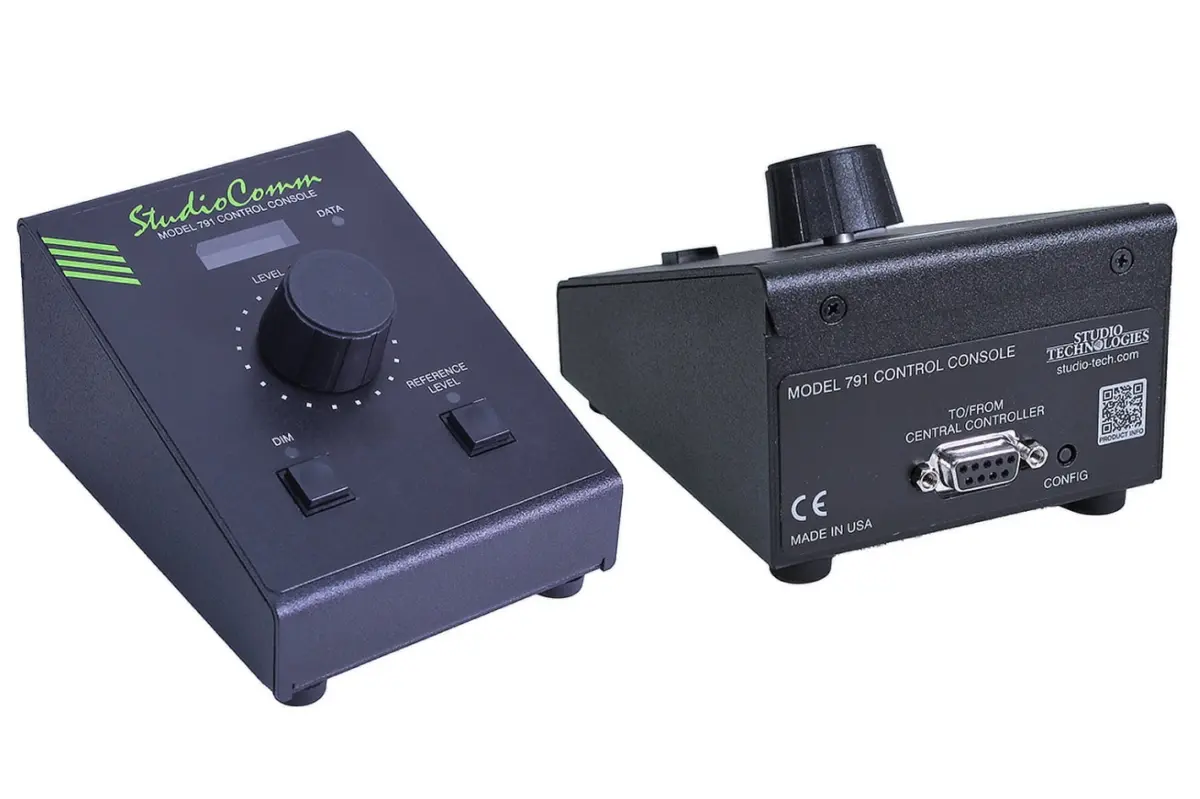
Housed in a rugged, compact steel enclosure, the Model 791 is built for desktop placement. Its heavy-duty chassis ensures it remains stationary on console bridges or desks without sliding under fast, repeated tactile operations.
The user interface is intentionally sparse yet highly functional:
- Rotary Encoder: Unlike a traditional analog potentiometer, which can introduce noise over time and has physical travel limits, the Model 791 utilizes a high-precision rotary encoder. This allows for smooth, continuous digital level adjustment with precise attenuation curves, mapped directly to the gain stages of the central controller.
- Pushbutton Switches: Two high-reliability, illuminated pushbuttons are dedicated to the Dim and Reference Level (Ref) functions. These switches provide clear visual feedback, letting the operator know at a glance if the monitoring system is attenuated or set to the calibrated room reference level.
The RS-485 Communication Protocol: Why Serial Beats Ethernet for Local Control
In an era dominated by Ethernet-everything, Studio Technologies’ choice of RS-485 for the connection between the Model 791 and the central controller is a deliberate, highly calculated engineering decision.
+-----------------------------------------------------------------------------+
|                     SYSTEM TOPOLOGY & INTERCONNECTION                       |
+-----------------------------------------------------------------------------+
|                                                                             |
|  [ Dante Network / Analog / AES3 Sources ]                                  |
|                       │                                                     |
|                       ▼                                                     |
|       +───────────────────────────────+                                     |
|       │  StudioComm Central Engine    │                                     |
|       │  (Model 792/793 or 794/795)   │                                     |
|       +───────────────────────────────+                                     |
|                       │                                                     |
|                       ├─[ RS-485 Bus ]───► [ Primary Control Console ]      |
|                       │                                                     |
|                       ├─[ RS-485 Bus ]───► [ Model 791 Console (Loc. 1) ]   |
|                       │                                                     |
|                       ├─[ RS-485 Bus ]───► [ Model 791 Console (Loc. 2) ]   |
|                       │                                                     |
|                       └─[ RS-485 Bus ]───► [ Model 791 Console (Loc. 3) ]   |
|                                                                             |
+-----------------------------------------------------------------------------+
While Ethernet is ideal for high-bandwidth audio data, utilizing it for simple control surfaces introduces unnecessary network overhead, IP address management, switch port consumption, and potential latency issues. RS-485 offers several distinct advantages in a broadcast facility:
| Parameter | RS-485 Protocol (Model 791) | Standard Ethernet (IP Control) |
|---|---|---|
| Wiring Simplicity | Single twisted-pair (shielded) | Category 5e/6 with RJ45 terminations |
| Maximum Distance | Up to 1,200 meters (4,000 feet) | 100 meters (without active repeaters) |
| Noise Immunity | High (Differential signaling resists EMI) | Moderate (Susceptible to packet loss/jitter) |
| Network Overhead | Zero (Does not consume IP addresses) | High (Requires DHCP/Static IP, switch ports) |
| Topology | Daisy-chain / Multi-drop bus | Star topology (Requires dedicated switch) |
By leveraging RS-485, the Model 791 ensures near-zero latency control. When an operator hits the "Dim" button, the command is transmitted instantly to the central controller, avoiding the queuing delays that can occasionally plague heavily loaded IP networks. Furthermore, the installation requires only standard, inexpensive shielded twisted-pair cabling, which is already abundant in legacy and modern broadcast facilities.
Multi-Point Control Topology
A single StudioComm for Dante system (utilizing either the Model 792/793 or Model 794/795 Central Controllers) can support up to three Model 791 Control Consoles simultaneously. This allows system integrators to deploy control interfaces at various functional zones within a single production space:
- The Primary Mix Position: Retains the full-featured StudioComm primary console for comprehensive routing, source selection, and format configuration (e.g., stereo, 5.1, or immersive monitoring setups).
- The Producer’s Desk: Equipped with a Model 791, allowing the producer to adjust their local monitor speakers or headphones without interrupting the mixer’s primary control interface.
- The Client/Sponsor Lounge: A second Model 791 provides simplified, foolproof volume adjustment for executives or clients observing the session.
- The Voiceover/ADR Booth: A third Model 791 gives the talent direct, tactile control over their monitor or headphone levels, minimizing communication barriers between the booth and the control room.
Official Statements & Strategic Analysis
The release of the Model 791 at IBC2026 highlights a broader product philosophy at Studio Technologies: solving complex workflow issues with simple, highly focused hardware.
Gordon Kapes, President of Studio Technologies, detailed the strategic thinking behind the product’s development:
"The Model 791 extends the flexibility of our StudioComm for Dante systems by making it simple to add additional control locations without duplicating the full set of controls provided by the primary console. For many broadcast and audio-with-picture applications, the ability to conveniently adjust monitoring level and access dim and reference level functions is exactly what is needed at secondary locations."
Kapes’ statement underscores a critical economic and operational reality in modern facility design. Outfitting every monitoring station with a full-scale controller is not only financially inefficient, but it also increases the risk of accidental setting changes. If a secondary user inadvertently alters the monitor routing, bass management, or speaker calibration from a full-featured console, it can disrupt the entire production. By restricting the Model 791’s feature set to volume, dim, and reference level, Studio Technologies has created a "safe" interface for non-technical users or secondary listeners.
Kapes further elaborated on the physical and functional design choices:
"The Model 791 is intentionally focused on the controls that are most useful when a full-featured StudioComm console isn’t required. Its compact form factor, simple RS-485 connection, and support for up to three devices make it a practical solution for facilities that need monitoring control in multiple locations."
This "intentional focus" reflects a pushback against the industry’s recent obsession with touchscreens and virtual control software. While software control panels offer endless flexibility, they lack the tactile immediacy required in live broadcast environments. If feedback occurs or an unexpected audio spike happens, an operator cannot afford to wake up an iPad, navigate to an app, and slide a virtual fader. They need a physical, highly reliable knob that they can grab instantly without looking. The Model 791 delivers this physical certainty.
Future Outlook: AoIP and the Next Generation of Broadcast Control
As the broadcast industry marches further into the era of IP-based infrastructure, the launch of the Model 791 at IBC2026 signals several key trends that will shape the next decade of facility design.
+-----------------------------------------------------------------------+
|                    FUTURE TRENDS IN BROADCAST AUDIO                   |
+-----------------------------------------------------------------------+
|                                                                       |
|  [ HYBRID CONTROL ARCHITECTURES ]                                     |
|  Combining IP-based audio routing (Dante/AES67) with dedicated,       |
|  highly reliable serial/hardware control paths for critical systems.  |
|                                                                       |
|  [ HYBRID HARDWARE-SOFTWARE UX ]                                      |
|  Physical knobs for immediate, high-risk functions (Volume, Dim)     |
|  paired with software back-ends for configuration and routing.        |
|                                                                       |
|  [ MODULAR FACILITY SCALING ]                                         |
|  Moving away from massive, monolithic consoles toward distributed,     |
|  networked modules that can be added or repositioned dynamically.      |
|                                                                       |
|  [ ST-2110 & DANTE CONVERGENCE ]                                      |
|  Continued integration of Dante ecosystems into broader SMPTE         |
|  ST 2110-30/31 workflows for seamless WAN/LAN audio transport.        |
|                                                                       |
+-----------------------------------------------------------------------+
1. The Coexistence of Serial and Network Protocols
While some manufacturers have attempted to migrate all peripheral control to Ethernet (using protocols like OCA/AES70 or proprietary IP schemes), the Model 791 proves that serial protocols like RS-485 remain highly relevant. The future of broadcast control is likely hybrid: high-bandwidth audio and configuration data will travel over IP networks, while local, critical, low-latency tactile interfaces will continue to leverage rugged serial buses for their unmatched reliability and simplicity.
2. The Rise of Modular, Distributed Production
The days of the massive, centralized mixing console dominating a single control room are slowly giving way to modular, agile production suites. In these environments, audio resources are shared across a network, and physical control surfaces must be equally modular. The ability to chain up to three Model 791 units to a single central controller allows facilities to scale their physical footprint dynamically, adjusting to the needs of different productions without requiring a complete system overhaul.
3. Continued Integration with Dante and Beyond
As Dante continues to solidify its position as the preferred audio-over-IP protocol for fixed installations and live broadcast, tools like the StudioComm series will remain essential. The compatibility of the Model 791 with controllers that support Dante, analog, and AES3 digital audio ensures that facilities can transition to IP at their own pace. Legacy analog gear and modern networked audio can be monitored side-by-side, controlled by the same tactile hardware.
Ultimately, the Studio Technologies Model 791 Control Console represents a refined, pragmatic approach to modern audio monitoring. By prioritizing physical reliability, simplified user interfaces, and robust, latency-free connectivity, it provides broadcast and production facilities with the exact tools they need to manage complex, multi-point listening environments in an increasingly networked world.