









Executive Overview
In the ongoing high-stakes battle between entertainment conglomerates and digital copyright infringers, the legal mechanisms utilized by rightsholders continue to evolve into sophisticated open-source intelligence (OSINT) operations. Under the framework of United States copyright law, particularly Section 512(h) of the Digital Millennium Copyright Act (DMCA), rightsholders possess a potent legal shortcut: the DMCA subpoena. This instrument allows copyright owners to unmask anonymous alleged infringers through third-party service providers without the burdensome, expensive prerequisite of filing a formal, protracted civil lawsuit. These documents, typically issued routinely by a court clerk without active judicial oversight, have effectively transformed into aggressive data-mining tools.
At the vanguard of this legal strategy is the Motion Picture Association (MPA), acting on behalf of the Alliance for Creativity and Entertainment (ACE)—the world’s leading anti-piracy coalition. Representing an imposing roster of entertainment giants, including Disney, Netflix, Warner Bros. Discovery, Universal Studios, Paramount Pictures, and sports bodies such as UEFA, ACE has consistently leveraged federal courts to pierce the veil of digital anonymity.
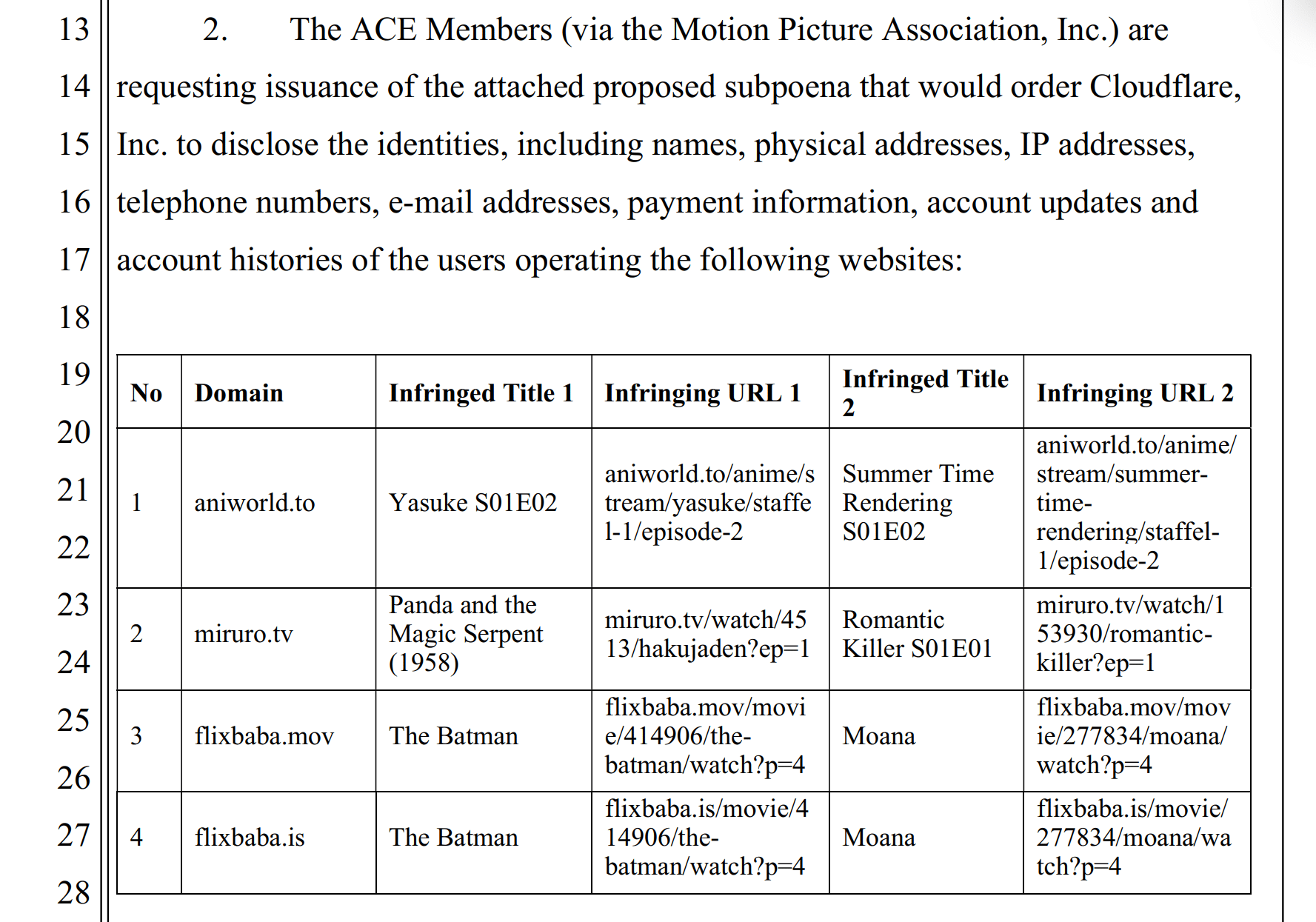
In a coordinated escalation of this digital enforcement campaign, the MPA filed two prominent new subpoena requests in federal courts across California. The first legal maneuver targets web infrastructure and content delivery giant Cloudflare, casting a wide net over 49 prominent streaming and downloading domain names. The second action zeroes in on popular communication platform Discord, targeting specific user accounts and servers allegedly functioning as command-and-control hubs or distribution channels for pirated media.
This dual-pronged offensive underscores the entertainment industry’s holistic approach to disrupting the digital gray market. By targeting both the foundational infrastructure providers that protect illicit streaming websites from DDoS attacks and conceal their origins, and the community-driven chat servers that foster viral distribution, the MPA is aggressively closing the loop on modern piracy networks. As these subpoena applications await formal clerk endorsement, the global piracy ecosystem watches nervously, bracing for potential fallout that could expose the real-world identities behind some of the internet’s most heavily trafficked unauthorized entertainment hubs.
Detailed Chronology and Technical Breakdown
The mechanics of the recent federal filings reveal a meticulous, targeted approach by the MPA’s legal representation, combining traffic analytics with digital forensics to map out clandestine operations.

The Cloudflare Inquest: Mapping 49 Domains
Filed in the U.S. District Court for the Central District of California, the first subpoena application directs its focus toward Cloudflare, Inc. Cloudflare acts as a reverse proxy, DNS provider, and security layer for millions of websites worldwide, effectively shielding the underlying host servers from direct exposure and traffic floods. Because of this architectural role, Cloudflare often possesses the most reliable, albeit sometimes falsified, registration and billing information for website operators.
The MPA’s application lists an extensive roster of 49 domain names. Among these, a few juggernauts command staggering traffic figures, according to web intelligence data from Similarweb:
- Miruro (
miruro.to/miruro.tv/miruro.bz/miruro.ru): Standing at the apex of the current anime piracy landscape, the.tovariant of Miruro pulls an astonishing 45 million monthly visits, complemented by another 37 million visits to its.tvcounterpart. - Aniworld.to: Operating as a massive German-language anime and television streaming portal, Aniworld.to commands an estimated 23 million visits per month, drawing the vast majority of its audience from German-speaking regions.
- The Global Gray Market: The remaining domains read like a rogue’s gallery of digital distribution models. The list features established legacy clone brands trading on the name recognition of defunct giants like 123movies, Fmovies, and SolarMovie. It also includes Spanish-language Pelisflix mirrors, Chinese-language Gimy network domains (
gimy.tv,gimy.now,gimyv.com), Hindi-language download portals (moviesmod.at,moviesmod.zone), and sports streaming portals branded around the StreamEast moniker (thestreameast.fun,streameasti.is), which brazenly broadcast live matches from UEFA competitions owned by ACE members.
For each of these 49 domains, the MPA is demanding that Cloudflare hand over comprehensive identifying details. This includes account holder names, physical addresses, IP addresses, telephone numbers, email addresses, payment information, and detailed account activity histories. Cybersecurity experts note that while experienced pirate operators frequently employ privacy-shielded registration, cryptocurrency payments, and stolen or synthetic identities to frustrate investigators, these subpoenas occasionally yield critical digital breadcrumbs—such as a forgotten personal email address or an unmasked IP connection used during initial account setup.
The Discord Crackdown: Unmasking Chat-Based Pirates
While the Cloudflare subpoena targets traditional web infrastructure, the second filing—lodged in the U.S. District Court for the Northern District of California—demonstrates ACE’s expanding footprint into chat and community platforms. Discord, traditionally built for gamers, has increasingly become a preferred sanctuary for unauthorized media sharing networks, offering private and public spaces for communities to aggregate and distribute torrent links, direct download mirrors, and streaming feeds.
The MPA’s Discord-focused subpoena targets specific numeric server IDs, channel IDs, and user accounts. The legal documentation highlights material allegedly used to distribute unauthorized copies of high-profile cinematic and television intellectual property, including major theatrical releases like Wreck-It Ralph and Shutter Island, alongside acclaimed serialized television programming such as Invincible and The Pitt.

A forensic examination of the Discord IDs reveals intriguing timelines regarding the lifecycle of these operations:
- The Rapid-Deployment Server: One of the targeted servers exhibits a hyper-compressed creation timeline. The user account, the specific channel, and the server itself were all generated within a compressed 30-minute window in September 2025. Following this rapid setup, the server maintained active operations until earlier in the current month.
- The Legacy Server: The second targeted entity presents a starkly different operational age. This server was originally established in September 2020. However, the specific user account flagged alongside it was created more recently, in November of last year. This temporal discrepancy indicates that the individual or operational cell currently administering or posting content within the server is not necessarily the original creator, pointing toward administrative handovers or shared account ecosystems common in underground syndicates.
Notably, by the time the legal filings were made public, both targeted Discord servers had already been completely deleted. It remains ambiguous whether Discord executed the removal pursuant to internal safety guidelines or independent copyright takedown notices, or if the operators proactively scrubbed the servers to destroy evidence upon realizing they were under surveillance. In parallel with the subpoena, the MPA submitted formal takedown communications to Discord, explicitly notifying the platform that the sole operational purpose of these environments was to bridge users to external pirate streaming portals.
Unlike broader fishing expeditions seen in past legal actions—such as Take-Two Interactive’s sprawling DMCA subpoena campaign targeting thousands of users across multiple servers in its hunt for Grand Theft Auto VI leakers—the MPA’s current Discord request is tightly scoped. It focuses strictly on unmasking the primary administrators and specific content-posting accounts associated with the targeted servers.
Supporting Context & Metrics
To fully understand the weight of these legal actions, one must examine the broader economic and technological landscape of modern digital piracy. The entertainment industry’s transition from physical media to centralized streaming services fractured the consumer experience, creating an environment where dozens of competing subscription platforms fragment content libraries. This fragmentation has fueled a persistent, resilient underground economy.
The Scale of Unauthorized Streaming
According to data compiled by intellectual property watchdogs and analytics firms, major piracy networks routinely rival legal streaming services in raw web traffic. The prominence of domains like Miruro (with over 80 million combined monthly visits across variants) and Aniworld.to highlights a structural shift: piracy is no longer driven solely by amateur hobbyists operating out of home basements, but by highly professionalized, multinational operations. Many of these entities monetize their traffic aggressively through unregulated pop-under advertising networks, premium subscription tiers for "VIP" streaming speeds, and cryptocurrency donations.

+--------------------------------------------------------------------------+
|                  Estimated Monthly Traffic (Similarweb)                  |
+--------------------------------------------------------------------------+
| Miruro (.to)              ██████████████████████████████ 45 Million      |
| Miruro (.tv)              █████████████████████████ 37 Million           |
| Aniworld.to               ████████████████ 23 Million                    |
+--------------------------------------------------------------------------+
The Evolution of the DMCA Subpoena as an OSINT Weapon
Section 512(h) of the DMCA was enacted by Congress in 1998 during the infancy of the commercial web, originally conceived primarily to unmask peer-to-peer (P2P) file-sharers operating on networks like BitTorrent via their Internet Service Provider (ISP) IP addresses. However, as web traffic centralized behind intermediaries like Cloudflare and community platforms like Discord, rightsholders creatively re-engineered the statute.
Rather than subpoenaing a local ISP for a residential subscriber, modern rightsholders serve DMCA subpoenas on global infrastructure companies, hosting providers, communication platforms, and domain registrars. This adaptation has converted the subpoena process into a rapid, low-cost reconnaissance instrument. ACE, functioning as the legal enforcement arm for Hollywood studios and global sports leagues, has mastered this technique, filing dozens of similar actions annually to build internal intelligence dossiers on repeat infringers before escalating matters to criminal referral or international civil litigation.
Official Statements and Industry Perspective
While neither Cloudflare nor Discord had formally contested the specific subpoena requests in court at the time of reporting, representatives for the Motion Picture Association and the Alliance for Creativity and Entertainment have repeatedly emphasized the necessity of these aggressive legal measures to protect the global creative economy.
In previous public statements regarding the deployment of DMCA subpoenas, ACE leadership has characterized these legal tools as indispensable for piercing the cloak of anonymity that global piracy networks rely upon. "The scale of commercial digital piracy requires an equally agile and robust legal response," noted an industry legal analyst familiar with ACE’s enforcement strategies. "When bad actors hide behind layers of reverse proxies, encrypted chat apps, and false registration data, tools like the DMCA subpoena provide the necessary key to begin dismantling the corporate structures hiding behind pseudonymous domain names."
Conversely, digital rights advocates and privacy organizations have long expressed systemic concerns regarding the ease with which DMCA subpoenas are issued. Because these instruments bypass the traditional judicial balancing test—requiring only a perfunctory sign-off from a federal court clerk rather than a substantive review by a judge—critics argue that they are vulnerable to overreach. There is persistent worry that overly broad subpoenas could sweep up innocent bystanders, proxy users, or legitimate website administrators whose services are misidentified or maliciously co-opted by bad actors.
Furthermore, platforms caught in the middle—such as Cloudflare and Discord—frequently walk a tightrope between maintaining user privacy and complying with statutory mandates. While Cloudflare routinely complies with valid U.S. court orders, the company has historically pushed back against overly broad discovery requests that threaten the privacy of non-infringing web traffic utilizing its vast network.
Future Outlook
The filing of these two distinct subpoena applications signals that the legal pressure from Hollywood and major sports organizations will not abate. As long as unauthorized streaming aggregators and chat-based distribution networks continue to siphon billions of views from licensed platforms, rightsholders will aggressively refine their OSINT methodologies.
Looking ahead, several key trends are likely to shape the landscape of digital copyright enforcement:
- Deepening Intermediary Accountability: Legal pressure on infrastructure providers like Cloudflare is expected to mount. Rightsholders increasingly argue that infrastructure networks bear ethical, if not legal, responsibilities to vet or more readily surrender the identities of repeat copyright abusers operating behind their walls.
- The Shift to Encrypted Communities: As traditional web-hosting domains face relentless takedowns and subpoena campaigns, underground operations are increasingly migrating toward decentralized, encrypted, and community-driven platforms like Discord, Telegram, and specialized Matrix servers. Consequently, law enforcement and industry coalitions will likely expand their technical capabilities to monitor, map, and subpoena chat-based ecosystems.
- Cross-Border Enforcement Challenges: Despite the effectiveness of U.S. federal subpoenas against domestic corporations, many pirate operators deliberately anchor their physical operations, shell companies, and server hardware in offshore jurisdictions with lax copyright enforcement or non-existent extradition treaties. Even if Cloudflare or Discord hands over identifying data, translating that data into actionable international law enforcement actions remains a formidable hurdle.
As the federal court clerks review the MPA’s latest filings, the immediate outcome will determine whether these specific digital operators can be successfully unmasked. Regardless of the individual yields from these specific requests, the broader trajectory is clear: the architecture of digital anonymity is under sustained, systematic siege, and the line between open internet infrastructure and copyright enforcement will continue to blur.