









Executive Overview
In what is being heralded as a watershed moment for the global carbon markets, technology titan Google has inked a landmark agreement with Indian climate-tech startup Mitti Labs. Under the terms of the four-year pact, Google has agreed to purchase 1 million carbon credits through 2030. Industry insiders and corporate representatives confirm this is the largest publicly announced offtake deal to date generated specifically from mitigating methane emissions in traditional rice cultivation.
The agreement spans vast agricultural belts across the southern Indian states of Karnataka, Andhra Pradesh, and Telangana, and is projected to scale up to approximately 100,000 hectares of active farmland at its peak delivery window. This strategic partnership arrives at a critical juncture for Google. As the company aggressively expands its data center infrastructure to support the explosive growth of artificial intelligence, its energy consumption—and consequently its greenhouse gas (GHG) emissions—has surged. According to Google’s corporate environmental disclosures, emissions climbed 18% year-over-year to roughly 14.5 million metric tons of carbon dioxide equivalent.
Faced with the formidable challenge of meeting its corporate pledge to achieve net-zero emissions by 2030, Google is increasingly looking beyond traditional tech-sector offsets. By placing a multi-million-dollar bet on Mitti Labs, Google is signaling a decisive shift toward high-impact, nature-based agricultural interventions that simultaneously tackle climate change, resource scarcity, and community-level economic resilience in the Global South.
Detailed Chronology: From Concept to Corporate Offtake
The genesis of this landmark agreement dates back approximately 12 years to the founding of Mitti Labs in 2023, though the dialogue with Google began in earnest a year prior to the finalization of the contract. Operating dual headquarters in New York and Bengaluru, Mitti Labs set out to solve one of agriculture’s most stubborn climate challenges: the immense volume of methane produced by flooded rice paddies.
As Google’s sustainability teams scoured the globe for verifiable, highly scalable methane-reduction projects to diversify their burgeoning carbon-credit portfolio, they initiated deep-dive technical evaluations of Mitti Labs. According to Mitti Labs co-founder Xavier Laguarta, the tech giant’s due diligence process was exceptionally rigorous. Google’s evaluation team did not merely rely on digital documentation; they conducted extensive on-site farm visits, scrutinized proprietary monitoring technologies, and stress-tested the startup’s data verification methodologies before ink ever met paper.
Following months of exhaustive technical audits and commercial negotiations, the parties formalized the agreement. The transaction allows Mitti Labs to establish financial predictability and scale its operations dramatically. Founded to leverage cutting-edge technology for agricultural decarbonization, the startup uses its GeoAI platform—a sophisticated system blending satellite radar imagery with real-time field measurements—to remotely track crop development, soil moisture dynamics, and flood cycles across fragmented smallholder farms.
This technological rigor ultimately satisfied Google’s stringent compliance requirements, paving the way for a contract that bridges Silicon Valley ambitions with the realities of Indian agrarian landscapes.
Supporting Context & Metrics: The Science of Rice and AI
To understand the profound impact of the Google-Mitti Labs partnership, one must examine the unique environmental footprint of rice farming. Rice is a dietary staple for more than half the global population, but its traditional cultivation method—continuous field flooding—creates an anaerobic environment ideal for methanogenic bacteria. These microbes generate massive quantities of methane, a potent greenhouse gas with a global warming potential significantly higher than carbon dioxide over a 20-year timescale. Furthermore, conventional rice production is notoriously water-intensive, placing immense strain on regional aquifers.
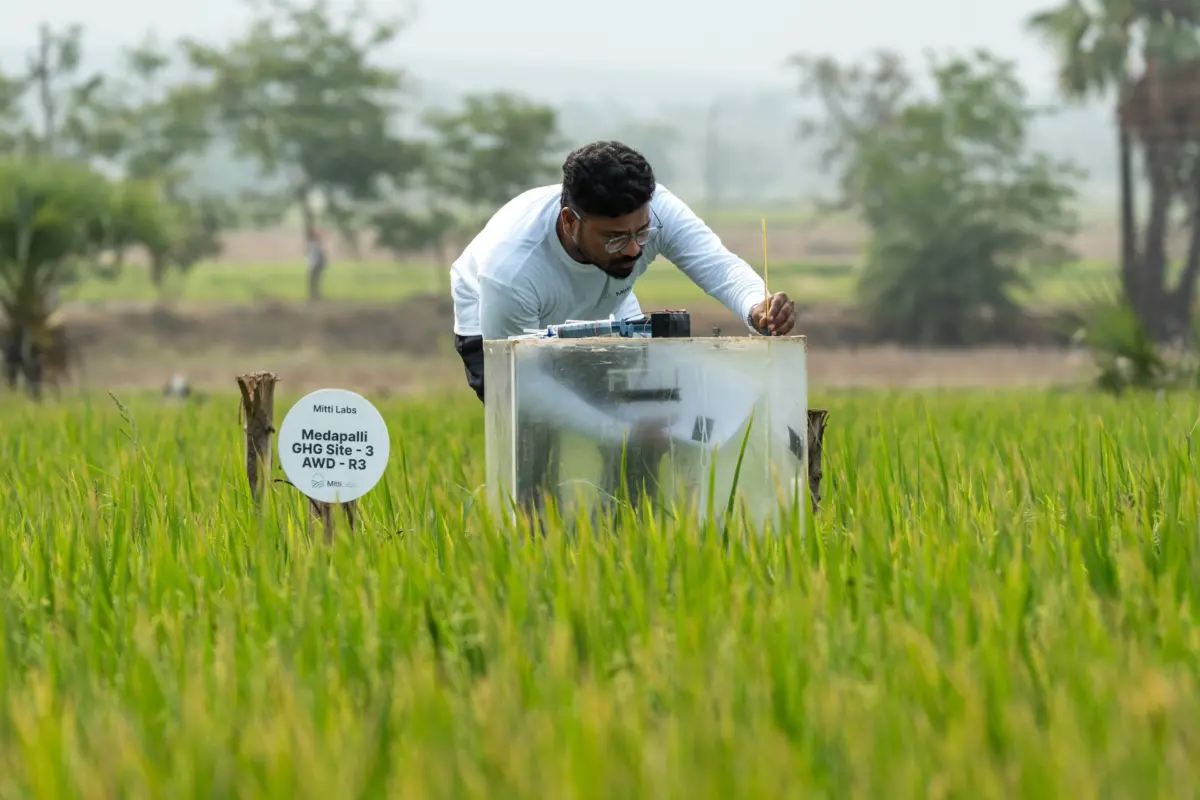
Mitti Labs addresses this dual crisis through an agronomic technique known as Alternate Wetting and Drying (AWD), combined with precision water management. By systematically reducing the duration that rice fields remain flooded, the startup’s methodology cuts methane emissions by approximately 50%. Crucially, this intervention also slashes irrigation water consumption by up to 40%—all without inflicting a penalty on crop yields, thereby protecting the livelihoods of smallholder farmers.
The Technological Engine: GeoAI and Satellite Radar
At the heart of Mitti Labs’ operational model is its proprietary GeoAI platform. Rather than relying solely on manual, labor-intensive spot-checks across hundreds of thousands of independent farms, the startup harnesses synthetic aperture radar (SAR) imagery captured by commercial and public satellites. Operating at resolutions ranging from 50 centimeters to 10 meters, SAR allows Mitti Labs to peer through cloud cover and darkness to map soil moisture and surface water dynamics with high fidelity.
This satellite telemetry is continuously cross-referenced and calibrated against ground-truth data collected via physical measurement chambers deployed across partner farms. These field units measure actual gas fluxes directly from the soil, feeding robust data arrays back into machine-learning models.
Verification and Compliance
To ensure the integrity of the 1 million carbon credits slated for delivery to Google, Mitti Labs relies on internationally recognized carbon-credit certification bodies: Gold Standard and Isometric. These organizations enforce strict protocols for additionality, permanence, and leakage prevention. Before a single credit is issued and transferred to Google’s registry account, the underlying projects must successfully pass independent, third-party audits.

This multi-layered verification framework shields corporate buyers against accusations of greenwashing, ensuring that every credit purchased represents a permanent, real-world reduction in atmospheric greenhouse gases.
Official Statements and Industry Perspective
The public announcement of the agreement has elicited widespread commentary from across the climate-tech, agricultural, and corporate sustainability sectors. For Mitti Labs, the partnership serves as an ultimate validation of its operational model by one of the world’s most sophisticated and discerning corporate buyers.
"Having Google, one of the most sophisticated buyers in the market with rigorous due diligence processes, is obviously a good signal for us," Xavier Laguarta remarked during an interview. Laguarta emphasized that the sheer scale of the 1,000,000-credit commitment provides Mitti Labs with the financial velocity required to transition from a regional player into a dominant global provider of agricultural carbon assets.
While Mitti Labs has declined to disclose the specific financial terms of the transaction, leadership noted that a significant majority of the revenue generated through these carbon credit sales flows directly back into farming communities. Although exact individual payouts to farmers participating in the Google-backed initiative were not publicized, the injection of carbon-finance revenues into rural economies is designed to create powerful economic incentives for sustainable land stewardship.
The startup’s broader ecosystem footprint is already substantial. Prior to securing the Google contract, Mitti Labs forged partnerships with notable agricultural and market entities, including carbon marketplace Cool Effect, global food giant Ebro Foods, and agribusiness leader Syngenta. Furthermore, the startup enjoys backing from prominent energy investors, including Saudi Aramco, which previously invested to help accelerate the adoption of water-resilient rice farming technologies across Asia.
Future Outlook: Scaling Across Asia and Beyond
The Google-Mitti Labs collaboration is merely the vanguard of a much larger structural shift in how multinational technology companies approach decarbonization in emerging economies. With approximately 150 million smallholder farmers cultivating rice across India, Southeast Asia, and China, the total addressable market for methane-mitigation projects in agriculture represents a massive, largely untapped frontier for global climate finance.
Expanding Footprints in India and Southeast Asia
Mitti Labs currently collaborates with more than 100,000 farmers across India. However, the capital injection and corporate validation provided by the Google offtake agreement form the cornerstone of an aggressive expansion strategy aimed at reaching millions of farmers by 2030.
Building on its established operational hubs in India, Mitti Labs plans to launch operations in the Philippines later this year, followed by systematic expansions into Indonesia and other key Southeast Asian agricultural markets by 2027. By systematically exporting its GeoAI monitoring framework and localized agronomic training programs to new geographies, the startup hopes to establish a standardized blueprint for pan-Asian agricultural decarbonization.
Google’s Broader Decarbonization Playbook in India
For Google, this agreement is part of a broader, multi-faceted strategy to green its operations and supply chains within India. The tech giant’s investment in Mitti Labs follows a major carbon-removal partnership established in January 2025 with Gurugram-based startup Varaha, through which Google purchased 100,000 tons of carbon credits generated via biomass-produced biochar—marking the world’s largest biochar deal of its kind at the time.
Beyond soil and agricultural carbon removal, Google is actively addressing its Scope 2 and supply-chain emissions through massive investments in renewable energy infrastructure. The company has secured agreements tied to a 150-megawatt solar project in Rajasthan, effectively doubling its contracted solar capacity with partner ReNew in the state to 300 megawatts.
As corporate sustainability standards tighten and the regulatory scrutiny surrounding carbon offsets intensifies, the Google-Mitti Labs partnership offers a compelling case study. It demonstrates that scalable climate action can be achieved when advanced artificial intelligence and satellite technology are deployed to empower traditional agrarian communities, transforming ancient farming practices into frontline defenses against global climate change.


