









Executive Overview
In a coordinated, highly aggressive legal strike against software emulation, Japanese gaming giant Nintendo has filed seven distinct Digital Millennium Copyright Act (DMCA) anti-circumvention notices with the popular code-hosting platform GitHub in a single day. The sweeping enforcement action resulted in the immediate removal or disabling of more than 400 Nintendo Switch emulator repositories, sending shockwaves through the open-source development community.
The targeted projects represent a veritable cross-section of the post-Yuzu emulation ecosystem. Among the casualties are numerous direct forks and successor projects, high-profile community builds, specialized ports, and even legacy code bases that had voluntarily ceased active development years prior. Most notably, the wave included suyu—the prominent spiritual successor to the dismantled Yuzu emulator—alongside network forks of the Android-based Skyline project, which had shut its doors back in 2023.
While Nintendo’s aggressive posture successfully forced these digital storehouses offline, the operation highlights an enduring cat-and-mouse dynamic. In the open-source world, code is notoriously hydra-headed; removing it from a centralized platform like GitHub often serves merely to scatter developers and mirror repositories across decentralized networks, encrypted peer-to-peer repositories, and independent web hosts.
This latest legal offensive underscores Nintendo’s uncompromising stance on intellectual property protection. It also reignites complex legal and philosophical debates concerning the legal boundaries of software preservation, the limits of anti-circumvention statutes, and the future viability of emulation for defunct or aging hardware platforms.
Detailed Chronology of the Takedown Campaign
To understand the scale and precision of Nintendo’s latest campaign, one must examine the specific mechanics of the takedowns executed on GitHub. Filed simultaneously, the seven notices systematically targeted distinct branches of the Switch emulation tree.
The Anatomy of the Seven Notices
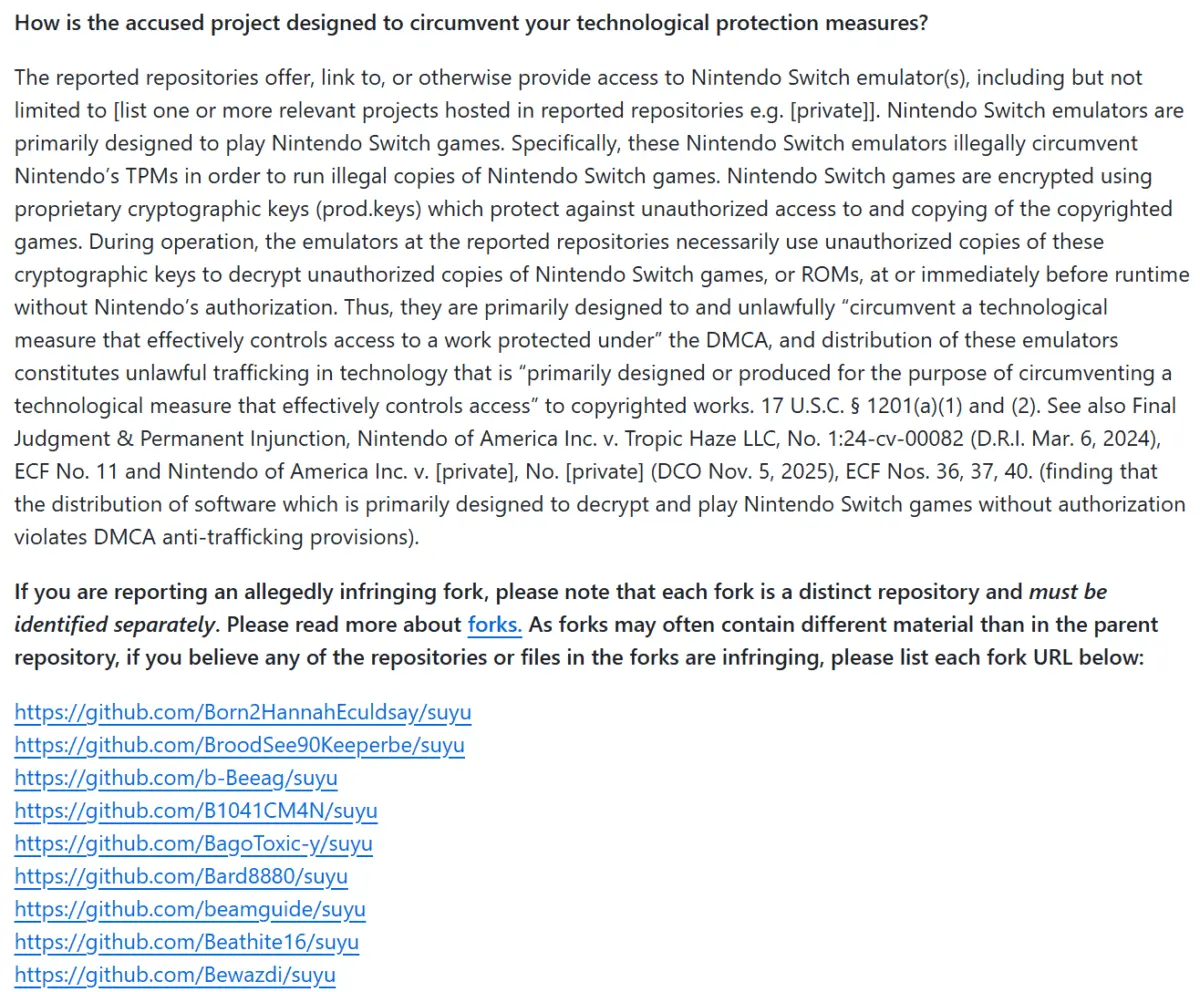
Nintendo’s legal strategy relied heavily on the DMCA’s anti-circumvention provisions (Section 1201), asserting that the targeted software’s primary or exclusive function is to bypass the cryptographic security measures protecting Nintendo Switch games (ROMs). Because GitHub processes takedown requests affecting entire repository networks when a parent or fork network exceeds specific volume thresholds, the impact of these seven notices multiplied exponentially.
- The suyu Network (
vstyler96/suyu): As the most expansive target of the batch, this notice covered an entire network of 311 repositories. suyu had risen rapidly to prominence in early 2024 following the sudden collapse of Yuzu, attempting to keep the codebase alive under a new moniker. - The Skyline Ecosystem (
skyline-emu/skyline): This notice targeted 29 repositories within the network of Skyline, an innovative, independent Android-based Switch emulator. Despite the project’s voluntary shutdown years earlier, its open-source legacy remained a target. - Yuzu Community Forks: Multiple notices targeted lingering iterations of the original Yuzu codebase, including networks managed by developers such as NicolasArvani (
NicolasArvani/yuzu, 14 repositories), liushuyu (liushuyu/yuzu-android, 8 repositories), and exverge-0 (exverge-0/yuzu-EA4176, 21 forks listed). - Alternative Architectures and Specialized Builds: Additional filings targeted niche projects, such as
irlbunny-archive/MonoNX(a C#-based exploration of Switch emulation encompassing 17 listed forks) andIpwnedU/yuzu-master(targeting the parent repository directly).
Immediate Impact on Developers and Users
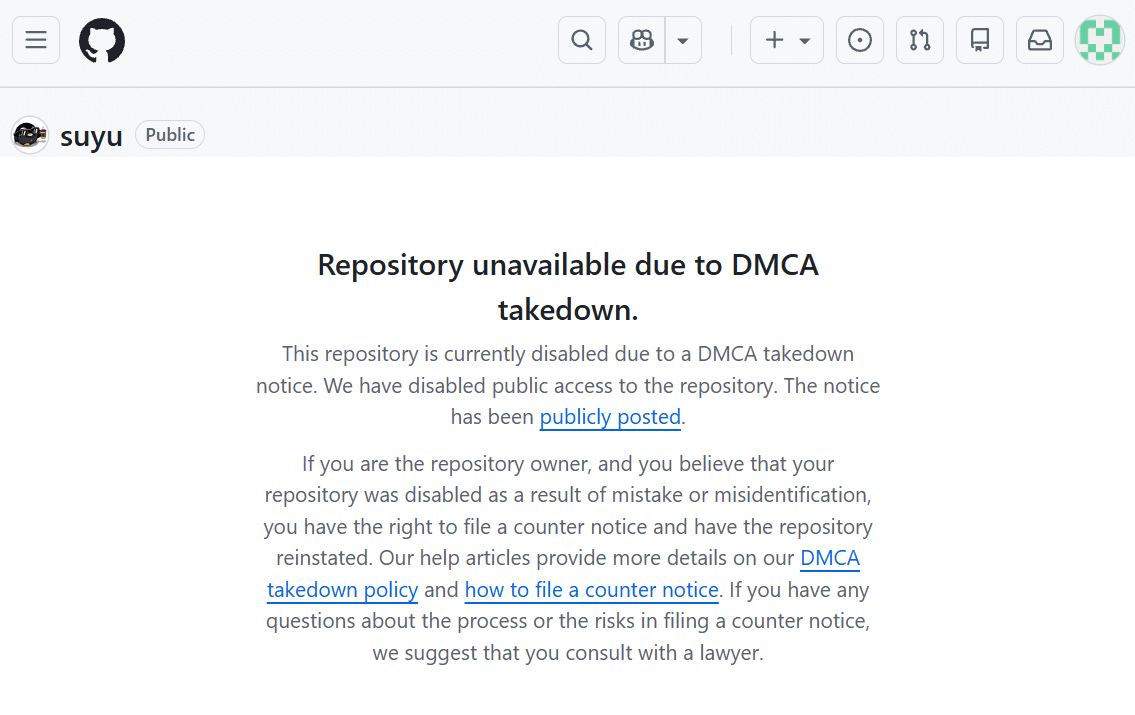
Within hours of GitHub processing the notices, visitors navigating to the affected URLs were greeted with standard platform notification banners reading: "Repository Unavailable due to a DMCA takedown notice." In several instances, repositories transformed into HTTP 404 error pages, signaling that individual code maintainers chose to voluntarily purge their directories to preempt further legal liability.

The swiftness of the execution demonstrates the streamlined nature of modern copyright enforcement on major developer platforms. Having established routine operational procedures through previous legal battles, Nintendo’s legal teams can deploy standardized anti-circumvention arguments across hundreds of codebases with minimal administrative friction.
Supporting Context & Metrics: The War on Emulation
Nintendo’s aggressive maneuvers against Switch emulators did not emerge in a vacuum. Over the past several years, the company has methodically dismantled the infrastructure supporting modern console emulation, transforming what was once a quiet, academic hobbyist space into a high-stakes legal battleground.
The Escalating Campaign Timeline
- February 2024: Nintendo drops a legal bombshell by filing a landmark lawsuit against Tropic Haze LLC, the developers behind Yuzu. The case concludes swiftly via a consent judgment involving a staggering $2.4 million settlement and the permanent surrender of the Yuzu domain and codebase.
- October 2024: Ryujinx, widely regarded as one of the most stable and structurally sophisticated alternative Switch emulators, abruptly shuts down its public operations following direct pressure from Nintendo representatives.
- Late 2024: Individual content creators and independent actors find themselves in the crosshairs. Notably, Colorado courts enter a default judgment against defiant streamer Jesse Keighin (known online as "EveryGameGuru"), ordering him to pay $17,500 for streaming unreleased and pirated Nintendo titles.
- August 2026 (Current Campaign): Nintendo pivots decisively toward the decentralized open-source community, executing a mass cull of over 400 GitHub repositories in a single operational burst.
The Legal Argument: Circumvention vs. Fair Use
At the core of Nintendo’s legal filings is a consistent, unyielding statutory argument: software emulators inherently violate the DMCA because they cannot function without utilizing cryptographic keys derived from copyrighted hardware.
As articulated directly in the latest GitHub notices:
"During operation, the emulators at the reported repositories necessarily use unauthorized copies of these cryptographic keys to decrypt unauthorized copies of Nintendo Switch games, or ROMs, at or immediately before runtime without Nintendo’s authorization."
This legal theory bypasses traditional copyright infringement arguments—which often involve complex debates regarding fair use, reverse engineering, and transformative software design—by framing emulators strictly as "circumvention tools." Under Section 1201 of the DMCA, the mere distribution of tools designed to bypass access controls is illegal, regardless of whether the software is used for piracy or legitimate archival purposes.
Precedents Built on Settlements, Not Trials
A critical nuance in Nintendo’s enforcement strategy is the nature of the legal precedents it cites. In its notices, Nintendo heavily relies on the Tropic Haze/Yuzu consent judgment and the default judgment against Jesse Keighin.

Legal scholars note a profound structural implication here: neither case tested the merits of emulator circumvention before a court of law.
- The Yuzu case ended in a pre-trial settlement, with the developers opting to settle rather than bankroll an expensive, high-risk defense against a corporate titan.
- The EveryGameGuru case resulted in a default judgment because the defendant failed to mount a defense and allegedly destroyed evidence.
Consequently, Nintendo continues to enforce its interpretation of the law through administrative takedowns and uncontested judgments, creating a de facto legal reality without ever establishing definitive judicial binding precedent regarding the legality of clean-room emulation itself.
Official Statements and Platform Policies
GitHub’s Balancing Act
As the intermediary hosting hundreds of millions of code repositories, GitHub occupies a difficult position. The platform must comply with statutory DMCA requirements while simultaneously protecting legitimate developer projects from overreaching or abusive censorship.
According to GitHub’s transparency reports and published policies regarding anti-circumvention claims:
- The platform employs specialized internal engineering and legal review teams to evaluate complex DMCA Section 1201 notices.
- When the validity of an anti-circumvention claim appears ambiguous or overly broad, GitHub’s stated policy is to "err on the side of the developer and leave the content up."
However, the sheer volume of Nintendo’s documentation—bolstered by the heavyweight legal shadow of the Yuzu settlement—leaves platforms with little practical leeway. Failing to honor validly structured DMCA notices exposes hosting providers to secondary copyright liability, making prompt compliance the path of least resistance.
The Silence of the Open Source Community
Reactions from the broader open-source community have been largely muted, characterized by a mixture of resignation and tactical retreat. Unlike the immediate outrage that followed the initial Yuzu takedowns, the August 2026 GitHub sweep was met with quiet pragmatism. Many maintainers of secondary forks recognized that fighting a prolonged legal battle against Nintendo’s corporate legal apparatus is financially untenable for individual hobbyists.
Future Outlook: The Hydra Effect in Open Source Software
As Nintendo celebrates the successful eradication of over 400 repositories from GitHub, industry analysts and intellectual property experts are already looking toward the horizon. The central question remains: Can a corporation permanently suppress open-source code through administrative takedowns?
The Hydra Phenomenon
The fundamental nature of open-source software makes permanent suppression exceedingly difficult. Code, unlike physical manufacturing plants or distribution servers, is infinitely reproducible and lightweight.
- Decentralized Mirrors: Within hours of GitHub takedowns, mirror networks frequently materialize on alternative, privacy-focused hosting platforms, decentralized git networks (such as Radicle or self-hosted Gitea instances), and encrypted file-sharing channels.
- Underground Collaboration: Development of core emulation technologies often shifts from public repositories to invite-only Discord servers, encrypted chat groups, and dark-web forums, making it significantly harder for rightsholders to monitor and issue timely legal threats.
The Curious Case of Defunct Projects
The targeting of abandoned projects like Skyline illustrates the totalizing scope of modern copyright enforcement. When independent developers abandoned the Android Switch emulator in 2023, they believed the project’s life cycle had ended. Nintendo’s decision to scrub even dormant, years-old forks demonstrates that the company views historical code as a continuing vector for future vulnerabilities.
What Lies Ahead for Emulation?
For gamers and preservationists, the outlook is sobering. Nintendo’s systematic destruction of Switch emulation infrastructure signals that commercial rightsholders will aggressively contest any software capable of running proprietary titles outside official hardware ecosystems.
As the hardware lifecycle of the Nintendo Switch transitions into its twilight years and next-generation hardware approaches, the legal battles surrounding software preservation, digital heritage, and anti-circumvention legislation will only intensify. For now, Nintendo has successfully cleared the public digital square of Switch emulators—even if the underlying code continues to whisper quietly in the dark corners of the internet.


