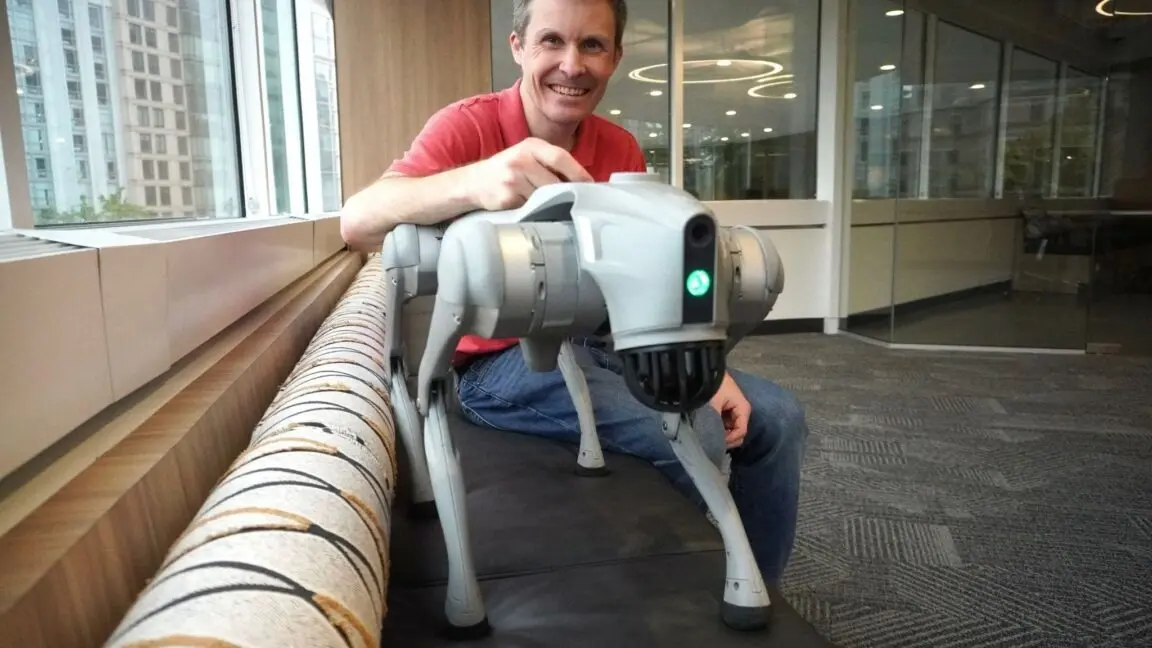
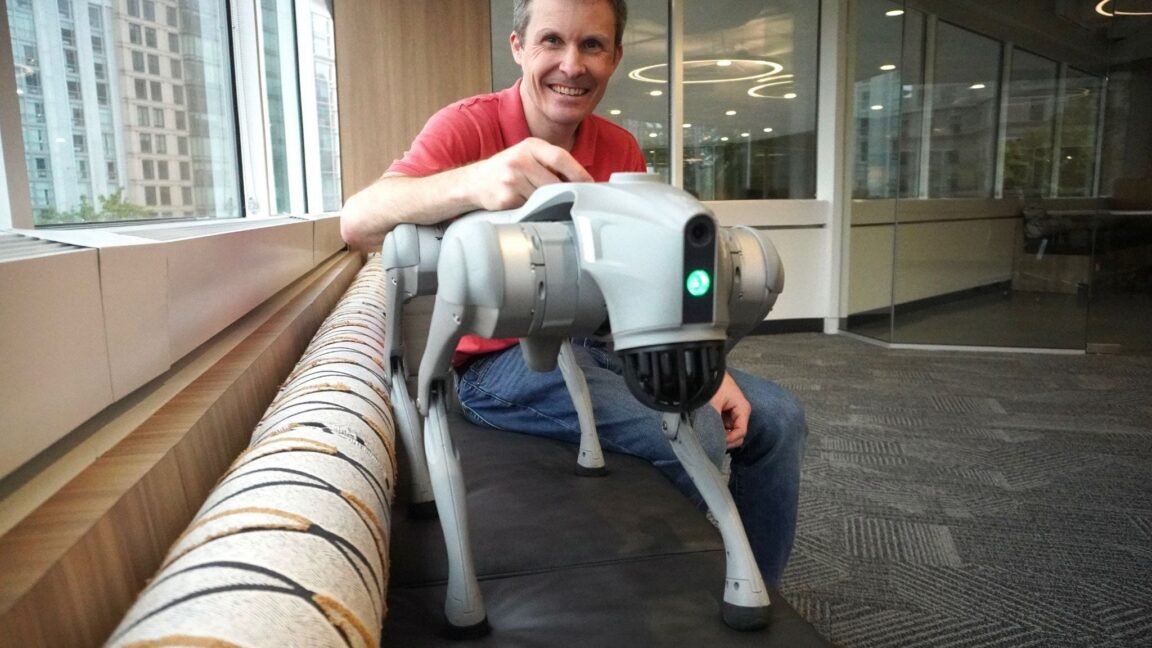
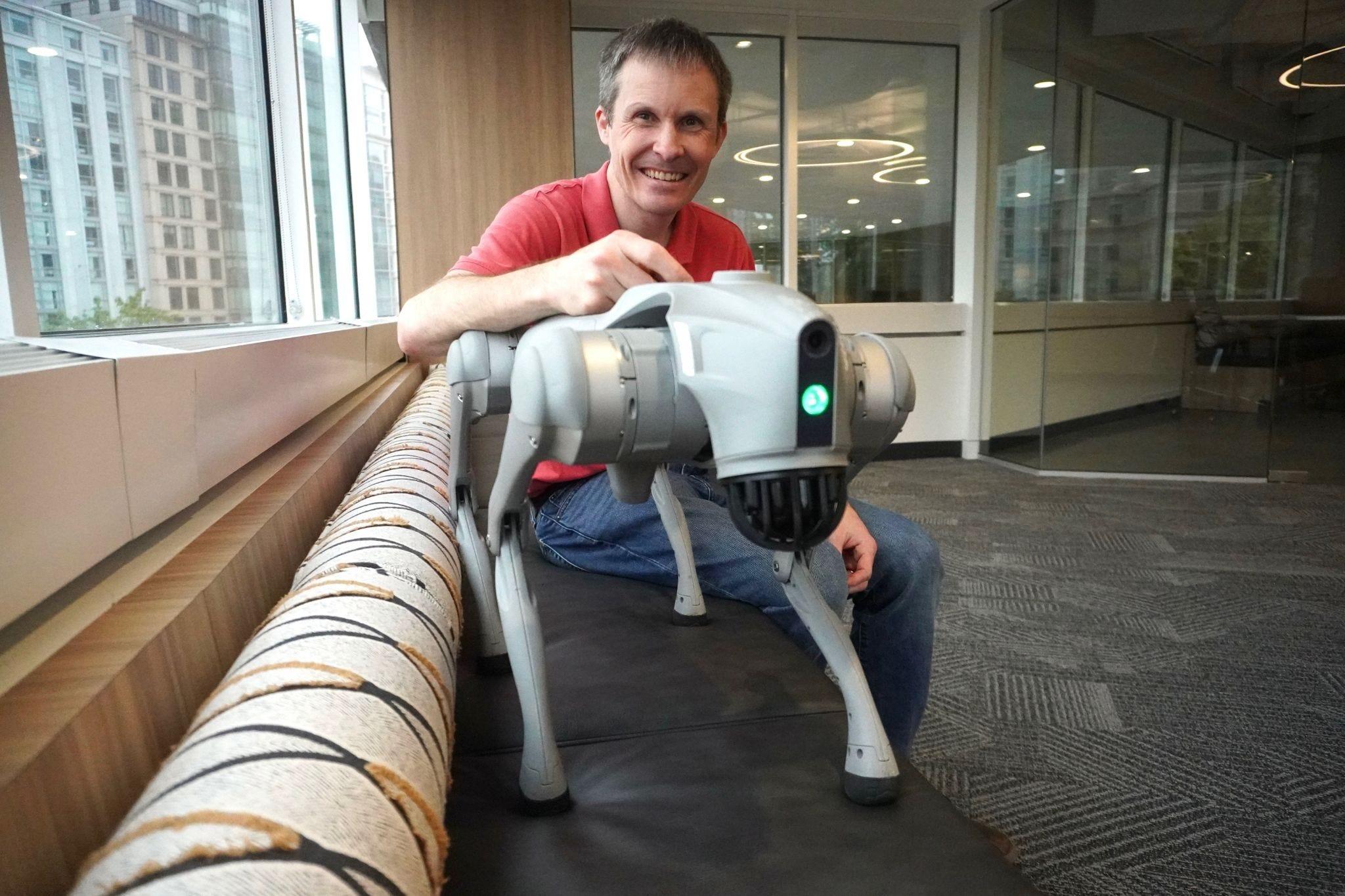
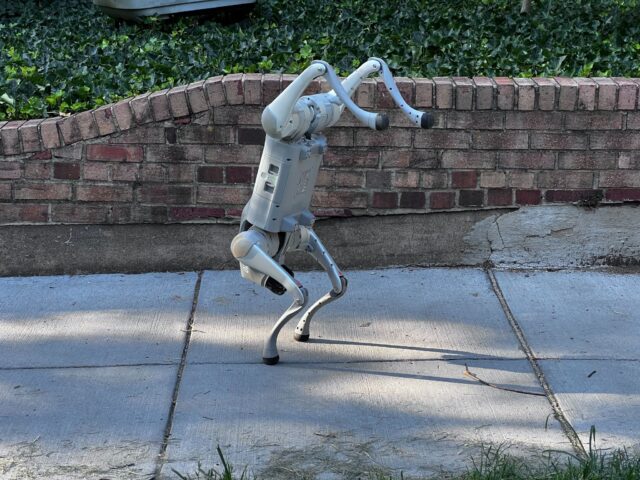
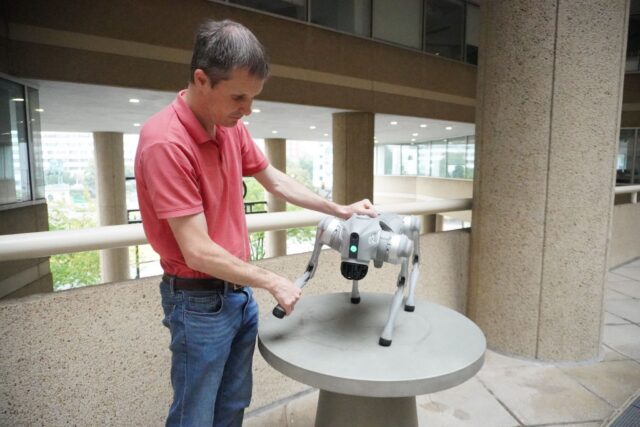
In the summer heat of Washington, D.C., a pedestrian walking a dog usually prompts little more than a passing glance. But when technology journalist Timothy B. Lee took his morning commute alongside a quadruped robot—a four-legged, headless mechanical hound manufactured by Chinese robotics firm Unitree—the reaction was altogether different. Cars slowed down, pedestrians whipped out smartphones for photographs, and biological dogs barked furiously at a safe distance.
For Lee, the two-mile journey to his office near the White House was more than just a quirky commute; it was a firsthand encounter with a profound industrial shift. Bought for just $4,017 (including shipping and tariffs), his Unitree Go2 Pro robot dog represents a staggering democratization of advanced robotics.
For decades, the realm of legged robotics was the exclusive domain of elite research universities and well-funded military contractors like Boston Dynamics, whose iconic “Spot” robot carries a price tag starting around $75,000. Today, Chinese hardware manufacturers like Unitree have upended that paradigm. By slashing the cost of quadruped locomotion and pivoting aggressively into the humanoid market, Unitree has experienced a meteoric rise. Following its Shanghai stock market debut, the company commands a multi-billion-dollar valuation, establishing itself as the “DJI of robotics”—a hardware giant poised to transform global automation.
Detailed Chronology: From Campus Experiments to the D.C. Pavement
The journey of Unitree and its founder, Wang Xingxing, mirrors the rapid, explosive evolution of modern Asian hardware engineering.
The Genesis: XDog and Boston Dynamics
Wang’s obsession with legged robotics began during his master’s studies at Shanghai University. Inspired by the pioneering work of Marc Raibert and Boston Dynamics, Wang developed a crude, early-stage quadruped robot christened XDog for his master’s thesis. In a 2016 interview with IEEE Spectrum, Wang openly acknowledged his influences: "Marc Raibert from Boston Dynamics is my idol. Their papers helped me to design XDog."
At the time, Boston Dynamics’ early prototypes—heavy, loud gas-powered machines like BigDog and WildCat—were unsuited for consumer or commercial deployment. Wang’s vision was starkly different: to build smaller, simpler, electric-powered quadruped robots capable of serving ordinary people as carriers and companions.
Founding Unitree and Commercializing the Quadruped
In May 2016, the same year Boston Dynamics unveiled its first electric-powered Spot prototype (which wouldn’t see commercial release until 2020), Wang founded Unitree Robotics.
2017–2019: Unitree launched its initial research-grade electric quadrupeds, the Laikago (2017) and AlienGo (2019). Priced in the tens of thousands, these machines primarily serviced academic labs.
2021: Unitree introduced the Go1 line, dropping the entry price of a robot dog down to an unprecedented $2,700 for the "Air" model.
2023: The launch of the Go2 series drove prices even lower—$1,600 for the Air and $2,800 for the more capable Pro. For the first time, hobbyists, independent researchers, and tech journalists could afford a dynamic quadruped.
The D.C. Commute: A Stress Test in Real-World Conditions
Lee’s experiment with the Go2 Pro highlighted both the brilliance and the limitations of consumer-grade robotics today. While the morning commute down the gentle slopes of Mount Pleasant went smoothly, the afternoon return trip exposed severe hardware strain.
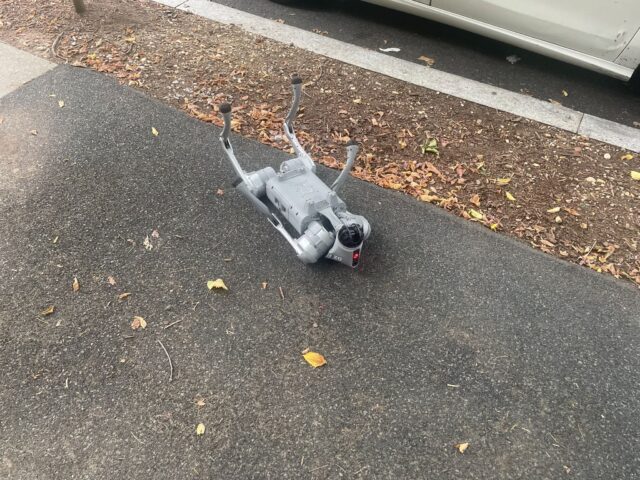
Walking uphill in 87°F (30°C) heat, the Go2 Pro struggled against the incline. As Lee approached his front door, his phone flashed critical warnings: battery at 5 percent, internal temperature at a scorching 84°C (183°F). Without a graceful shutdown protocol, the robot collapsed abruptly, rolling onto its back with its legs kicking in the air—the LED face flashing red while its nose-mounted LiDAR sensor spun helplessly.
It was a stark reminder that while Unitree’s machines are marvels of affordability, they still possess the rough edges characteristic of bleeding-edge hardware.
To understand how Unitree achieved a price point more than 97 percent cheaper than industry pioneers like Boston Dynamics, industry analysts have literally taken the machines apart.
Inside the Teardown: Simplexity and MAB Robotics
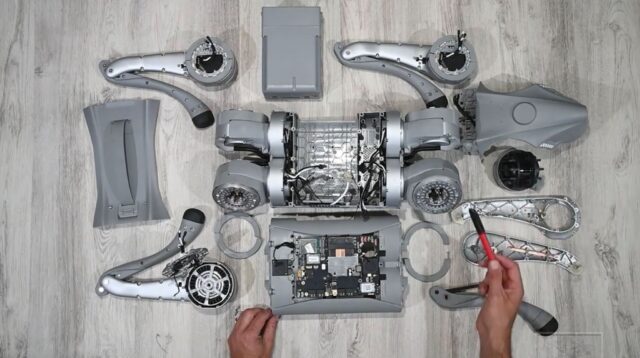
Last year, engineering firm Simplexity tore down a Unitree Go2 Air to examine its internal anatomy. According to mechanical engineer Luis Elenes, the secret to Unitree’s cost efficiency lies in radical component reuse.
Each of the robot’s four legs is powered by three identical motors—one in the shoulder controlling the leg angle, and one for each of the two leg segments. "With three motors, you get a really dynamic range of motion," Elenes noted. "All four shoulders are identical in arrangement. The more you can reuse motors and parts, the simpler your design gets, and the more robust overall your design will be."
However, compromises are made. Jakub Bartoszek, an expert on legged robotics at startup MAB Robotics, points out that Unitree achieves its low price partly by utilizing lower-quality components. Unitree’s in-house motors wear out faster than those found in Western enterprise hardware. Yet, this is a calculated trade-off: Unitree has designed its hardware for rapid field repairs. According to Simplexity, a user can swap out a damaged leg in under a minute thanks to a modular, simplified attachment system.
The Reduction Ratio Revolution
Traditional industrial robots prioritize extreme precision, employing complex, high-ratio gear reducers. For instance, Boston Dynamics’ Spot utilizes gear ratios as high as 51-to-1, meaning the motor must rotate 51 times to produce a single rotation of the leg joint. While this grants incredible precision and force multiplication, it drives up manufacturing costs and introduces mechanical rigidity, making the robot less adaptable to physical resistance (low backdriveability).
Unitree flips this script by combining powerful, large motors with a minimalist 6.33-to-1 gearbox. This low gear ratio makes the robots exceptionally nimble, dynamic, and cheaper to produce. It also simplifies physics simulations, making it significantly easier to train the robot’s control software using modern machine learning techniques. Because modern software is constantly making micro-corrections in real time, it easily compensates for the lower precision of the hardware.
Financial Ascent and the Humanoid Pivot
Financial markets have responded enthusiastically to Unitree’s market disruption. Following its debut on the Shanghai stock exchange, shares skyrocketed over fivefold on day one. Despite subsequent stabilization, the company boasts a valuation of roughly $34 billion—more than triple its pre-IPO valuation.
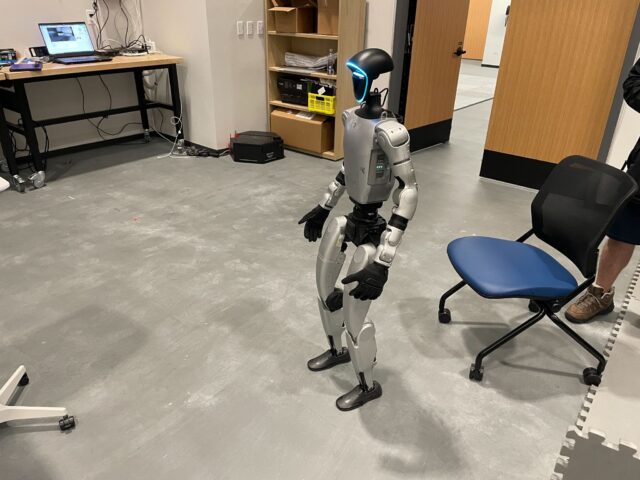
Crucially, Unitree did not stop at quadruped dogs. Leveraging its supply chain mastery, the company launched its first humanoid robot, the H1, in 2023, followed by the more advanced and dramatically cheaper G1 in 2024. Consumer versions of the G1 start at just $13,500, while research-grade EDU versions run around $50,000.
According to financial disclosures from Unitree’s stock offering, this pivot has been astonishingly successful:
Quadruped Revenue: Grew from RMB 230 million ($34 million) in 2024 to RMB 697 million ($104 million) in 2025.
Humanoid Revenue: Exploded from RMB 107 million ($16 million) to RMB 867 million ($129 million)—an eightfold increase in a single year.
By 2025, humanoids accounted for 51 percent of Unitree’s total revenue, cementing its status as a global leader in bipedal robotics.
Official Statements & Industry Perspectives
Industry experts view Unitree’s rise through the lens of historical technological disruptions, drawing explicit parallels to DJI’s domination of the global drone market a decade ago.
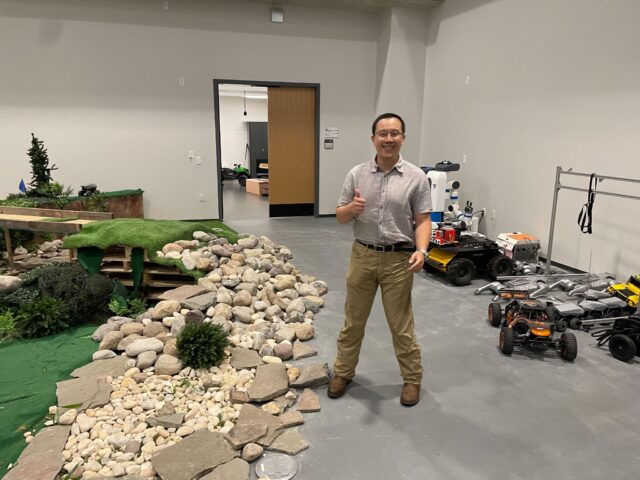
Professor Xuesu Xiao, a roboticist at George Mason University who maintains a lab filled with Unitree quadrupeds and humanoids in Arlington, Virginia, emphasizes the democratization effect:
"Ten years ago, only a very small set of research groups were working on quadruped locomotion because they were the only people on the planet who could build a quadruped. Then Unitree came onto the market. And it basically democratized the entire world of quadruped locomotion research."
A June market analysis by SemiAnalysis echoed this sentiment, comparing Unitree’s trajectory to DJI’s launch of the Phantom 1 in 2013:
"We are witnessing the birth of another Chinese hardware giant. Three years ago, Unitree was a quadruped company. By last year, they parlayed quadruped dominance into creating and leading the humanoid market."
SemiAnalysis highlights that Unitree has brought critical component manufacturing—including motors, gearboxes, LiDAR sensors, and cameras—in-house. Unitree’s self-produced motors reportedly cost as low as 30 to 40 percent of equivalent Western components, creating an unbeatable economic flywheel. More sales fund manufacturing optimizations, which lower costs further, fueling even greater market capture.
Future Outlook: Geopolitical Headwinds and the Global Robotics Market
Despite its hardware prowess, Unitree faces significant hurdles—most notably on the geopolitical front.
In the United States and Western markets, the rise of affordable Chinese robotics has triggered intense alarm. In June, a bipartisan group in the U.S. House of Representatives introduced legislation specifically targeting and naming Unitree to restrict the importation of Chinese robots. Shortly thereafter, the Federal Communications Commission (FCC) enacted broad new regulatory frameworks targeting foreign-made robotics and hardware.
However, industry analysts warn that Western protectionism may backfire. Much like the electric vehicle market—where Chinese firms like BYD are effectively locked out of the U.S. yet capturing dominant market share across Europe, Latin America, and Asia—banning Chinese robots risks isolating Western economies rather than protecting them. If U.S. startups remain trapped in high-cost, low-volume production models while Chinese firms iterate rapidly via mass-market deployment, Western nations risk turning into a "robotics backwater."
For now, consumer-grade marvels like the Go2 Pro remain imperfect. They cannot fetch tennis balls, their software apps are occasionally buggy, and they may collapse on your doorstep after a grueling uphill hike in the summer heat. But as history proves time and again, technological revolutions are rarely won by the company that builds the most expensive, polished prototype. They are won by the company that figures out how to make the technology cheap enough for the rest of the world to own.