









Executive Overview
For nearly two decades, the architecture of modern software development has been anchored by a foundational premise: that code is written, reviewed, and shipped by humans. The entire ecosystem of version control, continuous integration and continuous deployment (CI/CD) pipelines, pull requests, and automated testing suites was meticulously designed to accommodate the biological cognitive limits of human engineers. Repositories evolved to absorb commits paced by morning coffee runs, lengthy peer reviews, and standard working hours.
Today, that foundational assumption is fracturing under the relentless weight of autonomous artificial intelligence.
As enterprises transition from simple AI-powered autocomplete tools to fully autonomous coding agents and multi-agent swarms, the velocity of software generation has shifted from human time to machine time. Commits, pull requests, issue creation, and branch modifications now cascade across repositories around the clock, unhindered by sleep, fatigue, or office hours. The infrastructure built to scale gracefully for agile teams of human engineers is buckling under the hyper-accelerated output of algorithmic entities.
In a recent comprehensive discussion, industry veteran Mike Vizard sat down with Rob Whiteley, CEO of Coder, to dissect the friction points emerging at the intersection of AI agents and developer platforms. Their dialogue exposes a critical truth: while the foundational paradigm of Git—distributed version control—remains remarkably resilient, the surrounding orchestration layers, security perimeters, and CI/CD pipelines are hitting operational ceilings that were entirely invisible a single year ago.
This article explores the systemic strains introduced by agentic development, examining how sheer volume and velocity are overwhelming traditional platforms, complicating supply chain security, and forcing engineering leaders to urgently rethink developer infrastructure from the ground up.
Detailed Chronology: From Human-Paced Git to the Agentic Era
To understand the magnitude of the current infrastructure crisis, it is necessary to retrace the evolution of developer workflows and pinpoint where the friction begins.
Phase 1: The Human-Centric Baseline
Since the mid-2000s, Git and platforms like GitHub, GitLab, and Bitbucket established a predictable rhythm for software engineering. A developer would write code locally, push a branch, open a pull request, and wait for peer review. This workflow accommodated human constraints. Code reviews took hours or days; CI/CD pipelines ran asynchronously against discrete, manageable chunks of changes; and human administrators could easily audit who changed what and why.
Phase 2: The Acceleration of Copilots
The first wave of AI integration—typified by inline code generators and assistant tools—increased individual productivity without fundamentally breaking upstream systems. While developers were writing code faster, they remained the ultimate bottleneck. A human still had to initiate the prompt, evaluate the suggestion, copy or accept the code, and manually shepherd it through the standard pull request lifecycle. The volume of repository events rose moderately, but traditional CI/CD platforms absorbed the impact without structural failure.
Phase 3: The Autonomous Swarm
The tipping point arrived with the advent of agentic development. Modern AI agents do not merely suggest lines of code; they ingest entire codebases, diagnose bugs, write comprehensive patches, generate corresponding tests, and open pull requests autonomously. Furthermore, multi-agent architectures now allow swarms of AI entities to collaborate on complex refactoring tasks in parallel.
When a swarm of agents is unleashed upon a repository, the cadence of development shifts permanently. Issues are closed and reopened at machine speed; dozens of pull requests materialize simultaneously; and automated testing pipelines are flooded with concurrent execution requests. Platforms built to handle dozens of daily events from human contributors are suddenly processing thousands of events per hour, revealing deep latency bottlenecks, database locking issues, and resource exhaustion within enterprise developer tooling.
Supporting Context & Metrics: The Anatomy of Infrastructure Strain
The pressure points exerted by AI agents manifest across three primary operational dimensions: volume, velocity, and vector surface area.
1. Volume and Velocity Overload
The most immediate casualty of agentic development is raw system throughput. Traditional developer platforms utilize webhooks, database triggers, and asynchronous worker queues to manage repository events. When an AI agent generates continuous streams of commits and pull requests, these queues become saturated.
- CI/CD Pipeline Bottlenecks: Continuous integration runners—whether self-hosted or cloud-managed—are suddenly forced to spin up containerized environments at unprecedented frequencies. This leads to starvation for compute resources, delayed build times, and ballooning cloud infrastructure expenditures.
- Notification and Review Fatigue: Even if machines are writing the code, human engineers are still legally and organizationally required to review and approve merges in most compliance frameworks. The sheer volume of AI-generated pull requests creates an impossible review backlog, defeating the very productivity gains the agents were deployed to achieve.
2. The Security and Supply Chain Vulnerability
Beyond performance degradation, AI agents introduce profound security and software supply chain challenges. Software repositories are no longer passive storage systems for static code; through actions, webhooks, and deep CI/CD integrations, they have transformed into active operational control points.
- Amplified Attack Surfaces: AI agents operate via APIs and large language models that are susceptible to prompt injection, data poisoning, and unauthorized privilege escalation. If an attacker successfully compromises an AI agent’s context or training environment, malicious code can be injected, obfuscated, and propagated across hundreds of repositories at machine speed.
- Accidental Exfiltration and Hallucinations: Autonomous agents frequently hallucinate dependencies, import non-existent or typosquatted packages, or inadvertently expose hardcoded secrets within generated test cases. Because human oversight cannot possibly scale to match agent output, these vulnerabilities slip past review queues and embed themselves directly into production codebases.
3. The Breakdown of Traditional Permissions
Existing access control models—such as Role-Based Access Control (RBAC) and token-scoped repository permissions—were engineered around human actors who possess institutional memory, ethical boundaries, and identifiable accountability. An AI agent, however, acts as an autonomous proxy executing complex logic chains without human intuition. Granting an agent broad write access to a core repository creates an unacceptable blast radius if the agent misinterprets a prompt or executes a flawed algorithmic instruction.

Official Statements and Industry Insights
The dialogue between Mike Vizard and Coder CEO Rob Whiteley cuts to the heart of these structural challenges, offering an authoritative perspective on the future of developer platforms.
Rob Whiteley emphasizes that the core utility of Git remains unassailable. "The core idea of Git is still useful," Whiteley notes. "Distributed version control is not the problem." The fundamental mechanics of branching, merging, and version history are mathematically sound and perfectly suited for tracking changes, regardless of whether those changes originate from a human keyboard or an LLM’s inference engine.
The real failure, according to Whiteley, lies in the proprietary and open-source platforms wrapped around version control. These platforms were explicitly designed for a slower, more deliberate cadence than agentic development produces. "Volume and velocity are the pressure points," Whiteley explains, highlighting that the operational side of GitHub and similar developer environments is where system strain manifests first.
Addressing the security dimension, Whiteley points out that Actions, webhooks, and deep CI/CD integrations turned code repositories into critical operational control points. While this integration accelerated modern software delivery, it also converted GitHub into a single point of catastrophic dependency for a massive slice of the global technology industry.
"As agents take on more coding work, teams need real boundaries around what agents can access, how they trigger workflows, and how their activity is audited," Whiteley argues. "The permissions and execution environments that were adequate for human contributors are not obviously adequate for the agent equivalent."
This perspective is echoed across the broader software engineering community. DevOps leaders are increasingly recognizing that bolting AI agents onto legacy toolchains is a recipe for operational failure. The operational paradigm must shift from treating AI as a "faster human" to treating AI as an entirely new class of digital worker that requires specialized runtime sandboxes, fine-grained access policies, and automated audit trails.
Future Outlook: Re-Architecting Developer Infrastructure
As organizations look toward the next phase of software engineering, proactive infrastructure planning is no longer optional—it is a critical survival metric. Organizations that fail to anticipate the scaling limits of their developer platforms will find themselves paralyzed by security breaches, pipeline gridlock, and escalating technical debt.
To successfully navigate the agentic era, engineering organizations must focus on several core structural evolutions:
1. Distributed, Policy-Aware Systems
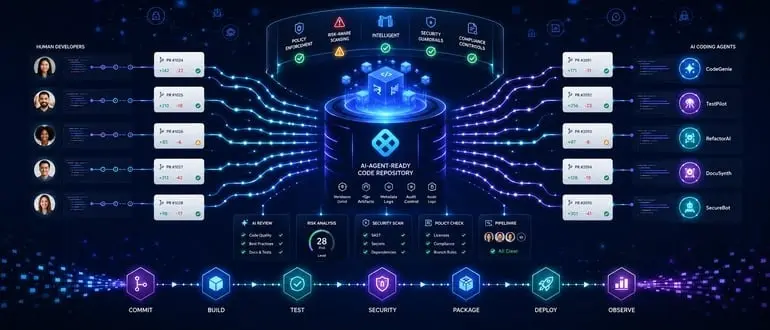
Future developer infrastructure must move away from monolithic, centralized repository models toward more distributed, policy-aware architectures. This involves implementing robust governance layers that intercept agent-generated changes before they hit core branches. Policies must be codified and enforced programmatically, ensuring that every AI-generated commit adheres to strict compliance, security, and architectural standards without requiring manual human bottlenecking.
2. Context-Rich Execution Sandboxes
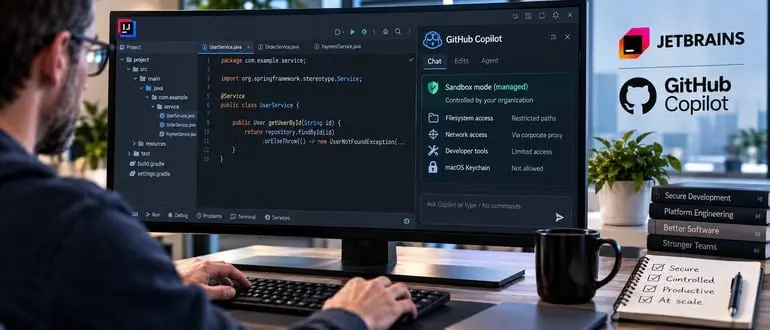
Giving AI agents direct access to production repositories is an untenable risk. The industry is rapidly moving toward isolated, ephemeral execution environments where agents can write, test, and validate code safely. These sandboxes must provide rich contextual boundaries—limiting what internal documentation, proprietary libraries, and external APIs an agent can interact with during its operational lifecycle.
3. Asynchronous Audit and Verification Layers
Because human review cannot scale to match the velocity of multi-agent swarms, organizations must build automated, secondary verification systems. These layers will utilize deterministic static analysis, automated fuzz testing, and specialized guardrail models to continuously audit agent activity in the background, flagging anomalies and malicious patterns long before code reaches a deployment pipeline.
Conclusion
The friction currently observed in GitHub and surrounding developer platforms is not a temporary growing pain; it is the early warning sign of a profound paradigm shift. Autonomous AI agents are rewriting the rules of software creation, pushing legacy infrastructure past its structural breaking point.
As Rob Whiteley and industry leaders assert, the solution does not lie in abandoning version control, but in fundamentally rethinking developer platforms for a world operating at machine speed. Organizations that invest in policy-aware, resilient, and secure infrastructure today will successfully harness the unprecedented power of agentic development. Those that delay will find their pipelines overwhelmed by the very intelligence they deployed to accelerate their business.