









Executive Overview
Over the past two years, the fundamental mechanics of software delivery have undergone a profound, accelerated transformation. What was once a deliberate, human-paced rhythm of design, typing, and testing has been supercharged by generative artificial intelligence. Yet, as the numbers from major industry benchmarks make clear, this revolution has created a profound structural imbalance.
According to Sonar’s 2026 State of Code Developer Survey, AI-generated or AI-assisted code now accounts for a staggering 42% of all code committed by respondents—a figure developers project will surge to 65% by 2027. Simultaneously, GitLab’s 2026 AI Accountability Report reveals that 85% of surveyed technology leaders agree AI has fundamentally shifted the primary bottleneck in the software development lifecycle (SDLC) from writing code to reviewing and validating it.
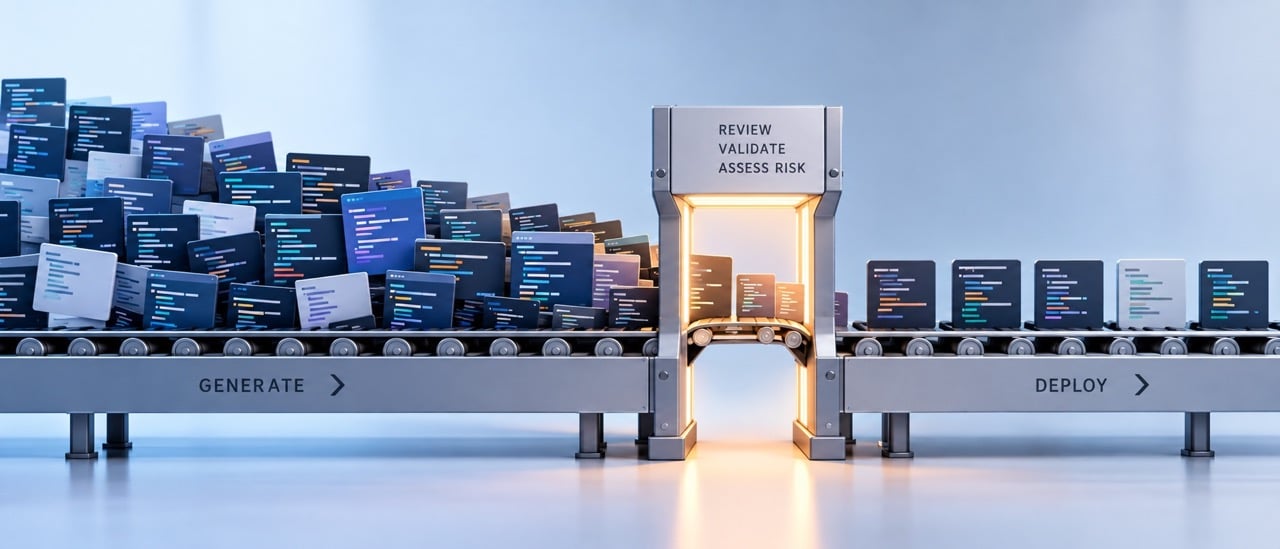
However, a closer examination of enterprise data reveals a critical nuance that is frequently omitted from industry optimism: the bottleneck did not migrate downstream on its own. Engineering leadership and organizations deliberately pushed it there. By focusing automation efforts on the mechanical, high-volume tasks of code generation and basic test creation, organizations have unleashed a tidal wave of machine-assisted output into verification pipelines that remain stubbornly bound to human judgment.
The resulting crisis is not merely technical; it is economic, operational, and cultural. As the cost of generation plummets, the true price of validation—requiring deep critical thought, risk assessment, and architectural oversight—is coming due. Organizations are discovering that adding more subscriptions, tools, or automated generation scripts cannot close a widening judgment gap. Navigating the next phase of software engineering requires a fundamental reckoning with where human capacity, rather than machine throughput, actually matters.
Detailed Chronology: The Two-Year Shift in Software Delivery
To understand how modern engineering finds itself in its current configuration, it is necessary to chart the rapid evolution of generative AI tools from experimental novelties into core infrastructure elements between 2024 and 2026.
The Initial Wave: Embracing Code Generation (2024–2025)
In the early days of generative coding assistants, adoption was driven largely by individual developer productivity. Developers experimented with autocompletion models to write boilerplate code, write standard loops, and translate simple algorithms between languages.
At this stage, leadership metrics celebrated velocity. Pull request volumes ticked upward, and lines of code (LoC) per day became a popular, albeit flawed, proxy for developer output. Organizations rushed to integrate AI copilots across their entire engineering fleets, viewing adoption rates as a direct indicator of technological modernization.
The Scaling Tipping Point (2025–2026)
By 2026, the paradigm shifted from individual experimentation to enterprise-wide integration. Sonar’s data showing 42% AI-committed code indicates that AI is no longer a peripheral assistant; it is a primary author.
Yet, as the volume of generated code scaled exponentially, engineering teams hit a wall. The tools that made writing code frictionless did nothing to accelerate the comprehension, security vetting, and integration testing required to merge that code safely into production. Reviewers found themselves drowning in massive, multi-file pull requests generated in seconds by AI models—pull requests that lacked the contextual narrative of a human author.
PractiTest’s 2026 State of Testing Report captures this uneven deployment clearly, noting that while overall AI adoption in testing sits at 76.8%, it is heavily skewed toward mechanical tasks. Teams rapidly automated test case creation (69.6%) and script maintenance (59.6%), leaving high-level risk identification hovering at a mere 19.9%.
The chronology of this shift reveals a systemic misallocation of AI capabilities. Organizations automated the tedious execution tasks—the "half that got cheap"—while leaving the expensive, cognitively demanding work of quality engineering entirely to human review teams whose numbers and capacities remained static.
Supporting Context & Metrics: The Anatomy of the Verification Gap
A synthesis of 2026 industry reports highlights the stark disconnect between perceived agility and operational reality.
+-------------------------------------------------------------------------+
                    THE 2026 SOFTWARE DELIVERY DIVIDE
+-------------------------------------------------------------------------+
 | Metric Category          | Industry Data Point / Finding              |
 +--------------------------+---------------------------------------------+
 | AI Code Share            | 42% of current commits (Projected 65% 2027) |
 | Shift in Bottleneck      | 85% agree bottleneck moved to review/verify |
 | Developer Trust          | 96% do not fully trust AI-generated code    |
 | Verification Habit       | Only 48% always verify before committing    |
 | Review Effort            | 38% say AI code takes *more* review effort  |
 | Enterprise QE Scaling    | Only 15% scaled GenAI enterprise-wide       |
 +-------------------------------------------------------------------------+
The Confidence Gap vs. The Reality Gap
Perhaps the most alarming metric uncovered in recent research is the confidence gap. GitLab’s report notes that 87% of surveyed professionals express confidence in their ability to identify whether AI-generated code was involved in an incident within 24 hours. However, when looking at organizations that had actually experienced a production incident involving AI code, that confidence crashed: 34% of those teams could not make that determination. Furthermore, 43% of respondents across the broader survey admitted they could not reliably distinguish between AI-generated and human-written code at all.
Perforce’s 2026 State of DevOps Report reinforces this finding from another angle. While 77% of IT professionals express high confidence in their AI outputs, only 38% have successfully embedded AI across multiple delivery stages, and a mere 39% maintain fully automated, reliable audit trails.
The enterprise landscape is effectively divided into two camps: those who know they lack end-to-end visibility, and those who will only discover it during their next major postmortem.
The Hidden Economics of Code Review
The math behind AI code review is increasingly working against engineering teams. Sonar’s survey reveals a paradox: while 96% of developers do not fully trust AI-generated code, only 48% always verify it before committing.
Worse still, 38% of developers report that reviewing AI-generated code actually requires more cognitive effort than reviewing code written by a human colleague. When a human writes code, there is often a shared contextual understanding, an identifiable style, and a colleague available for quick clarification. When an AI generates a complex, hallucination-prone block of logic, the reviewer must reverse-engineer the model’s assumptions from scratch. When this high-friction review process is applied to larger batches of code at a frequency nearing 65% of all enterprise commits, the review pipeline inevitably seizes up.
Official Statements and Industry Insights
Industry leaders and quality engineering experts have increasingly spoken out about the structural limits of current AI integration strategies.
Analyst firms examining enterprise readiness emphasize that tooling alone cannot solve systemic organizational bottlenecks. Speaking on the integration of generative AI within quality engineering, enterprise quality frameworks highlight that scaling remains elusive. The World Quality Report series has repeatedly noted that while adoption surges in early phases, enterprise-level scaling in quality engineering stays restricted. While a large percentage of organizations experiment with GenAI (often hovering around 43%), only a small fraction (around 15%) achieve true enterprise-wide scaling.
According to veteran DevOps architects:
"Generation got cheap in about two years. Verification didn’t, because verification is fundamentally a human act of deciding what matters. You cannot prompt engineer your way out of architectural judgment, and no software subscription can decide what risk your business is willing to tolerate on a Thursday afternoon."
Security and testing analysts echo these warnings, pointing out that automated testing frameworks frequently pass tests they should be failing because the underlying test logic was generated by the same class of model that wrote the original application code. Without independent human validation or rigorous risk modeling, organizations are simply building faster loops around blind spots.
Future Outlook: Redefining Metrics and Staffing for the AI Era
As organizations look toward 2027 and beyond, surviving and thriving in an AI-saturated development ecosystem will require a deliberate restructuring of how success is measured, how pipelines are gated, and how engineering teams are staffed.
1. Shifting Beyond Vanity Metrics
Traditional metrics like deployment frequency and lines of code committed will increasingly present a false sense of security. They measure the half of the SDLC that got cheaper.
Instead, engineering leaders must adopt more honest signals:
- Rework Ratios: Measuring the volume of cleanup, hotfixes, and patches following a release relative to the size and scope of that release. High-throughput, low-verification pipelines inevitably leak defects that manifest as frantic post-release remediation.
- Incident Attribution Audits: Following GitLab’s suggested framework, teams should routinely run table-top exercises to test how quickly they can trace an injected bug back to its human or artificial origin.
2. Treating Verification as a Dedicated Discipline
The reflex to purchase yet another AI review tool often exacerbates the problem. Tools can flag syntax issues, style violations, and known vulnerabilities, but they cannot make value judgments about business logic, regulatory compliance, or systemic architectural risk.
Organizations crossing the maturity threshold are realizing that verification capacity is, first and foremost, a staffing and architectural decision. Many are appointing dedicated platform and DevOps engineers whose primary mandate is to own the CI/CD pipeline, establish meaningful quality gates, and prevent the ingestion of unverified code blocks. One more SaaS subscription cannot replace human accountability.
3. Conclusion
The software industry has successfully automated the typing. The next two years will belong to the organizations that recognize the enduring value of thinking. By aligning engineering capacity with the half of the SDLC that remains inherently expensive—critical judgment, risk assessment, and rigorous verification—enterprises can harness the true power of AI without sacrificing the stability of their systems.