










Executive Overview
For decades, the sterile corridors of academia have been secretly echoing with "Yeah, yeah, yeah." While research papers are traditionally expected to be bastions of strict objectivity, dry technicalities, and formal nomenclature, a playful subculture thrives within the global scientific community. Researchers across disciplines are steadily embedding pop culture references into their peer-reviewed publications, turning abstracts and titles into clever winks for observant readers.
At the forefront of this academic mischief stands the most influential musical group in history: The Beatles.
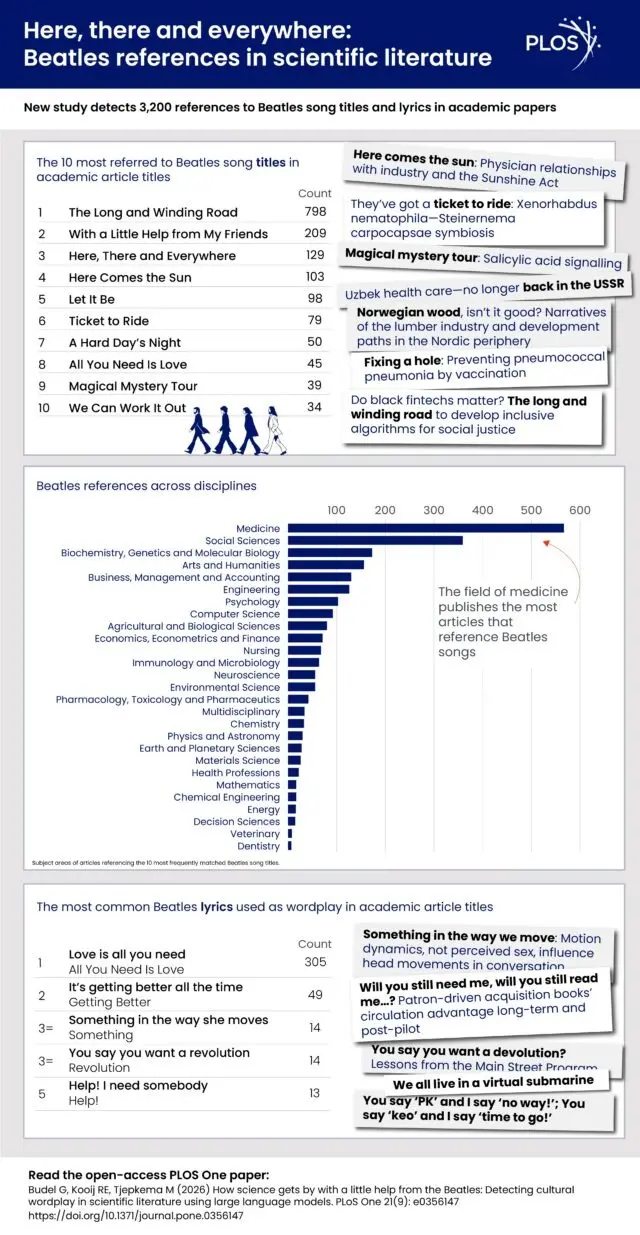
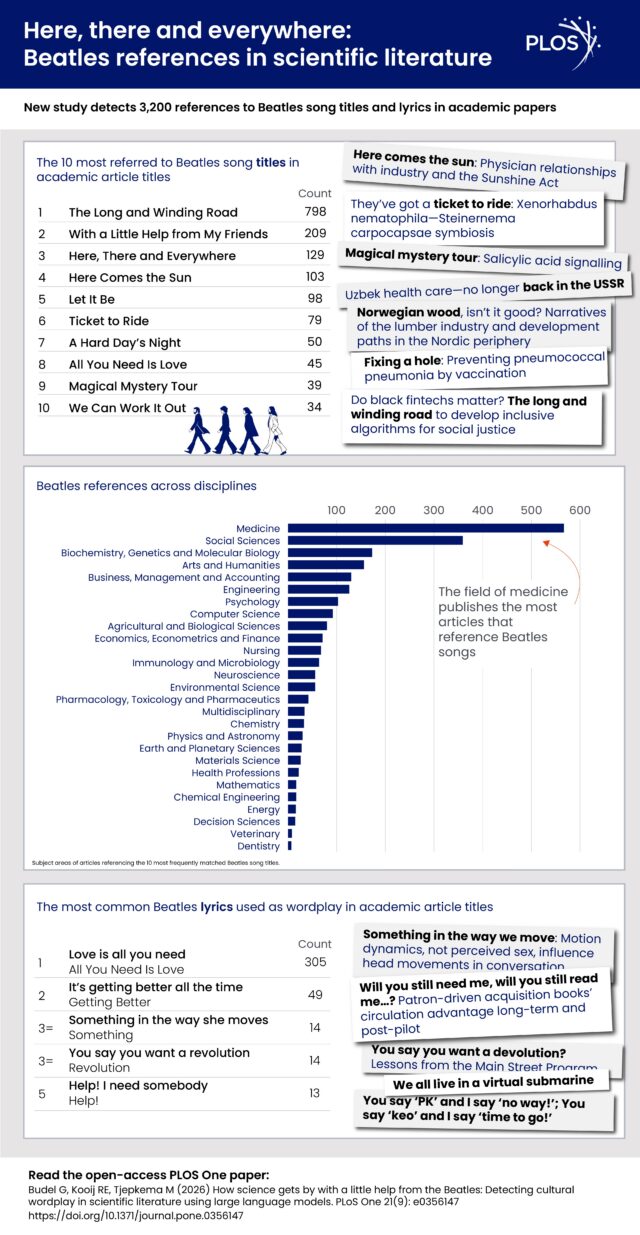
According to a landmark new study published in the journal PLoS ONE, researchers have cataloged over 3,200 distinct references to Beatles song titles and lyrics embedded within academic papers. Utilizing advanced large language models to scour massive bibliographic databases like Scopus and Google Scholar, the researchers went far beyond exact title matches to uncover subtle lyrical allusions, creative wordplay, and pun-heavy adaptations.
The findings offer a fascinating glimpse into the human side of science. Far from being isolated intellectuals working in vacuums, scientists are deeply culturally engaged individuals who view their experimental journeys—often fraught with long, winding roads of trial, error, and unexpected breakthroughs—through the timeless poetry of John, Paul, George, and Ringo.
Detailed Chronology: A History of Musical Easter Eggs in Science
The practice of smuggling pop lyrics into peer-reviewed literature is not entirely new, but it has evolved from an underground prank into a widespread, documented phenomenon.
The 1997 Genesis and the Bob Dylan Bet
The modern era of lyric-dropping in scientific literature traces its roots back to a clandestine wager made by researchers at Sweden’s prestigious Karolinska Institute. What started as a friendly challenge among colleagues in the late 1990s led to the intentional insertion of Bob Dylan lyrics into biomedical papers.
The streak kicked off quietly with a 1997 Nature review titled "Nitric Oxide and inflammation: The answer is blowing in the wind." For years, the Swedish researchers quietly continued their game, seeing how many Dylan tracks they could sneak past unsuspecting peer reviewers and editors.
The secret was finally revealed in 2014, sparking widespread amusement across the international scientific community. This disclosure prompted a formal 2015 study published in the British Medical Journal (BMJ) to investigate the prevalence of Dylan lyrics throughout biomedical literature. The analysis revealed that tracks like "The Times They Are A-Changin’" and "Blowin’ in the Wind" were regular fixtures in medical journals, quickly becoming a favorite pastime for meteorologists and climate scientists as well.
The 2017 Cross-Disciplinary Shift: The Beatles Take the Lead
As the trend gained notoriety, researchers began asking broader questions about musical dominance in academia. A 2017 comparative study analyzed the frequency of Bob Dylan versus Beatles references within biomedical literature. The results were decisive: while Dylan had paved the way, The Beatles emerged as the undisputed champions of academic homage.
The Clash Contender (2023)
The phenomenon briefly expanded beyond classic rock icons in 2023, when an eccentric bibliometric analysis revealed an unexpected surge in punk rock references. Specifically, researchers documented a staggering 408 citations of The Clash’s iconic track "Should I Stay or Should I Go" across various scientific papers.
While impressive, this punk rock spike turned out to be an outlier rather than a paradigm shift. It temporarily outpaced individual Beatles heavy-hitters like "The Long and Winding Road" (236 citations) and Bob Dylan’s "The Times They Are A-Changin’" (128 citations) at the time, but it did not dethrone the overall catalog dominance of the Fab Four.
The 2026 Comprehensive Mapping by Budel et al.
Enter the definitive 2026 study published in PLoS ONE by Gabriel Budel, Robert E. Kooij, and their colleagues at the Delft University of Technology in the Netherlands. Eschewing the narrow focus of previous studies—which were largely confined to biomedical fields—Budel and his team cast a wide net across all academic disciplines.
Using sophisticated large language models to parse the depths of Scopus and Google Scholar, the researchers mapped out the true scale of Beatles infiltration into global research, establishing a comprehensive baseline that dwarfs all prior estimates.
Supporting Context & Metrics: By the Numbers
The data compiled by the Delft University of Technology research team reveals surprising patterns regarding how, where, and why scientists quote The Beatles.
The Undisputed King: "The Long and Winding Road"
When tallying up the exact numbers, one song towers above the rest. "The Long and Winding Road" claimed the top spot with a staggering 798 direct and adapted references, thoroughly outpacing rival pop culture staples.
According to co-author Gabriel Budel, the song serves as a profound psychological and structural metaphor for the scientific process itself. Paul McCartney famously described the track as being "all about the unattainable; the door you never quite reach."
Budel and his colleagues noted that this sentiment aligns perfectly with research work, which routinely progresses through tedious trial and error toward meaningful, albeit temporary, conclusions. Furthermore, many complex scientific phenomena are characterized by prolonged, unpredictable developments—making the "long and winding road" a poetic shorthand for difficult research paths.
Power Law Distribution and Zipf’s Law
One of the most mathematically intriguing discoveries of the study is that Beatles references in science do not appear at random; rather, they follow a strict power law distribution (commonly known as Zipf’s law).
Co-author Robert E. Kooij, a network scientist, expressed delight at the statistical nature of the findings:
"As network scientists we’re used to seeing power laws in earthquakes, in social networks, in wealth. It turns out references to Beatles songs follow one too: a handful of songs are cited constantly and the bulk of them are used once or twice. The Beatles apparently obey the same statistics as the rest of nature."
While tracks like "The Long and Winding Road" and "Good Day Sunshine" are utilized constantly, the vast majority of catalog entries appear only once or twice across the multi-million-article archive of global scholarship.
Disciplinary Breakdown and Citation Heavyweights
While Beatles references span every conceivable subject area indexed by Scopus—proving it to be a genuinely cross-disciplinary phenomenon—certain fields lean into the humor more than others. Medicine and the social sciences clearly dominate the landscape.
Consider some of the most highly cited academic papers featuring direct Beatles references:
- "Good day sunshine: Stock returns and the weather" – 1,009 citations
- "Seizure prediction: The long and winding road" – 954 citations
- "Th17 cell differentiation: The long and winding road" – 599 citations
To put these numbers into perspective, the foundational 2017 transformer-architecture paper that birthed the modern generative AI boom—famously titled with the wordplay nod "Attention is all you need"—holds an astronomical 89,737 citations, proving that catchy, culturally resonant titles can achieve supreme academic visibility.
The Digital Surge: Streaming and the Attention Economy
When breaking down the data chronologically, the researchers observed a steady, upward trajectory in Beatles references starting around 1990, with a dramatic acceleration between 1995 and 2005.
This spike directly correlates with the release of The Beatles Anthology project (1995–1996), which reintroduced the band’s legendary catalog to younger generations of up-and-coming scientists. This trend received a secondary, reinforcing wave when the band’s discography finally hit major streaming platforms like Spotify in late 2015.
Concurrently, the rapid digitization of academic publishing placed unprecedented pressure on authors to stand out in an increasingly crowded sea of literature. A 2023 study suggested that clever song references in titles function as effective mechanisms for capturing a reader’s attention while gracefully bypassing dry, highly technical jargon.

Official Statements & Standout Examples
The authors of the PLoS ONE study, alongside external observers, have embraced the lighthearted nature of the findings while acknowledging what they reveal about the changing culture of academic writing.
"Some of these are genuinely brilliant," co-author Gabriel Budel remarked during press disclosures, highlighting clever adaptations like:
- "The lung and winding road" – A research paper focused on Long COVID that cleverly swaps out a single vowel to merge respiratory medicine with classic rock.
- "Here comes the SU(N)" – A quantum computing paper exploring mathematical groups that brilliantly adapts George Harrison’s classic "Here Comes the Sun."
Budel noted, "Someone was having a very good day at their desk."
The cultural footprint extends well beyond individual journal articles. Within the fast-paced field of pharmaceutical research, the immense challenge of bringing new drugs to market that offer significantly higher therapeutic benefits than existing treatments has been officially dubbed the "better than The Beatles" problem. Even aerospace engineers at NASA could not resist joining the fun, naming a research project investigating ice-cored hills known as "pingos" after the acronym Pingo STARR (SubTerranean Aquifer Reconnaissance and Reconstruction).
Furthermore, the researchers point out that more adventurous writers are moving past overused tropes to engage in high-level wordplay. Fans of the iconic White Album are treated to clever academic puns such as:
- "Happiness is a warm theorem"
- "Everybody’s got something to hide except me and my patented monkey: Patentability of cloned organisms"
Future Outlook: The Informal Evolution of Science
What do these 3,200 references signify for the future of scholarly communication? According to Budel and his team, this data provides concrete evidence that academic writing is becoming progressively more informal and increasingly attentive to its human readers.
For generations, academic prose was heavily policed by conservative gatekeepers who viewed rigid, emotionless language as the sole marker of scientific rigor. However, as the volume of published research explodes into the millions annually, the psychological barrier between scientist and reader is shifting. Authors are recognizing that effective communication requires narrative flair, personality, and engagement.
While overly saturated phrases like "The Long and Winding Road" may run the risk of semantic fatigue due to overuse, the appetite for witty subversion remains insatiable. As long as bright minds are huddled over microscopes, quantum computers, and clinical trials—and listening to classic rock while they write up their findings—the intersection of peer-reviewed data and pop culture will continue to yield delightful surprises.
Science may be hard work, but as these researchers prove, a little help from our friends—and a clever turn of phrase—makes the journey worthwhile.