The global entertainment landscape mourns the loss of Tim Curry, a singular performing force whose career redefined the boundaries between stage, screen, and interactive media. Passing away at the age of 80, Curry leaves behind a peerless legacy characterized by high-camp theatricality, chilling villainy, and an inimitable vocal cadence that elevated every project he touched. While mainstream cultural retrospectives heavily prioritize his immortal cinematic turns—most notably as the charismatic, corset-wearing transvestite scientist Dr. Frank-N-Furter in The Rocky Horror Picture Show and the delightfully wicked Lord of Darkness in Ridley Scott’s Legend—the gaming community acknowledges a parallel titan.
Curry was not merely a celebrity lending his name to a quick cash-grab tie-in; he was an active participant in the evolution of video game storytelling. From his pioneering voice work in early 1990s point-and-click adventures to his memorably unhinged, scenery-chewing live-action performances in strategy epics, Curry brought the exact same gravity, Shakespearean projection, and razor-sharp comedic timing to digital pixels that he brought to Broadway and Hollywood sets.
According to confirmations provided by his longtime friend and manager, Marcia Hurwitz, Curry’s passing closes the book on a life dedicated to performance. Although a debilitating stroke in 2012 largely curtailed his active on-screen and recording output—with his final video game credit arriving in 2009 via BioWare’s Dragon Age: Origins—the cultural footprint of his work has only expanded in the digital age. Through viral internet memes, enduring cult classics, and deep-seated industry nostalgia, Tim Curry’s indelible imprint on the video game medium remains as vibrant and influential as ever.
Detailed Chronology: From Cult Stardom to Digital Pioneers
The Genesis of a Cult Icon (1970s–1980s)
Tim Curry’s trajectory toward becoming an icon of alternative and geek culture began long before the commercialization of the modern video game industry. Born in Cheshire, England, Curry rose to international prominence via the stage adaptation of Richard O’Brien’s The Rocky Horror Show, subsequently reprising his role as Dr. Frank-N-Furter in the 1975 feature film adaptation, The Rocky Horror Picture Show. The film bombed initially upon theatrical release but quickly metastasized into a midnight-movie phenomenon, establishing Curry as the patron saint of theatrical excess and counter-cultural charm.
Throughout the late 1970s and 1980s, Curry honed a very specific archetype: the charismatic, delightfully theatrical antagonist. Whether playing Rooster Hannigan in the 1982 film adaptation of Annie or locking horns with Tom Cruise as the literal embodiment of the devil in Legend (1985), Curry mastered the art of magnetic villainy. This toolkit of operatic gestures, pitch-perfect timing, and vocal elasticity made him an inevitable candidate for the burgeoning realm of voice acting and, eventually, interactive entertainment.
Entering the Interactive Space: The 1990s
As the video game industry transitioned from simple 8-bit and 16-bit sprites to CD-ROM technology capable of storing full voice acting and pre-rendered cinematics, developers sought seasoned theatrical actors who could inject dramatic weight into emerging digital narratives. Curry answered that call.
His interactive debut came in 1993 with Sierra On-Line’s acclaimed PC adventure title, Gabriel Knight: Sins of the Fathers. As the voice of Dr. John Sahagi—and contributing to a star-studded cast that included Michael Dorn and Mark Hamill—Curry helped legitimize the adventure game genre as a mature storytelling medium. His performance established that high-caliber Hollywood and Broadway talent could comfortably inhabit virtual spaces without sacrificing artistic integrity.
Following Gabriel Knight, Curry’s vocal talents became a staple of both Saturday morning animation and interactive media. He frequently bridged these worlds, reprising beloved television characters—such as Nigel Thornberry from Nickelodeon’s The Wild Thornberries—for tie-in video games, while simultaneously tackling original roles in complex interactive projects like Interplay Entertainment’s cult-classic strategy game Sacrifice (2000).
The Mid-2000s Golden Era of Digital Villainy
Curry’s contributions to video games reached their zenith during the mid-2000s, a period when major publishers heavily invested in high-concept cinematic sequences and star-studded ensemble casts. During this window, Curry collaborated with three powerhouse studios—Double Fine Productions, EA Los Angeles, and BioWare—delivering a trio of performances that cemented his status as video gaming royalty.
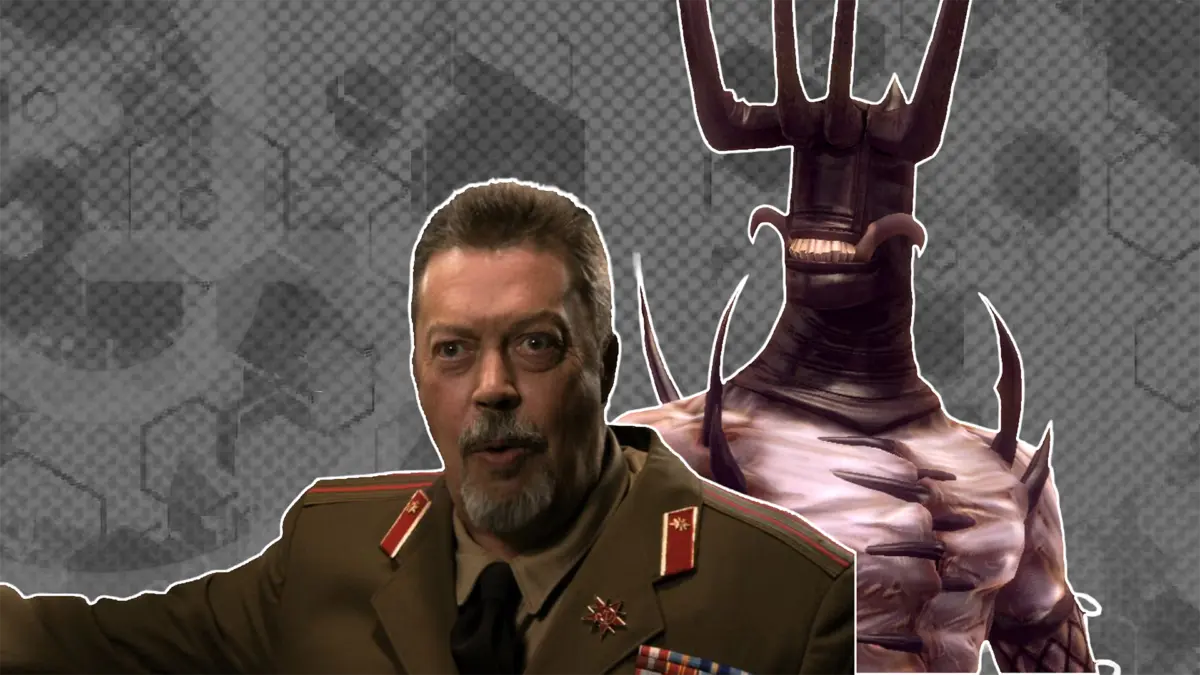
Brütal Legend (2009) – Double Fine Productions: Stepping into the heavy-metal fantasy world crafted by Tim Schafer, Curry voiced Doviculus, the demonic lord of evil. The role allowed Curry to channel his inner Legend and Rocky Horror personas, blending aristocratic arrogance with grotesque physical comedy. Doviculus stands as one of the medium’s most memorable fantasy villains, entirely propped up by Curry’s velvety, menacing vocal delivery.
Dragon Age: Origins (2009) – BioWare: Proving his range extended beyond campy villainy into genuinely menacing political treachery, Curry voiced the central antagonist Erl Howe. In BioWare’s sprawling dark-fantasy role-playing masterpiece, Curry portrayed a cold, calculating, and ruthlessly ambitious noble whose actions kick off devastating conflicts within the kingdom of Ferelden. It would ultimately serve as his final video game performance.
Command & Conquer: Red Alert 3 (2008) – EA Los Angeles: Perhaps his most culturally pervasive video game role, Curry donned heavy Russian military regalia to play Premier Anatoly Cherdenko in Electronic Arts’ real-time strategy titan. Embracing the inherently campy, alternate-history B-movie aesthetic of the Command & Conquer franchise, Curry delivered a live-action performance that transcended the gaming niche to achieve rare, enduring internet immortality.
Supporting Context & Metrics: The Viral Afterlife of Anatoly Cherdenko
While interactive media critics frequently laud Curry for his voice acting depth, it is his live-action FMV (Full Motion Video) work in Command & Conquer: Red Alert 3 that generated an entirely unexpected cultural renaissance decades after its release.
In the late 2010s and early 2020s, a specific cinematic clip from Red Alert 3 colonized social media timelines, TikTok algorithms, and YouTube recommendation feeds. In the scene, Premier Cherdenko realizes his grand plans are falling apart and resolves to escape the impending collapse of his regime. With a straight face and absolute dramatic conviction, Curry looks directly into the camera and delivers the immortal line:
"Space! The one place that hasn’t been corrupted by capitalism!"
As documented extensively by cultural retrospectives—including an in-depth oral history published by Vice in 2022—the clip resonated powerfully with internet audiences navigating economic uncertainty, transforming Cherdenko into an accidental socialist meme icon.
Behind the scenes, the creation of this legendary moment was a masterclass in professional commitment. Red Alert 3 cinematics writer Haris Orkin recounted to Vice the sheer awe he felt watching Curry work on set. According to Orkin, Curry delivered absurd, sci-fi geopolitical dialogue with "such conviction" that everyone on set bought into the reality of the scene.
"He seemed to believe what he was saying, as stupid as it was," Orkin remarked. That ability to elevate subpar or pulp material through sheer force of theatrical will was Curry’s superpower. The fact that this viral phenomenon emerged from an inserted gameplay cinematic rather than a blockbuster Hollywood film speaks volumes about Curry’s enduring pop-cultural magnetism.
Official Statements and Industry Tributes
The gaming industry, alongside broader entertainment guilds, moved quickly to honor the late actor following the announcement of his passing by manager Marcia Hurwitz.
Tim Schafer, founder of Double Fine Productions and director of Brütal Legend, shared heartfelt reflections on working with the legend. Schafer noted that having Curry in the recording booth was an exercise in pure master-level craft:
"Working with Tim Curry on Brütal Legend was a surreal, humbling honor for our entire team. He didn’t just read lines on a page; he stepped up to the microphone and inhabited a universe. He understood the exact frequency of fantasy and rock-and-roll absurdity we were aiming for, and he elevated every single scene he was in with unmatched elegance and bite."
BioWare alumni and strategy developers similarly took to social media to highlight his professionalism. Despite his massive international fame and status as an icon of stage and screen, colleagues consistently remembered Curry as intensely collaborative, deeply respectful of fellow artists, and entirely devoid of the ego that often plagues performers of his caliber.
Future Outlook: A Legacy Carved in Digital Stone
As the video game industry continues to mature—increasingly relying on motion capture, virtual production, and high-end cinematic storytelling—the blueprint left by pioneers like Tim Curry becomes ever more critical. Curry proved that traditional theatrical training is not mutually exclusive with interactive media; rather, it is an essential ingredient for crafting digital characters that resonate across generations.
The stroke Curry suffered in 2012 permanently altered his career path, shifting his public presence primarily toward convention appearances, wheelchair-bound voice cameos, and charity table reads. Yet, the work he completed prior to his health complications ensures that his voice and likeness will continue to delight players for decades to come.
Whether introducing a new generation of fantasy RPG fans to political intrigue as Erl Howe in Dragon Age, terrifying real-time strategy players as Premier Cherdenko, or enchanting adventure game enthusiasts in Gabriel Knight, Tim Curry approached the interactive medium with the exact same passion that defined his legendary runs on Broadway and the silver screen.
The pixels may age, the hardware will inevitably evolve, and gaming technology will march relentlessly forward into uncharted territories—yet the thunderous, theatrical echo of Tim Curry’s voice will permanently reverberate through the digital halls of gaming history.