







Executive Overview
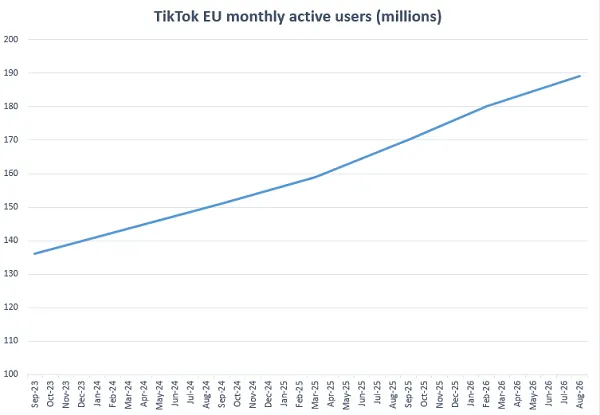
TikTok continues to cement its status as a dominant force in the global social media ecosystem, with its latest regulatory disclosures revealing sustained, robust growth across the European Union. According to the platform’s most recent Digital Services Act (DSA) transparency report, TikTok has officially reached 189 million monthly active users within the EU, adding an impressive 9 million users during the first half of 2026 alone.
This steady upward trajectory demonstrates the short-form video giant’s enduring appeal among European audiences, even as it navigates a complex regulatory environment and significant structural shifts in its operations. Under the stringent mandates of the EU’s Digital Services Act, very large online platforms (VLOPs) are legally required to provide comprehensive, biannual updates detailing user metrics, moderation staffing levels, content violations, and administrative suspensions.
While the new data underscores TikTok’s expanding cultural and economic footprint in Europe, it also sheds light on a fascinating operational paradox: the platform is successfully maintaining momentum and managing massive volumes of content moderation while operating with a significantly leaner human workforce than it did in previous years. By leaning heavily into advanced automated moderation tools, TikTok has managed to drastically trim its physical moderation infrastructure without sacrificing enforcement velocity. This report provides a thorough, investigative examination of TikTok’s latest European disclosures, analyzing user growth trends, content enforcement metrics, the evolution of its moderation workforce, and the broader implications for the future of digital governance.
Detailed Chronology: The Road to 189 Million EU Users
To fully understand TikTok’s current standing in Europe, it is essential to trace the chronological evolution of its user acquisition and regulatory reporting over the past few years. The EU Digital Services Act has served as a vital window into the platform’s internal metrics, stripping away corporate marketing gloss and replacing it with legally binding disclosures.
The Regulatory Catalyst: The EU Digital Services Act
Enacted to create a safer and more accountable digital space, the DSA imposes rigorous transparency obligations on platforms designated as VLOPs—those with an average of 45 million or more active monthly users in the European Union. For TikTok, this means opening its books twice a year to reveal the precise scale of its European audience and the operational machinery required to police it.
Late 2024 to 2025: Reaching Milestones and Shifting Baselines
In the latter half of 2024, TikTok reported a massive wave of engagement across Europe, culminating in a celebratory milestone announcement in September of that year. In a widely publicized corporate blog post, TikTok proudly declared that its vibrant community in Europe had officially topped 200 million monthly active users.
However, official regulatory filings often tell a more nuanced story than promotional press releases. While corporate announcements frequently capture peak traffic or aggregate overlapping metrics across broader geographic definitions (such as the wider European Economic Area or including non-EU European nations), the strict jurisdictional boundaries of the DSA transparency reports offer a more conservative count.
By the close of 2025, TikTok’s reported figures indicated that while growth remained positive, the march toward universal saturation in the EU was meeting the natural friction of market maturity.
The 2026 Data Release: 9 Million New Users in Six Months
TikTok’s August 2026 DSA update revealed that the platform added 9 million net new monthly active users in the first half of the year alone, bringing its official EU total to 189 million.

While this figure sits slightly below the 200-million threshold touted in previous marketing campaigns, it decisively disproves theories that the platform has plateaued in Western markets. Gaining 9 million active users in a six-month window within a heavily regulated, mature economic zone proves that TikTok’s algorithmic recommendation engine and cultural relevance remain remarkably potent. The platform is rapidly closing in on the 200-million mark within strict EU borders, positioning itself neck-and-neck with legacy social media giants like Meta’s Instagram and Facebook in the battle for European attention spans.
Supporting Context & Metrics: Content Moderation, Automation, and Workforce Reductions
Perhaps the most compelling narrative to emerge from TikTok’s 2026 DSA disclosure is not just how many people are using the app, but how the platform is managing the colossal influx of content generated by nearly 190 million Europeans.
The Scale of Content Removal
In the first half of 2026, TikTok reported the removal of approximately 104 million individual uploads that violated its community guidelines and terms of service in the EU. This staggering volume highlights the immense challenge of policing a platform built entirely around rapid, user-generated video creation.
To cope with this relentless flood of content, TikTok has relied heavily on artificial intelligence and automated moderation systems. According to the report, a staggering 94.1% of all violating uploads were removed via automated means—meaning the content was flagged, evaluated, and deleted by algorithms before any human moderator ever laid eyes on it.
The Shrinking Human Workforce Paradox
While automation has undeniably taken the heavy lifting out of content moderation, the sheer scale of modern social media governance still requires human oversight—particularly for complex context, appeals, and nuanced policy enforcement. Yet, a comparative analysis of TikTok’s historical DSA reports reveals a dramatic downsizing of its human moderation staff in Europe.
- October 2024 Baseline: In its transparency report covering the first half of 2024 (released in late 2024), TikTok reported a massive human moderation workforce of 6,354 individuals dedicated to the EU region.
- The Interim Decline: Over subsequent reporting cycles, as artificial intelligence matured and cost-optimization measures took effect across the tech sector, TikTok steadily trimmed this workforce. By the second half of 2025, staffing numbers had plummeted significantly.
- The 2026 Snapshot: In the latest August 2026 report, TikTok noted a minor recalibration, adding an extra 64 human moderators in the EU compared to the previous reporting period. However, the overall picture remains stark: the platform now operates its European moderation apparatus with just 3,738 human members—a reduction of more than 40% compared to its peak staffing levels in 2024.
This dramatic reduction raises critical questions about the viability of safety operations on major social platforms. Critics and digital rights advocates frequently question whether a leaner human workforce—even one backed by sophisticated AI—can adequately handle complex, localized harms, nuanced hate speech, and sophisticated disinformation campaigns across the EU’s diverse linguistic and cultural landscape. Conversely, TikTok’s leadership points to the high accuracy and speed of its automated filters as proof that technological innovation can successfully scale safety operations while improving efficiency.
Official Statements and Regulatory Perspectives
The release of TikTok’s seventh transparency report under the Digital Services Act has triggered widespread discussion among policymakers, digital safety watchdogs, and industry analysts.
European regulators have increasingly positioned the DSA as the gold standard for global tech accountability. Representatives from the European Commission have repeatedly emphasized that transparency reports are not merely administrative checkboxes, but vital diagnostic tools used to evaluate whether platforms are genuinely protecting their users from illegal content, harassment, and systemic risks.
In official statements accompanying the transparency release, TikTok’s European policy leads reiterated the company’s unwavering commitment to compliance with the DSA. A company spokesperson emphasized that TikTok continues to make substantial investments in both technological infrastructure and localized safety teams to ensure a secure environment for its 189 million European users.

"Our priority remains safeguarding our community while fostering creative expression," noted a representative from TikTok’s European public policy division. "The data released in our latest DSA transparency report demonstrates our ongoing dedication to accountability, rigorous enforcement of our community guidelines, and constructive collaboration with European regulators."
Independent civil society organizations and digital watchdogs, however, have adopted a more cautious tone. While acknowledging the value of the granular data provided in the disclosures, groups focused on online safety have called for deeper independent audits of TikTok’s automated moderation pipelines. Concerns persist regarding the transparency of algorithmic decision-making, particularly regarding the potential for over-censorship or the accidental suppression of marginalized viewpoints by automated filters operating without adequate human supervision.
Future Outlook: Challenges and Opportunities on the Horizon
As TikTok looks toward the remainder of 2026 and beyond, its trajectory in Europe will be defined by a delicate balancing act between aggressive user acquisition, algorithmic innovation, and stringent regulatory compliance.
1. Navigating the Approach to the 200-Million Milestone
With 189 million monthly active users firmly in its grasp, TikTok is within striking distance of officially clearing the 200-million active user mark within the strict borders of the EU. Achieving this milestone will not only validate its aggressive market penetration strategies but will also further cement its status as an indispensable cultural and commercial hub for European youth and brands alike. However, sustaining growth in saturated markets will require continuous product evolution, potentially through deeper integration into e-commerce (TikTok Shop), educational content, and professional networking spaces.
2. The Ongoing Evolution of AI vs. Human Moderation
The dramatic reduction of TikTok’s human moderation workforce—from over 6,300 down to roughly 3,700—signals a permanent industry shift toward AI-first content governance. As generative artificial intelligence continues to advance, platforms will increasingly rely on automated models to parse context, audio, and video streams in real-time. The central challenge for TikTok moving forward will be proving to European regulators that its automated systems possess the nuance required to protect free expression while aggressively purging harmful material. Any high-profile moderation failures or regulatory investigations into automated overreach could trigger immediate pressure to re-expand human oversight teams.
3. Global Realities and Geopolitical Pressures
While Europe represents a stable and legally defined growth zone, TikTok’s global footprint remains uniquely fractured. The platform continues to operate under a total ban in India, faces strict operating restrictions in Russia, and remains entirely absent from mainland China (where its sister app, Douyin, operates under distinct domestic frameworks). These geographic limitations place an even heavier strategic emphasis on Western markets like the EU and the United States to drive revenue, user growth, and cultural relevance.
Conclusion
TikTok’s latest EU Digital Services Act disclosure paints a picture of a resilient, highly optimized platform at the height of its powers. By adding 9 million users in just six months and successfully managing over 100 million content violations primarily through advanced automation, TikTok has proven its operational adaptability. Yet, as regulatory scrutiny intensifies and the debate over human versus machine moderation reaches a fever pitch, the platform’s long-term success in Europe will depend not just on how many millions of users it can attract, but on how safely and transparently it can steward its massive digital community.