In a coordinated, highly aggressive legal strike against software preservation and emulation, Nintendo has escalated its ongoing war against unauthorized gaming software. In a single day, the Japanese gaming giant filed seven distinct Digital Millennium Copyright Act (DMCA) anti-circumvention notices with code-hosting platform GitHub, successfully sweeping away more than 400 Nintendo Switch emulator repositories.
The targeted software ecosystem was wide-ranging, encompassing direct copies of the controversial suyu emulator—which rose from the ashes of the defunct Yuzu project—multiple active and dormant Yuzu forks, Android ports, early access builds, and even the independent, long-discontinued Skyline emulator. By leaning heavily on the anti-circumvention provisions of the DMCA, Nintendo has demonstrated its capacity to scrub hundreds of collaborative development nodes from the world’s most popular code-sharing platform virtually overnight.
While Nintendo’s takedown campaign has achieved its immediate goal of rendering these repositories inaccessible, the operation highlights a persistent game of digital whack-a-mole. Because open-source software can be effortlessly cloned, mirrored, and redistributed across decentralized networks before notices are even processed, the elimination of these GitHub nodes is merely a single battle in an ongoing war. Furthermore, legal scholars and digital rights advocates continue to scrutinize the precedents Nintendo relies upon, pointing out that the company’s legal victories have come via settlements and default judgments rather than a formal, merits-tested trial regarding the legality of emulation itself.
Detailed Chronology: The Anatomy of a Single-Day Takedown Blitz
The sweeping action executed earlier this week did not happen in a vacuum; it is the latest chapter in an escalating legal offensive that has systematically dismantled the architecture of Nintendo Switch emulation over the past few years.
The Escalation Path: From Yuzu to Ryujinx and Beyond
The foundational shockwave of this era occurred in February 2024, when Nintendo struck a crippling blow against Tropic Haze, the development group behind the premier Switch emulator, Yuzu. That high-profile lawsuit concluded swiftly with a massive $2.4 million settlement and a consent judgment that effectively handcuffed the core Yuzu team. Not long after, in October 2024, pressure from Nintendo forced the sudden closure of Ryujinx, another titan in the Switch emulation space.
With the primary projects forced into liquidation or voluntary closure, the open-source community did what it has traditionally done: it fragmented. Developers and enthusiasts generated countless forks, successor projects, and independent variations, attempting to keep the dream of hardware-agnostic Switch gaming alive.
The Seven Notices and the 400-Plus Repositories
Recognizing that the hydra was simply growing new heads, Nintendo mobilized its legal counsel to execute a multi-pronged strike on GitHub. In a single 24-hour window, the company issued seven distinct DMCA notices targeting the epicenter of these derivative projects.
The suyu Network (vstyler96/suyu): As the most detailed notice of the batch, this filing targeted the successor to Yuzu. Because the connected network exceeded 100 repositories, GitHub automatically processed the claim against the entire interconnected web, sweeping away 311 individual repos in one fell swoop.
The Skyline Network (skyline-emu/skyline): Demonstrating that even dormant projects are not safe, Nintendo targeted this independent Android-based Switch emulator. Despite shutting down voluntarily years prior, its entire network of 29 repositories was wiped out.
Yuzu Forks and Ports: Additional notices targeted various iterations, including NicolasArvani’s Yuzu fork (14 repositories), liushuyu/yuzu-android (8 repositories), exverge-0/yuzu-EA4176 (21 forks listed), irlbunny-archive/MonoNX (17 forks listed), and IpwnedU/yuzu-master (targeting the parent repository and select forks).
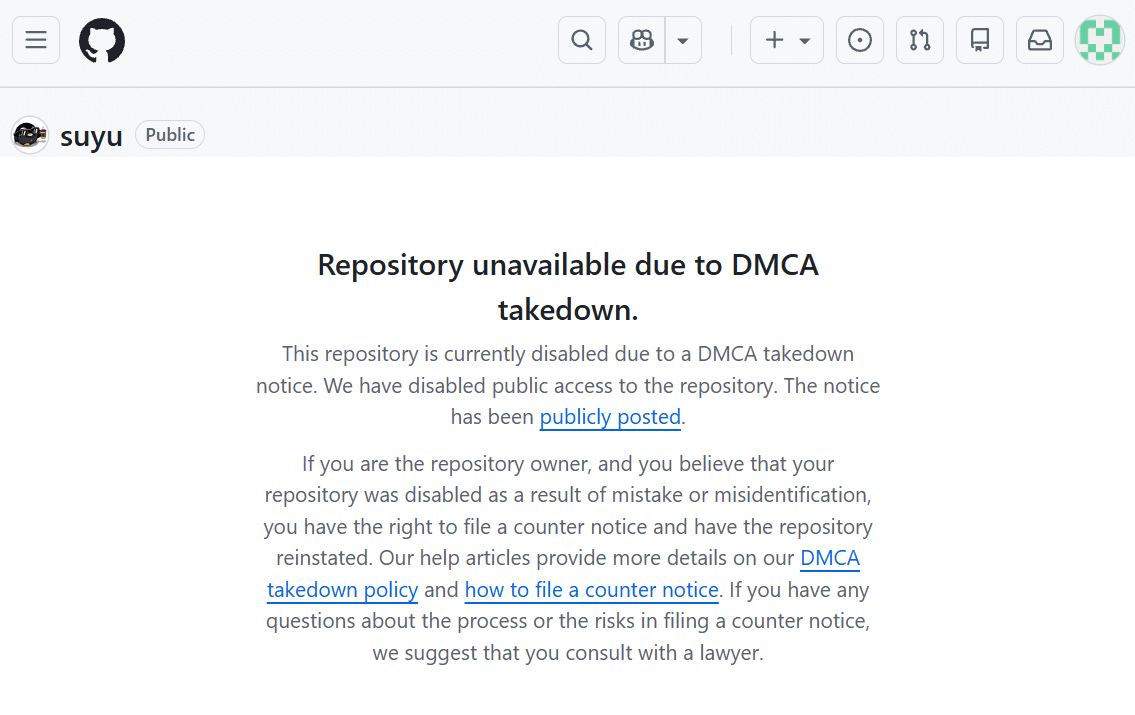
For the vast majority of these projects, visiting the once-active URLs now yields standard GitHub notices indicating that the repository has been disabled following a legal complaint, or returning 400-series errors where developers chose to proactively delete their code to avoid further legal entanglement.
Supporting Context & Metrics: The Mechanics of DMCA Anti-Circumvention
To understand the severity and effectiveness of Nintendo’s latest campaign, one must examine the specific legal mechanisms being deployed and the technical realities of modern code distribution.
The Legal Argument: Circumvention of Cryptographic Keys
Unlike traditional copyright infringement claims—which argue that unauthorized copies of copyrighted works are being distributed—Nintendo’s recent filings rely strictly on Section 1201 of the DMCA (Anti-Circumvention).
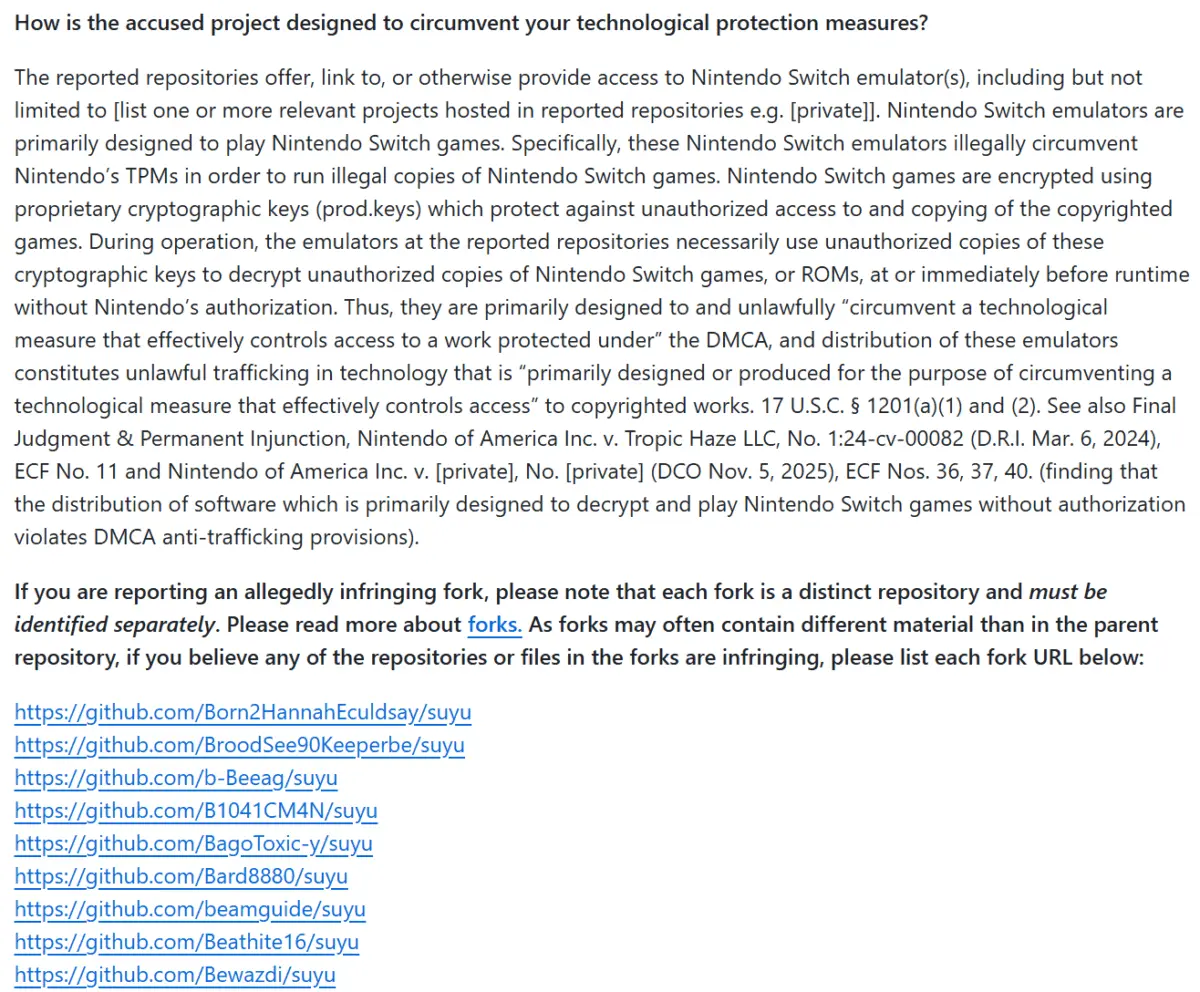
In its notices, Nintendo argues that the emulators do not merely replicate console hardware; rather, their core functionality relies on breaking the encryption barriers erected by the manufacturer. The text of the notices explicitly states:
"During operation, the emulators at the reported repositories necessarily use unauthorized copies of these cryptographic keys to decrypt unauthorized copies of Nintendo Switch games, or ROMs, at or immediately before runtime without Nintendo’s authorization."
By framing the emulation software as a tool designed primarily to bypass cryptographic access controls, Nintendo bypasses traditional fair-use defenses that have historically protected software emulation in landmark legal battles, such as the historic Sony Computer Entertainment, Inc. v. Connectix Corp. case from the turn of the millennium.
Metrics of the Takedown Sweep
Parent Repository & Notice ID
Project Description
Scope of Action
vstyler96/suyu
suyu (Yuzu successor)
311 repositories (Full network processed)
skyline-emu/skyline
Skyline (Android, independent)
29 repositories (Full network processed)
NicolasArvani/yuzu
Yuzu fork
14 repositories (Full network processed)
liushuyu/yuzu-android
Yuzu Android port
8 repositories (Full network processed)
exverge-0/yuzu-EA4176
Yuzu Early Access Build 4176
21 forks explicitly listed
irlbunny-archive/MonoNX
MonoNX (C#-based emulator)
17 forks explicitly listed
IpwnedU/yuzu-master
Yuzu fork
Parent repository and active derivatives
Precedents Built Without a Full Trial
A noteworthy aspect of Nintendo’s legal strategy is the reliance on judicial precedents that were never actually tested through a rigorous, adversarial trial on the merits of software emulation.
Every notice filed by the company cites two primary legal anchors:
The Tropic Haze/Yuzu Settlement (2024): Resulting in a $2.4 million consent judgment, this case was resolved via a settlement agreement rather than a judicial ruling after a trial.
The "EveryGameGuru" Default Judgment (October 2024): A Colorado court ordered streamer Jesse Keighin to pay $17,500 after he failed to respond to the lawsuit and allegedly destroyed evidence, leading to a default judgment.
Because neither case involved a court weighing the complex nuances of whether clean-room reverse-engineered emulators inherently violate anti-circumvention laws, legal scholars argue that Nintendo is building an empire of administrative precedent through settlements and defaults rather than establishing binding constitutional or statutory case law.
Official Statements and Platform Policies
GitHub occupies a delicate position in these high-stakes intellectual property disputes. As home to hundreds of millions of code repositories, the platform must balance developers’ rights to open-source collaboration against the aggressive demands of deep-pocketed rightsholders.
GitHub’s Review Process
According to platform transparency disclosures, GitHub reviews anti-circumvention claims with heightened scrutiny. Company representatives have previously noted that when the validity of a complex technical claim is unclear, the platform attempts to err on the side of the developer, leaving content online. However, the weight of Nintendo’s mounting legal victories—culminating in the Yuzu and Ryujinx capitulations—has effectively normalized these notices, transforming what might once have been contested administrative reviews into routine takedowns.
When asked about the latest batch of seven notices, platform moderators confirmed that the networks exceeding 100 repositories triggered automated network-wide sweeps, ensuring that downstream forks and derivative codebases were systematically purged alongside the parent repositories. For smaller repositories, individual notices explicitly targeted named or redacted ([private]) accounts, prompting swift compliance from code maintainers.
Future Outlook: The Endless Cycle of Open-Source Preservation
As the dust settles on this latest multi-hundred repository deletion, industry observers are left asking a fundamental question: Is Nintendo’s strategy a permanent solution, or merely a temporary containment measure?
The Hydra Effect of Open Source
The core philosophy of open-source software is resilience through distribution. Unlike proprietary software controlled by a single corporate entity, source code that has already been published to the internet can rarely be completely erased.
Mirrors and Decentralized Hosts: Long before Nintendo’s latest notices landed on GitHub, developers and archival groups had already begun backing up repositories to decentralized networks, independent Git instances, and peer-to-peer torrent archives.
The Skyline Paradox: The targeting of Skyline illustrates the futility of chasing ghost projects. Even though the original developers walked away from the Android emulator in 2023, the code possessed a life of its own. Scrubbing its forks from GitHub stops mainstream distribution on a major platform, but it does nothing to prevent sophisticated users from pulling the code from alternative repositories or private backups.
What Lies Ahead
For Nintendo, securing the removal of emulator repositories from GitHub is the path of least resistance—a streamlined administrative process that instantly neutralizes the most accessible avenues for casual pirates and enthusiasts. However, keeping the code permanently offline is an entirely different battle.
As long as consumer demand for hardware flexibility and digital preservation remains high, developers will continue to experiment with reverse engineering, and forks will inevitably reappear faster than legal teams can draft notices. Nintendo has undoubtedly won the battle for GitHub, but the war for the future of software emulation and digital preservation is far from over.