Executive Overview
The global robotics landscape is undergoing its most profound structural realignment in decades. Driven by escalating geopolitical tensions, heightened national security concerns, and a sweeping wave of protectionist federal legislation, the United States is rapidly decoupling its automation supply chains from foreign dominance. At the epicenter of this seismic shift is the transformation of RoboStore into Robo Inc.—a homegrown manufacturing enterprise racing to fill the multi-billion-dollar vacuum left by federal bans on imported robotic hardware.
For years, the domestic robotics market relied heavily on imported consumer and commercial hardware, ranging from ubiquitous household vacuum cleaners to advanced quadrupedal robot dogs and humanoid platforms manufactured overseas. However, a rapid sequence of legislative maneuvers in Washington—culminating in a landmark Federal Communications Commission (FCC) ban—has upended the status quo. Overnight, foreign-made robotics were barred from entering the U.S. market, forcing importers, distributors, and technology startups to either adapt or perish.
Rather than folding, the leadership team behind RoboStore accelerated an ambitious pivot. Abandoning its legacy distribution model, the company shuttered its import operations to concentrate entirely on domestic research, development, and advanced manufacturing. Now operating under the banner of Robo Inc., the team is leveraging years of deep market insight to engineer a suite of compliant, domestically produced robotic solutions. Targeting critical verticals such as healthcare, security, education, and research, Robo Inc. is poised to launch commercial production from a dedicated U.S. facility by early 2027.
This comprehensive report examines the regulatory catalysts that forced this corporate metamorphosis, the strategic roadmap underpinning Robo Inc.’s domestic manufacturing push, and the broader economic implications for a U.S. robotics industry standing at the precipice of a new era.
Detailed Chronology: From Import Distribution to Domestic Manufacturing
The rapid evolution of Robo Inc. is a textbook study in corporate agility under extreme regulatory pressure. To understand how the company arrived at its current manufacturing trajectory, one must trace the timeline of legislative and executive interventions that fundamentally reshaped the U.S. technology landscape throughout 2026.
Early 2026: Legislative Warning Shots
The writing had been on the wall for import-reliant distributors for some time, but the warning signs solidified into concrete legislative threats in the early months of 2026. Recognizing growing vulnerabilities in domestic critical infrastructure and consumer data privacy, U.S. lawmakers introduced a series of targeted bills designed to restrict or outright ban foreign-made robotics.
In March 2026, a bipartisan group of senators introduced the American Security Robotics Act (House Bill 8189). The legislation sought to prohibit federal agencies from procuring autonomous systems and robotic platforms from adversarial nations, citing severe risks related to data harvesting, remote override capabilities, and embedded cyber-espionage vectors. While initial drafts focused primarily on government procurement, industry insiders immediately recognized that commercial supply chains would soon face similar scrutiny.
Just three months later, in June 2026, the legislative pressure intensified with the introduction of the GUARD Act (House Bill 9129) in the House of Representatives. This broader bill aimed to restrict the deployment of foreign-connected robotics across critical civil infrastructure sectors, including logistics hubs, healthcare facilities, and educational institutions. The introduction of the GUARD Act signaled to businesses like RoboStore that operating a purely import-based distribution model was rapidly becoming an untenable business risk.
July 2026: The FCC Drops the Hammer
The most dramatic turning point arrived mid-summer. In July 2026, the U.S. Federal Communications Commission (FCC) issued a sweeping ruling that permanently altered the commercial robotics ecosystem: the agency banned the imports of new models of foreign-made robots.
The ban sent shockwaves through the consumer and commercial technology sectors. It targeted a massive swath of popular hardware, including ubiquitous robot vacuum cleaners equipped with mapping cameras, as well as advanced industrial and research platforms—such as the highly popular humanoid robots and robot dogs produced by firms like Unitree.
While the FCC justified the ruling strictly along national security lines, emphasizing unmitigated cybersecurity vulnerabilities and potential data leakage, the economic subtext was unmistakable. The policy was deliberately engineered to force supply chain decoupling and incentivize domestic corporations to build robust manufacturing infrastructure within the United States.
The Immediate Pivot: Shutting Down Distribution
Long before the FCC ruling took full effect, the leadership team at RoboStore had anticipated the writing on the wall. Recognizing that their traditional business model of importing and reselling foreign hardware was on borrowed time, executives initiated an aggressive pivot.
RoboStore made the difficult decision to systematically shut down its distribution business. However, rather than liquidating entirely, the company preserved its core competencies, customer relationships, and capital reserves to fulfill ethical and contractual obligations. The firm explicitly promised to continue supporting existing customers who relied on legacy foreign models, ensuring a steady supply of replacement parts, authorized repair services, and software upgrades for robots already deployed in the field.
With the distribution arm effectively wound down, all internal energy, capital, and engineering talent shifted toward a singular, highly ambitious objective: designing proprietary, U.S.-compliant commercial robots and building out a domestic manufacturing ecosystem from the ground up.
Supporting Context & Metrics: The Decoupling of Tech Supply Chains
The transformation of Robo Inc. does not occur in a vacuum; it is part of a broader macroeconomic decoupling trend that mirrors the semiconductor manufacturing shifts of the early 2020s. For decades, globalized supply chains favored cost efficiency over national resilience, leading to an over-reliance on overseas factories for high-tech components.
The National Security Imperative
Modern autonomous systems are essentially computers on wheels or legs, packed with high-resolution LiDAR, optical cameras, depth sensors, and sophisticated navigation algorithms. They continuously map physical environments, collect terabytes of sensitive spatial data, and connect seamlessly to cloud infrastructure.
From the perspective of U.S. national security agencies, permitting widespread deployment of foreign-made robotic hardware in sensitive environments—ranging from university research labs to hospital rooms and corporate logistics centers—presented an unacceptable risk. Regulators argued that foreign firmware updates or hidden backdoors could allow adversarial actors to compromise physical security, siphon proprietary data, or remotely disable critical domestic infrastructure.
The Economic Opportunity for Domestic Manufacturing
While national security served as the primary legislative justification, the regulatory squeeze created a massive commercial vacuum. The sudden disappearance of new foreign-made robotics left thousands of universities, healthcare providers, and security firms scrambling for alternatives.
- The Educational Void: Academic institutions, which had grown accustomed to utilizing affordable foreign-made robotic arms and quadrupedal platforms for engineering research, suddenly found themselves legally barred from purchasing new iterations of their standard lab equipment.
- The Commercial Deficit: Commercial enterprises seeking automated concierge services, hospital logistics support, and automated perimeter security were left with virtually no domestic alternatives ready for mass deployment.
This market imbalance transformed Robo Inc.’s strategic pivot from a high-risk gamble into an urgent commercial necessity. By stepping into the breach with a commitment to domestic manufacturing, the company positioned itself to capture pent-up demand in a newly protected domestic market.
Official Statements and Strategic Vision
At the helm of this corporate evolution is a leadership team determined to turn regulatory adversity into a competitive advantage. In recent interviews, executives have shed light on the strategic thinking driving Robo Inc.’s product development and fundraising efforts.
Reflecting on the motivations behind the rapid transition, leadership emphasized the unique position the company holds within the educational and commercial sectors. Operating under the new banner of Robo Inc., the engineering team has bypassed years of exploratory market research by leaning directly on the deep customer relationships forged during their days as a leading distributor.
"Universities are looking for a US-compliant product," explained Haggerty during a recent strategy briefing. "So we’ve taken everything we’ve learned from being easily the largest distribution channel for education for robotics."
This intimate familiarity with end-user requirements has allowed Robo Inc. to bypass the guesswork that typically plagues hardware startups. By maintaining an open dialogue with academic researchers, healthcare administrators, and security professionals throughout the regulatory crackdown, the company tailored its initial product lineup to hit exact market pain points.
Furthermore, Haggerty highlighted how the sudden regulatory shift has fundamentally changed the conversation with prospective financial backers. Having spent years operating as a strictly bootstrapped business—relying entirely on organic revenue without outside institutional capital—Robo Inc. is now preparing to execute its first major funding round.
The market response has been overwhelmingly positive.
"We’ve reached out to all these customers, and we have an incredible interest now as we’re going through the process of raising money," Haggerty noted. "It definitely helps, 100 percent."
The Product Pipeline: Working Toward Commercial Robotics
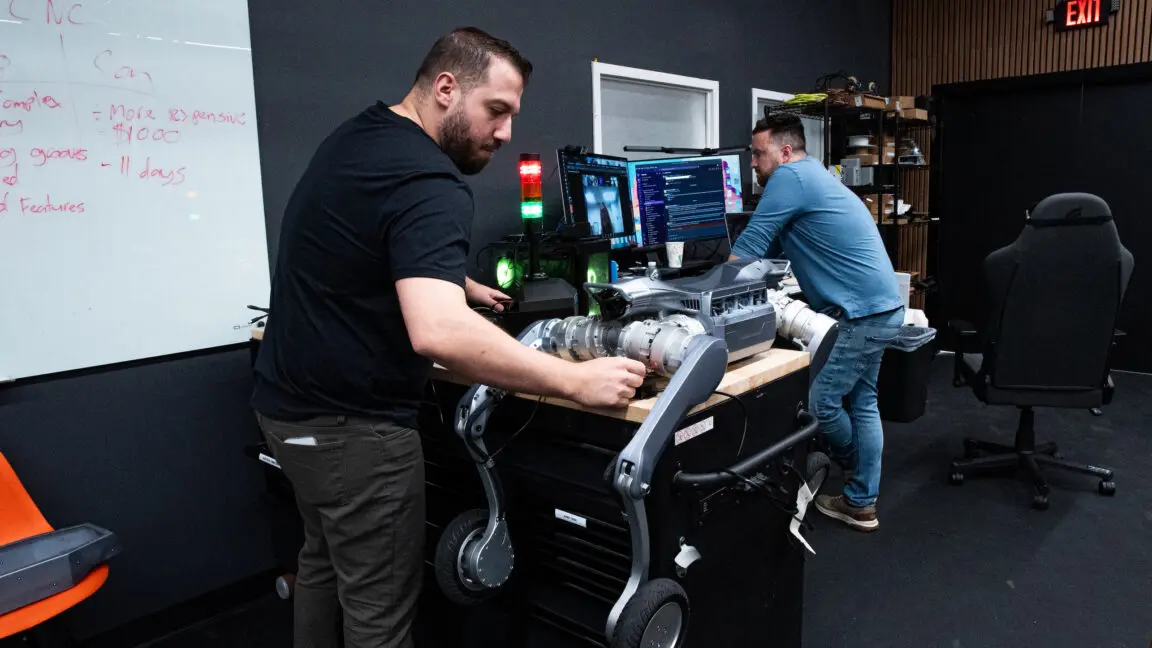
Operating under the newly minted Robo Inc. corporate identity, the engineering team has rapidly transitioned from concept art to physical prototyping. Leveraging advanced rapid-prototyping techniques—including industrial-grade 3D printing—the company has already developed working prototypes of several specialized robotic platforms, which are currently undergoing rigorous beta testing with select enterprise customers.
The initial commercial product lineup has been carefully curated to serve high-demand, high-compliance sectors where foreign alternatives have been entirely locked out:
1. Healthcare and Concierge Humanoid Platforms
Designed specifically for hospital environments, assisted living facilities, and high-end hospitality settings, Robo Inc.’s flagship healthcare robot features a sophisticated humanoid torso mounted on an agile, wheeled chassis.
- Core Capabilities: Equipped with advanced medical-grade optical sensors and thermal cameras, the robot is engineered to assist nursing staff by non-invasively capturing standard patient vital signs, including body temperature and blood oxygen saturation levels.
- Operational Value: By offloading routine data collection and patient check-ins from overworked medical staff, the platform aims to alleviate ongoing labor shortages in the healthcare sector while ensuring strict compliance with domestic health data privacy standards.
2. Specialized Quadrupeds for Security Applications
Recognizing the growing demand for autonomous perimeter monitoring, Robo Inc. has developed a ruggedized quadrupedal robot tailored specifically for industrial security and asset protection. Unlike consumer-grade robot dogs, this enterprise platform is built to withstand harsh weather conditions, navigate complex terrain, and integrate seamlessly with existing U.S.-compliant surveillance and access-control architectures.
3. Educational and Research Humanoid Platforms
Drawing directly on its heritage as a premier distributor for academic robotics, Robo Inc. is launching a versatile humanoid research platform built specifically for university engineering departments and AI research laboratories.
- Compliance Assurance: Because academic institutions are heavily restricted from utilizing foreign-made platforms that lack transparent source code or fail to meet federal cybersecurity standards, Robo Inc.’s fully domestic supply chain provides a welcome sanctuary for researchers.
- Flexibility: The platform is designed to be modular and programmable, allowing computer science and robotics students to test machine learning algorithms, computer vision models, and physical manipulation routines in a secure environment.
Future Outlook: Challenges and Roadmap to 2027
As Robo Inc. looks toward the horizon, the path forward is characterized by immense opportunity tempered by the harsh operational realities of hardware manufacturing.
Overcoming Manufacturing and Scaling Hurdles
Transitioning from a distribution model to an original equipment manufacturer (OEM) is notoriously difficult. Building physical robots requires complex supply chain orchestration, stringent quality control protocols, and substantial capital expenditure.
However, Robo Inc.’s proactive use of 3D printing for rapid prototyping has significantly compressed their design cycle, allowing engineers to iterate on mechanical assemblies and sensor mountings in days rather than months. The company remains on track to finalize its dedicated manufacturing facility, with commercial-grade production lines scheduled to roar to life by early 2027.
The Upcoming Funding Milestone
To successfully scale manufacturing capacity and meet surging customer demand, Robo Inc. is preparing to close its inaugural institutional funding round. Having proven its resilience and market viability as a bootstrapped entity, the company is now attracting significant attention from venture capital firms eager to invest in the burgeoning domestic hardware renaissance.
Conclusion: A New Dawn for American Robotics
The regulatory crackdown of 2026 served as a brutal stress test for the U.S. robotics industry. While many import-dependent businesses shuttered their doors permanently, forward-thinking enterprises like Robo Inc. recognized the mandate for change and seized the moment.
By pivoting decisively from distribution to domestic manufacturing, Robo Inc. is not merely surviving the regulatory storm—it is helping to build the foundational architecture of America’s autonomous future. With compliant products slated for commercial delivery by early 2027 and strong financial backing on the horizon, Robo Inc. stands as a prime example of how American enterprise can adapt, innovate, and conquer in an era of technological decoupling.