Executive Overview
In the summer of 2026, enterprise software developer Atlassian faced an existential wall of skepticism. Wall Street’s prevailing narrative—the ultimate bear case for traditional productivity tools—was deceptively simple: If autonomous artificial intelligence agents are writing code, filing tickets, and automatically orchestrating project workflows, where is the room left for the administrative systems of record that track the work?
As July rolled on, Atlassian stock languished near $84 per share, battered by macroeconomic jitters and an industry-wide panic over whether generative AI would disintermediate standard B2B SaaS platforms.
Then came the fourth-quarter and full-year fiscal results on August 6.
The report didn’t just beat consensus estimates; it systematically dismantled the prevailing industry panic. Atlassian posted a staggering 28% jump in total revenue to $1.766 billion, while cloud revenue accelerated to 31% growth, hitting $1.213 billion. Subscription Annual Recurring Revenue (ARR) surged to $6.6 billion, and Remaining Performance Obligations (RPO)—a crucial indicator of future contracted revenue—skyrocketed by 44% to $4.8 billion.
On the bottom line, the software titan posted a GAAP operating income of $211 million, completely reversing a $28 million loss from the same period a year prior.
The market response was immediate and historic. Atlassian shares closed at $110.17 on August 6 before rocketing as high as $146 the following morning—representing an explosive 35% single-day move. For a 25-year-old enterprise incumbent sitting at $6.6 billion in ARR, growth accelerating upward rather than decaying is a near-mythical financial anomaly.
Beyond the jaw-dropping headline numbers, Atlassian’s performance offers a masterclass in how legacy software giants can successfully absorb, weaponize, and survive the structural upheaval of the agentic AI era.
Detailed Chronology: The Reversal from Panic to Dominance
To fully understand Atlassian’s meteoric rise in August 2026, one must examine the macroeconomic trajectory that preceded it.
The Early-Summer Pessimism
Throughout May and June 2026, enterprise tech analysts argued that generative AI code-generation agents and autonomous project managers would render standard issue-tracking software obsolete. Software development was shifting from human-driven code commits and manual Jira ticket updates to machine-to-machine pipelines. Investors panicked, assuming that seat-based licensing models—the lifeblood of Atlassian’s business model—were heading toward a cliff. By early July, this sentiment dragged the stock down to the $84 range.
The August 6 Print
When Atlassian reported its fiscal year-end numbers on August 6, it revealed that user activity was not contracting; it was scaling horizontally and vertically. Cloud revenue growth had accelerated from 28% for the full fiscal year to 31% in the final quarter. At a multi-billion-dollar scale, accelerating top-line momentum defied standard software decay curves.
Furthermore, the company’s GAAP profitability swung violently into the black. Operating margins expanded, and cash metrics stabilized, proving that Atlassian could fund aggressive AI development without imploding its cost structure.
The Market Shockwave
The ensuing 35% single-day valuation correction underscored a glaring miscalculation by Wall Street: the market had dramatically over-discounted the "system of work" software category. Institutional investors realized that rather than replacing Jira, Confluence, and Trello, AI agents actually require these centralized hubs to function efficiently. Without an authoritative source of organizational truth, AI agents operate in a vacuum. Atlassian provided that foundational data layer, and the market rushed to reprice the stock accordingly.
Supporting Context & Metrics: Unpacking the Financial Engine
A closer inspection of Atlassian’s financial disclosures reveals several critical dynamics regarding cash flow, deferred revenue, and AI infrastructure costs.
RPO vs. Deferred Revenue: The Multi-Year Enterprise Shift
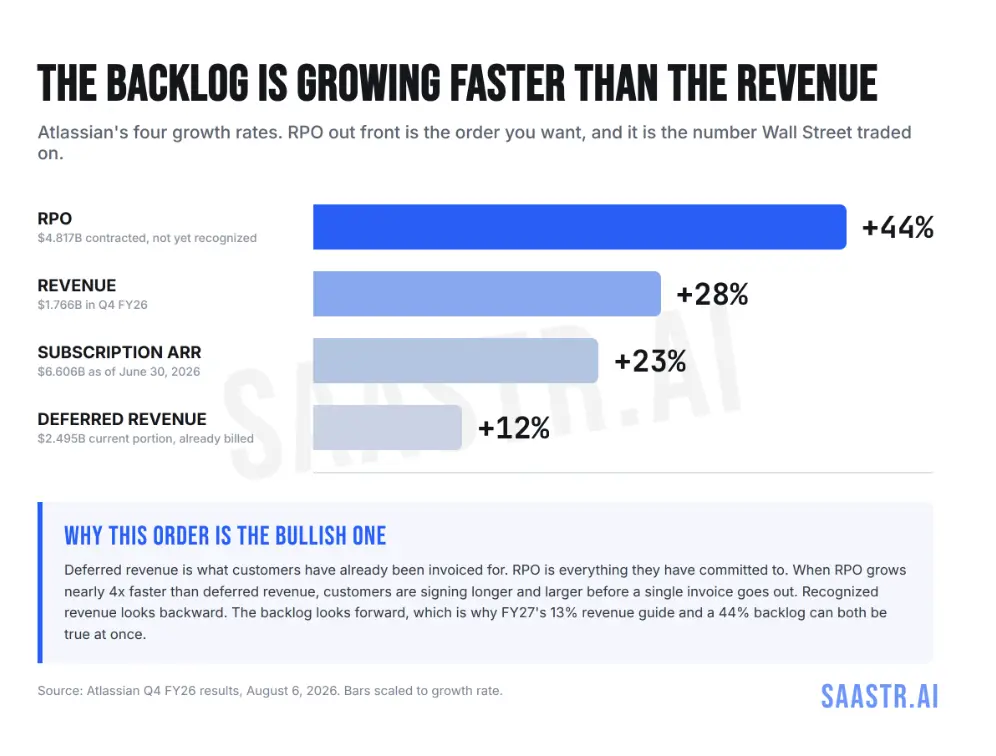
One of the most profound metrics in the report was the 44% surge in Remaining Performance Obligations (RPO), which reached $4.817 billion. This vastly outperformed the 28% revenue growth and 23% Subscription ARR growth rates.
To decode this divergence:
- Deferred Revenue represents invoices already billed to customers. It grew by a modest 12%.
- RPO encompasses total contracted commitments, both billed and unbilled.
An RPO growth rate nearly four times faster than deferred revenue signals a massive pivot toward long-term, multi-year enterprise contracts. Large-scale organizations are locking into extensive, enterprise-wide agreements ahead of billing cycles. When subtracting deferred revenue, the unbilled portion of RPO sits at roughly $2.2 billion—more than double the prior year’s figure.
This explains how Atlassian can issue a conservative FY27 revenue growth guide of 13% while simultaneously boasting a 44% backlog expansion. Public market investors are increasingly relying on RPO as the true north star for software health, looking past historical revenue figures that are weighed down by legacy Data Center contractions.
Cash Generation and Accounts Receivable
While RPO surged, Free Cash Flow (FCF) experienced a slight downward tick, falling 7% to $1.319 billion (representing a 20% FCF margin compared to 27% previously). This contraction correlates directly with a 63% explosion in accounts receivable, which hit $1.270 billion—nearly 2.5 times the rate of revenue growth.
This is the financial reality of moving up-market. Self-serve, SMB customers pay instantaneously via credit card, realizing immediate cash flow. Enterprise clients—such as global financial institutions—negotiate complex payment terms, often paying in arrears over 60 days on multi-year paper contracts, temporarily stretching cash conversion cycles while dramatically expanding contract value.

The Margin Reality: AI Cost Pre-Dates AI Revenue
Atlassian’s strategic decision regarding artificial intelligence monetization closely mirrors industry-wide challenges seen elsewhere in enterprise tech, such as Figma’s Q2 financial disclosures.
Atlassian opted to bundle its advanced agentic capabilities—including the orchestration of third-party coding agents like Claude Code, Cursor, and GitHub Copilot—directly into paid Jira Cloud tiers at no additional charge. Its proprietary AI assistant, Rovo, is now utilized by over 80% of the Fortune 500, with Rovo-assisted actions surging 50% quarter-over-quarter.
However, this generosity comes with a margin trade-off. Atlassian guided away 11 points of operating margin for the upcoming fiscal year to fund AI infrastructure, while non-GAAP gross margins are projected to trim from 88% down to 86.5%.
This highlights a universal truth for modern software companies: The infrastructural cost of AI inference lands on the profit and loss statement one to four quarters before the corresponding AI revenue materializes.
Figma faced a similar market reaction regarding its gross margin compression due to heavy inference costs on unmonetized beta products. Atlassian navigated this tension masterfully by shifting customers into higher-tier collections featuring 10x the Rovo credits, ultimately betting that stickier seats and collection upgrades will far outweigh raw API consumption costs.
Official Statements and Strategic Insights
Atlassian’s executive leadership team offered critical clarity during the earnings call regarding their enterprise go-to-market strategy and the unique defensive moat embedded in their data architecture.
Conquering the Fortune 500
A staggering statistic highlighted in the report is that 85% of the Fortune 500 utilizes Atlassian products, yet those same accounts account for roughly roughly 10% of total revenue.
For 25 years, Atlassian scaled via a bottoms-up, viral developer adoption model. The software found its way into virtually every major enterprise organically, but corporate monetization remained shockingly low. To bridge this gap, Atlassian executed a massive pivot toward an enterprise sales motion. Sales and marketing spend jumped 36% in FY26—surpassing the 26% revenue growth rate.
“Bottoms-up adoption is not monetization,” industry analysts note. “If your product is embedded in most of your target accounts and your Average Contract Values (ACVs) remain in the low four figures, the gap is structural. Closing it requires investing in the expensive, enterprise-grade sales motion you spent years avoiding.”
Atlassian capitalized on a quarter-century of free land acquisition. The corporate focus has officially shifted from land to expand.
The Power of the Teamwork Graph and MCP Server
Perhaps the most telling technological milestone in the report was the explosive growth of Atlassian’s Model Context Protocol (MCP) server and Teamwork Graph CLI. Crossing 1 million monthly active users after doubling in a single quarter, it represents the fastest-growing integration surface in the company’s history.
Management emphasized a vital thesis: The fastest-growing product surface is an interface that allows users to access Atlassian data without ever opening Atlassian.
The proprietary Teamwork Graph spans over 200 billion distinct objects and relationships. Co-founder and CEO Mike Cannon-Brookes noted that context is the ultimate competitive moat in the generative AI era. AI agents grounded in the Teamwork Graph deliver up to 44% more accurate answers while consuming 48% fewer tokens.
An application’s user interface (UI) can easily be disrupted or bypassed by conversational AI chat wrappers; however, a decade’s worth of institutional history, engineering dependencies, corporate decisions, and workflow relationships cannot be easily replicated. This is the ultimate defensive architecture for an incumbent SaaS platform.
Future Outlook: FY27 and the Road Ahead
As Atlassian looks toward fiscal year 2027, the forward guidance outlines a calculated balancing act:
- Total Revenue Growth: Guided at approximately 13%.
- Subscription ARR Growth: Projected at 18%.
- Cloud Growth: Expected to moderate to roughly 25.5%.
- Data Center Revenue: Projected to decline by 17% as legacy deployments wind down.
Management framed this guidance as prudent, adhering to a historical pattern of conservative forecasting amidst uncertain macroeconomic headwinds.
The central question for the upcoming fiscal year is whether massive unmonetized AI engagement—reflected in soaring Rovo adoption, heavy MCP utilization, and record Teamwork Graph queries—will successfully convert into high-margin ARR. Atlassian is betting that consumption will naturally drive collection upgrades, and that net expansion will comfortably outpace the runoff of legacy Data Center revenue, even while absorbing heavy near-term AI infrastructure expenses.
Key Takeaways for B2B Founders and Operators
Atlassian’s Q4 masterclass provides a definitive playbook for navigating technological disruption:
- Context is King: Software interfaces are commoditized by AI, but proprietary data graphs and institutional context are irreplaceable. Build the graph underneath the UI.
- Absorb Costs to Protect Moats: Do not be afraid to bundle AI capabilities if it drives seat retention and forces customers into higher-tier enterprise packaging.
- Bridge the Enterprise Gap: Viral adoption is only the first step. Unlocking the true monetization potential of Fortune 500 accounts requires building an intentional, aggressive enterprise sales motion.
If Atlassian’s strategy proves successful, its mid-summer stock crash and subsequent record-shattering recovery will be remembered as the defining moment legacy software successfully weaponized artificial intelligence against the disruptors.