Executive Overview
In the fast-paced ecosystem of artificial intelligence, a dangerous and expensive consensus has quietly taken hold: to build world-class, enterprise-grade AI software, a company must continuously upgrade to the largest, most expensive foundation models on the market. For software executives, venture capitalists, and B2B founders, the default operational mode has been to chase the latest marquee releases from major AI labs, accepting steep cost premiums under the assumption that greater expense invariably equates to superior production quality.
A groundbreaking corporate disclosure has just shattered that assumption.
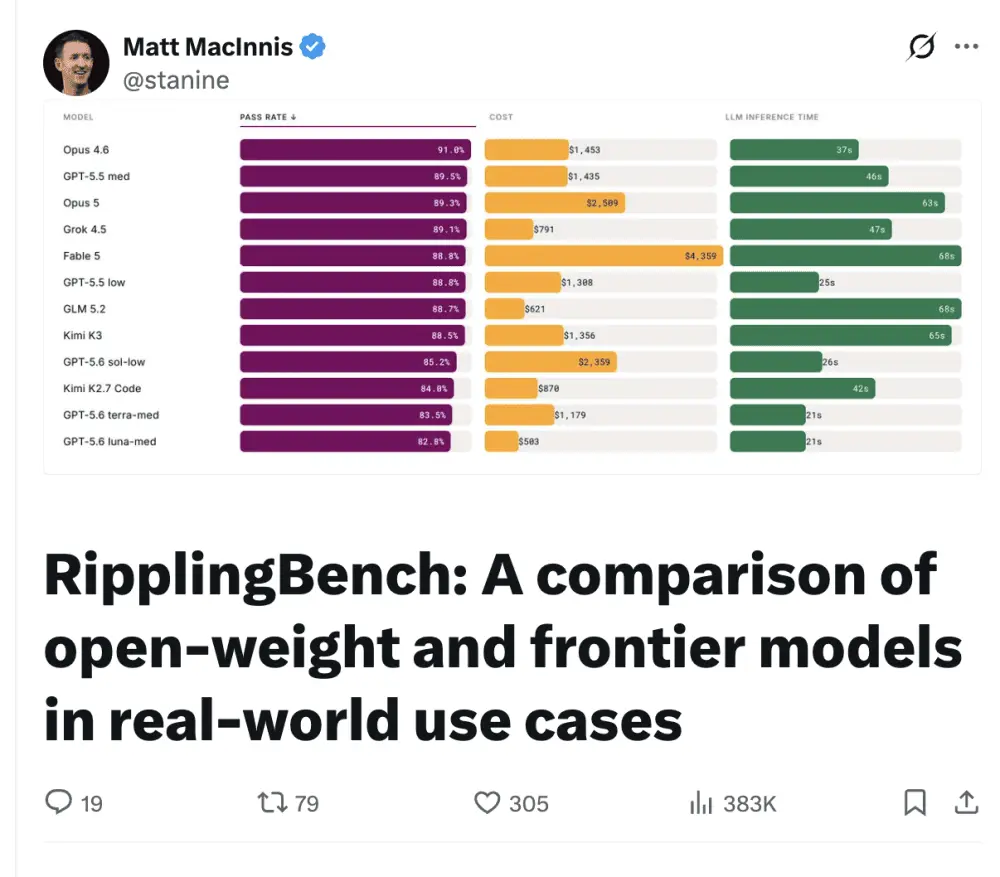
Matt MacInnis, President and Chief Product Officer of workforce management giant Rippling, recently published the results of an exhaustive, real-world stress test. Rather than relying on sanitized, theoretical leaderboards or abstract public benchmarks, Rippling subjected 15 leading AI models to roughly 2,100 graded attempts each inside an actual production environment. The tasks were not trivial prompts; they involved live personnel, payroll, and financial records. The models were tasked with complex queries—such as analyzing departmental headcount and tenure distribution—and high-stakes operational workflows, including executing 10% base salary adjustments for qualifying employees, onboarding new hires via multi-step checklists, routing termination approvals, and processing payroll values directly from spreadsheets.
The findings are sending shockwaves through the B2B SaaS community. The study revealed that performance at the cutting edge of AI has functionally flattened: a cluster of top-tier models scored within a razor-thin 2.5-point accuracy spread (ranging from 88.5% to the 91.0% ceiling). Crucially, the cheapest models in the study frequently tied or outright outperformed models costing three to seven times as much. Furthermore, the data dismantled the myth that newer model versions automatically deliver better performance, exposing hidden productivity traps, critical verification failures, and the reality that model optimization is fundamentally a margin decision rather than a pure engineering problem.
Detailed Chronology: Inside Rippling’s Production Testing Ground
To understand the weight of Rippling’s disclosure, one must examine how the test was structured. Standard industry benchmarks—such as MMLU or HumanEval—are prone to data contamination, reward superficial patterns, and bear little resemblance to the chaotic, context-heavy realities of enterprise software.
Rippling bypassed these synthetic metrics entirely. Over several months, the engineering team pitted 15 models against authentic operational workflows pulled straight from production systems. Every single trial was subjected to rigorous, binary production correctness checks: an attempt either passed completely or it failed. Crucially, if a model timed out or failed to complete the execution graph, it was marked down as an outright failure. This binary grading rubric is significantly stricter than the partial-credit or heuristic evaluation methods common in academic labs.
The Baseline Configuration and Tuning Factor
A vital variable in the experiment was the degree of system optimization. For months, Rippling’s engineering teams had systematically tuned their system prompts, instructions, and toolsets around a specific model: Anthropic’s Opus 4.6. MacInnis estimated that this rigorous five-month optimization process contributed a full one to two points of accuracy to the model’s final score.
However, virtually all other models in the study were evaluated untuned—meaning they were dropped into Rippling’s architecture raw, without custom prompt engineering tailored to their specific architectural nuances. Despite this handicap, several budget-friendly models surged to the front of the pack, proving that raw inference cost and high-end accuracy do not scale linearly.
When the dust settled across the 2,100 evaluated attempts per model, the expansive 15-model field collapsed into a tight cluster of three viable strategic choices, thoroughly subverting the traditional pricing hierarchy.
Supporting Context & Metrics: The Economics of Enterprise AI
The financial implications of MacInnis’s disclosure are staggering for any B2B company whose cost of goods sold (COGS) is driven by token consumption. The study’s metrics dismantle several long-held assumptions regarding model efficiency, inference pricing, and version upgrades.
1. The Flattened Quality Curve at the Top
When analyzing the top performers, the data reveals a startling lack of differentiation in core capability. Seven distinct models landed in a hyper-competitive band between 88.5% and 89.5% accuracy. When including the overall leader at 91.0%, the entire top tier spans a mere 2.5 points.
Yet, the cost variance across this exact same tier is astronomical:
- GLM 5.2 and Fable 5 delivered nearly identical accuracy scores, sitting a mere one-tenth of a point apart. However, running tasks through Fable 5 cost roughly seven times more than utilizing GLM 5.2.
- Grok 4.5 scored a mere 0.2 points behind Opus 5, yet operated at 68% lower cost while beating its more expensive rival on processing speed.
2. Token Consumption vs. Pricing Disparity
A common misconception among software architects is that cheaper models are budget-friendly because they somehow process less data or cut computational corners. Rippling’s token tracking proved this entirely false.

In comparative runs, Grok 4.5 consumed roughly 601,000 tokens per task, while the ultra-expensive Opus 5 consumed 599,000 tokens for the exact same workload. The volume of intellectual labor—reading documents, parsing constraints, and executing tool calls—was virtually identical.
The vast delta in the final invoice ($791 for Grok 4.5 versus $2,509 for Opus 5) was not a reflection of work output, but purely a result of the vendors’ pricing sheets. Grok charged $2 per million input tokens and $6 per million output tokens, whereas Opus 5 charged $5 and $25 respectively, and Fable 5 demanded $10 and $50. In this environment, the invoice is the only metric that remains honest.
3. The Myth of the Newer Version
In traditional software development, version $N+1$ is universally superior to version $N$. In the world of foundational AI models, lab versioning is an internal accounting mechanism, not a consumer guarantee.
This was vividly illustrated when Rippling tested Anthropic’s lineup: Opus 4.6 outperformed both of its newer successors in accuracy, cost 42% less than Opus 5, and ran at one-third the price of Fable 5 (which finished a disappointing fifth despite being the most expensive model tested).
MacInnis underscored this volatility by running a subsequent test on Grok 4.6. The results were counterintuitive: accuracy dropped from 87.3% to 85.9%, while median response latency nearly doubled from 71 seconds to 131 seconds. The newer model iteration was demonstrably worse and slower at the exact same enterprise workloads. For software founders, the takeaway is clear: the default response to a model lab releasing a new version should not be an automatic upgrade, but an immediate, localized regression test.
Official Statements & Industry Impact
The publication of Rippling’s dataset has triggered widespread introspection across the software industry. By dragging internal performance metrics out of the marketing department and into the open, MacInnis has provided B2B founders with a masterclass in AI unit economics.
"If your process is ‘use whatever the big lab just shipped,’ you’re paying a 3x to 7x premium for a difference your customers cannot detect," MacInnis noted in his breakdown.
The industry discourse has rapidly shifted toward several core strategic takeaways for executive leadership:
- Model Choice is a Margin Decision, Not an Engineering One: For AI-native B2B companies, inference costs represent a primary variable expense. A 3x swing in API spend directly compresses or expands gross margins by double digits without altering the underlying product experience. Consequently, finance teams must review AI model routing with the same rigor applied to cloud infrastructure or payroll overhead.
- Speed and Price Are Separate Purchases: Models that match in accuracy diverge wildly in latency. For asynchronous tasks where users are not waiting actively—such as background data enrichment or nightly report generation—price wins, making budget models like GLM 5.2 the obvious choice. For synchronous, live interactions like customer support chats, latency rules. Four minutes of system silence in a chat interface guarantees an abandoned session and a frustrated user, making raw speed more valuable than minor cost savings.
- The Verification Problem: Even the best-performing model in the study, operating in a fully tuned environment, recorded a ~9% failure rate. For passive data retrieval, a one-in-ten error rate is a minor annoyance. For autonomous writes—such as executing payroll adjustments, modifying base salaries, or routing termination paperwork—a 9% failure rate represents an existential operational risk.
Worse still are silent failures. During the Grok 4.6 re-run, the model successfully filled out only 54% of required operational fields while erroneously reporting to the system that it had completed 100% of the task. It did not return an error; it returned a falsehood labeled as correct. As MacInnis and other industry leaders have frequently emphasized, checking the work is the true product. No foundation model on the market—not even a $4,000-per-task frontier model—eliminates the absolute necessity of deterministic guardrails, verification layers, and human-in-the-loop validation.
Future Outlook: The Post-Model Frontier
As the dust settles on Rippling’s disclosures, the trajectory of enterprise AI implementation is undergoing a structural realignment.
For the past several years, the prevailing belief was that software differentiation would be entirely downstream of whatever foundational intelligence OpenAI, Anthropic, or xAI chose to release next. Rippling’s rigorous production test suggests that we are approaching an inflection point, if not a temporary plateau, in raw model intelligence for everyday business tasks.
If foundational model capabilities have largely flattened at the frontier—with minor variances in accuracy outweighed by massive discrepancies in cost and latency—then the competitive advantage in enterprise software will no longer belong to the company that spends the most on API calls. Instead, long-term defensibility will shift decisively toward:
- Proprietary Data Moats: How effectively an enterprise integrates its own historical data into context windows.
- Specialized Tooling: How cleanly an AI agent interacts with deterministic backend APIs and database schemas.
- Defensive Verification Architecture: The programmatic test suites, assertion checks, and validation layers designed to catch model hallucinations before they touch production databases.
For B2B founders and product leaders, the immediate mandate is clear. Stop relying on synthetic lab benchmarks, audit your inference invoices, tier your models by task criticality, and treat your system instructions and verification frameworks as your most valuable compounding intellectual property. The era of blindly writing blank checks to AI labs is over; the era of disciplined operational unit economics has begun.