








Executive Overview
For decades, the holy grail of enterprise content strategy has been the elusive "Single Source of Truth" (SSOT). Corporate slide decks and software vendors alike have long promised a digital utopia where all marketing assets, product data, and brand collateral reside in one harmonious, perfectly organized ecosystem. However, according to recent insights from digital asset management (DAM), marketing, and eCommerce specialist Taylor Jones, this concept remains little more than a corporate platitude.
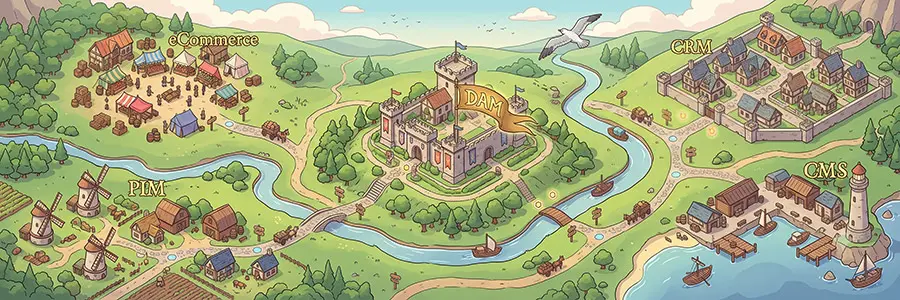
In his landmark commentary, Jones argues that in the modern enterprise, "truth" is fragmented by default. Rather than residing in a solitary, all-encompassing repository, organizational data is invariably scattered across a complex web of platforms: a primary DAM, a Product Information Management (PIM) or Product Experience Management (PXM) system, a Content Management System (CMS), and—inevitably—an unmanaged legacy Dropbox folder that a well-meaning team member keeps meaning to migrate.
This comprehensive feature explores Jones’s pragmatic perspective, dissecting why the dream of a unified repository fails, how poor ownership and misplaced migration priorities sabotage digital transformations, why creative-only leadership falls short, and the actual limits of AI-assisted tagging. Ultimately, this article outlines a paradigm shift for 2026 and beyond: moving away from the impossible dream of a single architectural repository and toward a unified framework of governance, clear accountability, and deliberate system handoffs.
Detailed Chronology: The Evolution of the DAM Dilemma
To understand how modern enterprises arrived at this state of digital fragmentation, one must examine the evolution of enterprise software architecture over the last twenty years.
The Early Days of Centralized Storage (Late 2000s – Early 2010s)
In the early iterations of Digital Asset Management, organizations viewed the DAM primarily as a digital filing cabinet. The core objective was simple: stop employees from storing high-resolution imagery on local hard drives or shared network drives. The early promises of DAM platforms centered on consolidation. Vendors marketed their software as the ultimate repository where designers, marketers, and sales teams could retrieve approved brand assets.
During this era, the concept of a "Single Source of Truth" felt achievable because digital ecosystems were far less complex. Omnichannel marketing was in its infancy, social media channels were limited, and the volume of localized, personalized content required by brands was a fraction of what it is today.
The Rise of Specialized Ecosystems (Mid 2010s – 2020)
As digital channels multiplied—spawning mobile apps, localized e-commerce storefronts, programmatic advertising, and dynamic social media feeds—a single digital filing cabinet could no longer keep pace. Organizations rushed to adopt best-of-breed software solutions.
- PIM and PXM systems emerged to handle complex product attributes, specifications, and multi-channel catalogs.
- Content Management Systems (CMS) evolved to manage web experiences at scale.
- Marketing Automation Platforms (MAPs) demanded direct access to rich media assets for email campaigns and lead nurturing.
Instead of simplifying the tech stack, this specialization fractured data ownership. Enterprises found themselves maintaining multiple repositories, each serving a specific departmental need. The DAM held the creative gold-masters, the PIM held the structured product data, and various regional marketing teams spun up localized repositories to meet fast-moving market demands.
The Modern Reality: Governance Over Consolidation (Present Day)
By 2026, the sheer volume of content generation—accelerated further by generative AI tools—has rendered the notion of a literal single source of truth entirely obsolete. As Taylor Jones aptly summarizes in his recent commentary:
"The promise isn’t dead. But in 2026 it’s more honest to treat it as an aspiration you govern toward than a state you arrive at."
Organizations are now realizing that trying to force every piece of digital media, product data, and marketing copy into one monolithic system creates more friction than value. The focus has decisively shifted from architectural consolidation to cross-platform governance.
Supporting Context & Metrics: The Anatomy of Digital Disorganization
Why do some departments maintain pristine digital ecosystems while others dissolve into organizational chaos? According to Jones, the root cause is rarely the software platform itself. Instead, success or failure comes down to ownership, accountability, and downstream utility.
The Contrast Between E-Commerce and General DAMs
In many organizations, a curious phenomenon occurs: the e-commerce slice of the digital supply chain is tightly organized, highly efficient, and reliably updated, while the broader organizational DAM remains a chaotic wasteland of untagged files, duplicate assets, and dead links.
Jones highlights the underlying mechanics of this discrepancy:
"The eCom slice was tight because it had a clear owner, a clear downstream consumer, and a system whose whole job was product data. The organizational DAM was a mess because it had none of those things."
This observation exposes a foundational flaw in how companies approach digital asset management projects. When an organization initiates a DAM migration, stakeholders frequently mistake the storage move for the primary project. Moving gigabytes or terabytes of data from an old server to a cloud-based DAM is treated as the finish line, when in reality, it is merely the starting block.
The true, labor-intensive work—tagging, de-duping, establishing metadata schemas, and cleaning up legacy files—is often neglected because no single stakeholder has been assigned explicit accountability for ongoing maintenance. Without a clear downstream consumer demanding high-data hygiene, organizational DAMs inevitably degrade into digital dumping grounds.
Official Perspectives: Leadership, Metadata, and AI Realities
Navigating the complexities of modern DAM ecosystems requires a strategic reassessment of who leads these initiatives, how data models are structured, and what role artificial intelligence truly plays.
Who Should Be Steering the DAM Ship?
Traditionally, organizations hand the keys of a DAM implementation directly to creative teams. After all, designers and art directors are the primary producers and consumers of high-resolution visual assets. However, Jones cautions that while creative vision is vital, taxonomy design and migration mechanics demand a fundamentally different discipline.
A successful DAM implementation requires a hybrid leadership model—one that pairs creative stakeholders with technical architects who understand data modeling and integration flows:
"Someone who owns the data model, understands the migration mechanics, and can map how assets actually flow between the DAM, the PIM/PXM, and every downstream integration."
Without technical oversight, creative teams often design taxonomies that reflect subjective artistic workflows rather than objective, scalable enterprise data structures. This disconnect leads to integration bottlenecks when assets need to be automatically synced with e-commerce platforms or localized marketing engines.
The Limits of AI-Assisted Tagging
In the current technological landscape, artificial intelligence is frequently touted as the silver bullet for metadata management. Automated tagging tools can scan an image, recognize objects, and instantly apply descriptive keywords. While Jones acknowledges the utility of AI for identifying visually obvious elements, he issues a stern warning against treating AI as a substitute for deep organizational context.
The most valuable metadata—the attributes that transform a passive image file into an authoritative enterprise asset—are rarely visible on the surface:
“…a lot of the tags that make a DAM authoritative aren’t visual at all. Which product or products does this asset belong to? Which campaign, which region, which usage rights, which internal approval state?”
An AI algorithm can easily identify that a photograph features a red winter coat on a snowy mountain. However, it cannot inherently know whether that coat has been approved for European markets, which specific marketing campaign it supports, whether its licensing rights expire next Tuesday, or which product SKU it maps to in the PIM system. Relying solely on visual AI without rigorous human governance and system integration results in a superficially tagged repository that fails under enterprise scrutiny.
Future Outlook: The Shift Toward Unified Governance
As enterprises look toward the remainder of the decade, the strategy for managing digital assets must mature. The pursuit of an impossible architectural monolith must be abandoned in favor of resilient, interconnected ecosystems governed by clear operational rules.
The Blueprint for 2026 and Beyond
- Ditch the Monolithic Illusion: Accept that data will naturally reside across multiple specialized platforms (DAM, PIM, CMS, localized storage). Stop fighting architecture and start focusing on integration.
- Enforce Named Accountability: Assign rigorous, non-negotiable ownership to every segment of the digital supply chain. If an asset repository does not have a designated owner and a clear downstream consumer, it will inevitably decay.
- Prioritize Metadata Over Migration: Shift budgets and resources away from the mere lifting and shifting of files. Invest heavily in taxonomy design, deduplication, and contextual metadata governance.
- Blend Creative and Technical Leadership: Ensure that DAM initiatives are co-led by creative visionaries and technical data architects who understand cross-platform integration mechanics.
- Use AI as a Tool, Not a Strategy: Leverage AI-assisted tagging to handle baseline visual categorization, but rely on human governance and system-to-system mapping to capture essential business context, usage rights, and campaign associations.
Conclusion
The journey toward digital maturity is not about finding a magical software platform that solves fragmentation once and for all. As Taylor Jones demonstrates, the modern enterprise operates in a multi-source reality. By replacing the myth of the "single source of truth" with a commitment to a single source of governance—defined by clear ownership, named accountability, and deliberate handoffs between systems—organizations can finally tame the chaos and unlock the true, practical value of their digital assets.
For further reading and to explore the original commentary, visit the full feature on Digital Asset Management News.