








Executive Overview
In the hyper-competitive landscape of global software-as-a-service (SaaS), a quiet paradox defines the strategies of the world’s most valuable tech firms. American B2B market leaders routinely scale to immense heights—often achieving multi-billion-dollar valuations, tens of millions of active users, and massive annualized run-rates—all while operating almost entirely out of domestic headquarters.
Consider the recent milestone announced by Replit. Founded in 2016, the code-collaboration and development platform surpassed 50 million users and is hurtling toward a staggering $1 billion in run-rate revenue. Yet, it wasn’t until a recent capital injection—highlighted by a $400 million funding round valuing the enterprise at $9 billion, earmarked explicitly for expansion across Europe, Asia, and the Middle East—that the company finally established its first international footprint: an office in London.
Ten years. Fifty million users. A billion-dollar run-rate. And only now is the first overseas outpost going live.
Replit’s delayed globalization is far from an outlier; it is the industry standard. Data pulled across leading public B2B companies reveals a fascinating and somewhat alarming operational truth: between 26% and 53% of these firms’ revenues are generated internationally, typically achieved long before a single employee is stationed on foreign soil.
This deep dive investigates the structural phenomenon of accidental internationalization. We will examine why modern cloud distribution allows products to "leak" across borders, the vast gap between user adoption and actual monetization, the direct correlation between local headcount and regional growth, and a definitive rule for when founders and executives should finally "lean in" to international markets.
Detailed Chronology: The Evolution of Cross-Border Tech Scaling
To understand how modern B2B software companies build multi-million-dollar international revenue streams by pure accident, one must trace the evolutionary shifts in product distribution over the last two decades.
Era 1: The On-Premise Era of Localized Footprints (Pre-2010s)
In the legacy era of enterprise software, international expansion was a deliberate, agonizingly slow, and capital-intensive chore. To sell software in Europe or Asia, a firm had to build localized sales offices, navigate complex regulatory frameworks country-by-country, establish local channel partners, and frequently ship physical media or manage localized data centers. Globalization was an explicit phase two of a company’s lifecycle, executed only after domestic saturation.
Era 2: The Self-Serve Digital Diffusion (2010s–2020)
The proliferation of cloud computing, developer-led growth, and self-serve freemium models fundamentally inverted this trajectory. SaaS products became instantly accessible worldwide via a web browser or API call. A developer in São Paulo, a product manager in Berlin, or a data engineer in Bengaluru could sign up for a US-based cloud tool with a corporate credit card in under three minutes.
Consequently, software companies began accidentally accumulating international user bases. They woke up one day to discover that 20% to 40% of their organic traffic, signups, and inbound revenue were originating outside the United States—without spending a single marketing dollar abroad or deploying a local sales representative.
Era 3: The Reckoning and Deliberate Localization (Present Day)
We have now entered the third era: the intentional capture of organic international demand. Companies are slowly realizing that treating international markets as a passive byproduct of self-serve distribution leaves massive amounts of capital on the table.
Recent high-profile strategic moves highlight this shift. Amjad Masad’s announcement of Replit’s London office and launch event signals a growing recognition that domestic-only scaling has a hard ceiling. Similarly, industry leaders like Figma have begun aggressively standing up localized hubs—such as their new office in Bengaluru, paired with localized data hosting and governance for India—to bridge the chasm between where their users live and where their revenue is collected.
Supporting Context & Metrics: The Anatomy of International SaaS Revenue
A statistical examination of leading B2B software enterprises reveals just how profound this global footprint is, even for companies traditionally viewed as US-centric.
According to data curated by SaaS thought leader Jason Lemkin, the international revenue breakdown for prominent public and late-stage private technology companies underscores the heavy reliance on cross-border transactions:
- Figma: 53% international revenue
- Cloudflare: 49% international revenue
- HubSpot: 49% international revenue
- MongoDB: 46% international revenue
- Twilio: 36% international revenue
- Snowflake: 26% international revenue
- Okta: 20% international revenue
The Disconnect Between Users and Revenue
The most striking manifestation of this phenomenon appears when comparing user concentration with revenue generation. Take Figma, arguably one of the most globally ubiquitous design platforms in existence. Approximately 85% of Figma’s total user base resides outside the United States. Yet, international markets account for 53% of its revenue.
This represents a staggering 30-point gap between global adoption and global monetization. For years, this gap was clearly visible in usage telemetry and traffic data, yet went unaddressed. India, for instance, quietly grew to become Figma’s second-largest market by monthly active users before the company established a dedicated physical presence, localized its offerings, or implemented regional data hosting and governance compliant with local laws.
Every self-serve distribution company harbors its own version of this gap. Unfortunately, very few executive teams audit their analytics deeply enough to uncover it.
Steady States vs. Declining Trajectories
A comparative look at performance metrics across other SaaS giants reveals divergent approaches to maintaining international momentum:
- MongoDB has maintained a remarkably stable international revenue share of 45% to 46% for over three consecutive years, proving that once established, cross-border demand can act as a resilient baseline.
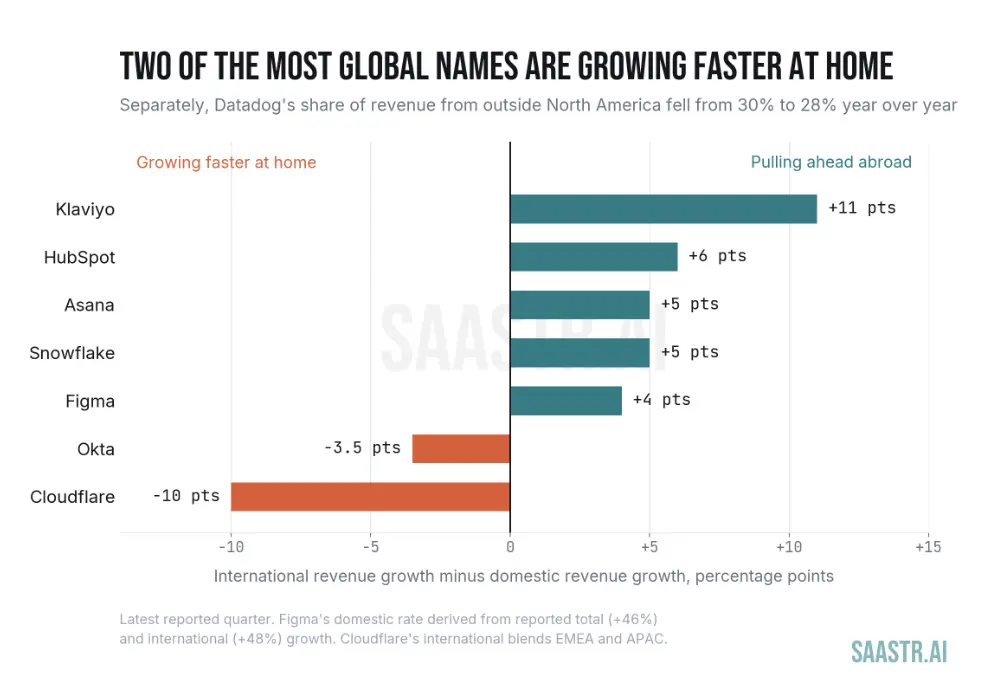
- Datadog maintains an international revenue share hovering between 28% and 30%. However, recent figures show its non-North American share contracting slightly year-over-year, illustrating the dangers of letting domestic growth outpace international cultivation.
- Cloudflare, operating near the top of the tier at 49% international revenue, experiences continuous balancing acts across its geographies. In recent quarters, US revenue grew 41%, while EMEA and APAC grew at 30% and 32% respectively, showing that maintaining high international ratios requires constant, aggressive regional execution.
- Klaviyo offers one of the clearest before-and-after case studies on the impact of targeted regional hubs. After establishing strategic outposts in Dublin and Singapore, Klaviyo’s international revenue share climbed from 39.5% to 42% within a single year. International revenue surged by 33% (outpacing domestic US revenue growth of 22%), shifting the overall mix nearly three points in just four quarters through two localized hubs rather than a sprawling global rollout.
Sales-Led vs. Self-Serve Dynamics: The Headcount Lag
The variance in international metrics is rarely a reflection of market demand; rather, it is a lagging indicator of executive headcount decisions.
For self-serve products like Figma or Klaviyo, low international revenue percentages point to an underinvestment in localization, regional currency processing, and compliance. For enterprise sales-led products like Snowflake (26% international) and Okta (20% international), the metric has a more literal interpretation: enterprise revenue rarely materializes in a given country until sales, support, and professional services personnel are stationed on the ground.
Snowflake and Okta do not suffer from weak international demand. Their numbers simply reflect the reality that enterprise deals require local champions, and those outposts were established later in the companies’ lifecycles. Once those regional hiring sprees begin, non-US revenue growth routinely outpaces domestic figures. Ultimately, an international revenue percentage is a spending decision, not a market fact.
Official Statements & Industry Perspectives
The realization that legacy scaling strategies left massive amounts of global value untapped has prompted candid admissions from top tech executives.
Reflecting on Okta’s international strategy and the realization that non-US revenue growth lagged behind domestic performance, Okta CEO Todd McKinnon took to social media to share a remarkably transparent assessment of executive oversight:
"We should have gone much harder much earlier. One of the many mistakes I’ve made. Like many things it’s just focus and priority!"
— Todd McKinnon, CEO of Okta
McKinnon’s reflection highlights a common blind spot in executive suites: early-stage hyper-growth in the domestic market often acts as a narcotic, blinding leadership teams to the quiet, organic green shoots appearing globally. When founders view international expansion as an expensive, risky distraction, they inadvertently starve hyper-organic demand of the resources required to convert casual users into enterprise accounts.
Similarly, Jason Lemkin of SaaStr emphasizes the folly of waiting for an arbitrary revenue milestone before committing resources to international territories:
"At 5% with zero local investment, that country has already proven the three hard things: people there can find you, the product works for them, and they’ll pay through a buying process you never designed for them. You cleared the hard part by accident. What’s left is the cheap part."
Future Outlook: The "5% Rule" and the Next Wave of Global SaaS
As the tech sector moves deeper into the era of AI-driven efficiencies and borderless digital ecosystems, the playbook for international expansion is undergoing a radical rewrite. Founders can no longer afford to wait until a decade into their corporate lifecycle—ala Replit—to plant their first international flag.
To capture the next wave of global growth, high-growth technology companies are increasingly adopting what can be termed The SaaStr AI Rule for International Expansion: The 5% Threshold.
Why 5% is the Magic Number
Traditional tech wisdom often dictates that a foreign market should only command executive attention and capital expenditure once it accounts for 15% to 20% of total revenue. This threshold is fundamentally flawed.
When a foreign country accounts for 5% of your total revenue organically—meaning with zero localized marketing, no local sales reps, no localized currency billing, and no regional data compliance frameworks—that market has already validated your product-market fit. It proves that:
- International users can organically discover your platform despite US-centric branding and SEO.
- The core utility of the software transcends cultural and linguistic barriers.
- Customers are willing to jump through bureaucratic hoops (such as international wire fees, foreign exchange conversions, and unfavorable time zones) just to use your tool.
Waiting until that market hits 20% means you have left millions of dollars on the table and allowed nimble local competitors time to copy your feature set.
What "Leaning In" Actually Means at 5%
Leaning in at the 5% threshold does not require signing expensive commercial real estate leases, hiring twenty local sales representatives, or standing up fully staffed regional subsidiaries overnight. Instead, a lean, high-ROI international playbook involves:
- Localized Payment Processing & Currencies: Ensuring checkout flows accept regional payment methods (e.g., Pix in Brazil, UPI in India, SEPA transfers in Europe) and bill in local currencies.
- Regional Data Compliance & Hosting: Setting up data residency options (such as GDPR-compliant European servers or local data sovereignty frameworks in India) to remove enterprise sales blockers.
- Targeted Regional Product Marketing: Translating key landing pages, documentation, and error states for the top non-English speaking markets driving organic traffic.
- Strategic Hub Placements: Deploying small, highly leveraged regional outposts—mirroring Klaviyo’s targeted hub strategy in Dublin and Singapore—rather than attempting a sprawling, uncoordinated global rollout.
Conclusion
The era of the purely domestic tech giant is coming to a close. As companies like Replit, Klaviyo, and Figma demonstrate, the world is waiting at your digital doorstep long before you ever buy a plane ticket.
The primary challenge for B2B software leaders in the coming years will not be generating international interest, but rather having the foresight to harvest the demand that has already survived years of total neglect. By abandoning outdated expansion thresholds and respecting the early signals of global adoption, forward-thinking tech companies can unlock their next great engine of compounding growth.