







Executive Overview
As businesses grapple with shrinking organic search traffic and shifting consumer discovery habits, digital marketers are increasingly forced to diversify their promotional channels. For years, social media platforms have served as foundational pillars for building brand awareness, nurturing communities, and driving direct sales. However, a persistent friction point has hindered comprehensive digital strategy: data fragmentation.
While prominent social media sites provide robust, native analytics tools to measure follower growth, likes, shares, and basic post engagement, these metrics remain strictly siloed. They offer little to no visibility into how social content performs in broader, cross-channel ecosystems—particularly within organic search engines. Marketers have long struggled to connect the dots between a viral TikTok video or an Instagram product showcase and its actual impact on Google Search visibility.
That paradigm is shifting. Following a gradual, highly anticipated rollout, Google Search Console has officially made its cross-platform tracking feature available to all account holders. This new capability allows businesses and creators to track organic search activity directly for their professional social media profiles. Officially categorized by Search Console as “platform properties,” these profiles are now treated much like traditional websites, supporting verified accounts across YouTube, TikTok, X (formerly Twitter), and Instagram professional accounts.
This development marks a significant milestone in modern search engine optimization (SEO) and social media marketing (SMM). By bridging the gap between social platforms and search engine analytics, Google is equipping digital strategists with unified performance insights. This comprehensive guide explores the mechanics of this update, how to implement it, actionable optimization strategies, and what this means for the future of cross-channel digital marketing.
Detailed Chronology: The Evolution of "Platform Properties"
The integration of social media profiles into Google Search Console did not happen overnight. It represents the culmination of a broader industry shift toward multimodal search, artificial intelligence integration, and the blurring lines between social discovery and traditional search engines.
1. The Pre-Integration Dilemma
Historically, Google Search Console was built exclusively for traditional web properties—domains, subdomains, and URL-prefix paths. Marketers could track how a blog post or a product page performed in Google Search, but social media profiles existed in a black box. If a YouTube video or an Instagram carousel post ranked organically in Google Search results, tracking its impressions, clicks, and average position required cumbersome, manual workarounds using generic site filters or third-party rank-tracking software.
2. The Slow Rollout
Recognizing the massive volume of social content appearing in search engine results pages (SERPs)—particularly YouTube videos and indexed social threads—Google quietly began testing the concept of treating social profiles as standalone indexable entities. After months of whispered beta tests and staggered access for enterprise accounts, Google initiated a slow rollout of the feature to the wider public.
3. General Availability
Today, the rollout is complete. The option is now fully operational and available to all verified Search Console account holders. By supporting YouTube, TikTok, X, and Instagram professional accounts, Google has acknowledged that modern search queries are no longer answered solely by traditional web pages. Social media content is a primary search result, and marketers finally have the native dashboard tools required to measure its impact.
How to Set Up and Navigate Social Platform Properties
Activating and configuring your social media profiles as platform properties within Search Console is a straightforward process, designed to mirror the traditional website-addition workflow.
Step-by-Step Activation Guide
- Access the Drop-Down Menu: Log into your Google Search Console account and navigate to the property selector located in the top-left corner of the dashboard.
- Add a Property: Click the “Add property” option from the drop-down menu.
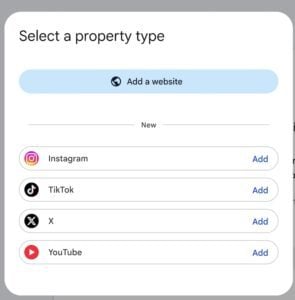
- Select Your Platform: You will see the traditional "Add a website" option alongside the newly introduced choices to add Instagram, TikTok, X, and YouTube properties.
- Complete Authentication: Follow the guided authentication and verification steps specific to each platform to prove administrative ownership of the professional account.
- Await Data Ingestion: Once verified, the property will appear in your dashboard. Initial performance data typically populates and becomes accessible within 36 hours.
Inside the Social Dashboard
Once activated, Search Console’s social media profile dashboard is streamlined to focus on two primary areas: the Insights tab and the Performance section.
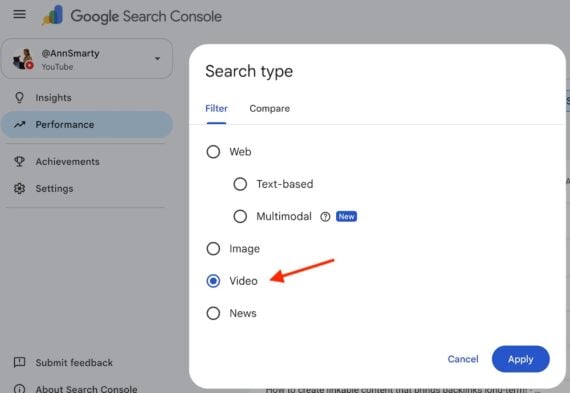
The Performance section is where the true analytical value lies. It allows account holders to view search metrics filtered by text or multimodal web search, image search, video search, and News, alongside Discover visibility.
Unlike traditional website properties, the new social metrics do not currently include the specialized Branded search filter. However, digital marketers can easily circumvent this limitation by manually filtering queries within the dashboard to track precisely where their social profiles and updates rank for brand names, product names, and relevant variations.
Supporting Context & Metrics: Leveraging Video and Multimodal SEO
The introduction of platform properties opens up unprecedented analytical avenues, particularly for video and visual search optimization.
The Power of YouTube Integration and AI Overviews
For ecommerce brands and content creators, the Video search type option is arguably the most valuable addition to the suite. YouTube content has always enjoyed preferential treatment and high organic visibility within Google Search. In the modern search landscape, this dynamic has accelerated exponentially.
YouTube videos are now widely cited, referenced, and embedded within Google’s AI Overviews, AI Mode, and Gemini search experiences. Previously, tracking the organic search performance of individual videos—let alone discovering the exact queries driving clicks from Google Search to YouTube—was a tedious, data-starved endeavor.
How to track and optimize your YouTube presence:
- Add your YouTube channel as a platform property in the drop-down menu.
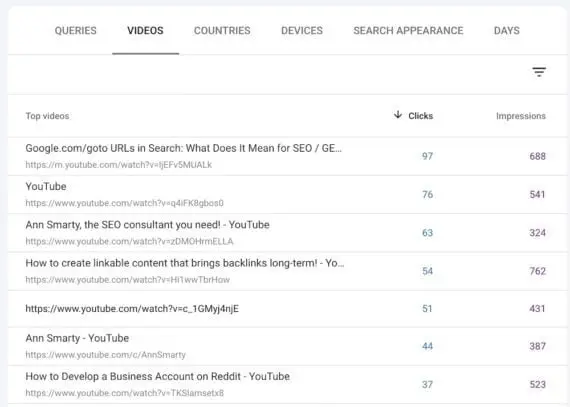
- Navigate to the Performance dashboard section and select the “Videos” search type filter.
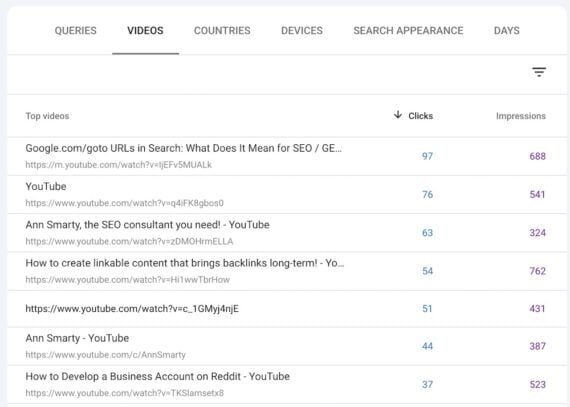
- Review the ranked list of your channel’s top-performing videos, complete with granular click and impression data.
- Click on individual video links within the list to uncover the exact search queries driving traffic to that specific asset.
Video SEO Best Practices
Armed with this granular data, marketers can deploy targeted optimization tactics to elevate their video content in organic search:
- Identify Underperforming Queries: Look for search queries that generate a high volume of views and impressions but suffer from low click-through rates and an average position lower than 4. Optimize your video titles by seamlessly integrating these exact high-potential queries.
- Refine High-Ranking Content: Analyze your top-ranking queries and experiment with iterative adjustments to video titles, tags, and descriptions to push your content into even higher SERP positions.
Multimodal Search and Instagram E-Commerce
For ecommerce businesses that rely heavily on visual platforms like Instagram to showcase product photography, the “Multimodal search” performance filter is a game-changer. By monitoring your Instagram property through this lens, you can instantly see whether your product photos and lifestyle imagery are successfully surfacing and capturing traffic within Google Image Search.
Official Insights & Strategic Implications
The integration of social media profiles into Search Console fundamentally redefines cross-channel digital marketing strategy. Rather than treating SEO and social media as entirely separate operational silos, modern marketers can now orchestrate synchronized, multi-touch campaigns with unified measurement.
A New Era for Cross-Channel Attribution
Consider a standard product launch campaign for an emerging ecommerce brand:
- The Article: The marketing team publishes an in-depth product review and buying guide on the company blog.
- The Video: Concurrently, the video production team creates an unboxing and review video on YouTube.
- The Visuals: The social media team shares high-resolution product photography and short-form reels on Instagram and TikTok.
With the new Search Console update, a digital strategist can annotate their Google Search Console timeline with the exact date each of these assets went live. They can then monitor how the blog post, YouTube video, and Instagram profile collectively perform in organic search, identifying symbiotic traffic loops where social assets lift web visibility and vice versa.
Uncovering Hidden Keyword Opportunities
Furthermore, tracking social platform properties—particularly YouTube channels—is guaranteed to unearth fresh, high-intent target keywords. Users search differently on video platforms than they do on traditional search bars, often using conversational, long-tail phrasing. By analyzing the query reports generated within the YouTube Search Console property, brands can capture emerging keyword clusters and feed those insights directly back into their broader content marketing and SEO strategies.
Future Outlook
As search engines continue to evolve into conversational, AI-driven, and multimodal ecosystems, the artificial boundaries separating websites, social media platforms, and video repositories are dissolving. Google’s decision to integrate social profiles into Search Console is a clear recognition of this reality.
Looking ahead, we can expect search analytics tools to become even more holistic. While the current iteration of platform properties focuses on core performance metrics and the Insights tab, future updates may introduce deeper integration with AI-generated search summaries, enhanced attribution modeling for social conversions, and more sophisticated filtering capabilities.
For businesses and digital marketers, the message is clear: the rules of organic search have expanded. Success no longer depends solely on optimizing a traditional domain. By embracing social platform properties within Google Search Console, forward-thinking brands can gain a competitive edge, unlock hidden traffic streams, and build resilient, data-driven cross-channel marketing engines designed for the future of search.