








Executive Overview
The modern artificial intelligence ecosystem moves at a velocity that renders historical benchmarks of startup growth obsolete. Companies are scaling their user bases, technical capabilities, and market footprints at a speed that would have felt entirely unimaginable just a generation ago. Yet, this hyper-growth coexists with a stark, demanding reality: scaling an AI enterprise requires capital injections of unprecedented magnitude. Founders are frequently forced to make foundational financing decisions long before the ephemeral momentum of early market traction can prove itself to be an enduring, profitable business model.
Amid this gold rush of computational scaling, a critical question confronts investors and founders alike: What truly separates the AI companies built to last from those that simply grow fast?
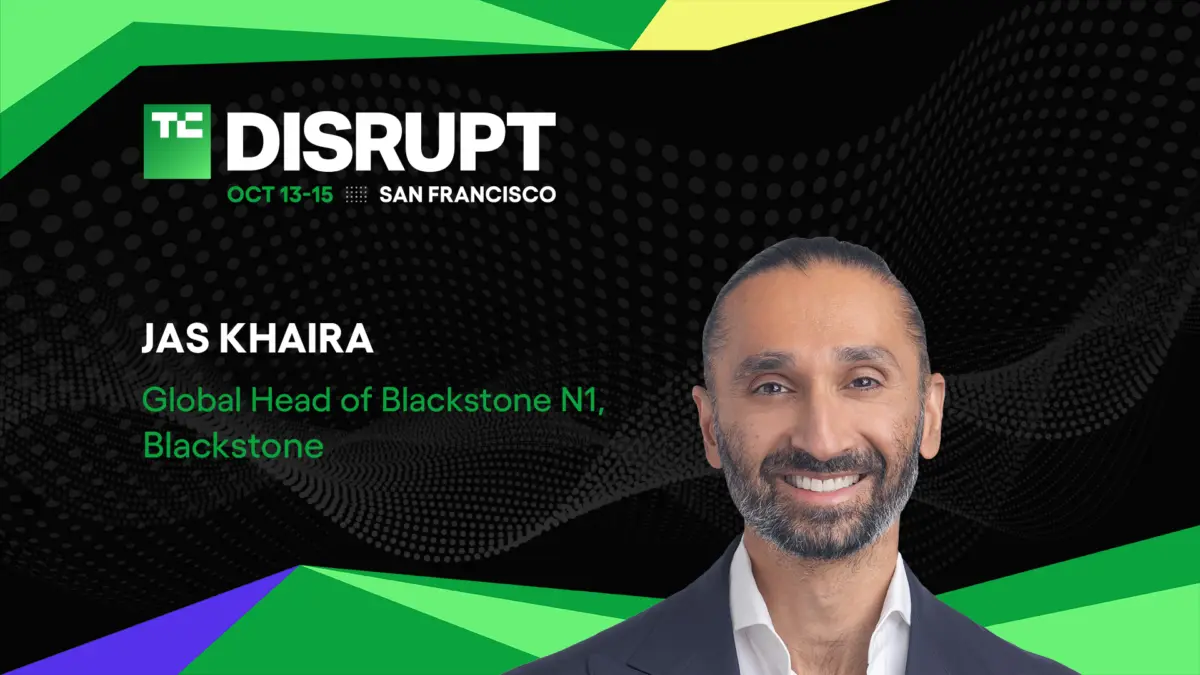
At TechCrunch Disrupt 2026, this central tension will take center stage when Jas Khaira, global head of Blackstone N1, steps up to the Builders Stage for a keynote session titled “Building the Next Generation of AI Giants.” Khaira brings the heavyweight perspective of one of the world’s largest alternative asset managers, detailing what Blackstone looks for when backing category-defining enterprises, how modern founders must conceptualize capital allocation, and how to spot the difference between fleeting market hype and structural staying power.
As capital transforms from a tool for baseline product development into massive funding mechanisms for proprietary compute infrastructure, data centers, and specialized talent pools, the rules of venture scaling have been rewritten. This deep-dive report examines the shifting capital equation of the AI era, explores high-stakes transactions that define the current macroeconomic landscape, and analyzes the strategic insights Khaira will bring to San Francisco this October.
Detailed Chronology: The Escalating Scale of AI Capital
To understand how the venture landscape arrived at its current crossroads, one must look at the rapid evolution of capital deployment over recent years. The progression from software-as-a-service (SaaS) capital requirements to AI-era infrastructure demands represents a massive paradigm shift.
The Shift from Code to Compute
Historically, early-stage technology startups required modest seed or Series A rounds primarily dedicated to engineering talent and digital customer acquisition. The marginal cost of scaling software was near zero.
The generative AI boom shattered this economic model. Building frontier models, training robust architectures, and running continuous inference demand specialized hardware—specifically advanced GPUs—alongside massive physical data centers and unprecedented power consumption. Consequently, modern AI startups are operating more like industrial enterprises than traditional software companies, requiring heavy capital outlays years before achieving profitability.
Landmark Transactions: The Blackstone Blueprint
Blackstone’s recent strategic deployments illustrate the staggering capital requirements of the contemporary AI landscape.
- February 2026: Blackstone and an elite group of co-investors committed up to $600 million in primary equity to Neysa, an Indian AI infrastructure company. This financing round was structured to include an additional $600 million in debt financing, bringing the total capitalization package to $1.2 billion. The move underscored a vital trend: the race for domestic, localized AI compute sovereignty outside of traditional Western hubs.
- July 2026: In a striking validation of the thesis that implementation outweighs raw model creation, Anthropic launched Ode with Anthropic. This dedicated AI implementation enterprise was catalyzed by a staggering $1.5 billion joint venture backed by Blackstone, Hellman & Friedman, Goldman Sachs, and other financial giants.
These deals position Blackstone at ground zero of the modern tech economy, granting the firm deep visibility into where capital is most critically needed, which bets carry sustainable long-term value, and how massive private equity juggernauts can partner with hyper-growth tech innovators.
Supporting Context & Metrics: Navigating the AI Venture Landscape
As AI startups scale, they navigate a minefield of financial, operational, and structural hurdles. Securing capital is no longer a simple badge of honor; it is a complex financial obligation that changes a company’s trajectory forever.
+-------------------------------------------------------------------+
                  THE AI CAPITALIZATION DILEMMA
+-------------------------------------------------------------------+
  Early Traction          Massive Capital Injection       Enduring Business?
  (Rapid growth,          (Compute, data centers,         (Defensible moat,
   hype, users)        ->  infrastructure, talent)    ->   retention, long-
                           [Led by giants like Blackstone] term margins)
+-------------------------------------------------------------------+
Momentum vs. Staying Power
Fast growth can be a double-edged sword. While it effortlessly attracts top-tier talent, eager enterprise customers, and enthusiastic venture capitalists, it can also mask fundamental weaknesses in unit economics.

- The Trap of Premature Scaling: Founders often find themselves forced into massive financing rounds while simultaneously attempting to ship products, outmaneuver aggressive competitors, and forge product-market fit.
- The Moat Question: When everyone has access to foundational large language models via API, a startup’s true differentiation must lie elsewhere—in proprietary data, workflow integration, specialized enterprise implementation, or deep domain expertise.
Why Institutional Scale Matters
Alternative asset managers like Blackstone operate on a vastly different timeline and scale than traditional venture capital firms. While early-stage VCs hunt for breakout returns across a wide portfolio, private equity and hybrid investment platforms look for structural durability, clear paths to enterprise monetization, and operational resilience.
When Jas Khaira evaluates a company, he looks past the hockey-stick growth curves on a slide deck. He examines whether the underlying business possesses the operational discipline and capital efficiency required to survive market corrections and hardware supply constraints.
Official Perspectives and Leadership
Jas Khaira’s career within Blackstone gives him a unique vantage point over global tech markets. Having joined Blackstone in 2004, Khaira currently serves as the global head of Blackstone N1 and Blackstone Growth, as well as the head of Tactical Opportunities Americas. He sits on several of the firm’s key investment committees and was the driving force behind the founding of Blackstone N1—a specialized platform dedicated to growth, hybrid, and perpetual private equity investing across the AI ecosystem and next-generation high-growth enterprises.
What Khaira Will Address at Disrupt 2026
During his session, "Building the Next Generation of AI Giants," Khaira is expected to break down:
- The Anatomy of Endurance: How institutional investors differentiate between temporary hype cycles and durable, category-defining enterprises.
- Capital Strategy for Founders: How early-stage and growth-stage leaders should approach fundraising when compute costs threaten to outpace revenue growth.
- The Infrastructure Imperative: Why physical infrastructure, power generation, and data sovereignty are becoming the ultimate bottlenecks—and opportunities—for AI expansion.
Future Outlook: What Lies Beyond Early Momentum
The next chapter of the artificial intelligence boom will not be won by the companies that raise the most money the fastest, but by those that deploy capital with strategic precision. As the market matures, enterprise buyers are becoming increasingly sophisticated, demanding measurable return on investment rather than novel demonstrations.
For founders navigating this high-stakes environment, the insights shared on the Builders Stage at TechCrunch Disrupt 2026 will be invaluable. Securing funding is merely the opening milestone; engineering a company capable of withstanding macroeconomic shifts, hardware evolutions, and intense market competition is the ultimate test.
Join the Conversation at TechCrunch Disrupt 2026
TechCrunch Disrupt 2026 runs from October 13–15 at Moscone West in San Francisco. The event brings together more than 10,000 founders, investors, operators, and tech leaders across six industry stages, offering over 200 sessions, roundtables, and tactical breakouts.
Attendees will have access to:
- 250+ expert speakers sharing actionable blueprints for modern tech leadership.
- 300+ exhibiting startups showcasing the bleeding edge of software and hardware innovation.
- Unmatched matchmaking and dealmaking opportunities designed to connect visionary founders with tier-one capital partners.
To help founders bring their strategic partners into the room, TechCrunch is currently offering a 50% discount on a second pass when purchased alongside a standard ticket, with additional deep discounts available for teams of four or more.
Prepare your team for the next phase of the AI revolution. Secure your pass to TechCrunch Disrupt 2026 today and learn directly from the investors shaping the future of global enterprise.